
A main applicant may be looking for EU mobility, but a spouse may need long-term security, a child may need access to European education, and parents may need a formal residence route tied to family support. This guide explains who can be included, what documents are required, how family members apply, and whether they receive the same residency rights as the main investor.
Who Can Be Included in a Portugal Golden Visa Family Application?
Portugal allows family reunification for eligible relatives of a lawful resident, including holders of the ARI, Autorização de Residência para Investimento, the formal name of the Golden Visa residence permit. In practice, family eligibility depends on the relationship, dependency status, documentation, and whether Portuguese authorities recognise the family tie.
The legal framework is administered by AIMA, the Agency for Integration, Migration and Asylum, which processes residence applications and family reunification requests in Portugal. For Golden Visa applicants, family inclusion is usually planned alongside Portugal’s residency investment program so the family structure is clear before the application is filed.
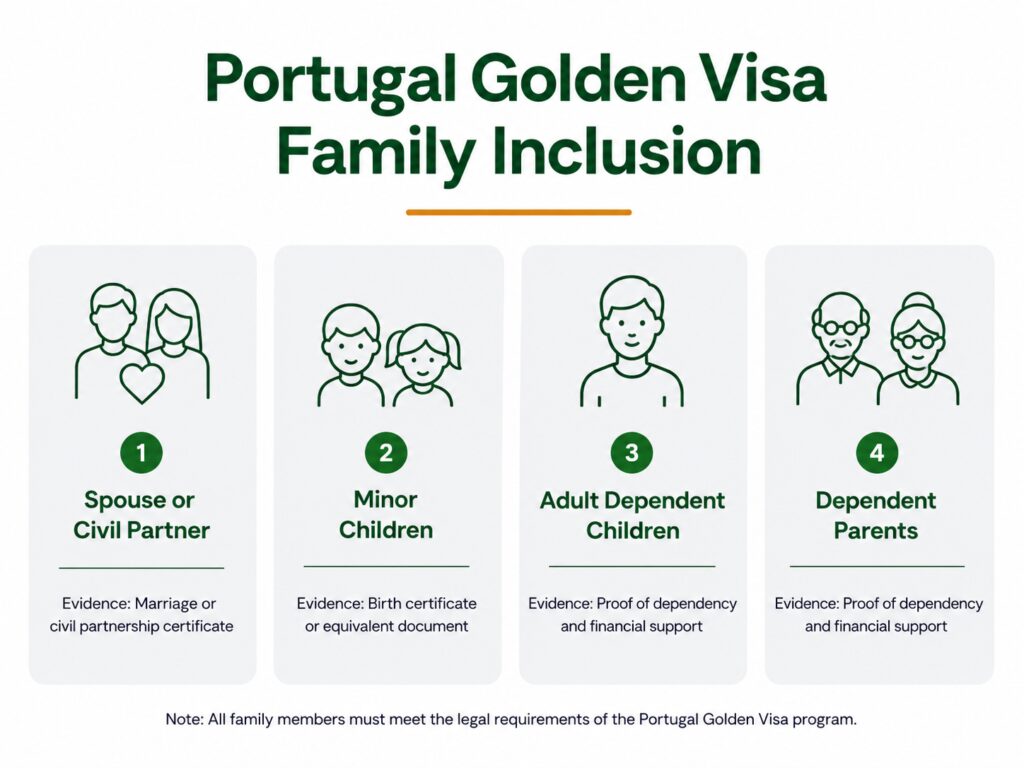
Spouse or Civil Partner
A spouse can usually be included in a Portugal Golden Visa family application, provided the marriage is legally valid and recognised under Portuguese family law. The applicant must provide a marriage certificate, and the document may need apostille or legalisation depending on the country of issue.
Civil partners or unmarried partners may also qualify where the relationship is legally recognised and properly documented. In these cases, authorities may ask for evidence of a stable relationship, cohabitation, shared responsibilities, or formal civil partnership registration.
For spouse or partner inclusion, the file should normally include:
- Valid passport
- Marriage certificate or civil partnership proof
- Criminal record certificate where required
- Health insurance for dependants
- Proof of legal relationship, translated and apostilled where necessary
- Application forms and biometric data submission
The main point is simple: the relationship must be real, legally documented, and acceptable under Portuguese rules.
Minor Children
Minor children are among the clearest categories for ARI family inclusion. This usually includes biological children, adopted children, and children legally under the care of the main applicant or spouse.
For minor children, the application should include a birth certificate or adoption document showing the relationship to the parent. If only one parent is applying or if a child will reside in Portugal with one parent, additional parental consent may be required.
A child’s file may include:
- Passport
- Birth certificate
- Parental consent, if applicable
- Adoption or custody decision, if applicable
- Health insurance
- Proof of family relationship
- Apostille and certified translation, where required
Minor children do not need to prove financial dependency in the same way as adult children. Their age and legal relationship usually establish dependency, although custody or guardianship documents may still be needed.
Adult Children Who Are Students or Financially Dependent
Adult children can be included, but the rules are more specific. The applicant must show that the adult child remains dependent, usually because they are unmarried, studying, and financially supported by the family.
For Portugal Golden Visa adult children, the most important evidence usually includes:
- Birth certificate proving the parent-child relationship
- Proof of enrolment in education
- Evidence that the child is unmarried, where required
- Bank transfers or financial support records
- Proof that the main applicant or spouse supports the child
- Health insurance for the adult dependant
This is one of the areas where families should avoid assumptions. An adult child who is working full-time, married, or financially independent may not meet the dependant standard. AIMA looks at the substance of dependency, not only the family relationship.
Dependent Parents
Dependent parents may also qualify for Portugal Golden Visa family reunification. This can include parents of the main applicant or parents of the spouse, provided they are financially dependent on the resident.
For parents, the key issue is dependency. The family must be able to show that the parent relies on the main applicant or spouse for financial support. This may involve pension records, bank statements, proof of regular transfers, medical dependency evidence, or other documents showing that the parent cannot reasonably support themselves independently.
A typical parent inclusion file may include:
- Passport
- Birth certificate of the main applicant or spouse, proving the parent-child relationship
- Marriage certificate if the parent is related through the spouse
- Proof of financial dependency
- Health insurance
- Criminal record certificate where required
- Apostilled and translated civil documents
Dependent parents can be included, but their eligibility should be reviewed carefully before submission. A weak dependency file can delay the entire family application.
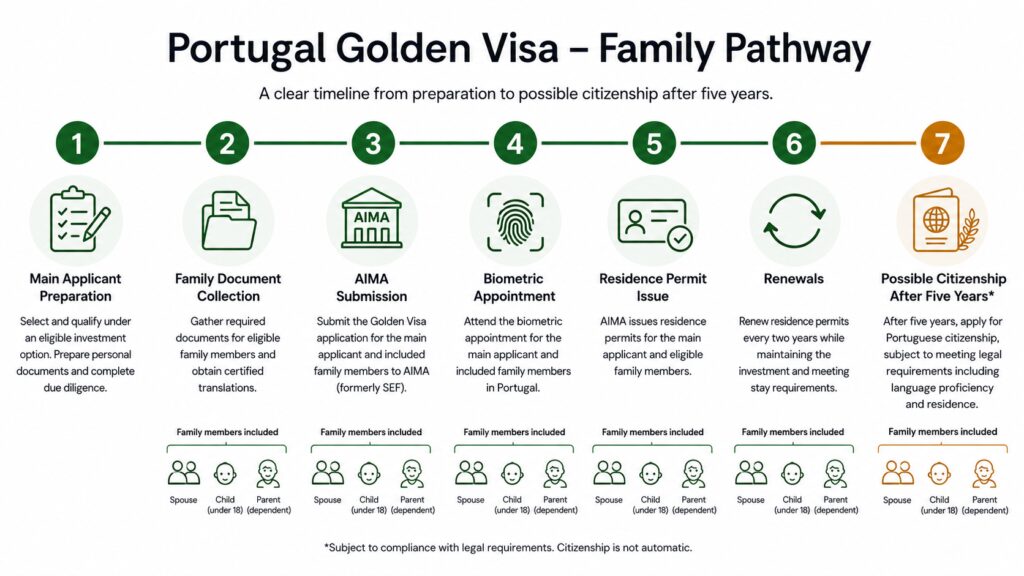
How to Include Family Members: Upfront vs Later
Families can usually be included at the beginning of the process or added later through family reunification. The better option depends on timing, document readiness, family circumstances, and whether the main applicant wants all residence permits issued around the same period.
For many investors, upfront planning is cleaner. It reduces the risk of missing documents, inconsistent timelines, or discovering too late that a dependant needs stronger evidence.
Including Family at the Time of Application
A simultaneous application means the main applicant and eligible family members are prepared together from the start. This is often the preferred route when the investor already knows which spouse, children, or parents should be included.
The main advantages are:
- Better timeline coordination
The family file can move through the application process together, even if individual appointments or approvals are not always issued on the same date. - Clearer cost planning
Government fees, legal fees, health insurance, translations, apostilles, and travel costs can be estimated more accurately. - Cleaner document review
The legal team can check all family documents before submission, including relationship proof and financial dependency proof. - Reduced risk of later gaps
If a child is close to adulthood or a parent’s dependency needs stronger evidence, the issue can be addressed early.
A simultaneous application is especially useful for families with adult children, dependent parents, or documents issued in several countries.
Adding Family Members After Approval
Family members may also be added after the main applicant receives approval or residence status. This is useful where the family situation changes after the initial application, such as marriage, birth of a child, adoption, or a parent becoming dependent.
Adding family later may also be practical if a dependant’s documents are not ready at the time of the main application. However, this route can involve a separate review, additional fees, and a different processing schedule.
A later family reunification file usually needs:
- Proof of the main applicant’s residence permit
- Updated proof of relationship
- Updated proof of dependency, where relevant
- Health insurance for each dependant
- Valid passports
- Criminal record certificates where required
- AIMA appointment and biometric submission
The key risk is timing. If a dependant’s eligibility depends on age, study status, or financial dependency, delay can make the file harder to prove.
Documents Required for Each Family Member
The documents for Portugal Golden Visa family members vary by relationship category. A spouse does not submit the same evidence as an adult child, and a dependent parent usually needs more financial evidence than a minor child.
Every file should be checked before submission because civil documents issued outside Portugal may need apostille, legalisation, and certified translation.
Proof of Relationship
Proof of relationship is the foundation of the family reunification file. Without it, the application cannot establish why the dependant should be included.
Common documents include:
| Family member | Common proof required |
| Spouse | Marriage certificate |
| Civil partner | Civil partnership registration or recognised relationship evidence |
| Minor child | Birth certificate, adoption document, or custody document |
| Adult child | Birth certificate plus study and dependency evidence |
| Parent | Birth certificate linking the parent to the applicant or spouse |
| Adopted child | Adoption decree recognised under relevant law |
If documents are issued outside Portugal, they may need an apostille under the Hague Convention or another form of legalisation. They may also need certified translation into Portuguese.
Proof of Financial Dependency
Financial dependency proof matters most for adult children and parents. The purpose is to show that the dependant genuinely relies on the main applicant or spouse for support.
Useful evidence may include:
- Regular bank transfers
- Proof of tuition payments
- Shared household expenses
- Medical support payments
- Pension statements showing insufficient income
- Affidavits or declarations, where appropriate
- Evidence that the dependant is unmarried and studying, for adult children
The evidence should tell a coherent story. One bank transfer rarely proves dependency. A pattern of support is stronger.
For adult children, education records are especially important. For parents, regular financial support and limited independent income are often the central documents.
Health Insurance Requirements
Family members usually need health insurance coverage suitable for their stay in Portugal. This requirement applies separately to dependants, not only to the main applicant.
Health insurance for dependants should normally cover:
- The spouse or partner
- Minor children
- Adult dependent children
- Dependent parents
Families should check the policy terms carefully. Authorities may reject weak or unsuitable coverage, especially if the policy does not clearly apply in Portugal.
The best approach is to prepare health insurance together with the broader family file so that every dependant has coverage before the relevant appointment.
Do Family Members Get the Same Residency Rights?
Family members approved under Portugal Golden Visa family reunification receive residence status connected to the main applicant’s permit. They are not simply visitors. They hold residence rights in Portugal, subject to the conditions of their permit and continued eligibility.
The EU Family Reunification Directive also recognises family reunification as a framework for lawful third-country national residents to be joined by eligible family members, while national law sets the specific requirements.
Work and Study Rights
Family members generally receive residency rights that allow them to live in Portugal. Depending on the category and permit conditions, they may also access education and employment rights.
For families, this can matter in practical ways:
- A spouse may want the option to work or manage business interests.
- Children may need school or university access.
- Adult dependants may need lawful residence while studying.
- Parents may need stable residence for long-term family support.
The Golden Visa itself is often chosen because the main applicant does not need to relocate full-time. However, family members who do spend time in Portugal should understand local obligations, including healthcare registration, tax considerations, education enrolment, and permit renewals.
Path to Citizenship for Family Members
Family members may also build their own residence history in Portugal. After five years of legal residency, they may be able to apply for naturalisation if they meet the applicable requirements, including language, documentation, and legal eligibility.
This makes family inclusion important for long-term planning. A child included early may begin the residence timeline sooner. A spouse included from the start may align their future nationality planning with the main applicant.
For a deeper explanation of the nationality route, read our guide to the path to Portuguese citizenship.
Costs of Adding Family Members to Your Golden Visa
Adding family members increases the total cost of a Golden Visa application. The main investment is made by the principal applicant, but each dependant can create additional government, legal, document, insurance, and travel costs.
Family-related costs may include:
| Cost category | Applies to | Notes |
| Government processing fees | Each applicant | Fees may vary by application stage and applicant category |
| Biometric appointment costs | Each applicant | Each family member usually needs biometric data collection |
| Legal fees | Family file | More dependants usually mean more document review |
| Translation and apostille | Foreign civil documents | Marriage, birth, adoption, and dependency documents may need formal treatment |
| Health insurance | Each dependant | Coverage should be valid for Portugal |
| Travel costs | Each family member | Appointments may require travel to Portugal |
| Renewal fees | Each residence permit holder | Family members must maintain valid permits |
The AIMA official portal should be checked when referencing current administrative procedures and fees because government charges can change. Families should also review the full eligibility requirements before budgeting, since a document issue can become a cost issue if it causes delays or resubmissions.
A family of four will not have the same total cost profile as a single investor. The investment threshold may remain tied to the main qualifying investment, but the application file becomes larger, more document-heavy, and more expensive to administer.
For applicants still comparing routes, our application process guide explains the broader sequence from preparation to approval.
FAQs About Portugal Golden Visa Family Inclusion
Can I include my spouse in my Portugal Golden Visa application?
Yes. A spouse can usually be included in a Portugal Golden Visa family reunification application if the marriage is legally valid and properly documented. You should expect to provide a marriage certificate, passport, health insurance, and any required criminal record documents. If the marriage certificate was issued outside Portugal, it may need apostille and certified translation.
What age limits apply to dependent children?
Minor children can generally be included as dependants. Adult children may also qualify if they remain unmarried, financially dependent, and studying, subject to the specific evidence required. Because adult child eligibility depends heavily on documentation, families should prepare education records and financial dependency proof before submission.
Can I include my parents as dependants?
Yes, dependent parents may be included if they rely financially on the main applicant or the applicant’s spouse. The file should prove both the family relationship and the dependency. This usually means birth certificates, financial support records, pension or income documents, and health insurance.
Do family members get the same residency rights as the main applicant?
Approved family members receive residence permits linked to the main applicant’s status and can live in Portugal under that permit. They may also access relevant rights such as education and, depending on their status and applicable rules, employment. Family members can also build their own legal residence period toward future citizenship eligibility, subject to meeting the requirements at the time of application.
Is Portugal Golden Visa Family Reunification Right for Your Family?
Portugal Golden Visa family reunification is most valuable when the family plan is clear from the beginning. A spouse, child, or parent may qualify, but each person must be supported by the right documents. Relationship evidence, dependency proof, apostille, translations, and health insurance all matter.
The safest approach is to treat the family file as part of the main strategy, not as an afterthought. This is especially important for adult children and dependent parents, where eligibility depends on more than family connection alone.
If you are applying with a spouse, children, or parents, plan the family structure before submission. It will make the process clearer, the budget more accurate, and the path to future residency and citizenship easier to manage.
Ready to take the next step?
Book a free initial assessment. We’ll assess your eligibility, walk through the current qualifying routes, and answer your questions, no cost, no commitment.












