Portugal’s Golden Visa, formally the ARI (Autorização de Residência para Investimento), has a low physical stay requirement compared with relocation visas. That does not mean living costs are irrelevant. Housing, healthcare, school fees, transport, tax planning and day-to-day expenses can change the real value of the programme for families, retirees and investors who want Portugal as more than a paper residency.
What Does It Cost to Live in Portugal as a Golden Visa Holder?
For most Golden Visa holders, the monthly budget depends on one question: are you using Portugal as an occasional base, a part-time residence or a full family relocation destination?
A single investor who visits Portugal for short periods may only need to budget for accommodation, dining, transport and insurance during stays. A family relocating to Lisbon with children in international schools will need a completely different budget.
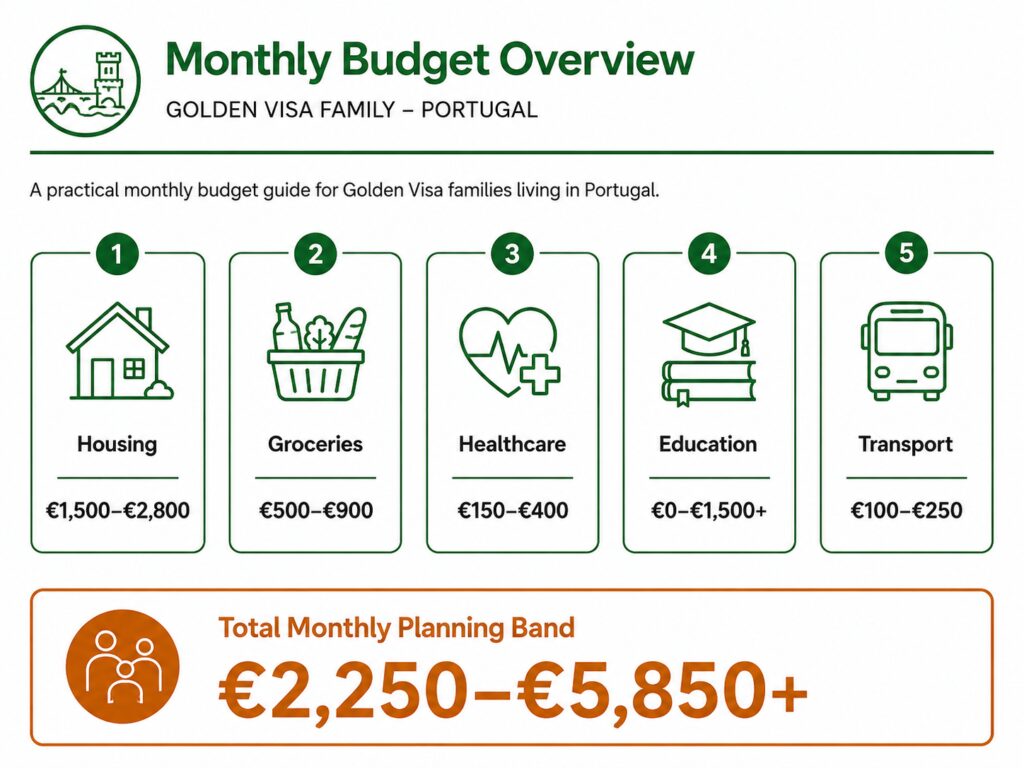
| Household type | Practical monthly budget | Notes |
| Single person, modest lifestyle | €1,600 to €2,400 | Easier outside central Lisbon |
| Single person, comfortable Lisbon lifestyle | €2,300 to €3,500 | Rent is the main cost driver |
| Couple, comfortable lifestyle | €3,000 to €5,000 | Depends heavily on housing |
| Family of four without private school | €4,000 to €6,500 | Public school and location matter |
| Family of four with international school | €6,500 to €10,000+ | School fees can exceed rent |
These are planning ranges, not fixed prices. The cost of living in portugal for expats changes sharply by city, school choice, housing standard and whether the household uses public or private healthcare.
Golden Visa holders who are still deciding whether to move should start with a broader portugal golden visa plan first, then build a lifestyle budget around how often they expect to be in Portugal.

Housing Costs: Renting vs Buying
Housing is usually the largest monthly expense in Portugal. For Golden Visa holders, the key distinction is practical rather than legal: renting gives flexibility, while buying creates a long-term base.
Real estate no longer qualifies as the standard Portugal Golden Visa investment route after the 2023 legislative reform, so buying a home should be treated as a lifestyle or investment decision, not as the qualifying Golden Visa investment itself.
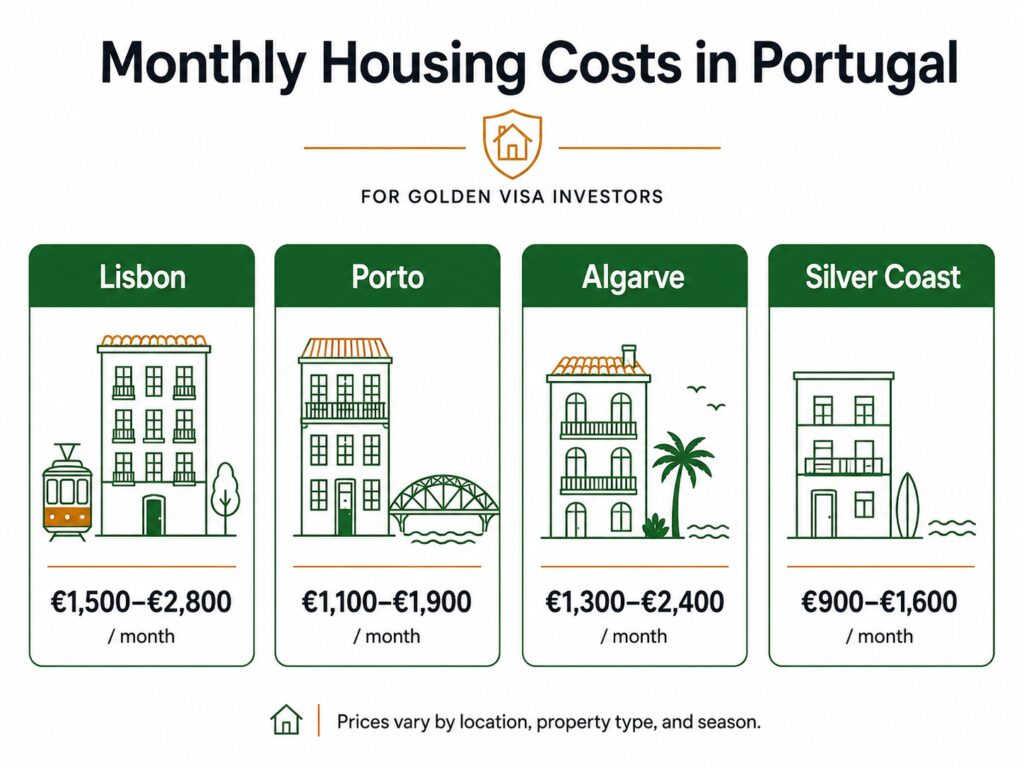
Lisbon Rental Market
Lisbon is Portugal’s most expensive rental market. It also offers the deepest expat community, the largest choice of international schools and the strongest professional services network.
Typical long-term rental planning ranges:
| Lisbon rental type | Monthly planning range |
| One-bedroom apartment | €1,100 to €1,800 |
| Two-bedroom apartment | €1,700 to €2,800 |
| Three-bedroom family apartment | €2,500 to €4,500+ |
| Premium central apartment | €4,000+ |
The cost of living in lisbon is highest in central areas such as Chiado, Príncipe Real, Avenida da Liberdade and parts of Estrela. More residential districts such as Areeiro, Alvalade, Benfica or Lumiar may offer better value, although availability can still be competitive.
If your plan involves relocating to Portugal, Lisbon is convenient, but not always the most efficient budget choice.
Porto Rental Market
Porto is generally more affordable than Lisbon, although the gap has narrowed in recent years. It works well for investors who want city infrastructure, strong cultural life and access to international travel without paying Lisbon-level rents.
Typical Porto rental planning ranges:
| Porto rental type | Monthly planning range |
| One-bedroom apartment | €850 to €1,400 |
| Two-bedroom apartment | €1,200 to €2,100 |
| Three-bedroom family apartment | €1,800 to €3,200 |
| Premium central apartment | €3,000+ |
Porto can be a strong option for remote professionals, semi-retired couples and families who do not need daily access to Lisbon’s business network.
Algarve and Silver Coast
The Algarve and Silver Coast appeal to retirees, part-time residents and families seeking more space. The challenge is seasonality. Some coastal areas have attractive winter rental rates but become expensive during summer.
Typical monthly planning ranges:
| Region | One-bedroom | Family home |
| Algarve, popular coastal towns | €900 to €1,700 | €2,000 to €4,500+ |
| Algarve, inland areas | €700 to €1,200 | €1,400 to €2,800 |
| Silver Coast | €650 to €1,200 | €1,300 to €3,000 |
| Smaller inland towns | €500 to €1,000 | €1,000 to €2,200 |
The Algarve can be excellent for lifestyle, but Golden Visa holders should budget carefully if they want year-round housing near the coast.
Daily Living Expenses
Daily costs in Portugal are often lower than in major US and UK cities, but not uniformly low. Imported goods, private schooling, premium restaurants and central-city housing can quickly lift the monthly budget.
A useful approach is to separate local living costs from expat lifestyle costs. Local groceries and transport can be reasonable. International schools, imported products and frequent dining in central Lisbon are not cheap.
Groceries and Dining
Grocery prices depend on whether you shop locally or rely on imported products. Fresh produce, bread, local cheese, seafood, meat and wine can be good value. Imported brands, specialty health foods and international products cost more.
Typical monthly grocery budgets:
| Household | Monthly groceries |
| Single adult | €250 to €400 |
| Couple | €450 to €750 |
| Family of four | €750 to €1,200 |
Dining out costs vary by city and restaurant type:
| Meal type | Planning range |
| Local café breakfast | €4 to €8 |
| Casual lunch | €10 to €18 |
| Mid-range dinner per person | €25 to €45 |
| Premium restaurant dinner | €70+ |
For Golden Visa holders spending part of the year in Portugal, dining out costs often run higher than expected because short stays usually involve fewer home-cooked meals.
Transport
Portugal’s public transport is one of the strongest budget advantages for residents in Lisbon and Porto. Metro, bus, tram and train networks reduce the need for a car in central areas.
Typical monthly transport costs:
| Transport type | Monthly planning range |
| Public transport pass | €40 to €50 |
| Occasional taxis and ride-hailing | €80 to €250 |
| Car ownership and fuel | €300 to €700+ |
| Intercity train travel | Variable by route and timing |
A car is useful in the Algarve, Silver Coast and rural areas. In central Lisbon, it can become more of a parking problem than a mobility solution.
Utilities
Utility costs depend on property size, insulation, air conditioning, heating habits and internet package. Older Portuguese properties can feel cold in winter if insulation is poor, which affects electricity usage.
Typical monthly utility budget:
| Expense | Monthly planning range |
| Electricity, water and gas | €100 to €220 |
| Internet and mobile plans | €40 to €90 |
| Building condominium fees, if owner | €50 to €250+ |
| Total utilities estimate | €160 to €350 |
For rented apartments, confirm whether condominium fees are included in rent. For owned property, budget for maintenance, insurance and building charges separately.
For a wider lifestyle overview, see the full expat living guide.
Healthcare Costs for Golden Visa Residents
Healthcare is one of the main reasons families and retirees compare Portugal with the US and UK. The public system is accessible to legal residents, but many Golden Visa holders still choose private insurance for speed, convenience and English-speaking care.
Portugal’s official public healthcare system is the SNS national health service. According to the government’s migrant healthcare guidance, a legally resident foreigner can obtain a National Health Service user number and access public SNS units through the National Health Service (SNS).
SNS Public System Access
Golden Visa holders who become legal residents may register for SNS access, subject to the required documentation. In practice, you should expect to provide:
- Valid residence permit
- Portuguese tax identification number, known as NIF
- Portuguese address
- Identification document
- Local health centre registration
Public healthcare can reduce medical costs significantly, but it may involve waiting times for non-urgent care. For serious relocation planning, do not assume SNS access replaces private coverage immediately.
Private Health Insurance Costs
Private health insurance is common among expats, retirees and families. It gives access to private hospitals, shorter appointment times and broader English-speaking provider choice.
Typical monthly planning ranges:
| Applicant type | Monthly private insurance estimate |
| Adult under 45 | €40 to €100 |
| Adult 45 to 65 | €80 to €180 |
| Retiree | €150 to €350+ |
| Family of four | €180 to €600+ |
Costs depend on age, exclusions, deductible, inpatient coverage and whether international coverage is included. For retirees evaluating a golden visa for retirees, healthcare planning should be part of the residency budget from the start.
Education Costs for Families
For families, education can change the entire cost structure. A couple without children may live comfortably in Portugal on a moderate budget. A family with two children in international schools may need a budget closer to major Western European levels.
International Schools in Lisbon and Porto
International schools are concentrated around Lisbon, Cascais, Sintra and Porto. Many offer British, American, French, German or International Baccalaureate curricula.
Typical annual fee ranges:
| School type | Annual tuition per child |
| Smaller private bilingual school | €6,000 to €10,000 |
| Established international school | €10,000 to €18,000 |
| Premium international school | €18,000 to €25,000+ |
Additional costs may include:
- Application fees
- Registration fees
- Uniforms
- Transport
- Lunch
- Exams
- Technology fees
- Extracurricular activities
For two children, international school fees can easily exceed the family’s annual rent in smaller cities. This is why education planning should come before choosing a neighbourhood.
Public School as an Option
Public school is a real option for families who plan to integrate long term. It reduces cost significantly and can help children learn Portuguese faster.
The trade-off is language, curriculum and transition time. Older children may need additional tutoring, while younger children often adapt more easily.
A practical family budget should include:
| Education route | Monthly equivalent per child |
| Public school with tutoring | €150 to €500 |
| Private Portuguese school | €500 to €1,000 |
| International school | €800 to €2,100+ |
Public education can make Portugal much more affordable for relocating families, but the decision should be based on the child’s age, language ability and long-term university plans.
Portugal vs US and UK Cost of Living Comparison
The cost of living portugal vs usa comparison usually favours Portugal on healthcare, local transport, groceries and dining. The comparison is less simple for housing in prime Lisbon, private education and imported goods.
Eurostat tracks purchasing power and price level indicators across EU countries through the EU Cost of Living Index, which is useful for broad cost comparison EU analysis. These indicators do not tell you what one family will spend in Lisbon, but they help frame Portugal against other European markets.
| Category | Portugal vs major US cities | Portugal vs London |
| Rent | Usually lower outside prime Lisbon | Usually lower, except premium districts |
| Healthcare | Usually much lower than US private costs | Often lower for private care |
| Groceries | Often lower for local products | Often lower |
| Dining out | Usually lower | Usually lower |
| Fuel and cars | Can be expensive | Similar pressure in cities |
| International schools | Often high | Comparable to private education |
The UK comparison depends heavily on whether you are comparing Lisbon with London, Porto with Manchester or the Algarve with regional coastal towns. Portugal is not uniformly cheap. It is better described as cost-efficient when housing and schooling are planned carefully.
Golden Visa holders should also budget for tax advice. The NHR tax regime was a major attraction for many earlier arrivals, but tax treatment depends on timing, eligibility and personal circumstances. Use the Portuguese Tax and Living Info portal for official tax administration access, then confirm your position with a qualified Portuguese tax advisor.
How Much Do You Need Per Month to Live Well?
A comfortable budget in Portugal depends less on nationality and more on lifestyle design. The same family can spend €4,000 or €9,000 per month depending on rent, school choice and how often they dine out.
Here is a practical budgeting guide:
| Lifestyle profile | Monthly budget | Best fit |
| Part-time Golden Visa holder | €1,500 to €3,000 during stays | Short visits, rented apartment, no school costs |
| Single full-time resident | €2,000 to €3,500 | Comfortable city lifestyle |
| Retired couple | €3,000 to €5,000 | Good healthcare and dining budget |
| Family using public school | €4,000 to €6,500 | More realistic outside prime Lisbon |
| Family using international school | €6,500 to €10,000+ | Lisbon, Cascais, Porto or premium Algarve |
To control living in Portugal expenses, focus on five decisions:
- Choose the city before choosing the property.
- Decide whether you need a car.
- Compare public school, private Portuguese school and international school.
- Budget healthcare before arrival.
- Get tax advice before becoming tax resident.
For investors comparing visa options, relocating to Portugal full time is a different decision from maintaining a Golden Visa with limited annual stays. The budget should match the actual residency plan.
Wondering if you qualify?
Book a free initial assessment with our team. We’ll confirm your eligibility, outline the current qualifying routes, and answer your questions, no commitment required.
Book a Consultation
FAQs: Cost of Living in Portugal for Expats
How much does it cost to live in Portugal as a Golden Visa holder?
A single Golden Visa holder can budget around €1,600 to €3,500 per month, depending on city and lifestyle. A couple may need €3,000 to €5,000 for a comfortable lifestyle. A family with international school fees should often budget €6,500 to €10,000 or more.
Is Portugal cheaper to live in than the US or UK?
Portugal is usually cheaper than major US cities and London for healthcare, public transport, local groceries and dining out. The difference becomes smaller in central Lisbon, premium Algarve locations and households using international schools. Housing and education are the two categories that can make Portugal feel less affordable than expected.
What is the cost of renting an apartment in Lisbon?
A one-bedroom apartment in Lisbon often requires a planning budget of €1,100 to €1,800 per month. A two-bedroom apartment may range from €1,700 to €2,800, while family-sized apartments in strong central or international school areas can exceed €3,000 or €4,000 per month.
Can a family live comfortably in Portugal on 3000 per month?
A family can live on €3,000 per month in Portugal if they choose a lower-cost city, avoid international school fees and keep housing costs controlled. It is unlikely to feel comfortable for a family in Lisbon with private schooling, a car and frequent dining out. For a family relocating with children, €4,000 to €6,500 is a more realistic starting range before international school costs.
Is Portugal’s Cost of Living Right for Your Residency Plan?
The cost of living in Portugal can be attractive for Golden Visa holders, but only if the budget reflects the real plan. A part-time resident, a retired couple and a family moving to Lisbon with children will not have the same expenses.
Portugal remains cost-efficient compared with many US and UK locations, especially for healthcare, transport, groceries and local dining. The main budget risks are rent in Lisbon, international school fees, private insurance for older applicants and tax assumptions that have not been checked properly.
If Portugal is part of your family’s residency, lifestyle or long-term citizenship strategy, build the budget before choosing the city. That is how you avoid turning a good residency plan into an expensive surprise.
Ready to take the next step?
Book a free initial assessment. We’ll assess your eligibility, walk through the current qualifying routes, and answer your questions, no cost, no commitment.