

For non-resident applicants, the process is manageable, but it is rarely as simple as filling in an online form. Portuguese banks apply Know Your Customer checks, Anti-Money Laundering screening, and source of funds review before they allow high-value international transfers. This guide explains what to prepare, which questions to ask the bank, and how the account fits into the Golden Visa process.
Why Golden Visa Investors Need a Portuguese Bank Account
A Portuguese bank account gives the investor a local financial base for the Golden Visa process. It is used to receive funds, document the investment transfer, pay fees, and create a clear audit trail for the application.
For applicants comparing Portugal’s investment residency program with other EU options, banking is not a side issue. It is part of the compliance file.
It Is a Mandatory Step Before Investment Transfer
In practice, a Portuguese bank account is required before most Golden Visa investment transfers because the qualifying investment must be clearly documented. The bank account shows where the funds came from, how they entered Portugal, and how they moved into the qualifying investment.
This is especially important for fund-based applications. The investor usually transfers capital from an overseas account into a Portuguese account, then from that account into the selected regulated fund.
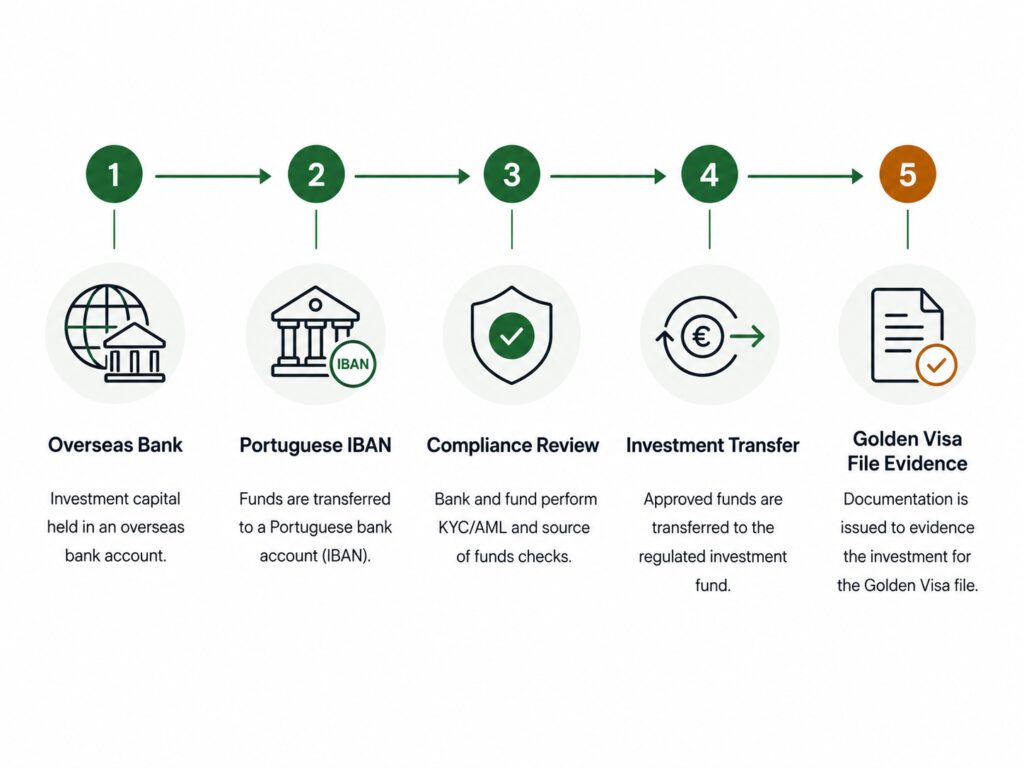
A typical flow looks like this:
- Obtain a NIF, the Portuguese tax identification number.
- Open a Portuguese bank account as a non-resident.
- Transfer funds from the investor’s overseas bank.
- Complete bank KYC and AML checks.
- Transfer the qualifying amount into the approved investment.
- Keep proof of the international wire transfer and investment subscription.
The bank account also creates key evidence for the Golden Visa file, including IBAN details, SWIFT or BIC records, transfer receipts, and capital transfer documentation.
Which Portuguese Banks Work with Golden Visa Investors?
Not every bank is equally comfortable with non-resident Golden Visa clients. Some banks are faster with remote onboarding, some prefer in-person verification, and some apply stricter rules depending on nationality, occupation, source of funds, and country of residence.
The best approach is not to ask which bank is “best” in general. Ask which bank can open a non-resident account for your profile, your documents, and your investment timeline.
Major Banks That Accept Non-Residents
Several large Portuguese banks commonly work with foreign clients and non-resident investors. These may include:
| Bank type | Typical advantage | What to check before applying |
| Large retail banks | Wider branch network and established compliance teams | Whether they currently accept remote non-resident onboarding |
| Private banking divisions | Better handling of high-value transfers | Minimum balance and onboarding requirements |
| Digital-friendly banks | Faster communication and document upload | Whether they support Golden Visa investment transfers |
| International banks with Portugal operations | Familiarity with foreign clients | Whether the Portuguese entity can issue all required documents |
The account must support the Golden Visa process, not just daily banking. Before choosing a bank, confirm that it can provide account statements, transfer confirmations, IBAN records, and proof of incoming capital.
Portuguese bank accounts are identified by an account number or IBAN, and Banco de Portugal states that current accounts may be opened in person or through distance communication via the Banco de Portugal banking portal.
What to Ask a Bank Before Opening
Before starting the account opening process, ask clear operational questions. This avoids delays after your investment deadline has already started to matter.
Ask the bank:
- Do you open accounts for non-resident Golden Visa investors?
- Can the process be completed remotely?
- Do you require a Portuguese lawyer or fiscal representative to be present?
- What documents do you need for KYC, meaning Know Your Customer checks?
- What evidence do you require for AML, meaning Anti-Money Laundering review?
- Can the account receive an international wire transfer from my country?
- Can you issue proof of funds arrival and outgoing investment transfer?
- Do you need documents translated, notarised, or apostilled?
- How long does approval usually take after documents are submitted?
A bank that answers these questions clearly is usually easier to work with than one that gives vague reassurance and asks for missing documents one week at a time.
Can You Open a Portuguese Bank Account Remotely?
Many non-resident investors can start or complete the process remotely, depending on the bank. Remote opening is common, but it is not automatic. Banks still need to verify identity, address, tax details, professional background, and source of funds.
If you still need the tax number first, review how to get your NIF first before starting the banking process. The NIF prerequisite is usually one of the first items the bank will ask for.
Remote Opening Process
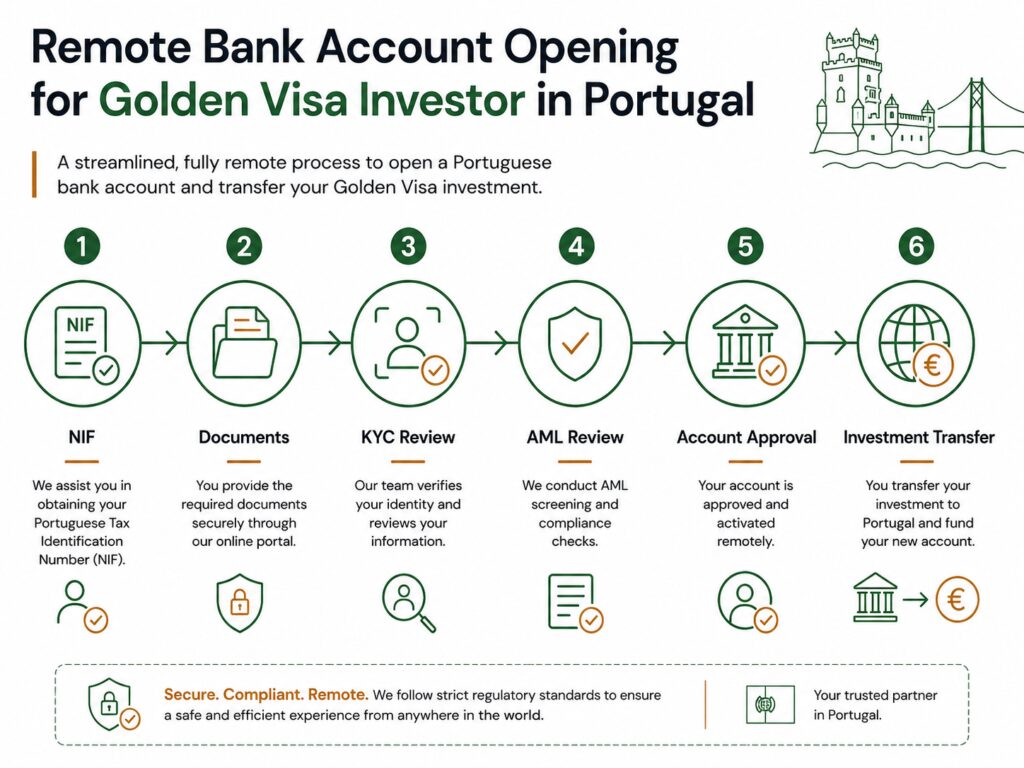
The remote process normally involves document collection, identity verification, compliance review, and account activation.
A typical remote sequence looks like this:
- The investor obtains a NIF.
- The bank or legal representative sends the account opening forms.
- The investor provides passport, proof of address, tax residence details, and financial profile.
- The bank requests source of funds evidence.
- Identity verification is completed through video call, certified copies, or bank-specific verification tools.
- The compliance team reviews KYC and AML information.
- The bank opens the account and issues IBAN details.
- The investor sends the first transfer once the account is active.
Remote opening is practical for many applicants, but it requires clean documentation. A missing proof of address, inconsistent spelling, or unclear income evidence can delay the file.
In-Person Opening: What to Bring
Some investors still choose to open the account in person. This can be useful if timing is tight, documents are complex, or the bank requires physical verification.
Bring the following:
- Valid passport
- NIF confirmation document
- Proof of residential address
- Tax identification number from your home country
- Employment or business ownership evidence
- Recent bank statements
- Proof of income or business revenue
- Source of funds declaration
- Evidence of the intended Golden Visa investment
- Contact details for your Portuguese lawyer or advisor
For investors already planning a visit for legal meetings or banking appointments, in-person opening can reduce back-and-forth. For everyone else, remote opening is often more efficient if the bank accepts it.
Documents Required to Open the Account
Portuguese banks ask for documents that prove identity, tax status, residence, and the legal origin of funds. The exact list varies by bank, but the core requirements are broadly similar.
The most common delay comes from source of funds evidence. Investors often prepare passport and address documents quickly, then underestimate how detailed the bank will be about capital origin.
Passport and NIF
The passport confirms identity and nationality. The NIF connects the investor to the Portuguese tax system and is normally required before the account can be opened.
Banks usually ask for:
- Passport copy
- NIF confirmation
- Home country tax number
- Date of birth and nationality
- Occupation or business role
- Contact details
The NIF should match the investor’s identity documents exactly. Even small spelling differences can create unnecessary compliance questions.
Proof of Address
Banks need proof of residential address because the investor is opening a non-resident account. The address document should be recent and should match the country of declared tax residence.
Common examples include:
- Utility bill
- Bank statement
- Tax authority letter
- Government-issued residence certificate
- Tenancy agreement, if accepted by the bank
Many banks require the proof of address to be dated within the last three months. Some may also request certified translation if the document is not in Portuguese or English.
Source of Funds Declaration
The source of funds declaration explains where the investment capital came from. This is not just a formality. It supports the bank’s AML review and helps document the investment transfer for the Golden Visa file.
Acceptable evidence may include:
| Source of capital | Typical supporting documents |
| Salary or bonuses | Payslips, employment contract, tax returns |
| Business ownership | Company accounts, dividends, shareholder records |
| Property sale | Sale agreement, completion statement, bank receipt |
| Investment portfolio | Broker statements, sale confirmations, account statements |
| Inheritance | Probate documents, estate distribution records |
| Gift from family | Gift deed, donor bank statements, donor source of funds |
Banks may ask follow-up questions if the funds pass through multiple accounts, come from a company account, or originate in a higher-risk jurisdiction. Clear documentation makes the process faster.
For a broader view of what documents may be needed after banking is complete, use the full documents checklist.
Anti-Money Laundering AML Checks: What to Expect
AML checks are part of regulated banking. They help banks confirm that the funds are lawful, traceable, and consistent with the investor’s profile.
KYC checks identify the client. AML checks examine risk. Together, they help the bank decide whether to open the account and accept the transfer.
Expect the bank to review:
- Identity and nationality
- Country of residence
- Tax residence
- Occupation or business activity
- Political exposure status
- Sanctions screening
- Source of wealth
- Source of funds
- Purpose of the account
- Expected transaction size
A Golden Visa investor sending €500,000 or more into Portugal should expect detailed questions. This does not mean the bank suspects wrongdoing. It means the transaction is large enough to require proper documentation.
The European Commission explains that EU rules on access to bank accounts aim to make basic payment account access clearer and more transparent through the EU Banking Access for Non-Residents framework.
Transferring Your Investment Capital to Portugal
Once the account is open, the investor can transfer capital into Portugal. This step should be planned carefully because the transfer record becomes part of the investment file.
For Golden Visa investors, the transfer should show:
- The investor’s name as sender
- The Portuguese account as receiving account
- The amount transferred
- The currency used
- The sending bank
- IBAN and SWIFT or BIC details
- Date of transfer
- Purpose or payment reference
- Final transfer into the qualifying investment
The account should be ready before the investor commits to a fund subscription deadline. Some banks also ask for advance notice before receiving a large international wire transfer.
For fund applicants, the transfer usually moves from the Portuguese bank account into the qualifying investment vehicle. Investors reviewing investment visa options in Portugal should confirm early whether their bank can provide the transfer evidence required by the fund and legal team.
The cleanest process is to keep every document in one folder:
- Incoming international wire transfer confirmation
- Portuguese bank account statement
- Proof of funds credited
- Outgoing investment transfer receipt
- Subscription agreement or investment confirmation
- Source of funds declaration
- Bank correspondence confirming transfer details
This documentation matters because AIMA, the Agency for Integration, Migration and Asylum, may need to review the investment file as part of the ARI, Autorização de Residência para Investimento, application. Applicants can check immigration authority information through the AIMA official portal.
FAQs: Portuguese Bank Account for Golden Visa
Do I need a Portuguese bank account for the Golden Visa?
Yes. In practice, Golden Visa investors need a Portuguese bank account to receive investment funds, document capital transfer, and complete the investment process. The account creates a clear financial record showing how money entered Portugal and moved into the qualifying investment.
Which Portuguese banks work best for non-resident Golden Visa investors?
The best bank depends on your nationality, tax residence, document profile, investment route, and whether you need remote opening. Large Portuguese banks and private banking teams often work with non-resident investors, but you should confirm remote onboarding, KYC requirements, source of funds rules, and transfer documentation before choosing one.
Can I open a Portuguese bank account without visiting Portugal?
Often, yes. Banco de Portugal confirms that current accounts may be opened in person or through distance communication, but each bank sets its own onboarding process. Some banks accept remote verification, while others may require certified documents, video identification, or an in-person appointment.
What documents do I need to open the account?
You usually need a passport, NIF, proof of address, home country tax number, professional or business information, bank statements, and source of funds evidence. For Golden Visa investors, banks may also ask for details of the intended investment and supporting documentation showing where the investment capital came from.
Is Opening a Portuguese Bank Account the Right First Step?
Opening the account is not the most exciting part of the Golden Visa process, but it is one of the most important. Without a functioning Portuguese bank account, the investment transfer becomes harder to document and the application file becomes weaker.
The practical order is simple: secure your NIF, prepare your source of funds evidence, open the bank account, then move capital into the qualifying investment. Investors comparing how the Golden Visa compares to the D7 should also note that banking requirements differ depending on the immigration route.
A well-prepared bank file saves time later. It also helps your lawyer, fund manager, and immigration advisor work from the same set of documents.
Ready to take the next step?
Book a free initial assessment. We’ll assess your eligibility, walk through the current qualifying routes, and answer your questions, no cost, no commitment.












