

Portugal golden visa

Portugal Golden Visa vs D7 Visa: Which Residency Route Is Right for You?

Most comparisons of portugal golden visa vs d7 focus on cost first. Cost matters, but it is not the real dividing line. The real difference is lifestyle: the Golden Visa is designed for investors who want residency with limited physical presence, while the D7 Passive Income Visa is designed for people who intend to live in Portugal.

Both routes can lead to Portuguese residency, Schengen Area access, residency permit renewal, and a possible path to citizenship. The right choice depends on whether you want investment-based flexibility or residence-based relocation.

Portugal Golden Visa vs D7 Visa: Key Differences at a Glance

The two routes solve different problems. The ARI, or Autorização de Residência para Investimento, is Portugal’s investment-based residence permit. The D7 is a passive income residence visa for applicants who can support themselves and intend to live in Portugal.

Category Portugal Golden Visa Portugal D7 Visa
Best for Investors who want flexibility Retirees and passive-income residents
Main requirement Qualifying investment Stable passive income
Physical stay Low minimum stay requirement Real residence in Portugal expected
Investment threshold Usually starts from €500,000 for qualifying funds No investment threshold
Income requirement Not based on monthly income Based on passive income and financial self-sufficiency
Tax residence risk Lower if you do not spend significant time in Portugal Higher because relocation is usually expected
Family suitability Strong for internationally mobile families Strong for families relocating to Portugal
Citizenship path Possible after 5 years, subject to eligibility Possible after 5 years, subject to eligibility

For a broader view of residency routes, review all ways to immigrate to Portugal before choosing between these two options.
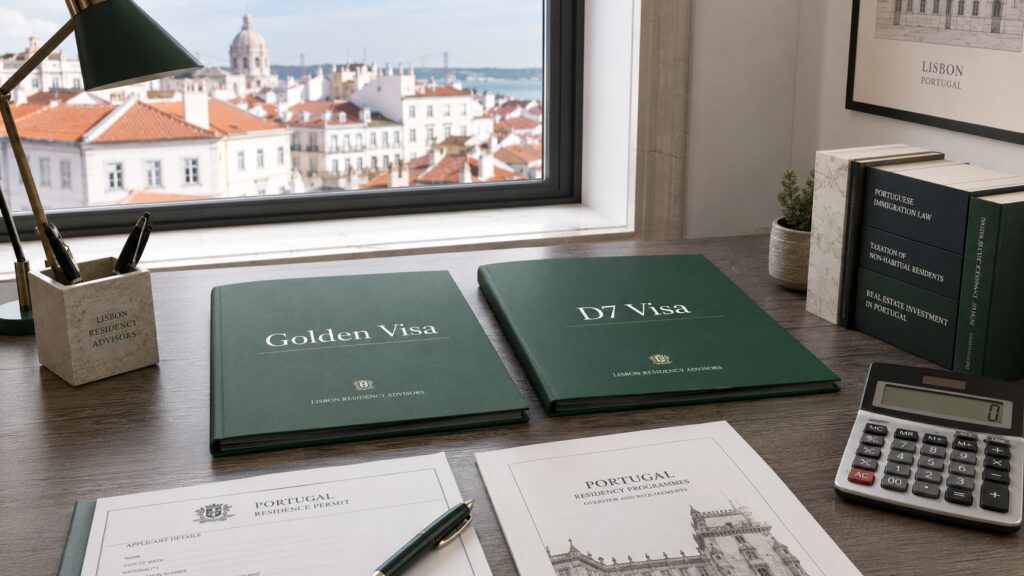
Portugal Golden Visa vs D7 Visa comparison for residency planning

What Is the Portugal Golden Visa (ARI)?

The Portugal Golden Visa is the common name for the ARI, or Autorização de Residência para Investimento. It allows non-EU nationals to apply for Portuguese residency through a qualifying investment.

AIMA, the Agency for Integration, Migration and Asylum, processes residence applications. The AIMA Official Residency Portal confirms that ARI holders may enter Portugal, reside and work in Portugal, circulate in the Schengen Area without a visa, benefit from family reunification, and apply for permanent residence or nationality after meeting the legal requirements.

The Golden Visa is usually best for applicants who:

  • Want Portuguese residency but do not plan to relocate immediately
  • Have sufficient capital for a qualifying investment
  • Want low physical presence requirements
  • Need family inclusion under one application
  • Want a possible route to Portuguese citizenship after five years

The current investment route most relevant to many applicants is a qualifying investment fund structure, not real estate. Real estate has not qualified as a Golden Visa route since Portugal’s 2023 legislative reform.

What Is the Portugal D7 Passive Income Visa?

The D7 Passive Income Visa is a residence visa for financially self-sufficient applicants who can live in Portugal from stable income. It is often called a retirement visa because pension income is commonly used, but it can also apply to other passive income sources.

The official Portuguese visa portal describes this category as fixed residency for retirement purposes, religious purposes, or people living from passive income. Passive income may include revenue from movable or immovable property, intellectual assets, or financial assets.

The D7 is usually best for applicants who:

  • Want to live in Portugal full time or most of the year
  • Have stable passive income
  • Are retired or financially independent
  • Do not want to commit €500,000 to a qualifying investment
  • Are comfortable becoming resident in Portugal
  • Can meet ongoing residence obligations

Remote workers should be careful here. A remote worker visa is a separate category from D7. If your income comes mainly from active remote work rather than passive income, the D8 Digital Nomad route may be more relevant than the D7.
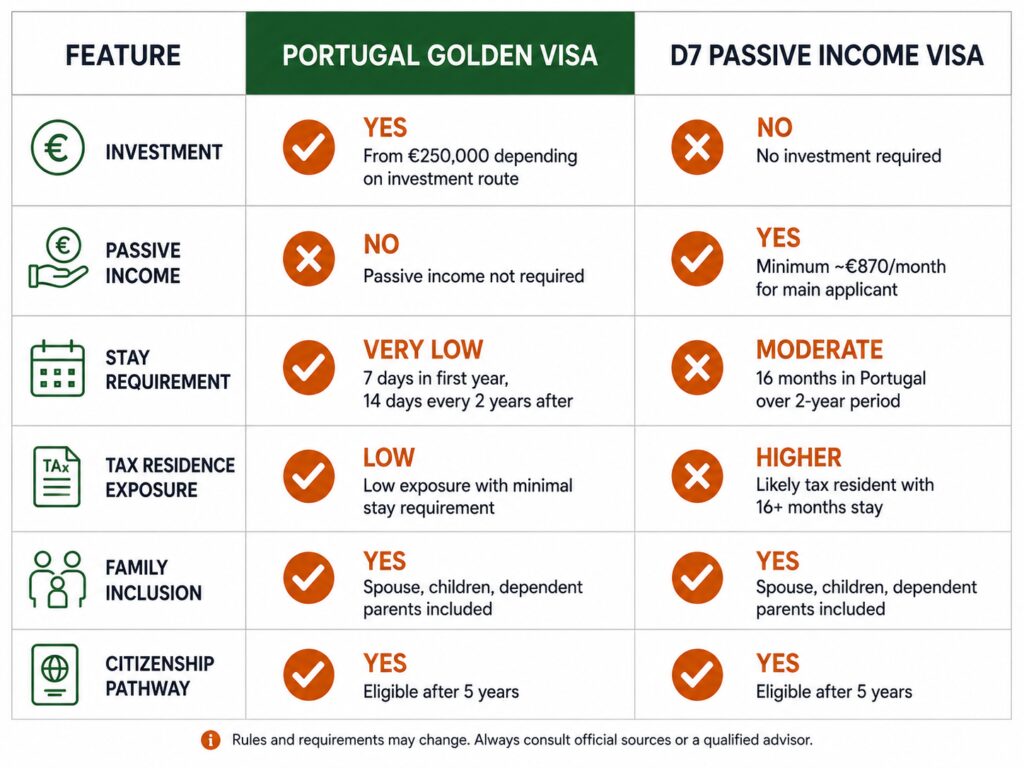
portugal-golden-visa-d7-requirements-comparison

Investment and Income Requirements Compared

The Golden Visa asks whether you can make and maintain a qualifying investment. The D7 asks whether you can support yourself from stable passive income while living in Portugal.

That difference affects cost, documentation, tax planning, and long-term suitability.

Golden Visa Minimum Investment

The Golden Visa is investment-led. A common current route is a minimum investment of €500,000 in qualifying non-real-estate investment funds.

The applicant should expect to prove:

  • The investment meets ARI rules
  • The funds were transferred legally
  • The investment is maintained for the required period
  • The fund is structured correctly under Portuguese law
  • The applicant passes background and eligibility checks

For a deeper cost view, see this Golden Visa cost breakdown.

The Golden Visa is not the cheapest route. It is the more flexible route for people who have capital available but do not want to spend most of the year in Portugal.

D7 Minimum Monthly Income

The D7 is income-led. The official visa portal states that means of subsistence are based on Portugal’s minimum monthly salary, which is €920 in 2026. The standard formula is:

Applicant type Minimum means of subsistence formula
Main applicant 100% of the minimum monthly salary
Second adult or additional adult 50%
Child or dependent young person 30%

For a single applicant, the baseline monthly figure is therefore €920 in 2026. For a couple, the baseline rises because the second adult adds 50%. For children or dependent young people, the additional amount is 30% each.

The consulate or visa authority may still expect more than the baseline if the applicant’s file needs stronger financial support. A high-cost city, weak documentation, unstable income, or unclear accommodation can all make the file less persuasive.

The D7 is not an investment visa. It is a residence visa based on financial self-sufficiency.

Stay Requirements: Which Is More Flexible?

This is the biggest practical difference between the two routes. The Golden Visa is built for low physical presence. The D7 is built for relocation.

If you cannot or do not want to live in Portugal for much of the year, the D7 may not fit your life.

Golden Visa 7-Day Minimum Stay Rule

The Golden Visa has a low minimum stay requirement. AIMA’s ARI guidance states that the beneficiary must remain in Portugal for at least 7 days in the first year and at least 14 days in subsequent two-year periods.

This is why the portugal golden visa program is often used by investors who want EU residency optionality without immediate relocation.

The Golden Visa may suit you if:

  1. You travel frequently for business.
  2. Your family is not ready to relocate.
  3. You want a European backup plan.
  4. You want to keep your tax residence outside Portugal, subject to proper tax advice.
  5. You can satisfy the investment threshold but cannot commit to living in Portugal full time.

Seven days is not a lifestyle plan. It is a compliance threshold. Investors should still keep records of travel, residence cards, renewals, and investment maintenance.

D7 Visa Residency Obligations

The D7 is different. It is for applicants who intend to live in Portugal. The initial visa allows entry into Portugal so the applicant can apply for a residence permit with AIMA.

In practical terms, D7 applicants should expect to show genuine residence planning. This usually includes accommodation, passive income, health coverage, and a credible plan to reside in Portugal.

The D7 may not be suitable if:

  • You only want a backup residence card
  • You cannot spend significant time in Portugal
  • Your income is mainly active remote work
  • You want to avoid tax residence exposure
  • You cannot show stable passive income

For many retirees, the D7 is a good fit. For internationally mobile investors who want minimal stay obligations, the Golden Visa is usually the more practical route.

Path to Citizenship: How Each Route Compares

Both routes can support a possible path to Portuguese citizenship. Neither route gives citizenship automatically.

The applicant must maintain legal residence, meet applicable nationality requirements, and satisfy conditions such as language and documentation requirements.

Timeline to Portuguese Citizenship via Golden Visa

The Golden Visa can support a citizenship application after five years of legal residency, subject to eligibility. AIMA’s ARI guidance confirms that ARI holders may request Portuguese nationality by naturalisation if they comply with the requirements of nationality law.

This is one of the main reasons investors choose the Golden Visa. They can maintain a low physical presence while still building legal residence time, provided they renew correctly and comply with the rules.

Key points:

  • Legal residence can count toward the five-year timeline.
  • The investment must be maintained during the required period.
  • Renewal compliance matters.
  • Citizenship is not guaranteed.
  • Portuguese language and nationality requirements still apply.

Applicants should review the path to Portuguese citizenship before treating the Golden Visa as a passport purchase. It is a residence route first.

Timeline to Portuguese Citizenship via D7

The D7 can also lead to citizenship after five years of legal residency, subject to eligibility. The difference is that D7 applicants are normally expected to live in Portugal and maintain residence in a more conventional way.

For D7 applicants, the citizenship path may feel more natural because they are often actually living in Portugal, integrating, learning the language, and building a Portuguese life.

The D7 route may be stronger if your goal is full relocation. The Golden Visa may be stronger if your goal is flexibility before possible future relocation.

Tax Implications for Each Route

Tax should never be treated as a side note. The same visa can create very different tax outcomes depending on physical presence, income type, home country tax rules, and family structure.

A visa gives immigration status. It does not automatically give a favourable tax outcome.

NHR Regime Eligibility

Many older comparisons mention Portugal’s NHR tax regime as if it is still broadly available to all new residents. That is outdated for many applicants.

The former NHR tax regime is no longer the simple planning tool it once was for new arrivals. Portugal has moved toward more targeted tax incentives, and eligibility depends on current law, transitional rules, and the applicant’s professional profile.

This affects both Golden Visa and D7 applicants:

Route Tax planning issue
Golden Visa Low stay requirements may reduce tax residence risk, but tax advice is still needed
D7 Living in Portugal may create Portuguese tax residence
Retirees Pension treatment needs specific review
Investors Fund income, dividends, and capital gains need planning
Families Spouse and dependent tax residence may differ

Do not choose the D7 because an old article promised NHR benefits. Do not choose the Golden Visa assuming it eliminates tax exposure. Get tax advice before applying.

US Tax Considerations for Both Visas

US citizens need special attention because US tax reporting usually continues regardless of residence. A US applicant may need advice on foreign accounts, fund structures, pensions, passive income, and foreign tax credits.

The Golden Visa may appeal to US citizens who want Portuguese residency without immediately becoming Portugal-based. The D7 may appeal to US retirees or financially independent applicants who genuinely want to live in Portugal.

US applicants should review:

  • IRS reporting obligations
  • Portuguese tax residence risk
  • Bank account disclosures
  • PFIC treatment for certain funds
  • Pension income treatment
  • Estate and inheritance planning
  • Double tax treaty considerations

The visa decision should come after tax review, not before it.

Which Visa Is Better for Your Situation?

The better route depends on how you plan to use Portuguese residency. A person who wants a backup residence option should not choose the same route as someone who wants to move to Porto next month.

The safest way to compare is by applicant profile.

Best for Investors

The Golden Visa is usually better for investors who have capital available and want flexibility. It fits people who want Portuguese residency without immediately changing their main home, business base, or children’s schooling.

Choose the Golden Visa if you:

  • Can meet the investment threshold
  • Want low physical presence requirements
  • Want Schengen Area access
  • Want family inclusion
  • Want a possible citizenship pathway
  • Are not ready to relocate full time
  • Prefer investment-based qualification over passive income qualification

The Golden Visa is a residency strategy. The investment must still be reviewed carefully.

Best for Retirees and Remote Workers

The D7 is usually better for retirees with stable pensions or applicants with passive income from rents, dividends, royalties, financial assets, or other recurring sources.

Choose the D7 if you:

  • Want to live in Portugal
  • Have stable passive income
  • Prefer income qualification over investment qualification
  • Are comfortable with residence obligations
  • Can plan for Portuguese tax residence
  • Want a lower entry cost than the Golden Visa

Remote workers should not assume D7 is the correct route. If the income is active employment or freelance work performed remotely, the Digital Nomad visa may be more appropriate.

Best for Families

Both routes can work for families, but they serve different family plans.

The Golden Visa is often better for families who want optionality. It can help parents secure a European residence pathway while children remain in school elsewhere.

The D7 is often better for families who are moving to Portugal and want to build daily life there.

Family objective Better fit
Keep current home base while securing EU optionality Golden Visa
Move to Portugal and live there D7
Include spouse and dependent children Both may work
Minimise required stay Golden Visa
Lower upfront cost D7
Build immediate Portuguese lifestyle D7

If the family is unsure, the decision usually turns on physical presence. If you cannot live in Portugal, the D7 becomes difficult to justify. If you can and want to live there, the Golden Visa may be more expensive than necessary.

FAQs: Portugal Golden Visa vs D7

What is the difference between the Portugal Golden Visa and the D7 Visa?

The Portugal Golden Visa is an investment-based residence route, while the D7 Visa is a passive income residence route. The Golden Visa is usually better for investors who want flexibility and low physical stay requirements. The D7 is usually better for retirees or financially independent applicants who intend to live in Portugal.

Which is better for US citizens, the Golden Visa or the D7 Visa?

For US citizens, the better option depends on relocation plans and tax exposure. The Golden Visa may suit US investors who want Portuguese residency without moving full time. The D7 may suit US retirees or passive-income applicants who want to live in Portugal. In both cases, US tax advice is essential before applying.

Does the D7 visa lead to citizenship like the Golden Visa?

Yes, the D7 can lead to Portuguese citizenship after five years of legal residency, subject to eligibility and nationality requirements. The Golden Visa can also support a citizenship pathway after five years, subject to compliance. Neither route provides automatic citizenship.

What are the minimum stay requirements for the D7 vs Golden Visa?

The Golden Visa has a low minimum stay requirement: at least 7 days in the first year and at least 14 days in subsequent two-year periods. The D7 is intended for applicants who live in Portugal, so the residence obligation is much more substantial in practice. This is one of the main reasons investors choose the Golden Visa over the D7.

Final Takeaway: Portugal Golden Visa or D7?

The portugal golden visa vs d7 decision is not simply a question of which route is cheaper. It is a question of how you plan to use Portuguese residency.

Choose the Golden Visa if you want investment-based residency, low stay requirements, and flexibility. Choose the D7 if you want to live in Portugal and can prove stable passive income.

The right route should match your residence plan, tax position, family structure, income type, and long-term citizenship goals. A good application starts with the visa category that fits your life, not the one that looks easiest on paper.

Ready to take the next step?
Book a free initial assessment. We’ll assess your eligibility, walk through the current qualifying routes, and answer your questions, no cost, no commitment.


Portugal Golden Visa vs D7 Visa: Which Residency Route Is Right for You?

Most comparisons of portugal golden visa vs d7 focus on cost first. Cost matters, but it is not the real dividing line. The real difference is lifestyle: the Golden Visa is designed for investors who want residency with limited physical presence, while the D7 Passive Income Visa is designed for people who intend to live in Portugal.

Both routes can lead to Portuguese residency, Schengen Area access, residency permit renewal, and a possible path to citizenship. The right choice depends on whether you want investment-based flexibility or residence-based relocation.

Portugal Golden Visa vs D7 Visa: Key Differences at a Glance

The two routes solve different problems. The ARI, or Autorização de Residência para Investimento, is Portugal’s investment-based residence permit. The D7 is a passive income residence visa for applicants who can support themselves and intend to live in Portugal.

Category Portugal Golden Visa Portugal D7 Visa
Best for Investors who want flexibility Retirees and passive-income residents
Main requirement Qualifying investment Stable passive income
Physical stay Low minimum stay requirement Real residence in Portugal expected
Investment threshold Usually starts from €500,000 for qualifying funds No investment threshold
Income requirement Not based on monthly income Based on passive income and financial self-sufficiency
Tax residence risk Lower if you do not spend significant time in Portugal Higher because relocation is usually expected
Family suitability Strong for internationally mobile families Strong for families relocating to Portugal
Citizenship path Possible after 5 years, subject to eligibility Possible after 5 years, subject to eligibility

For a broader view of residency routes, review all ways to immigrate to Portugal before choosing between these two options.

Portugal Golden Visa vs D7 Visa comparison for residency planning

What Is the Portugal Golden Visa (ARI)?

The Portugal Golden Visa is the common name for the ARI, or Autorização de Residência para Investimento. It allows non-EU nationals to apply for Portuguese residency through a qualifying investment.

AIMA, the Agency for Integration, Migration and Asylum, processes residence applications. The AIMA Official Residency Portal confirms that ARI holders may enter Portugal, reside and work in Portugal, circulate in the Schengen Area without a visa, benefit from family reunification, and apply for permanent residence or nationality after meeting the legal requirements.

The Golden Visa is usually best for applicants who:

  • Want Portuguese residency but do not plan to relocate immediately
  • Have sufficient capital for a qualifying investment
  • Want low physical presence requirements
  • Need family inclusion under one application
  • Want a possible route to Portuguese citizenship after five years

The current investment route most relevant to many applicants is a qualifying investment fund structure, not real estate. Real estate has not qualified as a Golden Visa route since Portugal’s 2023 legislative reform.

What Is the Portugal D7 Passive Income Visa?

The D7 Passive Income Visa is a residence visa for financially self-sufficient applicants who can live in Portugal from stable income. It is often called a retirement visa because pension income is commonly used, but it can also apply to other passive income sources.

The official Portuguese visa portal describes this category as fixed residency for retirement purposes, religious purposes, or people living from passive income. Passive income may include revenue from movable or immovable property, intellectual assets, or financial assets.

The D7 is usually best for applicants who:

  • Want to live in Portugal full time or most of the year
  • Have stable passive income
  • Are retired or financially independent
  • Do not want to commit €500,000 to a qualifying investment
  • Are comfortable becoming resident in Portugal
  • Can meet ongoing residence obligations

Remote workers should be careful here. A remote worker visa is a separate category from D7. If your income comes mainly from active remote work rather than passive income, the D8 Digital Nomad route may be more relevant than the D7.

portugal-golden-visa-d7-requirements-comparison

Investment and Income Requirements Compared

The Golden Visa asks whether you can make and maintain a qualifying investment. The D7 asks whether you can support yourself from stable passive income while living in Portugal.

That difference affects cost, documentation, tax planning, and long-term suitability.

Golden Visa Minimum Investment

The Golden Visa is investment-led. A common current route is a minimum investment of €500,000 in qualifying non-real-estate investment funds.

The applicant should expect to prove:

  • The investment meets ARI rules
  • The funds were transferred legally
  • The investment is maintained for the required period
  • The fund is structured correctly under Portuguese law
  • The applicant passes background and eligibility checks

For a deeper cost view, see this Golden Visa cost breakdown.

The Golden Visa is not the cheapest route. It is the more flexible route for people who have capital available but do not want to spend most of the year in Portugal.

D7 Minimum Monthly Income

The D7 is income-led. The official visa portal states that means of subsistence are based on Portugal’s minimum monthly salary, which is €920 in 2026. The standard formula is:

Applicant type Minimum means of subsistence formula
Main applicant 100% of the minimum monthly salary
Second adult or additional adult 50%
Child or dependent young person 30%

For a single applicant, the baseline monthly figure is therefore €920 in 2026. For a couple, the baseline rises because the second adult adds 50%. For children or dependent young people, the additional amount is 30% each.

The consulate or visa authority may still expect more than the baseline if the applicant’s file needs stronger financial support. A high-cost city, weak documentation, unstable income, or unclear accommodation can all make the file less persuasive.

The D7 is not an investment visa. It is a residence visa based on financial self-sufficiency.

Stay Requirements: Which Is More Flexible?

This is the biggest practical difference between the two routes. The Golden Visa is built for low physical presence. The D7 is built for relocation.

If you cannot or do not want to live in Portugal for much of the year, the D7 may not fit your life.

Golden Visa 7-Day Minimum Stay Rule

The Golden Visa has a low minimum stay requirement. AIMA’s ARI guidance states that the beneficiary must remain in Portugal for at least 7 days in the first year and at least 14 days in subsequent two-year periods.

This is why the portugal golden visa program is often used by investors who want EU residency optionality without immediate relocation.

The Golden Visa may suit you if:

  1. You travel frequently for business.
  2. Your family is not ready to relocate.
  3. You want a European backup plan.
  4. You want to keep your tax residence outside Portugal, subject to proper tax advice.
  5. You can satisfy the investment threshold but cannot commit to living in Portugal full time.

Seven days is not a lifestyle plan. It is a compliance threshold. Investors should still keep records of travel, residence cards, renewals, and investment maintenance.

D7 Visa Residency Obligations

The D7 is different. It is for applicants who intend to live in Portugal. The initial visa allows entry into Portugal so the applicant can apply for a residence permit with AIMA.

In practical terms, D7 applicants should expect to show genuine residence planning. This usually includes accommodation, passive income, health coverage, and a credible plan to reside in Portugal.

The D7 may not be suitable if:

  • You only want a backup residence card
  • You cannot spend significant time in Portugal
  • Your income is mainly active remote work
  • You want to avoid tax residence exposure
  • You cannot show stable passive income

For many retirees, the D7 is a good fit. For internationally mobile investors who want minimal stay obligations, the Golden Visa is usually the more practical route.

Path to Citizenship: How Each Route Compares

Both routes can support a possible path to Portuguese citizenship. Neither route gives citizenship automatically.

The applicant must maintain legal residence, meet applicable nationality requirements, and satisfy conditions such as language and documentation requirements.

Timeline to Portuguese Citizenship via Golden Visa

The Golden Visa can support a citizenship application after five years of legal residency, subject to eligibility. AIMA’s ARI guidance confirms that ARI holders may request Portuguese nationality by naturalisation if they comply with the requirements of nationality law.

This is one of the main reasons investors choose the Golden Visa. They can maintain a low physical presence while still building legal residence time, provided they renew correctly and comply with the rules.

Key points:

  • Legal residence can count toward the five-year timeline.
  • The investment must be maintained during the required period.
  • Renewal compliance matters.
  • Citizenship is not guaranteed.
  • Portuguese language and nationality requirements still apply.

Applicants should review the path to Portuguese citizenship before treating the Golden Visa as a passport purchase. It is a residence route first.

Timeline to Portuguese Citizenship via D7

The D7 can also lead to citizenship after five years of legal residency, subject to eligibility. The difference is that D7 applicants are normally expected to live in Portugal and maintain residence in a more conventional way.

For D7 applicants, the citizenship path may feel more natural because they are often actually living in Portugal, integrating, learning the language, and building a Portuguese life.

The D7 route may be stronger if your goal is full relocation. The Golden Visa may be stronger if your goal is flexibility before possible future relocation.

Tax Implications for Each Route

Tax should never be treated as a side note. The same visa can create very different tax outcomes depending on physical presence, income type, home country tax rules, and family structure.

A visa gives immigration status. It does not automatically give a favourable tax outcome.

NHR Regime Eligibility

Many older comparisons mention Portugal’s NHR tax regime as if it is still broadly available to all new residents. That is outdated for many applicants.

The former NHR tax regime is no longer the simple planning tool it once was for new arrivals. Portugal has moved toward more targeted tax incentives, and eligibility depends on current law, transitional rules, and the applicant’s professional profile.

This affects both Golden Visa and D7 applicants:

Route Tax planning issue
Golden Visa Low stay requirements may reduce tax residence risk, but tax advice is still needed
D7 Living in Portugal may create Portuguese tax residence
Retirees Pension treatment needs specific review
Investors Fund income, dividends, and capital gains need planning
Families Spouse and dependent tax residence may differ

Do not choose the D7 because an old article promised NHR benefits. Do not choose the Golden Visa assuming it eliminates tax exposure. Get tax advice before applying.

US Tax Considerations for Both Visas

US citizens need special attention because US tax reporting usually continues regardless of residence. A US applicant may need advice on foreign accounts, fund structures, pensions, passive income, and foreign tax credits.

The Golden Visa may appeal to US citizens who want Portuguese residency without immediately becoming Portugal-based. The D7 may appeal to US retirees or financially independent applicants who genuinely want to live in Portugal.

US applicants should review:

  • IRS reporting obligations
  • Portuguese tax residence risk
  • Bank account disclosures
  • PFIC treatment for certain funds
  • Pension income treatment
  • Estate and inheritance planning
  • Double tax treaty considerations

The visa decision should come after tax review, not before it.

Which Visa Is Better for Your Situation?

The better route depends on how you plan to use Portuguese residency. A person who wants a backup residence option should not choose the same route as someone who wants to move to Porto next month.

The safest way to compare is by applicant profile.

Best for Investors

The Golden Visa is usually better for investors who have capital available and want flexibility. It fits people who want Portuguese residency without immediately changing their main home, business base, or children’s schooling.

Choose the Golden Visa if you:

  • Can meet the investment threshold
  • Want low physical presence requirements
  • Want Schengen Area access
  • Want family inclusion
  • Want a possible citizenship pathway
  • Are not ready to relocate full time
  • Prefer investment-based qualification over passive income qualification

The Golden Visa is a residency strategy. The investment must still be reviewed carefully.

Best for Retirees and Remote Workers

The D7 is usually better for retirees with stable pensions or applicants with passive income from rents, dividends, royalties, financial assets, or other recurring sources.

Choose the D7 if you:

  • Want to live in Portugal
  • Have stable passive income
  • Prefer income qualification over investment qualification
  • Are comfortable with residence obligations
  • Can plan for Portuguese tax residence
  • Want a lower entry cost than the Golden Visa

Remote workers should not assume D7 is the correct route. If the income is active employment or freelance work performed remotely, the Digital Nomad visa may be more appropriate.

Best for Families

Both routes can work for families, but they serve different family plans.

The Golden Visa is often better for families who want optionality. It can help parents secure a European residence pathway while children remain in school elsewhere.

The D7 is often better for families who are moving to Portugal and want to build daily life there.

Family objective Better fit
Keep current home base while securing EU optionality Golden Visa
Move to Portugal and live there D7
Include spouse and dependent children Both may work
Minimise required stay Golden Visa
Lower upfront cost D7
Build immediate Portuguese lifestyle D7

If the family is unsure, the decision usually turns on physical presence. If you cannot live in Portugal, the D7 becomes difficult to justify. If you can and want to live there, the Golden Visa may be more expensive than necessary.

FAQs: Portugal Golden Visa vs D7

What is the difference between the Portugal Golden Visa and the D7 Visa?

The Portugal Golden Visa is an investment-based residence route, while the D7 Visa is a passive income residence route. The Golden Visa is usually better for investors who want flexibility and low physical stay requirements. The D7 is usually better for retirees or financially independent applicants who intend to live in Portugal.

Which is better for US citizens, the Golden Visa or the D7 Visa?

For US citizens, the better option depends on relocation plans and tax exposure. The Golden Visa may suit US investors who want Portuguese residency without moving full time. The D7 may suit US retirees or passive-income applicants who want to live in Portugal. In both cases, US tax advice is essential before applying.

Does the D7 visa lead to citizenship like the Golden Visa?

Yes, the D7 can lead to Portuguese citizenship after five years of legal residency, subject to eligibility and nationality requirements. The Golden Visa can also support a citizenship pathway after five years, subject to compliance. Neither route provides automatic citizenship.

What are the minimum stay requirements for the D7 vs Golden Visa?

The Golden Visa has a low minimum stay requirement: at least 7 days in the first year and at least 14 days in subsequent two-year periods. The D7 is intended for applicants who live in Portugal, so the residence obligation is much more substantial in practice. This is one of the main reasons investors choose the Golden Visa over the D7.

Final Takeaway: Portugal Golden Visa or D7?

The portugal golden visa vs d7 decision is not simply a question of which route is cheaper. It is a question of how you plan to use Portuguese residency.

Choose the Golden Visa if you want investment-based residency, low stay requirements, and flexibility. Choose the D7 if you want to live in Portugal and can prove stable passive income.

The right route should match your residence plan, tax position, family structure, income type, and long-term citizenship goals. A good application starts with the visa category that fits your life, not the one that looks easiest on paper.

Ready to take the next step?
Book a free initial assessment. We’ll assess your eligibility, walk through the current qualifying routes, and answer your questions, no cost, no commitment.

Portugal Golden Visa vs D7 Visa: Which Residency Route Is Right for You?

Portugal-Golden-Visa-vs-D7-Visa-Which-Residency-Route-Is-Right-for-You
Most comparisons of portugal golden visa vs d7 focus on cost first. Cost matters, but it is not the real dividing line. The real difference is lifestyle: the Golden Visa is designed for investors who want residency with limited physical presence, while the D7 Passive Income Visa is designed for people who intend to live in Portugal.

Both routes can lead to Portuguese residency, Schengen Area access, residency permit renewal, and a possible path to citizenship. The right choice depends on whether you want investment-based flexibility or residence-based relocation.

Portugal Golden Visa vs D7 Visa: Key Differences at a Glance

The two routes solve different problems. The ARI, or Autorização de Residência para Investimento, is Portugal’s investment-based residence permit. The D7 is a passive income residence visa for applicants who can support themselves and intend to live in Portugal.

Category Portugal Golden Visa Portugal D7 Visa
Best for Investors who want flexibility Retirees and passive-income residents
Main requirement Qualifying investment Stable passive income
Physical stay Low minimum stay requirement Real residence in Portugal expected
Investment threshold Usually starts from €500,000 for qualifying funds No investment threshold
Income requirement Not based on monthly income Based on passive income and financial self-sufficiency
Tax residence risk Lower if you do not spend significant time in Portugal Higher because relocation is usually expected
Family suitability Strong for internationally mobile families Strong for families relocating to Portugal
Citizenship path Possible after 5 years, subject to eligibility Possible after 5 years, subject to eligibility

For a broader view of residency routes, review all ways to immigrate to Portugal before choosing between these two options.

Portugal Golden Visa vs D7 Visa comparison for residency planning

What Is the Portugal Golden Visa (ARI)?

The Portugal Golden Visa is the common name for the ARI, or Autorização de Residência para Investimento. It allows non-EU nationals to apply for Portuguese residency through a qualifying investment.

AIMA, the Agency for Integration, Migration and Asylum, processes residence applications. The AIMA Official Residency Portal confirms that ARI holders may enter Portugal, reside and work in Portugal, circulate in the Schengen Area without a visa, benefit from family reunification, and apply for permanent residence or nationality after meeting the legal requirements.

The Golden Visa is usually best for applicants who:

  • Want Portuguese residency but do not plan to relocate immediately
  • Have sufficient capital for a qualifying investment
  • Want low physical presence requirements
  • Need family inclusion under one application
  • Want a possible route to Portuguese citizenship after five years

The current investment route most relevant to many applicants is a qualifying investment fund structure, not real estate. Real estate has not qualified as a Golden Visa route since Portugal’s 2023 legislative reform.

What Is the Portugal D7 Passive Income Visa?

The D7 Passive Income Visa is a residence visa for financially self-sufficient applicants who can live in Portugal from stable income. It is often called a retirement visa because pension income is commonly used, but it can also apply to other passive income sources.

The official Portuguese visa portal describes this category as fixed residency for retirement purposes, religious purposes, or people living from passive income. Passive income may include revenue from movable or immovable property, intellectual assets, or financial assets.

The D7 is usually best for applicants who:

  • Want to live in Portugal full time or most of the year
  • Have stable passive income
  • Are retired or financially independent
  • Do not want to commit €500,000 to a qualifying investment
  • Are comfortable becoming resident in Portugal
  • Can meet ongoing residence obligations

Remote workers should be careful here. A remote worker visa is a separate category from D7. If your income comes mainly from active remote work rather than passive income, the D8 Digital Nomad route may be more relevant than the D7.

portugal-golden-visa-d7-requirements-comparison

Investment and Income Requirements Compared

The Golden Visa asks whether you can make and maintain a qualifying investment. The D7 asks whether you can support yourself from stable passive income while living in Portugal.

That difference affects cost, documentation, tax planning, and long-term suitability.

Golden Visa Minimum Investment

The Golden Visa is investment-led. A common current route is a minimum investment of €500,000 in qualifying non-real-estate investment funds.

The applicant should expect to prove:

  • The investment meets ARI rules
  • The funds were transferred legally
  • The investment is maintained for the required period
  • The fund is structured correctly under Portuguese law
  • The applicant passes background and eligibility checks

For a deeper cost view, see this Golden Visa cost breakdown.

The Golden Visa is not the cheapest route. It is the more flexible route for people who have capital available but do not want to spend most of the year in Portugal.

D7 Minimum Monthly Income

The D7 is income-led. The official visa portal states that means of subsistence are based on Portugal’s minimum monthly salary, which is €920 in 2026. The standard formula is:

Applicant type Minimum means of subsistence formula
Main applicant 100% of the minimum monthly salary
Second adult or additional adult 50%
Child or dependent young person 30%

For a single applicant, the baseline monthly figure is therefore €920 in 2026. For a couple, the baseline rises because the second adult adds 50%. For children or dependent young people, the additional amount is 30% each.

The consulate or visa authority may still expect more than the baseline if the applicant’s file needs stronger financial support. A high-cost city, weak documentation, unstable income, or unclear accommodation can all make the file less persuasive.

The D7 is not an investment visa. It is a residence visa based on financial self-sufficiency.

Stay Requirements: Which Is More Flexible?

This is the biggest practical difference between the two routes. The Golden Visa is built for low physical presence. The D7 is built for relocation.

If you cannot or do not want to live in Portugal for much of the year, the D7 may not fit your life.

Golden Visa 7-Day Minimum Stay Rule

The Golden Visa has a low minimum stay requirement. AIMA’s ARI guidance states that the beneficiary must remain in Portugal for at least 7 days in the first year and at least 14 days in subsequent two-year periods.

This is why the portugal golden visa program is often used by investors who want EU residency optionality without immediate relocation.

The Golden Visa may suit you if:

  1. You travel frequently for business.
  2. Your family is not ready to relocate.
  3. You want a European backup plan.
  4. You want to keep your tax residence outside Portugal, subject to proper tax advice.
  5. You can satisfy the investment threshold but cannot commit to living in Portugal full time.

Seven days is not a lifestyle plan. It is a compliance threshold. Investors should still keep records of travel, residence cards, renewals, and investment maintenance.

D7 Visa Residency Obligations

The D7 is different. It is for applicants who intend to live in Portugal. The initial visa allows entry into Portugal so the applicant can apply for a residence permit with AIMA.

In practical terms, D7 applicants should expect to show genuine residence planning. This usually includes accommodation, passive income, health coverage, and a credible plan to reside in Portugal.

The D7 may not be suitable if:

  • You only want a backup residence card
  • You cannot spend significant time in Portugal
  • Your income is mainly active remote work
  • You want to avoid tax residence exposure
  • You cannot show stable passive income

For many retirees, the D7 is a good fit. For internationally mobile investors who want minimal stay obligations, the Golden Visa is usually the more practical route.

Path to Citizenship: How Each Route Compares

Both routes can support a possible path to Portuguese citizenship. Neither route gives citizenship automatically.

The applicant must maintain legal residence, meet applicable nationality requirements, and satisfy conditions such as language and documentation requirements.

Timeline to Portuguese Citizenship via Golden Visa

The Golden Visa can support a citizenship application after five years of legal residency, subject to eligibility. AIMA’s ARI guidance confirms that ARI holders may request Portuguese nationality by naturalisation if they comply with the requirements of nationality law.

This is one of the main reasons investors choose the Golden Visa. They can maintain a low physical presence while still building legal residence time, provided they renew correctly and comply with the rules.

Key points:

  • Legal residence can count toward the five-year timeline.
  • The investment must be maintained during the required period.
  • Renewal compliance matters.
  • Citizenship is not guaranteed.
  • Portuguese language and nationality requirements still apply.

Applicants should review the path to Portuguese citizenship before treating the Golden Visa as a passport purchase. It is a residence route first.

Timeline to Portuguese Citizenship via D7

The D7 can also lead to citizenship after five years of legal residency, subject to eligibility. The difference is that D7 applicants are normally expected to live in Portugal and maintain residence in a more conventional way.

For D7 applicants, the citizenship path may feel more natural because they are often actually living in Portugal, integrating, learning the language, and building a Portuguese life.

The D7 route may be stronger if your goal is full relocation. The Golden Visa may be stronger if your goal is flexibility before possible future relocation.

Tax Implications for Each Route

Tax should never be treated as a side note. The same visa can create very different tax outcomes depending on physical presence, income type, home country tax rules, and family structure.

A visa gives immigration status. It does not automatically give a favourable tax outcome.

NHR Regime Eligibility

Many older comparisons mention Portugal’s NHR tax regime as if it is still broadly available to all new residents. That is outdated for many applicants.

The former NHR tax regime is no longer the simple planning tool it once was for new arrivals. Portugal has moved toward more targeted tax incentives, and eligibility depends on current law, transitional rules, and the applicant’s professional profile.

This affects both Golden Visa and D7 applicants:

Route Tax planning issue
Golden Visa Low stay requirements may reduce tax residence risk, but tax advice is still needed
D7 Living in Portugal may create Portuguese tax residence
Retirees Pension treatment needs specific review
Investors Fund income, dividends, and capital gains need planning
Families Spouse and dependent tax residence may differ

Do not choose the D7 because an old article promised NHR benefits. Do not choose the Golden Visa assuming it eliminates tax exposure. Get tax advice before applying.

US Tax Considerations for Both Visas

US citizens need special attention because US tax reporting usually continues regardless of residence. A US applicant may need advice on foreign accounts, fund structures, pensions, passive income, and foreign tax credits.

The Golden Visa may appeal to US citizens who want Portuguese residency without immediately becoming Portugal-based. The D7 may appeal to US retirees or financially independent applicants who genuinely want to live in Portugal.

US applicants should review:

  • IRS reporting obligations
  • Portuguese tax residence risk
  • Bank account disclosures
  • PFIC treatment for certain funds
  • Pension income treatment
  • Estate and inheritance planning
  • Double tax treaty considerations

The visa decision should come after tax review, not before it.

Which Visa Is Better for Your Situation?

The better route depends on how you plan to use Portuguese residency. A person who wants a backup residence option should not choose the same route as someone who wants to move to Porto next month.

The safest way to compare is by applicant profile.

Best for Investors

The Golden Visa is usually better for investors who have capital available and want flexibility. It fits people who want Portuguese residency without immediately changing their main home, business base, or children’s schooling.

Choose the Golden Visa if you:

  • Can meet the investment threshold
  • Want low physical presence requirements
  • Want Schengen Area access
  • Want family inclusion
  • Want a possible citizenship pathway
  • Are not ready to relocate full time
  • Prefer investment-based qualification over passive income qualification

The Golden Visa is a residency strategy. The investment must still be reviewed carefully.

Best for Retirees and Remote Workers

The D7 is usually better for retirees with stable pensions or applicants with passive income from rents, dividends, royalties, financial assets, or other recurring sources.

Choose the D7 if you:

  • Want to live in Portugal
  • Have stable passive income
  • Prefer income qualification over investment qualification
  • Are comfortable with residence obligations
  • Can plan for Portuguese tax residence
  • Want a lower entry cost than the Golden Visa

Remote workers should not assume D7 is the correct route. If the income is active employment or freelance work performed remotely, the Digital Nomad visa may be more appropriate.

Best for Families

Both routes can work for families, but they serve different family plans.

The Golden Visa is often better for families who want optionality. It can help parents secure a European residence pathway while children remain in school elsewhere.

The D7 is often better for families who are moving to Portugal and want to build daily life there.

Family objective Better fit
Keep current home base while securing EU optionality Golden Visa
Move to Portugal and live there D7
Include spouse and dependent children Both may work
Minimise required stay Golden Visa
Lower upfront cost D7
Build immediate Portuguese lifestyle D7

If the family is unsure, the decision usually turns on physical presence. If you cannot live in Portugal, the D7 becomes difficult to justify. If you can and want to live there, the Golden Visa may be more expensive than necessary.

FAQs: Portugal Golden Visa vs D7

What is the difference between the Portugal Golden Visa and the D7 Visa?

The Portugal Golden Visa is an investment-based residence route, while the D7 Visa is a passive income residence route. The Golden Visa is usually better for investors who want flexibility and low physical stay requirements. The D7 is usually better for retirees or financially independent applicants who intend to live in Portugal.

Which is better for US citizens, the Golden Visa or the D7 Visa?

For US citizens, the better option depends on relocation plans and tax exposure. The Golden Visa may suit US investors who want Portuguese residency without moving full time. The D7 may suit US retirees or passive-income applicants who want to live in Portugal. In both cases, US tax advice is essential before applying.

Does the D7 visa lead to citizenship like the Golden Visa?

Yes, the D7 can lead to Portuguese citizenship after five years of legal residency, subject to eligibility and nationality requirements. The Golden Visa can also support a citizenship pathway after five years, subject to compliance. Neither route provides automatic citizenship.

What are the minimum stay requirements for the D7 vs Golden Visa?

The Golden Visa has a low minimum stay requirement: at least 7 days in the first year and at least 14 days in subsequent two-year periods. The D7 is intended for applicants who live in Portugal, so the residence obligation is much more substantial in practice. This is one of the main reasons investors choose the Golden Visa over the D7.

Final Takeaway: Portugal Golden Visa or D7?

The portugal golden visa vs d7 decision is not simply a question of which route is cheaper. It is a question of how you plan to use Portuguese residency.

Choose the Golden Visa if you want investment-based residency, low stay requirements, and flexibility. Choose the D7 if you want to live in Portugal and can prove stable passive income.

The right route should match your residence plan, tax position, family structure, income type, and long-term citizenship goals. A good application starts with the visa category that fits your life, not the one that looks easiest on paper.

Ready to take the next step?
Book a free initial assessment. We’ll assess your eligibility, walk through the current qualifying routes, and answer your questions, no cost, no commitment.

What do you think?
Blog

More Related Articles

top








