

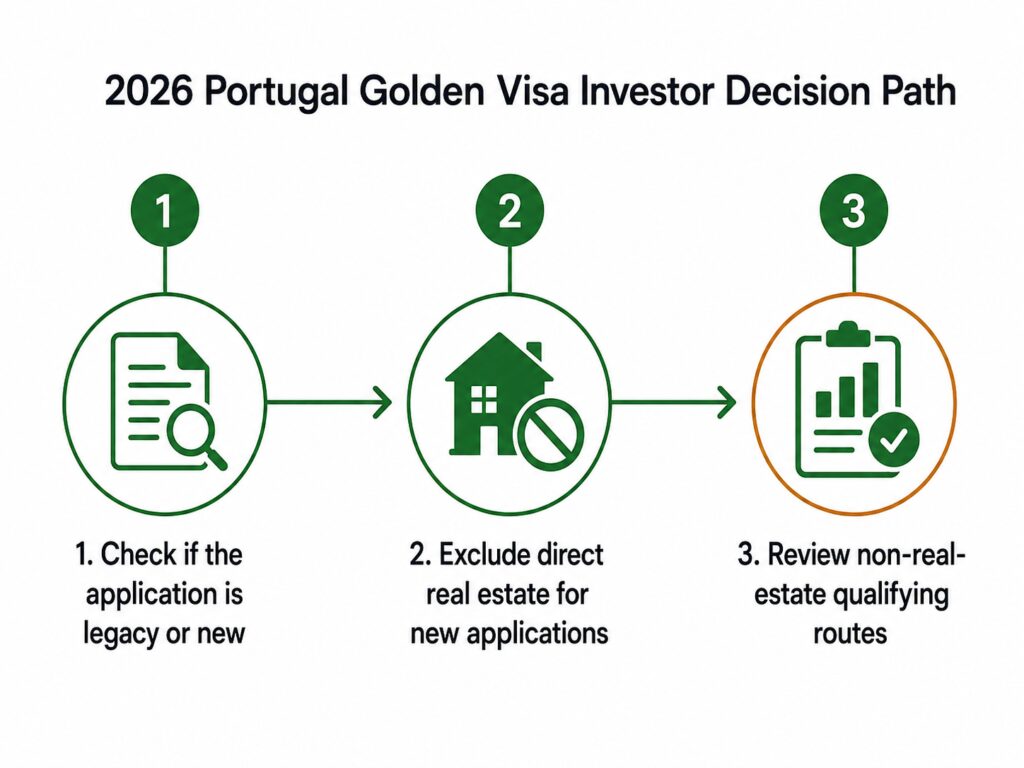
The question now is not simply where to buy property in Portugal. It is whether your case falls under a protected pre-2023 application, or whether a current non-property route, such as a regulated investment fund, is the safer path.

Portugal Golden Visa Real Estate: What the Law Changed in 2023
The 2023 reform changed the centre of gravity of the Portugal Golden Visa programme. Before the reform, many applicants used property acquisition or rehabilitation investment as the main route to residency.
Today, new applicants need to understand one clear point first: direct real estate investment is no longer a qualifying route for new Golden Visa applications.
When and Why Residential Property Was Removed
Portugal removed new real estate-based Golden Visa applications through Law 56/2023, commonly associated with the Mais Habitação housing reform. The measure responded to domestic housing pressure and redirected the ARI, Autorização de Residência para Investimento, away from direct property acquisition.
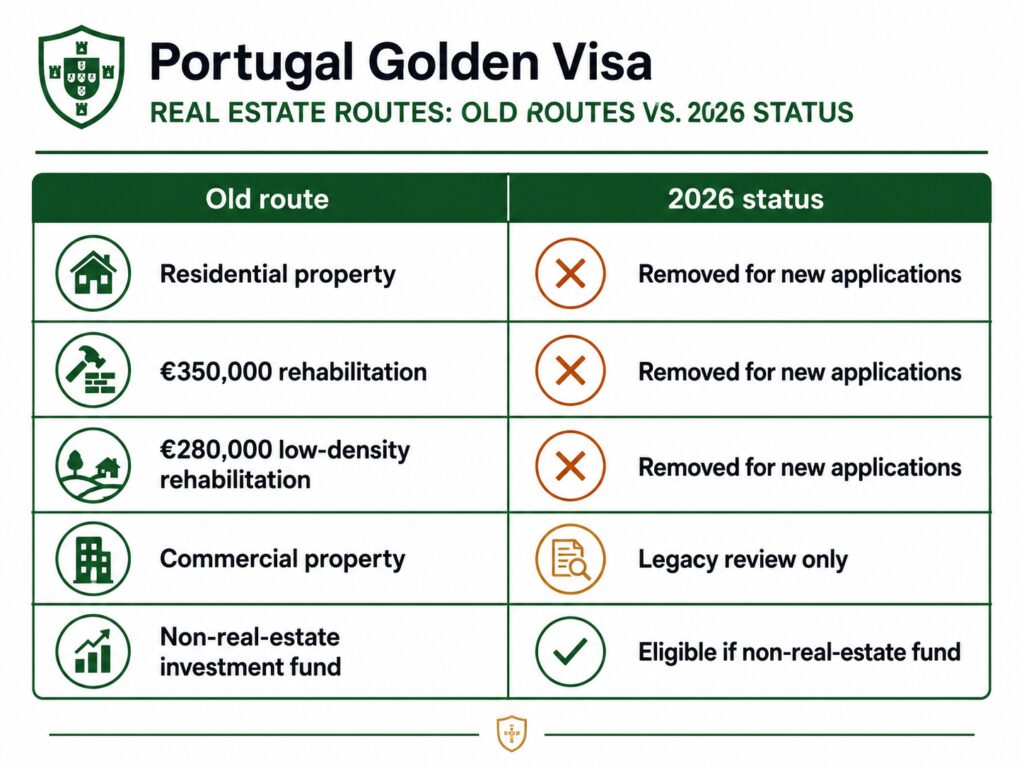
Before the change, applicants often relied on:
- Residential property purchases
- Commercial property purchases
- The €350,000 rehabilitation investment route
- The €280,000 low-density rehabilitation option
- Property-linked due diligence, IMT, IMI, notary fees, and property registry steps
For new applications in 2026, those routes should not be treated as active qualifying options.
What Law 56/2023 Actually Says
Law 56/2023, published in the Portuguese Official Gazette Law 56/2023, changed the legal framework for residence permits by investment and removed the real estate route for new applications.
That does not mean every old ARI real estate route disappeared overnight for existing cases. Transitional rules may protect certain applications already submitted or pending before the reform took effect. This is why some investors still see references to property in ARI discussions.
The practical distinction is simple:
| Situation | 2026 Treatment |
| New residential property purchase | Not eligible for a new Golden Visa application |
| New €350,000 rehabilitation route | Not eligible for a new Golden Visa application |
| New €280,000 low-density rehabilitation route | Not eligible for a new Golden Visa application |
| Pending pre-reform ARI real estate route application | May require case-specific review |
| Renewal of an existing property-based ARI | May remain possible if the original permit was lawfully granted |
If you are starting from zero in 2026, the old property routes should not be your planning base.
What Real Estate Is Still Eligible in 2026?
For new applicants, the direct answer is narrow: direct real estate is not eligible as a new Portugal Golden Visa route in 2026. This includes residential property, commercial property, and rehabilitation property.
The only real estate-related cases that may still matter are legacy cases, renewals, or applications protected by transitional provisions.
The 350000 Rehabilitation Option
The 350000 rehabilitation option was previously used for older properties or properties located in urban rehabilitation areas. It generally involved acquisition plus renovation, with additional checks linked to the age, location, condition, and rehabilitation plan of the asset.
In 2026, this route is not available for new Portugal Golden Visa real estate applications.
It may still appear online because many older articles were written before the reform or were not updated after Law 56/2023. Treat any source presenting the €350,000 route as currently open with caution.
The 280000 Low-Density Rehabilitation Option
The 280k rehabilitation option was a reduced-threshold version of the old rehabilitation route for qualifying low-density areas. It combined property rehabilitation with location-based eligibility.
In 2026, this route is also not available for new real estate-based ARI applications.
Low-density areas still matter in some investment discussions, but they should not be misunderstood as a way to revive the old property route. For a deeper explanation of the location concept, see this low-density area investment guide.
Commercial Property Considerations
Commercial property also needs careful handling. Some investors assume residential property was removed but commercial property remains eligible. That is not a safe assumption for new ARI planning.
Commercial property may still be relevant as a normal investment decision. It may involve IMT, property transfer tax, IMI, annual property tax, notary fees, leases, rental income, and property registry checks. But buying commercial property directly does not create a new Golden Visa route by itself.
A commercial asset may matter in a wider business structure, but that is not the same as a direct property-based Golden Visa application.
Low-density areas were important under the old real estate framework because they could reduce certain investment thresholds. The issue in 2026 is that a location map alone does not make a property eligible.
A property can sit in a low-density municipality and still fail to qualify because the real estate route itself has been removed for new applications.
How to Identify Qualifying Low-Density Areas
Low-density areas are generally assessed by population density and economic indicators. Under older rules, they were used to reduce certain qualifying investment thresholds.
For 2026 planning, investors should ask a more precise question:
- Is this location relevant to a current ARI route?
- Is the investment activity still listed as eligible by law?
- Does the structure involve real estate directly or indirectly?
- Is the application new, pending, or a renewal?
A map is useful only after the legal route has been confirmed. Otherwise, it can create false confidence.
Silver Coast and Interior Regions
The Silver Coast and interior regions were often discussed in connection with lower-threshold real estate routes. They may still be attractive for lifestyle, rental, or long-term property investment reasons.
But attractiveness and Golden Visa eligibility are separate issues.
An investor can still buy property in Portugal. The purchase may still involve tax planning, legal due diligence, notary fees, and property registry checks. It simply should not be presented as a new ARI real estate route in 2026.
Real Estate Investment Funds: The Alternative Route
This is another area where wording matters. A real estate investment fund is not the same thing as a current qualifying Golden Visa fund.
The current fund route is generally based on a €500,000 capital transfer into qualifying non-real-estate collective investment undertakings. AIMA, the Agency for Integration, Migration and Asylum, lists current ARI investment possibilities through the AIMA Official Investment Routes, including the non-real-estate fund route and other non-property routes.
How Real Estate Funds Differ from Direct Purchase
A direct property purchase gives the investor ownership of a specific asset. A fund investment gives the investor units in a regulated collective investment vehicle.
For Golden Visa purposes, the fund must be structured correctly. The current route is not designed for funds that are directly or indirectly intended for real estate investment.
That is why due diligence is critical. Investors should check:
- Whether the fund is supervised by CMVM, Portugal’s Securities Market Commission
- Whether it qualifies as a non-real-estate collective investment undertaking
- Whether the fund maturity meets the legal minimum
- Whether at least 60% of the investment is made in Portuguese commercial companies where required
- Whether the fund documentation supports ARI eligibility
For investors comparing options, golden visa fund investment options are now more relevant than direct property purchases.
Pros and Cons of the Rehabilitation Route
The rehabilitation route can still matter historically, especially for investors who applied before the law changed. But it should not be promoted to new applicants as an active 2026 real estate pathway.
The main value of understanding the old route is avoiding confusion. Many investors still ask about the €350,000 and €280,000 options because those figures remain visible across outdated guides.
Renovation Risks and Timelines
The old rehabilitation route came with risks that were often underestimated. A lower investment threshold did not necessarily mean a simpler process.
Common issues included:
- Construction delays
- Contractor disputes
- Municipality approvals
- Cost overruns
- Property registry issues
- Legal due diligence problems
- Documentation gaps for rehabilitation status
For legacy cases, these issues may still affect renewals or pending decisions. For new applicants, they are mainly useful as context for why the route became administratively complex.
Rental Income Potential
Property investment can still generate rental income, depending on the asset, location, tax profile, and market conditions. But rental income potential does not create Golden Visa eligibility.
Investors considering property in Portugal should separate two decisions:
| Decision | Key Question |
| Property investment | Is this asset financially and legally sound? |
| Golden Visa planning | Does this investment qualify under current ARI rules? |
A property can be a good investment and still have no Golden Visa value.
For broader programme planning, start with the current portugal golden visa rules, then evaluate whether investment funds, cultural support, research, job creation, or business investment routes fit your circumstances.
FAQs About Portugal Golden Visa Real Estate in 2026
Can I still buy residential property for the Portugal Golden Visa in 2026?
No, new applicants cannot qualify for the Portugal Golden Visa through residential property purchase in 2026. Residential property removal was part of the 2023 reform under Law 56/2023. You can still buy residential property in Portugal as a private investment, but it will not qualify you for a new ARI residence permit.
What is the 350000 rehabilitation option?
The 350000 rehabilitation option was an old Golden Visa route based on buying and rehabilitating qualifying property, often older buildings or assets in urban rehabilitation areas. It is no longer available for new applications in 2026. If you submitted a qualifying application before the reform, your case needs individual legal review under the transitional rules.
What types of real estate are still eligible?
For new applications, direct real estate is not eligible. This includes residential property, commercial property, rehabilitation property, and low-density rehabilitation property. Real estate may still matter for legacy cases, renewals, or separate investment planning, but not as a new Golden Visa route.
When was residential real estate removed from the Portugal Golden Visa?
Residential real estate was removed from new Portugal Golden Visa applications through Law 56/2023, which was published in October 2023. The reform changed the ARI framework and removed the old real estate routes for new applicants. Some pending or already granted cases may continue under transitional rules, depending on timing and documentation.
Is Portugal Golden Visa Real Estate Still Worth Considering?
Portugal property may still be worth considering as a normal investment, lifestyle asset, or rental strategy. But it should not be treated as a Golden Visa route for new applicants in 2026.
The safest starting point is to separate property planning from residency planning. If your goal is EU residency and a pathway to citizenship, focus first on current ARI routes. If your goal is property ownership, evaluate the property on its own financial and legal merits.
The old property-based Golden Visa era is over for new applicants. The programme still exists, but the qualifying route has changed.
Ready to take the next step?
Book a free initial assessment. We’ll assess your eligibility, walk through the current qualifying routes, and answer your questions, no cost, no commitment.












