
The key point is simple: Americans can apply, but they must plan differently from many other nationalities. US citizens carry ongoing IRS reporting obligations, foreign asset disclosure rules, and document requirements that can affect timing, investment structure, and tax coordination.
This guide explains what US applicants need to know in 2026 before choosing an investment route, preparing documents, or moving funds across borders.
Can Americans Apply for the Portugal Golden Visa?
Yes. US citizens can apply for the Portugal Golden Visa as long as they meet the eligibility rules for the ARI, or Autorização de Residência para Investimento, which is the formal name of Portugal’s residence permit for investment.
The programme is open to non-EU, non-EEA, and non-Swiss nationals. That includes American citizens, whether they are applying from the United States or already spending time in Portugal under short-stay rules.
Portugal’s immigration authority, AIMA official portal, the Agency for Integration, Migration and Asylum, processes ARI applications and replaced SEF, Serviço de Estrangeiros e Fronteiras, in 2023.
For Americans, the main benefits include:
- Legal residency in Portugal
- Visa-free movement across the Schengen Area
- Family inclusion under one application
- A minimum stay requirement that is significantly lower than standard relocation visas
- A potential citizenship pathway after five years, subject to eligibility
- The ability to keep US citizenship, since Portugal permits dual citizenship
The portugal golden visa is especially relevant for US applicants who want European residency without committing to full-time relocation.

Why US Interest in Portugal Golden Visa Is Surging
US interest has grown because many Americans now view European residency as practical planning, not lifestyle speculation. The motivation is often a mix of family access, political uncertainty, education options, retirement flexibility, and a desire for a credible plan B residency.
For high-net-worth US investors, Portugal is attractive because the Golden Visa does not require permanent relocation. The minimum stay requirement is limited, while the residency clock can still support a future citizenship application if the applicant continues to meet the legal requirements.
This makes the programme different from relocation-led visas. A US applicant can keep business, tax residence, and family life primarily in the United States while building a Portuguese residency position.
| US investor concern | Why the Portugal route matters |
| Full-time relocation | Not required for Golden Visa applicants |
| Family planning | Spouse, dependent children, and qualifying parents may be included |
| EU access | Schengen mobility is included with residency |
| Long-term optionality | Citizenship may be possible after five years |
| Tax exposure | Requires US and Portuguese tax coordination |
Investment Options for US Citizens
US citizens have access to the same current Golden Visa investment routes as other eligible non-EU investors. The practical question is which route fits an American investor’s tax profile, liquidity needs, reporting obligations, and risk tolerance.
Real estate no longer qualifies for Portugal Golden Visa purposes following the 2023 reform, so US applicants should be cautious with outdated content that still presents property purchase as a qualifying path.
Investment Fund Route (Most Popular for Americans)
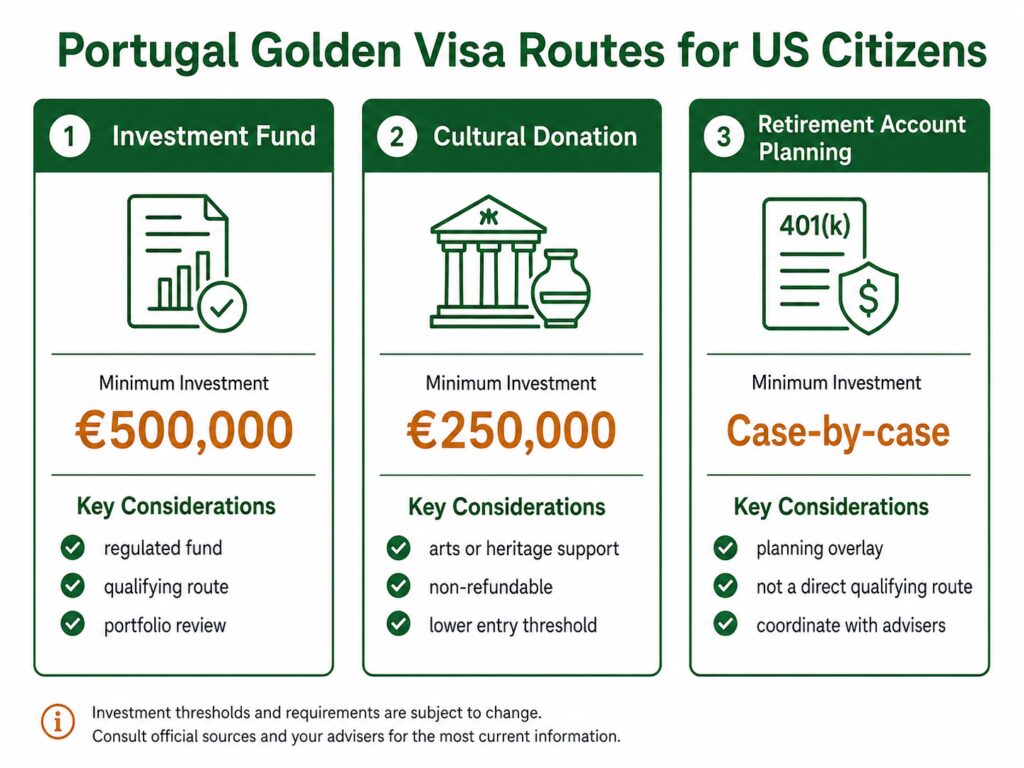
The most common route for American investors is the €500,000 investment fund route. Under this option, the applicant invests in qualifying Portuguese investment funds that meet the legal requirements for ARI purposes.
AIMA lists this route as a capital transfer of at least €500,000 for the acquisition of units in non-real-estate collective investment undertakings established under Portuguese law. The fund must have a maturity of at least five years at the time of investment, and at least 60% of the investment value must be made in commercial companies headquartered in Portugal.
For many US investors, the portugal golden visa investment fund route is attractive because it is structured, professionally managed, and aligned with the current post-real-estate Golden Visa framework.
However, fund investment is not automatic approval. US applicants should review:
- Fund eligibility for ARI purposes
- CMVM supervision, meaning oversight by Portugal’s Securities Market Commission
- FATCA compatibility and US investor onboarding
- Fund subscription documents
- Exit terms and maturity
- Tax reporting documentation
- Legal due diligence before transfer
Some Portuguese funds may not accept US persons because FATCA, the Foreign Account Tax Compliance Act, creates additional compliance obligations for foreign financial institutions.
Cultural Donation Route
The cultural route can be available through a capital transfer of at least €250,000 for investment or support of artistic production, or the recovery or maintenance of national cultural heritage.
This route may appeal to applicants who prefer a lower threshold than the investment fund route. However, it is usually non-refundable, meaning the capital should be treated as a contribution rather than an investment asset that may later be redeemed or sold.
US applicants should understand three points before choosing this route:
- The recipient entity must qualify under Portuguese rules.
- Documentation must prove that the contribution meets ARI requirements.
- The lower threshold may come with less financial flexibility than the fund route.
For American investors comparing routes, the cultural option can be suitable in specific cases, but it should not be evaluated only by headline cost.
Using IRA or 401k Funds
Some US investors ask whether they can use retirement assets for the Golden Visa. The answer is possible in certain structures, but only with careful tax and legal review.
A self-directed IRA or 401k rollover may allow exposure to alternative investments, but the structure must be reviewed for:
- IRS compliance
- Prohibited transaction rules
- Custodian requirements
- Investment eligibility
- Fund acceptance of retirement-account capital
- Reporting obligations
- Liquidity and distribution planning
Before you use IRA or 401k for your investment, coordinate with a US tax advisor, a retirement account custodian, and a Portugal Golden Visa legal team.
This is not an area for guesswork. A structure that works for immigration purposes can still create US tax problems if it is handled incorrectly.
US Tax Obligations When Holding a Portugal Golden Visa
A Portugal Golden Visa does not remove US tax obligations. US citizens are generally taxed by the United States on worldwide income, even when they live abroad or hold foreign residency.
This is the area where American applicants need more planning than most investors. The Portuguese immigration process, Portuguese tax position, and US reporting rules should be reviewed together before the investment is made.
FATCA and FBAR Filing Requirements
FATCA, the Foreign Account Tax Compliance Act, may require certain US taxpayers holding foreign financial assets to report those assets on IRS Form 8938. The IRS also makes clear that Form 8938 does not replace FBAR, or FinCEN Form 114, when FBAR reporting applies.
US applicants should review IRS FATCA and FBAR Requirements before opening foreign accounts or subscribing to Portuguese investment funds.
Common reporting triggers may include:
- Foreign bank accounts
- Foreign financial accounts linked to fund subscription
- Foreign investment holdings
- Specified foreign financial assets
- Ownership structures used for investment purposes
The threshold and form depend on filing status, residence position, asset value, and account type. A US tax professional should review the facts before filing season, not after a notice arrives.
The US-Portugal Tax Treaty
The United States and Portugal have an income tax treaty. The treaty can help determine how certain income is treated between the two countries, but it does not eliminate all US filing obligations.
The IRS maintains the official Portugal tax treaty documents, including the 1994 income tax treaty and technical explanation.
For US investors, the treaty may be relevant to:
- Dividends
- Interest
- Capital gains
- Pension income
- Residency tie-breaker questions
- Foreign tax credit planning
Treaty analysis is personal. The same investment can produce different results for a US resident, a US expat living in Portugal, and a dual-status family with assets in several countries.
NHR Regime and Its Limits for US Citizens
NHR Portugal, or the Non-Habitual Resident tax regime, is often mentioned in older Golden Visa content. New applicants must be careful because the old NHR regime was repealed from 1 January 2024, with transitional rules for certain existing or grandfathered applicants.
The replacement framework is narrower and does not work like the original NHR regime. US citizens should not assume that Portuguese tax benefits automatically reduce US tax exposure.
For Americans, the practical rule is this: Portuguese tax planning and US tax planning must be coordinated. A Portuguese tax advantage may still require disclosure to the IRS, and US rules may still tax income that Portugal treats differently.
For a deeper review of the Portuguese side, read tax benefits and NHR explained.
FBI Background Check: What Americans Need to Know
US citizens applying for the Portugal Golden Visa usually need an FBI background check, often referred to as an Identity History Summary. This is part of proving that the applicant satisfies criminal record requirements.
The FBI Identity History Summary process requires fingerprints and can be requested directly from the FBI or through an approved channeler.
American applicants should plan for four document steps:
- Request the FBI Identity History Summary.
- Ensure the document is valid for Portuguese submission timing.
- Obtain an apostille where required.
- Arrange certified translation if required for the application file.
The US State Department provides guidance on authentication and apostille services, including Form DS-4194 and document submission requirements. Review the US State Department Abroad Living Resources before mailing documents.
Do not leave the background check until the end. If the document expires or the apostille arrives late, it can delay the entire application file.
Portugal as a Plan B for Americans
For many Americans, the Portugal Golden Visa is not about leaving the United States tomorrow. It is about building a legally credible alternative before it becomes urgent.
A plan B residency can support:
- Family mobility
- Children’s future EU education options
- Retirement flexibility
- Easier Schengen travel
- Long-term citizenship planning
- Geographic diversification of personal risk
The main attraction is optionality. US citizens can maintain their existing life while securing a European residence permit, subject to ongoing compliance.
This is why portugal golden visa benefits for americans are often different from the benefits marketed to full-time movers. The value is not only Portugal as a destination. It is Portugal as a structured gateway to European residency.
Step-by-Step Application Guide for US Residents
US residents should treat the application as a coordinated legal, tax, and investment process. The goal is not only to submit documents, but to avoid mismatches between Portuguese immigration rules and US reporting requirements.
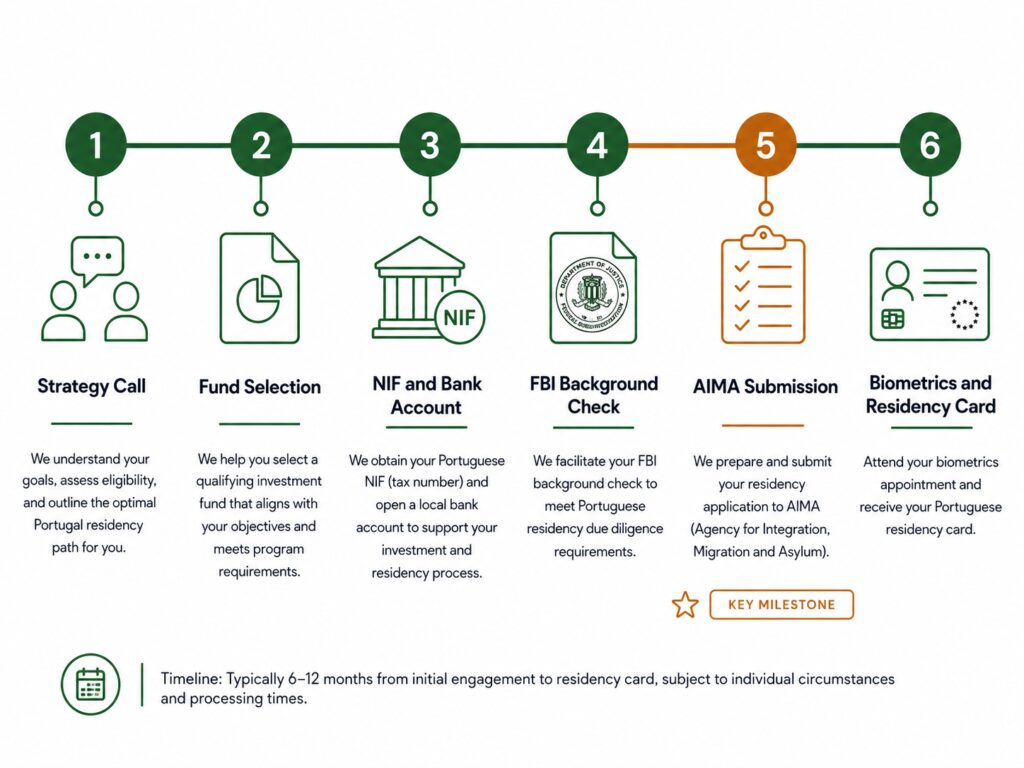
A typical process looks like this:
- Eligibility review
Confirm nationality, family inclusion, source of funds, criminal record position, and investment suitability. - Tax and structure review
Review US expat tax obligations, FATCA, FBAR, IRS Form 8938, capital gains tax exposure, and whether retirement-account funds are involved. - NIF and banking setup
Obtain a NIF, the Portuguese tax identification number, and arrange banking or transfer requirements. - Investment selection
Choose a qualifying route, usually a fund route for many American investors. Review fund documents, CMVM supervision, maturity, and US-person onboarding. - Document collection
Prepare passport copies, proof of address, FBI background check, apostille, evidence of funds, and family documents where applicable. - Application submission
Submit the ARI file through the relevant process, with AIMA handling immigration review and appointment coordination. - Biometric appointment
Attend biometrics in Portugal when scheduled. Family members may also need to attend. - Residence permit issuance
Once approved, the residence card is issued. Ongoing compliance includes maintaining the qualifying investment and meeting stay requirements.
| Application stage | US-specific issue to watch |
| Investment review | FATCA acceptance and US-person documentation |
| Tax planning | FBAR, Form 8938, treaty review, capital gains |
| Criminal record | FBI report timing and apostille |
| Family inclusion | Birth, marriage, and dependency documents |
| Biometrics | Travel planning for appointment dates |
This is where experienced coordination matters. A US applicant may have a clean immigration file but still face complications if the fund cannot onboard US persons, the FBI document is late, or the tax structure was not reviewed before transfer.
FAQs: Portugal Golden Visa for Americans
Can US citizens apply for the Portugal Golden Visa?
Yes. US citizens are eligible because the programme is available to qualifying non-EU nationals. Americans must meet the investment requirement, provide required documentation, pass background checks, and maintain the investment for the required period.
What are the US tax implications?
A Portugal Golden Visa does not end US tax filing obligations. US citizens generally remain subject to US tax rules on worldwide income and may need to report foreign accounts or assets under FATCA, FBAR, and IRS Form 8938. Applicants should work with a US tax advisor before opening Portuguese accounts or subscribing to a qualifying fund.
What investment options are available to American investors?
American investors may consider routes such as the €500,000 qualifying investment fund route or the cultural support route, depending on eligibility and current rules. The fund route is often preferred by US applicants because it is structured as an investment, but not every fund accepts US persons. Proper due diligence is essential before transferring capital.
Do Americans need an FBI background check?
Yes, US applicants typically need an FBI Identity History Summary as part of the criminal record documentation. The document may also need an apostille and, depending on the file, translation for Portuguese submission. Timing matters because criminal record documents can expire for immigration purposes.
Is the Portugal Golden Visa Right for US Citizens?
The Portugal Golden Visa can be a strong option for American investors who want European residency without full-time relocation. It is especially useful for families seeking long-term access, investors who want geographic diversification, and US citizens who want a structured route toward Portuguese citizenship after five years.
The main caution is tax and documentation. American applicants must consider FATCA, FBAR, IRS Form 8938, the US-Portugal tax treaty, FBI background checks, apostilles, and fund onboarding rules before moving forward.
For US investors, the best outcome comes from treating the application as one integrated process: immigration, investment, tax, and family planning.
Ready to take the next step?
Book a free initial assessment. We’ll assess your eligibility, walk through the current qualifying routes, and answer your questions, no cost, no commitment.












