
Portugal golden visa

Portugal Golden Visa for Canadians: Eligibility, Costs and How to Apply

The portugal golden visa for canadians is not a relocation-first visa. It is a residency-by-investment route for Canadian investors who want EU residency, Schengen mobility, and a potential path to Portuguese citizenship after five years without immediately moving their life from Canada.

For Canadians, the main questions are practical: eligibility, criminal record checks, proof of funds, tax exposure, and whether Portugal still accepts real estate. The short answer is clear: Canadian citizens can apply as non-EU nationals, but the application must be built carefully around documentation, investment compliance, and tax planning.

Can Canadians Get the Portugal Golden Visa?

Yes. Canadians can apply for Portugal’s Autorização de Residência para Investimento, usually referred to as ARI, if they meet the investment, documentation, and admissibility requirements. ARI is Portugal’s formal residence permit for investment activity.

Canadian applicants are treated as non-EU nationals, which is exactly the applicant category the programme is designed for. A Canadian passport can support the application, provided the applicant also submits the required criminal record check, financial proof, health insurance, and investment evidence.

The current golden visa in Portugal is no longer a real estate programme. Residential and most real estate acquisition routes were removed after the 2023 reform, so Canadians should focus on compliant fund, cultural, research, or business-related routes instead of relying on older online information.

According to the AIMA Official Portal, AIMA, the Agency for Integration, Migration and Asylum, processes ARI residence applications and lists the qualifying investment activities under the current framework.

Portugal Golden Visa for Canadians application documents in Lisbon office

Why Canada Is One of the Top Applicant Countries

Canada is a natural source of interest for Portugal’s Golden Visa because Canadian investors often want European optionality without giving up their Canadian base. The programme answers a very specific concern: long-term EU access without a full relocation requirement.

Canadian applicants usually fall into three groups:

Applicant profile Main motivation Typical concern
High-net-worth investors EU residency and citizenship pathway Fund regulation and capital protection
Family planners Children’s education and future mobility Dependent eligibility and timeline
Retirement planners Portugal as a future base Tax residency, pensions, and healthcare

Canada also has strong travel access already, but visa-free travel is not the same as residency. Canadians can visit Schengen countries for short stays, but a residence permit is required for a longer-term legal base in Portugal.

That distinction matters. The Golden Visa is not mainly about tourism. It is about building a legal residency position in Portugal while maintaining flexibility in Canada.

Portugal Golden Visa Requirements for Canadian Applicants

Canadian applicants must satisfy the same core eligibility rules as other non-EU investors, with a few Canada-specific documentation steps. The process starts with identity, admissibility, proof of funds, and a qualifying investment.

A typical Canadian applicant will need:

  • Valid Canadian passport
  • Portuguese NIF, which is the Portuguese tax identification number
  • Portuguese bank account
  • Proof of qualifying investment
  • RCMP criminal record check
  • Apostille for Canadian public documents where required
  • Health insurance
  • Financial proof showing legal source of funds
  • Application submission and biometric appointment through AIMA

For a deeper eligibility overview, see the full eligibility requirements before preparing the document file.

RCMP Criminal Record Check and Apostille

Canadian applicants usually need an RCMP criminal record check based on fingerprints. This document supports the background check stage and helps Portuguese authorities assess criminal admissibility.

Because the document is issued in Canada and used in Portugal, it normally requires proper authentication or apostille treatment. Canada is part of the Apostille Convention, and Global Affairs Canada explains that an apostille confirms the authenticity of the signature on a Canadian public document for use abroad.

In practice, applicants should plan this step early. Criminal record checks and apostille processing can create delays if names, dates, fingerprints, or document formats are inconsistent.

A clean document file should include:

  1. RCMP criminal record check
  2. Apostille or authentication where required
  3. Certified translation if requested
  4. Passport copy
  5. Proof of residence and civil status documents, if applicable

Proof of Funds from Canadian Accounts

Portugal’s Golden Visa is not approved simply because an applicant has wealth. The applicant must show that the investment funds are legal, traceable, and available.

For Canadians, financial proof may include:

  • Canadian bank statements
  • Investment account statements
  • Sale agreements for business or property proceeds
  • Tax returns or accountant letters
  • RRSP or pension-related documentation, where relevant
  • Evidence of transfer from Canada to Portugal

The goal is to create a clear paper trail. If CAD funds are converted into euros, the exchange route should also be documented.

This matters especially for the investment fund route, where the Portuguese bank, fund manager, compliance teams, and immigration advisors may all request source-of-funds evidence. A vague explanation is not enough. The file should show how the money was earned, held, transferred, and invested.

Health Insurance for Canadian Applicants

Canadian provincial healthcare does not automatically replace the need for health insurance in Portugal. Applicants should expect to provide coverage that is valid for Portugal and acceptable for the residence process.

Canadian applicants who do not intend to relocate immediately often use international private health insurance for the application stage. Those who later become tax residents or spend more time in Portugal may need to review their healthcare position more carefully.

Health insurance should be active, correctly named, and consistent with the applicant and dependent family members included in the ARI application.

Investment Options for Canadian Investors

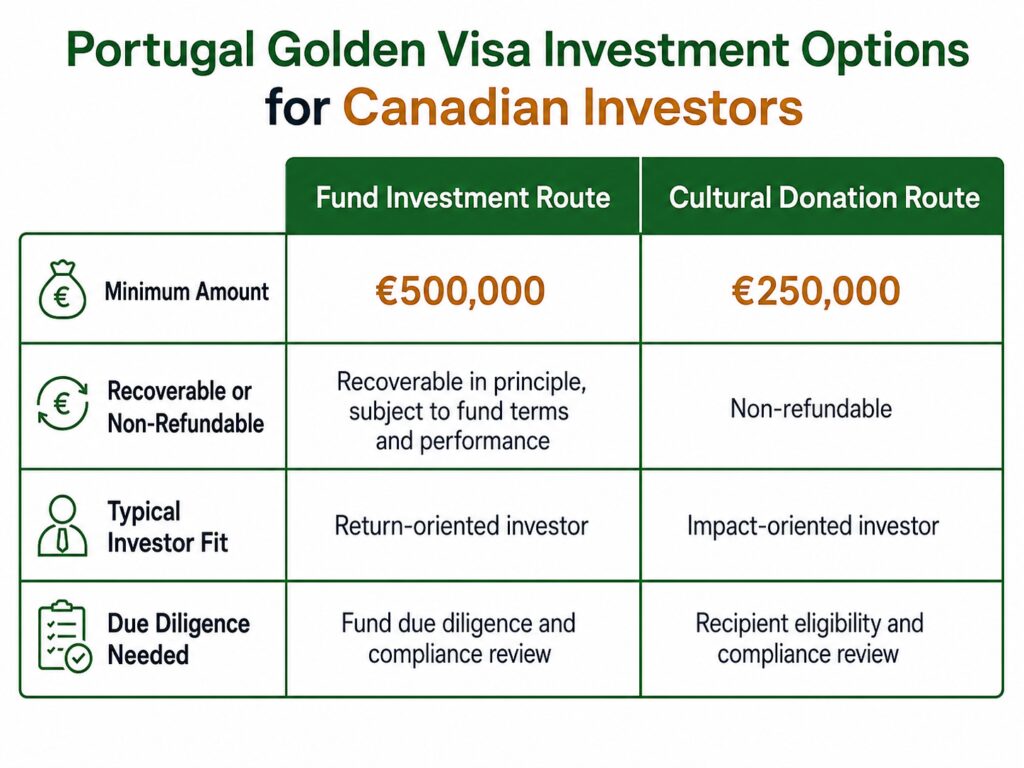
Canadian applicants should focus on routes that remain legally available after the real estate changes. The most common route for investors is the fund route, but the cultural donation route may also be relevant in specific cases.

The choice depends on risk profile, liquidity expectations, family strategy, and whether the applicant wants a potentially recoverable investment or accepts a non-refundable contribution.
Portugal Golden Visa investment options for Canadian investors comparison

Fund Route Most Accessible for Canadians

The fund route is generally the most practical route for Canadian investors. It requires a minimum investment of €500,000 in eligible Portuguese investment funds that meet ARI requirements.

A qualifying fund must be structured under Portuguese law and supervised by CMVM, Portugal’s Securities Market Commission. The fund must also meet the programme’s requirements on maturity and Portuguese investment exposure.

Canadian investors should review Portugal Golden Visa investment fund options with attention to:

  • CMVM registration and supervision
  • Fund strategy and underlying assets
  • Minimum term and exit structure
  • Fees and subscription process
  • Whether the fund accepts Canadian investors
  • Tax reporting implications in Canada
  • Currency conversion from CAD to EUR

Some funds may have restrictions or additional onboarding questions for Canadian investors due to securities, compliance, and tax reporting considerations. This does not mean Canadians cannot use the fund route. It means the fund selection stage should be handled before the immigration timeline is built around it.

Portugal Golden Visa

Start Your Portugal Golden Visa Journey

Receive personalized legal guidance from experienced immigration lawyers and discover the most effective pathway to securing your Portugal Golden Visa.

Book Your Free Consultation →
✓ No Obligation   •   ✓ Licensed Lawyers   •   ✓ Confidential Consultation

Cultural Donation Route

The cultural donation route may be available through a qualifying contribution to artistic production, national heritage, or cultural preservation. It is generally structured as a non-refundable support contribution rather than an investment with expected capital return.

This route may appeal to applicants who want a simpler asset-management profile, but it is not necessarily easier. The recipient entity, purpose, documentation, and eligibility must still align with the ARI rules.

For Canadian investors, the cultural route should be reviewed carefully because:

  • The contribution is typically non-refundable
  • The applicant may not receive investment upside
  • Documentation must prove the qualifying nature of the support
  • Availability can depend on approved institutions and project structure
  • Tax treatment in Canada should be reviewed before proceeding

The fund route remains more common for Canadians who want a regulated financial asset. The cultural route may suit applicants who prioritise simplicity over capital recovery.

Tax Considerations for Canadians

The Portugal Golden Visa does not automatically make a Canadian applicant a Portuguese tax resident. Tax residency depends on facts such as days spent in Portugal, home availability, personal ties, and Canadian residence status.

This is one of the most important planning points. A residence permit and tax residency are related, but they are not the same thing.

Canadian applicants should review cross-border tax planning before investing, especially if they hold RRSPs, pensions, business shares, investment portfolios, rental property, or taxable capital gains in Canada.

Canada-Portugal Tax Treaty Overview

Canada and Portugal have a tax treaty designed to reduce double taxation and clarify how certain income is treated between both countries. The Canada Revenue Agency explains that tax treaties can define who is eligible for treaty benefits and may reduce withholding tax on certain categories of income.

For Canadians, this does not mean tax becomes simple. It means there is a legal framework to analyse.

Relevant income categories may include:

  • Dividends
  • Interest
  • Rental income
  • Pensions
  • Capital gains
  • Business income
  • Trust or estate income

A Canadian investor should not assume the Golden Visa itself changes Canadian tax obligations. If the applicant remains tax resident in Canada, Canadian reporting may continue. If the applicant later becomes non-resident of Canada, departure tax, withholding tax, and ongoing Canadian-source income rules may become relevant.

NHR Regime Eligibility for Canadians

NHR Portugal, the former Non-Habitual Resident regime, was a major planning point for many foreign residents. However, the classic NHR regime was repealed for new entrants from 2024, with transitional rules for people who qualified under specific conditions.

Some applicants may now examine newer Portuguese tax incentives, including the Tax Incentive for Scientific Research and Innovation, depending on their professional activity and eligibility. This is not a Golden Visa benefit by itself.

For Canadians, the correct sequence is:

  1. Decide whether you intend to become tax resident in Portugal
  2. Review whether any Portuguese tax incentive applies
  3. Check whether Canadian tax residency will continue
  4. Analyse treaty treatment
  5. Confirm reporting for Canadian assets and income

This should be done before relocating, not after the first Portuguese tax filing deadline appears.

Implications for RRSP and Canadian Pension

RRSPs, Canadian pensions, CPP, OAS, and private retirement income require careful planning. Canada may withhold tax on certain payments to non-residents, and treaty treatment may affect the rate or reporting method.

The Golden Visa itself does not force a Canadian applicant to withdraw an RRSP or move pension assets. However, if the applicant becomes Portuguese tax resident, Portugal may need to review foreign pension and investment income depending on the applicable rules at that time.

Canadian investors should also review:

  • RRSP withdrawals
  • RRIF conversion
  • CPP and OAS treatment
  • Pension withholding
  • Capital gains on non-registered portfolios
  • Canadian departure tax exposure
  • Portuguese tax residence timing

This is a tax planning issue, not an immigration formality. The best result usually comes from coordinating a Portuguese tax advisor with a Canadian cross-border tax specialist.

Step-by-Step Application Process for Canadians

The application process for Canadians follows the standard ARI structure, but the document preparation stage has Canada-specific steps.

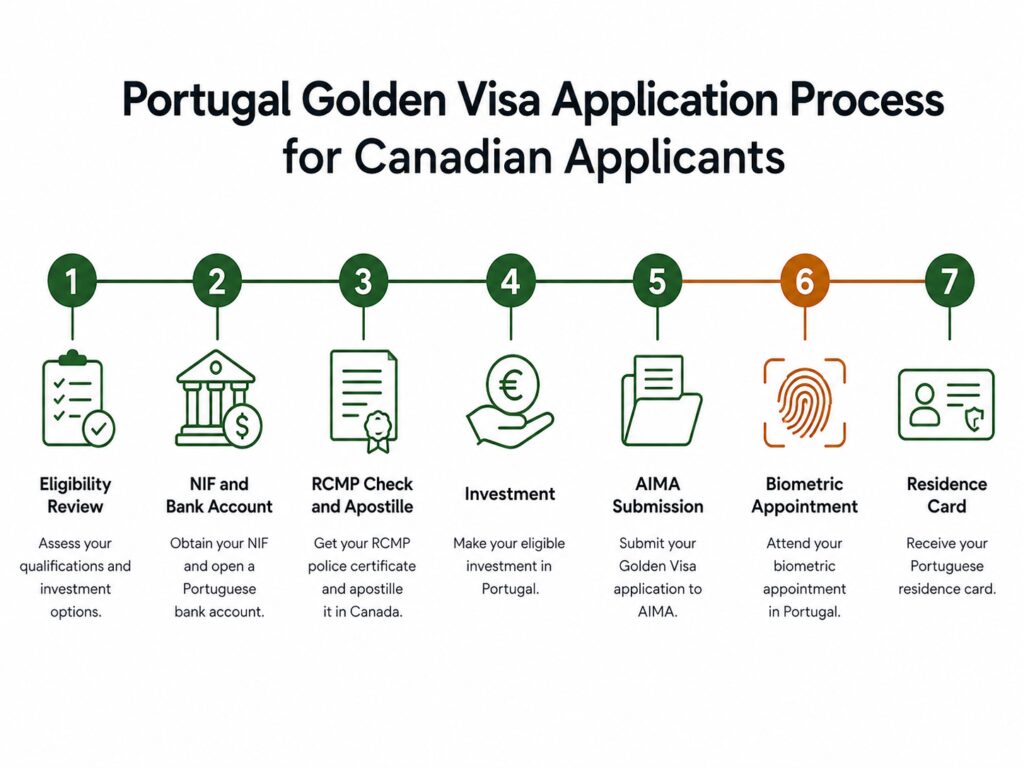
Here is the typical process:

  1. Confirm eligibility
    Review nationality, age, criminal record, investment capacity, family inclusion, and timing.
  2. Choose the investment route
    Most Canadian investors compare the fund route and cultural donation route first. The fund route is generally the most accessible for investors who want a regulated financial structure.
  3. Obtain a Portuguese NIF
    The Portuguese NIF is required for tax registration, banking, and investment onboarding.
  4. Open a Portuguese bank account
    The account supports the transfer of investment funds and payment of related costs.
  5. Prepare Canadian documents
    This includes the Canadian passport, RCMP criminal record check, apostille, civil documents, financial proof, and translations where required.
  6. Complete the qualifying investment
    For fund investors, this usually means subscribing to an eligible fund and obtaining confirmation of the investment.
  7. Submit the ARI application
    The application is submitted to AIMA with supporting documents and payment of government processing fees.
  8. Attend the biometric appointment
    The biometric appointment usually involves fingerprints, photographs, and identity confirmation.
  9. Receive the residence card
    Once approved, the applicant and qualifying family members receive residence permits.
  10. Maintain the investment and renewal obligations
    The investment must be maintained for the required period, and applicants must renew their residence permits as required.

For planning purposes, Canadians should also review the full cost breakdown before starting. The investment amount is only one part of the total cost. Government fees, legal fees, translations, apostilles, banking, tax advice, and travel should also be budgeted.
Portugal Golden Visa for Canadians step by step application process

FAQs: Portugal Golden Visa for Canadians

Can Canadians apply for the Portugal Golden Visa?

Yes. Canadians can apply because they are non-EU nationals, which is the core eligibility category for ARI. A Canadian passport is acceptable, provided the applicant meets the investment, documentation, health insurance, criminal record, and admissibility requirements. Family members may also be included if they qualify under the dependency rules.

What criminal record check do Canadians need?

Canadian applicants generally need an RCMP criminal record check, usually fingerprint-based, for the background check stage. The document may also need an apostille or authentication before it can be used in Portugal. Applicants should prepare this early because criminal record documents can expire or require reissue if the application timeline changes.

Are there investment funds that accept Canadian investors?

Yes, but not every fund is automatically suitable for every Canadian investor. Some funds may accept Canadian investors after completing onboarding, compliance, tax, and source-of-funds checks. Canadians should confirm fund eligibility, CMVM supervision, ARI suitability, and investor acceptance before transferring capital.

How does the Portugal Golden Visa affect Canadian tax obligations?

The Golden Visa does not automatically end Canadian tax residency or create Portuguese tax residency. Tax obligations depend on where the applicant is resident for tax purposes, how much time they spend in Portugal, what assets they hold, and how Canadian-source income is treated. Canadians should review the Canada-Portugal tax treaty, RRSPs, pensions, capital gains, and possible departure tax exposure with qualified advisors.

Is the Portugal Golden Visa Right for Canadian Investors?

The Portugal Golden Visa can be a strong option for Canadian investors who want EU residency, Schengen access, and a five-year pathway toward citizenship eligibility without immediately relocating. It is especially relevant for applicants who want a structured plan B residency and are comfortable with a €500,000 regulated investment route.

The key is preparation. Canadian applicants need to handle the RCMP criminal record check, apostille, source-of-funds file, Portuguese NIF, bank account, tax planning, and biometric appointment correctly. A weak document file can slow down an otherwise eligible application.

For Canadians comparing Portugal with other options, the most important question is not only “Can I apply?” It is “Which route fits my investment profile, tax position, and family plan?” Reviewing the process with advisors before moving funds is usually the safest first step.

Ready to take the next step?
Book a free initial assessment. We’ll assess your eligibility, walk through the current qualifying routes, and answer your questions, no cost, no commitment


Portugal Golden Visa for Canadians: Eligibility, Costs and How to Apply

The portugal golden visa for canadians is not a relocation-first visa. It is a residency-by-investment route for Canadian investors who want EU residency, Schengen mobility, and a potential path to Portuguese citizenship after five years without immediately moving their life from Canada.

For Canadians, the main questions are practical: eligibility, criminal record checks, proof of funds, tax exposure, and whether Portugal still accepts real estate. The short answer is clear: Canadian citizens can apply as non-EU nationals, but the application must be built carefully around documentation, investment compliance, and tax planning.

Can Canadians Get the Portugal Golden Visa?

Yes. Canadians can apply for Portugal’s Autorização de Residência para Investimento, usually referred to as ARI, if they meet the investment, documentation, and admissibility requirements. ARI is Portugal’s formal residence permit for investment activity.

Canadian applicants are treated as non-EU nationals, which is exactly the applicant category the programme is designed for. A Canadian passport can support the application, provided the applicant also submits the required criminal record check, financial proof, health insurance, and investment evidence.

The current golden visa in Portugal is no longer a real estate programme. Residential and most real estate acquisition routes were removed after the 2023 reform, so Canadians should focus on compliant fund, cultural, research, or business-related routes instead of relying on older online information.

According to the AIMA Official Portal, AIMA, the Agency for Integration, Migration and Asylum, processes ARI residence applications and lists the qualifying investment activities under the current framework.

Portugal Golden Visa for Canadians application documents in Lisbon office

Why Canada Is One of the Top Applicant Countries

Canada is a natural source of interest for Portugal’s Golden Visa because Canadian investors often want European optionality without giving up their Canadian base. The programme answers a very specific concern: long-term EU access without a full relocation requirement.

Canadian applicants usually fall into three groups:

Applicant profile Main motivation Typical concern
High-net-worth investors EU residency and citizenship pathway Fund regulation and capital protection
Family planners Children’s education and future mobility Dependent eligibility and timeline
Retirement planners Portugal as a future base Tax residency, pensions, and healthcare

Canada also has strong travel access already, but visa-free travel is not the same as residency. Canadians can visit Schengen countries for short stays, but a residence permit is required for a longer-term legal base in Portugal.

That distinction matters. The Golden Visa is not mainly about tourism. It is about building a legal residency position in Portugal while maintaining flexibility in Canada.

Portugal Golden Visa Requirements for Canadian Applicants

Canadian applicants must satisfy the same core eligibility rules as other non-EU investors, with a few Canada-specific documentation steps. The process starts with identity, admissibility, proof of funds, and a qualifying investment.

A typical Canadian applicant will need:

  • Valid Canadian passport
  • Portuguese NIF, which is the Portuguese tax identification number
  • Portuguese bank account
  • Proof of qualifying investment
  • RCMP criminal record check
  • Apostille for Canadian public documents where required
  • Health insurance
  • Financial proof showing legal source of funds
  • Application submission and biometric appointment through AIMA

For a deeper eligibility overview, see the full eligibility requirements before preparing the document file.

RCMP Criminal Record Check and Apostille

Canadian applicants usually need an RCMP criminal record check based on fingerprints. This document supports the background check stage and helps Portuguese authorities assess criminal admissibility.

Because the document is issued in Canada and used in Portugal, it normally requires proper authentication or apostille treatment. Canada is part of the Apostille Convention, and Global Affairs Canada explains that an apostille confirms the authenticity of the signature on a Canadian public document for use abroad.

In practice, applicants should plan this step early. Criminal record checks and apostille processing can create delays if names, dates, fingerprints, or document formats are inconsistent.

A clean document file should include:

  1. RCMP criminal record check
  2. Apostille or authentication where required
  3. Certified translation if requested
  4. Passport copy
  5. Proof of residence and civil status documents, if applicable

Proof of Funds from Canadian Accounts

Portugal’s Golden Visa is not approved simply because an applicant has wealth. The applicant must show that the investment funds are legal, traceable, and available.

For Canadians, financial proof may include:

  • Canadian bank statements
  • Investment account statements
  • Sale agreements for business or property proceeds
  • Tax returns or accountant letters
  • RRSP or pension-related documentation, where relevant
  • Evidence of transfer from Canada to Portugal

The goal is to create a clear paper trail. If CAD funds are converted into euros, the exchange route should also be documented.

This matters especially for the investment fund route, where the Portuguese bank, fund manager, compliance teams, and immigration advisors may all request source-of-funds evidence. A vague explanation is not enough. The file should show how the money was earned, held, transferred, and invested.

Health Insurance for Canadian Applicants

Canadian provincial healthcare does not automatically replace the need for health insurance in Portugal. Applicants should expect to provide coverage that is valid for Portugal and acceptable for the residence process.

Canadian applicants who do not intend to relocate immediately often use international private health insurance for the application stage. Those who later become tax residents or spend more time in Portugal may need to review their healthcare position more carefully.

Health insurance should be active, correctly named, and consistent with the applicant and dependent family members included in the ARI application.

Investment Options for Canadian Investors

Canadian applicants should focus on routes that remain legally available after the real estate changes. The most common route for investors is the fund route, but the cultural donation route may also be relevant in specific cases.

The choice depends on risk profile, liquidity expectations, family strategy, and whether the applicant wants a potentially recoverable investment or accepts a non-refundable contribution.

Portugal Golden Visa investment options for Canadian investors comparison

Fund Route Most Accessible for Canadians

The fund route is generally the most practical route for Canadian investors. It requires a minimum investment of €500,000 in eligible Portuguese investment funds that meet ARI requirements.

A qualifying fund must be structured under Portuguese law and supervised by CMVM, Portugal’s Securities Market Commission. The fund must also meet the programme’s requirements on maturity and Portuguese investment exposure.

Canadian investors should review Portugal Golden Visa investment fund options with attention to:

  • CMVM registration and supervision
  • Fund strategy and underlying assets
  • Minimum term and exit structure
  • Fees and subscription process
  • Whether the fund accepts Canadian investors
  • Tax reporting implications in Canada
  • Currency conversion from CAD to EUR

Some funds may have restrictions or additional onboarding questions for Canadian investors due to securities, compliance, and tax reporting considerations. This does not mean Canadians cannot use the fund route. It means the fund selection stage should be handled before the immigration timeline is built around it.

Portugal Golden Visa

Start Your Portugal Golden Visa Journey

Receive personalized legal guidance from experienced immigration lawyers and discover the most effective pathway to securing your Portugal Golden Visa.

Book Your Free Consultation →
✓ No Obligation   •   ✓ Licensed Lawyers   •   ✓ Confidential Consultation

Cultural Donation Route

The cultural donation route may be available through a qualifying contribution to artistic production, national heritage, or cultural preservation. It is generally structured as a non-refundable support contribution rather than an investment with expected capital return.

This route may appeal to applicants who want a simpler asset-management profile, but it is not necessarily easier. The recipient entity, purpose, documentation, and eligibility must still align with the ARI rules.

For Canadian investors, the cultural route should be reviewed carefully because:

  • The contribution is typically non-refundable
  • The applicant may not receive investment upside
  • Documentation must prove the qualifying nature of the support
  • Availability can depend on approved institutions and project structure
  • Tax treatment in Canada should be reviewed before proceeding

The fund route remains more common for Canadians who want a regulated financial asset. The cultural route may suit applicants who prioritise simplicity over capital recovery.

Tax Considerations for Canadians

The Portugal Golden Visa does not automatically make a Canadian applicant a Portuguese tax resident. Tax residency depends on facts such as days spent in Portugal, home availability, personal ties, and Canadian residence status.

This is one of the most important planning points. A residence permit and tax residency are related, but they are not the same thing.

Canadian applicants should review cross-border tax planning before investing, especially if they hold RRSPs, pensions, business shares, investment portfolios, rental property, or taxable capital gains in Canada.

Canada-Portugal Tax Treaty Overview

Canada and Portugal have a tax treaty designed to reduce double taxation and clarify how certain income is treated between both countries. The Canada Revenue Agency explains that tax treaties can define who is eligible for treaty benefits and may reduce withholding tax on certain categories of income.

For Canadians, this does not mean tax becomes simple. It means there is a legal framework to analyse.

Relevant income categories may include:

  • Dividends
  • Interest
  • Rental income
  • Pensions
  • Capital gains
  • Business income
  • Trust or estate income

A Canadian investor should not assume the Golden Visa itself changes Canadian tax obligations. If the applicant remains tax resident in Canada, Canadian reporting may continue. If the applicant later becomes non-resident of Canada, departure tax, withholding tax, and ongoing Canadian-source income rules may become relevant.

NHR Regime Eligibility for Canadians

NHR Portugal, the former Non-Habitual Resident regime, was a major planning point for many foreign residents. However, the classic NHR regime was repealed for new entrants from 2024, with transitional rules for people who qualified under specific conditions.

Some applicants may now examine newer Portuguese tax incentives, including the Tax Incentive for Scientific Research and Innovation, depending on their professional activity and eligibility. This is not a Golden Visa benefit by itself.

For Canadians, the correct sequence is:

  1. Decide whether you intend to become tax resident in Portugal
  2. Review whether any Portuguese tax incentive applies
  3. Check whether Canadian tax residency will continue
  4. Analyse treaty treatment
  5. Confirm reporting for Canadian assets and income

This should be done before relocating, not after the first Portuguese tax filing deadline appears.

Implications for RRSP and Canadian Pension

RRSPs, Canadian pensions, CPP, OAS, and private retirement income require careful planning. Canada may withhold tax on certain payments to non-residents, and treaty treatment may affect the rate or reporting method.

The Golden Visa itself does not force a Canadian applicant to withdraw an RRSP or move pension assets. However, if the applicant becomes Portuguese tax resident, Portugal may need to review foreign pension and investment income depending on the applicable rules at that time.

Canadian investors should also review:

  • RRSP withdrawals
  • RRIF conversion
  • CPP and OAS treatment
  • Pension withholding
  • Capital gains on non-registered portfolios
  • Canadian departure tax exposure
  • Portuguese tax residence timing

This is a tax planning issue, not an immigration formality. The best result usually comes from coordinating a Portuguese tax advisor with a Canadian cross-border tax specialist.

Step-by-Step Application Process for Canadians

The application process for Canadians follows the standard ARI structure, but the document preparation stage has Canada-specific steps.

Here is the typical process:

  1. Confirm eligibility
    Review nationality, age, criminal record, investment capacity, family inclusion, and timing.
  2. Choose the investment route
    Most Canadian investors compare the fund route and cultural donation route first. The fund route is generally the most accessible for investors who want a regulated financial structure.
  3. Obtain a Portuguese NIF
    The Portuguese NIF is required for tax registration, banking, and investment onboarding.
  4. Open a Portuguese bank account
    The account supports the transfer of investment funds and payment of related costs.
  5. Prepare Canadian documents
    This includes the Canadian passport, RCMP criminal record check, apostille, civil documents, financial proof, and translations where required.
  6. Complete the qualifying investment
    For fund investors, this usually means subscribing to an eligible fund and obtaining confirmation of the investment.
  7. Submit the ARI application
    The application is submitted to AIMA with supporting documents and payment of government processing fees.
  8. Attend the biometric appointment
    The biometric appointment usually involves fingerprints, photographs, and identity confirmation.
  9. Receive the residence card
    Once approved, the applicant and qualifying family members receive residence permits.
  10. Maintain the investment and renewal obligations
    The investment must be maintained for the required period, and applicants must renew their residence permits as required.

For planning purposes, Canadians should also review the full cost breakdown before starting. The investment amount is only one part of the total cost. Government fees, legal fees, translations, apostilles, banking, tax advice, and travel should also be budgeted.

Portugal Golden Visa for Canadians step by step application process

FAQs: Portugal Golden Visa for Canadians

Can Canadians apply for the Portugal Golden Visa?

Yes. Canadians can apply because they are non-EU nationals, which is the core eligibility category for ARI. A Canadian passport is acceptable, provided the applicant meets the investment, documentation, health insurance, criminal record, and admissibility requirements. Family members may also be included if they qualify under the dependency rules.

What criminal record check do Canadians need?

Canadian applicants generally need an RCMP criminal record check, usually fingerprint-based, for the background check stage. The document may also need an apostille or authentication before it can be used in Portugal. Applicants should prepare this early because criminal record documents can expire or require reissue if the application timeline changes.

Are there investment funds that accept Canadian investors?

Yes, but not every fund is automatically suitable for every Canadian investor. Some funds may accept Canadian investors after completing onboarding, compliance, tax, and source-of-funds checks. Canadians should confirm fund eligibility, CMVM supervision, ARI suitability, and investor acceptance before transferring capital.

How does the Portugal Golden Visa affect Canadian tax obligations?

The Golden Visa does not automatically end Canadian tax residency or create Portuguese tax residency. Tax obligations depend on where the applicant is resident for tax purposes, how much time they spend in Portugal, what assets they hold, and how Canadian-source income is treated. Canadians should review the Canada-Portugal tax treaty, RRSPs, pensions, capital gains, and possible departure tax exposure with qualified advisors.

Is the Portugal Golden Visa Right for Canadian Investors?

The Portugal Golden Visa can be a strong option for Canadian investors who want EU residency, Schengen access, and a five-year pathway toward citizenship eligibility without immediately relocating. It is especially relevant for applicants who want a structured plan B residency and are comfortable with a €500,000 regulated investment route.

The key is preparation. Canadian applicants need to handle the RCMP criminal record check, apostille, source-of-funds file, Portuguese NIF, bank account, tax planning, and biometric appointment correctly. A weak document file can slow down an otherwise eligible application.

For Canadians comparing Portugal with other options, the most important question is not only “Can I apply?” It is “Which route fits my investment profile, tax position, and family plan?” Reviewing the process with advisors before moving funds is usually the safest first step.

Ready to take the next step?
Book a free initial assessment. We’ll assess your eligibility, walk through the current qualifying routes, and answer your questions, no cost, no commitment

Portugal Golden Visa for Canadians: Eligibility, Costs and How to Apply

Portugal-Golden-Visa-for-Canadians-Eligibility-Costs-and-How-to-Apply
The portugal golden visa for canadians is not a relocation-first visa. It is a residency-by-investment route for Canadian investors who want EU residency, Schengen mobility, and a potential path to Portuguese citizenship after five years without immediately moving their life from Canada.

For Canadians, the main questions are practical: eligibility, criminal record checks, proof of funds, tax exposure, and whether Portugal still accepts real estate. The short answer is clear: Canadian citizens can apply as non-EU nationals, but the application must be built carefully around documentation, investment compliance, and tax planning.

Can Canadians Get the Portugal Golden Visa?

Yes. Canadians can apply for Portugal’s Autorização de Residência para Investimento, usually referred to as ARI, if they meet the investment, documentation, and admissibility requirements. ARI is Portugal’s formal residence permit for investment activity.

Canadian applicants are treated as non-EU nationals, which is exactly the applicant category the programme is designed for. A Canadian passport can support the application, provided the applicant also submits the required criminal record check, financial proof, health insurance, and investment evidence.

The current golden visa in Portugal is no longer a real estate programme. Residential and most real estate acquisition routes were removed after the 2023 reform, so Canadians should focus on compliant fund, cultural, research, or business-related routes instead of relying on older online information.

According to the AIMA Official Portal, AIMA, the Agency for Integration, Migration and Asylum, processes ARI residence applications and lists the qualifying investment activities under the current framework.

Portugal Golden Visa for Canadians application documents in Lisbon office

Why Canada Is One of the Top Applicant Countries

Canada is a natural source of interest for Portugal’s Golden Visa because Canadian investors often want European optionality without giving up their Canadian base. The programme answers a very specific concern: long-term EU access without a full relocation requirement.

Canadian applicants usually fall into three groups:

Applicant profile Main motivation Typical concern
High-net-worth investors EU residency and citizenship pathway Fund regulation and capital protection
Family planners Children’s education and future mobility Dependent eligibility and timeline
Retirement planners Portugal as a future base Tax residency, pensions, and healthcare

Canada also has strong travel access already, but visa-free travel is not the same as residency. Canadians can visit Schengen countries for short stays, but a residence permit is required for a longer-term legal base in Portugal.

That distinction matters. The Golden Visa is not mainly about tourism. It is about building a legal residency position in Portugal while maintaining flexibility in Canada.

Portugal Golden Visa Requirements for Canadian Applicants

Canadian applicants must satisfy the same core eligibility rules as other non-EU investors, with a few Canada-specific documentation steps. The process starts with identity, admissibility, proof of funds, and a qualifying investment.

A typical Canadian applicant will need:

  • Valid Canadian passport
  • Portuguese NIF, which is the Portuguese tax identification number
  • Portuguese bank account
  • Proof of qualifying investment
  • RCMP criminal record check
  • Apostille for Canadian public documents where required
  • Health insurance
  • Financial proof showing legal source of funds
  • Application submission and biometric appointment through AIMA

For a deeper eligibility overview, see the full eligibility requirements before preparing the document file.

RCMP Criminal Record Check and Apostille

Canadian applicants usually need an RCMP criminal record check based on fingerprints. This document supports the background check stage and helps Portuguese authorities assess criminal admissibility.

Because the document is issued in Canada and used in Portugal, it normally requires proper authentication or apostille treatment. Canada is part of the Apostille Convention, and Global Affairs Canada explains that an apostille confirms the authenticity of the signature on a Canadian public document for use abroad.

In practice, applicants should plan this step early. Criminal record checks and apostille processing can create delays if names, dates, fingerprints, or document formats are inconsistent.

A clean document file should include:

  1. RCMP criminal record check
  2. Apostille or authentication where required
  3. Certified translation if requested
  4. Passport copy
  5. Proof of residence and civil status documents, if applicable

Proof of Funds from Canadian Accounts

Portugal’s Golden Visa is not approved simply because an applicant has wealth. The applicant must show that the investment funds are legal, traceable, and available.

For Canadians, financial proof may include:

  • Canadian bank statements
  • Investment account statements
  • Sale agreements for business or property proceeds
  • Tax returns or accountant letters
  • RRSP or pension-related documentation, where relevant
  • Evidence of transfer from Canada to Portugal

The goal is to create a clear paper trail. If CAD funds are converted into euros, the exchange route should also be documented.

This matters especially for the investment fund route, where the Portuguese bank, fund manager, compliance teams, and immigration advisors may all request source-of-funds evidence. A vague explanation is not enough. The file should show how the money was earned, held, transferred, and invested.

Health Insurance for Canadian Applicants

Canadian provincial healthcare does not automatically replace the need for health insurance in Portugal. Applicants should expect to provide coverage that is valid for Portugal and acceptable for the residence process.

Canadian applicants who do not intend to relocate immediately often use international private health insurance for the application stage. Those who later become tax residents or spend more time in Portugal may need to review their healthcare position more carefully.

Health insurance should be active, correctly named, and consistent with the applicant and dependent family members included in the ARI application.

Investment Options for Canadian Investors

Canadian applicants should focus on routes that remain legally available after the real estate changes. The most common route for investors is the fund route, but the cultural donation route may also be relevant in specific cases.

The choice depends on risk profile, liquidity expectations, family strategy, and whether the applicant wants a potentially recoverable investment or accepts a non-refundable contribution.

Portugal Golden Visa investment options for Canadian investors comparison

Fund Route Most Accessible for Canadians

The fund route is generally the most practical route for Canadian investors. It requires a minimum investment of €500,000 in eligible Portuguese investment funds that meet ARI requirements.

A qualifying fund must be structured under Portuguese law and supervised by CMVM, Portugal’s Securities Market Commission. The fund must also meet the programme’s requirements on maturity and Portuguese investment exposure.

Canadian investors should review Portugal Golden Visa investment fund options with attention to:

  • CMVM registration and supervision
  • Fund strategy and underlying assets
  • Minimum term and exit structure
  • Fees and subscription process
  • Whether the fund accepts Canadian investors
  • Tax reporting implications in Canada
  • Currency conversion from CAD to EUR

Some funds may have restrictions or additional onboarding questions for Canadian investors due to securities, compliance, and tax reporting considerations. This does not mean Canadians cannot use the fund route. It means the fund selection stage should be handled before the immigration timeline is built around it.

Portugal Golden Visa

Start Your Portugal Golden Visa Journey

Receive personalized legal guidance from experienced immigration lawyers and discover the most effective pathway to securing your Portugal Golden Visa.

Book Your Free Consultation →
✓ No Obligation   •   ✓ Licensed Lawyers   •   ✓ Confidential Consultation

Cultural Donation Route

The cultural donation route may be available through a qualifying contribution to artistic production, national heritage, or cultural preservation. It is generally structured as a non-refundable support contribution rather than an investment with expected capital return.

This route may appeal to applicants who want a simpler asset-management profile, but it is not necessarily easier. The recipient entity, purpose, documentation, and eligibility must still align with the ARI rules.

For Canadian investors, the cultural route should be reviewed carefully because:

  • The contribution is typically non-refundable
  • The applicant may not receive investment upside
  • Documentation must prove the qualifying nature of the support
  • Availability can depend on approved institutions and project structure
  • Tax treatment in Canada should be reviewed before proceeding

The fund route remains more common for Canadians who want a regulated financial asset. The cultural route may suit applicants who prioritise simplicity over capital recovery.

Tax Considerations for Canadians

The Portugal Golden Visa does not automatically make a Canadian applicant a Portuguese tax resident. Tax residency depends on facts such as days spent in Portugal, home availability, personal ties, and Canadian residence status.

This is one of the most important planning points. A residence permit and tax residency are related, but they are not the same thing.

Canadian applicants should review cross-border tax planning before investing, especially if they hold RRSPs, pensions, business shares, investment portfolios, rental property, or taxable capital gains in Canada.

Canada-Portugal Tax Treaty Overview

Canada and Portugal have a tax treaty designed to reduce double taxation and clarify how certain income is treated between both countries. The Canada Revenue Agency explains that tax treaties can define who is eligible for treaty benefits and may reduce withholding tax on certain categories of income.

For Canadians, this does not mean tax becomes simple. It means there is a legal framework to analyse.

Relevant income categories may include:

  • Dividends
  • Interest
  • Rental income
  • Pensions
  • Capital gains
  • Business income
  • Trust or estate income

A Canadian investor should not assume the Golden Visa itself changes Canadian tax obligations. If the applicant remains tax resident in Canada, Canadian reporting may continue. If the applicant later becomes non-resident of Canada, departure tax, withholding tax, and ongoing Canadian-source income rules may become relevant.

NHR Regime Eligibility for Canadians

NHR Portugal, the former Non-Habitual Resident regime, was a major planning point for many foreign residents. However, the classic NHR regime was repealed for new entrants from 2024, with transitional rules for people who qualified under specific conditions.

Some applicants may now examine newer Portuguese tax incentives, including the Tax Incentive for Scientific Research and Innovation, depending on their professional activity and eligibility. This is not a Golden Visa benefit by itself.

For Canadians, the correct sequence is:

  1. Decide whether you intend to become tax resident in Portugal
  2. Review whether any Portuguese tax incentive applies
  3. Check whether Canadian tax residency will continue
  4. Analyse treaty treatment
  5. Confirm reporting for Canadian assets and income

This should be done before relocating, not after the first Portuguese tax filing deadline appears.

Implications for RRSP and Canadian Pension

RRSPs, Canadian pensions, CPP, OAS, and private retirement income require careful planning. Canada may withhold tax on certain payments to non-residents, and treaty treatment may affect the rate or reporting method.

The Golden Visa itself does not force a Canadian applicant to withdraw an RRSP or move pension assets. However, if the applicant becomes Portuguese tax resident, Portugal may need to review foreign pension and investment income depending on the applicable rules at that time.

Canadian investors should also review:

  • RRSP withdrawals
  • RRIF conversion
  • CPP and OAS treatment
  • Pension withholding
  • Capital gains on non-registered portfolios
  • Canadian departure tax exposure
  • Portuguese tax residence timing

This is a tax planning issue, not an immigration formality. The best result usually comes from coordinating a Portuguese tax advisor with a Canadian cross-border tax specialist.

Step-by-Step Application Process for Canadians

The application process for Canadians follows the standard ARI structure, but the document preparation stage has Canada-specific steps.

Here is the typical process:

  1. Confirm eligibility
    Review nationality, age, criminal record, investment capacity, family inclusion, and timing.
  2. Choose the investment route
    Most Canadian investors compare the fund route and cultural donation route first. The fund route is generally the most accessible for investors who want a regulated financial structure.
  3. Obtain a Portuguese NIF
    The Portuguese NIF is required for tax registration, banking, and investment onboarding.
  4. Open a Portuguese bank account
    The account supports the transfer of investment funds and payment of related costs.
  5. Prepare Canadian documents
    This includes the Canadian passport, RCMP criminal record check, apostille, civil documents, financial proof, and translations where required.
  6. Complete the qualifying investment
    For fund investors, this usually means subscribing to an eligible fund and obtaining confirmation of the investment.
  7. Submit the ARI application
    The application is submitted to AIMA with supporting documents and payment of government processing fees.
  8. Attend the biometric appointment
    The biometric appointment usually involves fingerprints, photographs, and identity confirmation.
  9. Receive the residence card
    Once approved, the applicant and qualifying family members receive residence permits.
  10. Maintain the investment and renewal obligations
    The investment must be maintained for the required period, and applicants must renew their residence permits as required.

For planning purposes, Canadians should also review the full cost breakdown before starting. The investment amount is only one part of the total cost. Government fees, legal fees, translations, apostilles, banking, tax advice, and travel should also be budgeted.

Portugal Golden Visa for Canadians step by step application process

FAQs: Portugal Golden Visa for Canadians

Can Canadians apply for the Portugal Golden Visa?

Yes. Canadians can apply because they are non-EU nationals, which is the core eligibility category for ARI. A Canadian passport is acceptable, provided the applicant meets the investment, documentation, health insurance, criminal record, and admissibility requirements. Family members may also be included if they qualify under the dependency rules.

What criminal record check do Canadians need?

Canadian applicants generally need an RCMP criminal record check, usually fingerprint-based, for the background check stage. The document may also need an apostille or authentication before it can be used in Portugal. Applicants should prepare this early because criminal record documents can expire or require reissue if the application timeline changes.

Are there investment funds that accept Canadian investors?

Yes, but not every fund is automatically suitable for every Canadian investor. Some funds may accept Canadian investors after completing onboarding, compliance, tax, and source-of-funds checks. Canadians should confirm fund eligibility, CMVM supervision, ARI suitability, and investor acceptance before transferring capital.

How does the Portugal Golden Visa affect Canadian tax obligations?

The Golden Visa does not automatically end Canadian tax residency or create Portuguese tax residency. Tax obligations depend on where the applicant is resident for tax purposes, how much time they spend in Portugal, what assets they hold, and how Canadian-source income is treated. Canadians should review the Canada-Portugal tax treaty, RRSPs, pensions, capital gains, and possible departure tax exposure with qualified advisors.

Is the Portugal Golden Visa Right for Canadian Investors?

The Portugal Golden Visa can be a strong option for Canadian investors who want EU residency, Schengen access, and a five-year pathway toward citizenship eligibility without immediately relocating. It is especially relevant for applicants who want a structured plan B residency and are comfortable with a €500,000 regulated investment route.

The key is preparation. Canadian applicants need to handle the RCMP criminal record check, apostille, source-of-funds file, Portuguese NIF, bank account, tax planning, and biometric appointment correctly. A weak document file can slow down an otherwise eligible application.

For Canadians comparing Portugal with other options, the most important question is not only “Can I apply?” It is “Which route fits my investment profile, tax position, and family plan?” Reviewing the process with advisors before moving funds is usually the safest first step.

Ready to take the next step?
Book a free initial assessment. We’ll assess your eligibility, walk through the current qualifying routes, and answer your questions, no cost, no commitment

What do you think?
Blog

More Related Articles

top








