
Portugal golden visa

Portugal Citizenship Requirements After Golden Visa: Language Test and Application

Portugal citizenship requirements after the Golden Visa changed significantly in 2026. The route is still possible, but investors now need to understand the updated legal residency period, the A2 Portuguese language requirement, the IRN application process, and the documents that prove eligibility.

For Golden Visa holders, citizenship is not automatic. The ARI, short for Autorização de Residência para Investimento, gives legal residence first. Citizenship comes later, through a separate naturalization application handled by the IRN Civil Registry.

This guide explains what changed, what remains required, and how to prepare a complete citizenship file without relying on outdated five-year assumptions.

Portugal Citizenship Requirements for Golden Visa Holders

Golden Visa holders apply for Portuguese citizenship through naturalization. That means the applicant must meet the general naturalization requirements under Portuguese nationality law, not just maintain the Golden Visa permit.

The most important point is timing. Portugal’s nationality framework was amended by Law 37/81 as updated by Lei Orgânica n.º 1/2026. Under the updated law, the general legal residence period is now longer than the previous five-year pathway for many applicants.

Requirement What the applicant must show
Legal residency period Valid residence under the applicable nationality rules
Language ability Sufficient Portuguese language and cultural knowledge, usually through A2 certification
Criminal record No disqualifying criminal history under Portuguese standards
Community connection Evidence of integration, lawful residence, and compliance
Application file Correct civil, identity, residence, and criminal record documents

For a broader overview of the route from residence to citizenship, see this full citizenship pathway guide. The key point is simple: the Golden Visa opens the door to residence, but citizenship requires a separate legal analysis.

Continuous Legal Residency

Continuous legal residency means the applicant has held lawful residence in Portugal for the period required by the nationality law in force at the time of application.

Before the 2026 amendment, many investors planned around a five-year citizenship timeline. After the 2026 change, the general rule now requires:

  • 7 years of legal residence for nationals of Portuguese-speaking countries and EU Member States
  • 10 years of legal residence for nationals of other countries
  • Protection for administrative citizenship procedures already pending before the new law entered into force, where the previous law may apply

Because this is a major change, applicants should review their position before assuming they qualify. The official amendment to Law 37/81 was published in the Portuguese Diário da República, and the transitional rules matter for anyone close to filing.

This is also why updated planning is essential. A Golden Visa holder who started the process years ago may be in a different position from a new applicant entering the programme in 2026.

Clean Criminal Record in Portugal and Home Country

A clean criminal record is one of the core naturalization requirements. In practical terms, the applicant must show that there are no disqualifying convictions under Portuguese law.

Most applicants should prepare criminal record certificates from:

  • Portugal
  • Country of nationality
  • Country of birth, if different and requested
  • Countries where they have lived for a relevant period

Foreign criminal record certificates usually need legalization or apostille, depending on the issuing country. If the document is not in Portuguese, a certified translation may also be required.

This requirement should not be treated as a final-week task. Criminal record certificates can expire, take time to obtain, and require careful sequencing with translation and apostille.

Ties to the Portuguese Community

Ties to Portugal are not only about spending long periods in the country. Golden Visa holders often meet the residency obligation with limited physical presence, but citizenship asks a broader question: does the file show a genuine, lawful, and credible connection to Portugal?

Useful evidence may include:

  • Valid residence permits and renewals
  • Portuguese NIF and tax records
  • Proof of visits and address history
  • Language test certificate
  • Family records, if dependents are included in the broader plan
  • Evidence of compliance with legal and administrative obligations

The standard is not the same for every applicant. Nationality applications are reviewed individually, and the strength of the file matters.

The A2 Portuguese Language Requirement

The language requirement is one of the parts investors can prepare for early. It is also one of the easiest to underestimate.

The Portuguese citizenship language test is not designed to test advanced fluency. It checks whether the applicant can communicate at a basic level and show enough knowledge of Portuguese language and culture for naturalization.

What the A2 Level Covers

The A2 language test Portugal applicants usually prepare for is based on basic communication. At this level, the applicant should be able to understand and use simple Portuguese in everyday situations.

A2 normally covers:

  • Basic personal introductions
  • Simple questions and answers
  • Everyday vocabulary
  • Short written texts
  • Listening comprehension
  • Basic spoken interaction

For investors who do not live full-time in Portugal, preparation should start early. The minimum stay requirement for the Golden Visa may be low, but the language requirement still needs real preparation.
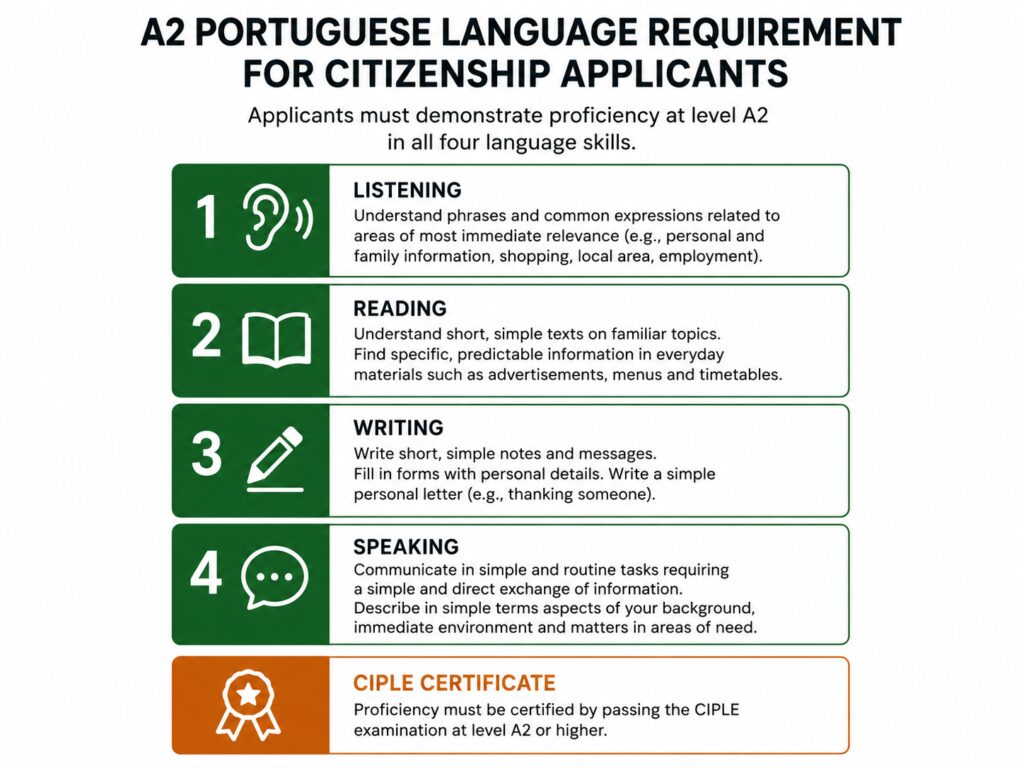
A2 Portuguese language test for Portugal citizenship requirements

CIPLE: The Official Certification Exam

CIPLE, short for Certificado Inicial de Português Língua Estrangeira, is the common official exam used to prove A2 Portuguese for citizenship. It is administered through CAPLE, the Centre for Evaluation and Certification of Portuguese as a Foreign Language at the University of Lisbon.

CAPLE states that CIPLE corresponds to A2 level under the Common European Framework of Reference for Languages. Applicants can check the exam description and registration details through CAPLE Official Language Testing.

The CIPLE test is usually the most practical option for Golden Visa holders because it is designed for non-native speakers and is widely recognized for nationality purposes.

FREE LEGAL CONSULTATION

Have a Quick Question?

Our legal team is available Monday–Friday to answer your Portugal Golden Visa questions and help you understand your next steps.

Book Your Free Consultation Message Us on WhatsApp

Approved International Testing Centers

Applicants do not always need to take the exam in Portugal. CAPLE exams are offered through authorized LAPE centers, which are official testing locations for Portuguese as a foreign language.

The availability of exam levels, dates, and seats varies by center. CAPLE notes that each LAPE decides which exams it offers and how many seats are available, so applicants should confirm directly with the selected center before planning travel.

This matters for high-net-worth investors who travel frequently. A missed deadline or fully booked test center can delay the citizenship application more than expected.

How to Prepare: Resources and Courses

Preparation depends on the applicant’s starting level. Someone with prior exposure to Portuguese may need a short structured course. Someone starting from zero should allow several months.

A practical preparation plan includes:

  1. Take a placement test before choosing a course.
  2. Study European Portuguese, not Brazilian Portuguese, if preparing for CIPLE.
  3. Practice listening and speaking early, not only grammar.
  4. Complete mock exams before booking the real test.
  5. Keep the certificate safely once issued.

The language requirement is manageable, but it is not a box to tick at the last minute. Most applicants should begin preparation at least one year before they expect to file for citizenship.

The Citizenship Application Process

The citizenship application process is handled separately from the Golden Visa residence process. AIMA, the Agency for Integration, Migration and Asylum, handles immigration residence matters. The citizenship file is handled through IRN, the Institute of Registries and Notary.

For investors, this distinction matters. A valid Golden Visa residence card does not mean the citizenship application is ready. The file must prove eligibility under nationality law.

Gathering All Required Documents

A citizenship application file usually includes civil records, identity documents, proof of residence, language proof, and criminal record certificates.

The core document list often includes:

  • Valid passport copy
  • Birth certificate
  • Residence permit evidence
  • Proof of legal residency period
  • A2 Portuguese language certificate, usually CIPLE
  • Criminal record certificate from Portugal
  • Criminal record certificate from the country of nationality
  • Criminal record certificates from other relevant countries
  • Apostille or legalization for foreign documents
  • Certified translations where required
  • Power of attorney, if a lawyer submits the application

Document quality matters. A scan that is unclear, incomplete, expired, or not properly apostilled can slow the file.

Applicants should also confirm whether their civil documents need to be recently issued. Some registry offices and authorities prefer recent certificates, even where the underlying fact has not changed.

Submitting Through the IRN Online Portal

Nationality applications can be submitted online by qualified Portuguese lawyers and solicitors. The public information page for the IRN Citizenship Application Portal explains that the online nationality service is intended for legal professionals representing applicants.

This is why many Golden Visa holders work with counsel at the citizenship stage. The lawyer can prepare the digital file, submit the documents, pay the relevant fee, and monitor the case status.

Applicants without a lawyer may still have alternative filing routes, such as mail or in-person submission at an appropriate nationality desk. However, professional submission is often more efficient for investors with international documents and complex residence histories.

Typical IRN Processing Times

There is no single guaranteed processing time for Portuguese citizenship applications. IRN processing depends on workload, document completeness, nationality basis, background checks, and whether the file receives requests for clarification.

Applicants should expect the process to move in stages:

Stage What happens
Submission File is lodged with IRN or through the online professional portal
Initial review IRN checks whether the documents are complete and readable
Legal assessment Eligibility is reviewed under the relevant nationality basis
Background checks Criminal record and security checks are considered
Decision and registration If approved, nationality is registered and civil status is updated

The best way to reduce delay is not to guess timelines. The better approach is to file a complete, clean, properly translated, and properly apostilled application.
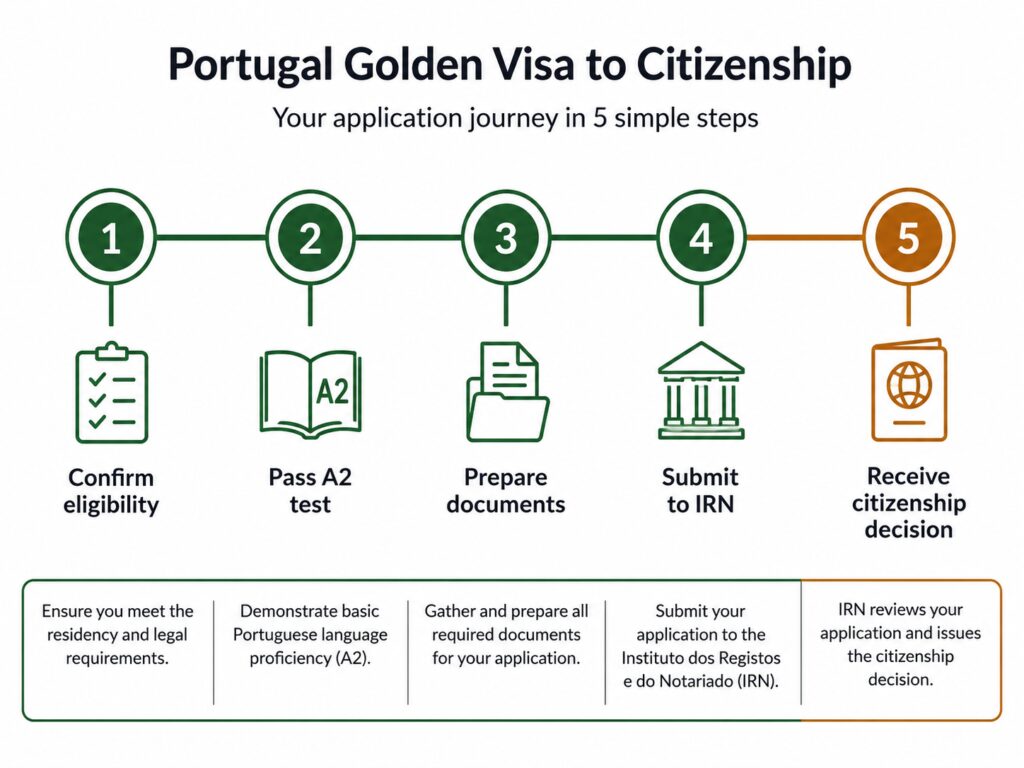
Portugal citizenship application process after Golden Visa

Dual Citizenship: Portugal Rules

Portugal allows dual citizenship. In most cases, applicants do not need to give up their existing nationality when they become Portuguese citizens.

That said, the applicant must also check the rules of their current country of citizenship. Portugal may allow dual citizenship, but some countries restrict it, require notification, or impose consequences on citizens who acquire another nationality.

For Golden Visa families, dual citizenship is often one of the strongest long-term benefits. It can allow the main applicant and qualifying family members to keep their existing passport while adding Portuguese citizenship, subject to eligibility and each family member’s own application position.

This is one reason the portugal citizenship stage should be planned years before the filing date. The legal residence period, language test, and document preparation should be part of the original residency strategy.

What Portuguese Citizenship Gives You

Portuguese citizenship gives more than residence. It gives the rights of a Portuguese national and, by extension, EU citizenship.

The main benefits include:

  • Portuguese passport eligibility
  • EU citizenship rights
  • Right to live, work, and study in Portugal
  • Broader mobility and settlement rights within the European Union
  • Long-term family security
  • Access to Portuguese consular protection abroad
  • A stronger succession and relocation planning tool for many families

For investors, the EU passport is often the final objective. The Golden Visa is the residence structure that can support that objective, but citizenship requires its own preparation.

The biggest mistake is waiting until the end of the residence period to begin. The better approach is to prepare the language certificate, document strategy, and nationality law review early.

Given the 2026 changes, applicants should also review whether they are affected by the extended legal residency period. For a detailed discussion of this change, see our guide to citizenship timeline changes.

FAQs: Portuguese Citizenship After the Golden Visa

What language test do I need for Portuguese citizenship?

Most applicants use the CIPLE exam, which certifies A2 Portuguese. CIPLE is administered through CAPLE and is commonly used to prove the language requirement for naturalization. Some applicants may have alternative recognized proof, but CIPLE is the standard route for many Golden Visa holders.

Where can I take the A2 test outside Portugal?

You can take the A2 test at approved CAPLE examination centers outside Portugal, depending on availability. These centers are known as LAPE centers. Each center decides which exam levels and dates it offers, so you should confirm CIPLE availability directly before booking travel or planning your filing date.

What documents do I need to apply for citizenship?

You usually need a valid passport, birth certificate, residence permit evidence, proof of legal residence, A2 language certificate, criminal record certificates, and any required apostilles or certified translations. The exact list depends on your nationality, residence history, family circumstances, and the legal basis of your application. A lawyer should review the file before submission to avoid missing or expired documents.

How long does the citizenship application process take?

There is no fixed guaranteed processing time. IRN processing depends on workload, document quality, background checks, and whether the file needs clarification. Applicants should plan for a multi-stage process and prepare documents carefully before submission.

Is Portuguese Citizenship After the Golden Visa Right for You?

Portuguese citizenship can be a strong long-term objective for Golden Visa investors, but it should not be treated as automatic. The residence permit, language requirement, criminal record checks, and IRN application all need planning.

The 2026 nationality law change makes this even more important. Investors who previously planned around a five-year citizenship timeline should confirm whether the old or new rules apply to their situation before making decisions.

A well-prepared citizenship strategy starts early. Confirm the legal residency period, prepare for the A2 language test, keep residence records organized, and build a complete document file before the application window opens.

Ready to take the next step?
Book a free initial assessment. We’ll assess your eligibility, walk through the current qualifying routes, and answer your questions — no cost, no commitment. 

Portugal Citizenship Requirements After Golden Visa: Language Test and Application

Portugal citizenship requirements after the Golden Visa changed significantly in 2026. The route is still possible, but investors now need to understand the updated legal residency period, the A2 Portuguese language requirement, the IRN application process, and the documents that prove eligibility.

For Golden Visa holders, citizenship is not automatic. The ARI, short for Autorização de Residência para Investimento, gives legal residence first. Citizenship comes later, through a separate naturalization application handled by the IRN Civil Registry.

This guide explains what changed, what remains required, and how to prepare a complete citizenship file without relying on outdated five-year assumptions.

Portugal Citizenship Requirements for Golden Visa Holders

Golden Visa holders apply for Portuguese citizenship through naturalization. That means the applicant must meet the general naturalization requirements under Portuguese nationality law, not just maintain the Golden Visa permit.

The most important point is timing. Portugal’s nationality framework was amended by Law 37/81 as updated by Lei Orgânica n.º 1/2026. Under the updated law, the general legal residence period is now longer than the previous five-year pathway for many applicants.

Requirement What the applicant must show
Legal residency period Valid residence under the applicable nationality rules
Language ability Sufficient Portuguese language and cultural knowledge, usually through A2 certification
Criminal record No disqualifying criminal history under Portuguese standards
Community connection Evidence of integration, lawful residence, and compliance
Application file Correct civil, identity, residence, and criminal record documents

For a broader overview of the route from residence to citizenship, see this full citizenship pathway guide. The key point is simple: the Golden Visa opens the door to residence, but citizenship requires a separate legal analysis.

Continuous Legal Residency

Continuous legal residency means the applicant has held lawful residence in Portugal for the period required by the nationality law in force at the time of application.

Before the 2026 amendment, many investors planned around a five-year citizenship timeline. After the 2026 change, the general rule now requires:

  • 7 years of legal residence for nationals of Portuguese-speaking countries and EU Member States
  • 10 years of legal residence for nationals of other countries
  • Protection for administrative citizenship procedures already pending before the new law entered into force, where the previous law may apply

Because this is a major change, applicants should review their position before assuming they qualify. The official amendment to Law 37/81 was published in the Portuguese Diário da República, and the transitional rules matter for anyone close to filing.

This is also why updated planning is essential. A Golden Visa holder who started the process years ago may be in a different position from a new applicant entering the programme in 2026.

Clean Criminal Record in Portugal and Home Country

A clean criminal record is one of the core naturalization requirements. In practical terms, the applicant must show that there are no disqualifying convictions under Portuguese law.

Most applicants should prepare criminal record certificates from:

  • Portugal
  • Country of nationality
  • Country of birth, if different and requested
  • Countries where they have lived for a relevant period

Foreign criminal record certificates usually need legalization or apostille, depending on the issuing country. If the document is not in Portuguese, a certified translation may also be required.

This requirement should not be treated as a final-week task. Criminal record certificates can expire, take time to obtain, and require careful sequencing with translation and apostille.

Ties to the Portuguese Community

Ties to Portugal are not only about spending long periods in the country. Golden Visa holders often meet the residency obligation with limited physical presence, but citizenship asks a broader question: does the file show a genuine, lawful, and credible connection to Portugal?

Useful evidence may include:

  • Valid residence permits and renewals
  • Portuguese NIF and tax records
  • Proof of visits and address history
  • Language test certificate
  • Family records, if dependents are included in the broader plan
  • Evidence of compliance with legal and administrative obligations

The standard is not the same for every applicant. Nationality applications are reviewed individually, and the strength of the file matters.

The A2 Portuguese Language Requirement

The language requirement is one of the parts investors can prepare for early. It is also one of the easiest to underestimate.

The Portuguese citizenship language test is not designed to test advanced fluency. It checks whether the applicant can communicate at a basic level and show enough knowledge of Portuguese language and culture for naturalization.

What the A2 Level Covers

The A2 language test Portugal applicants usually prepare for is based on basic communication. At this level, the applicant should be able to understand and use simple Portuguese in everyday situations.

A2 normally covers:

  • Basic personal introductions
  • Simple questions and answers
  • Everyday vocabulary
  • Short written texts
  • Listening comprehension
  • Basic spoken interaction

For investors who do not live full-time in Portugal, preparation should start early. The minimum stay requirement for the Golden Visa may be low, but the language requirement still needs real preparation.

A2 Portuguese language test for Portugal citizenship requirements

CIPLE: The Official Certification Exam

CIPLE, short for Certificado Inicial de Português Língua Estrangeira, is the common official exam used to prove A2 Portuguese for citizenship. It is administered through CAPLE, the Centre for Evaluation and Certification of Portuguese as a Foreign Language at the University of Lisbon.

CAPLE states that CIPLE corresponds to A2 level under the Common European Framework of Reference for Languages. Applicants can check the exam description and registration details through CAPLE Official Language Testing.

The CIPLE test is usually the most practical option for Golden Visa holders because it is designed for non-native speakers and is widely recognized for nationality purposes.

FREE LEGAL CONSULTATION

Have a Quick Question?

Our legal team is available Monday–Friday to answer your Portugal Golden Visa questions and help you understand your next steps.

Book Your Free Consultation Message Us on WhatsApp

Approved International Testing Centers

Applicants do not always need to take the exam in Portugal. CAPLE exams are offered through authorized LAPE centers, which are official testing locations for Portuguese as a foreign language.

The availability of exam levels, dates, and seats varies by center. CAPLE notes that each LAPE decides which exams it offers and how many seats are available, so applicants should confirm directly with the selected center before planning travel.

This matters for high-net-worth investors who travel frequently. A missed deadline or fully booked test center can delay the citizenship application more than expected.

How to Prepare: Resources and Courses

Preparation depends on the applicant’s starting level. Someone with prior exposure to Portuguese may need a short structured course. Someone starting from zero should allow several months.

A practical preparation plan includes:

  1. Take a placement test before choosing a course.
  2. Study European Portuguese, not Brazilian Portuguese, if preparing for CIPLE.
  3. Practice listening and speaking early, not only grammar.
  4. Complete mock exams before booking the real test.
  5. Keep the certificate safely once issued.

The language requirement is manageable, but it is not a box to tick at the last minute. Most applicants should begin preparation at least one year before they expect to file for citizenship.

The Citizenship Application Process

The citizenship application process is handled separately from the Golden Visa residence process. AIMA, the Agency for Integration, Migration and Asylum, handles immigration residence matters. The citizenship file is handled through IRN, the Institute of Registries and Notary.

For investors, this distinction matters. A valid Golden Visa residence card does not mean the citizenship application is ready. The file must prove eligibility under nationality law.

Gathering All Required Documents

A citizenship application file usually includes civil records, identity documents, proof of residence, language proof, and criminal record certificates.

The core document list often includes:

  • Valid passport copy
  • Birth certificate
  • Residence permit evidence
  • Proof of legal residency period
  • A2 Portuguese language certificate, usually CIPLE
  • Criminal record certificate from Portugal
  • Criminal record certificate from the country of nationality
  • Criminal record certificates from other relevant countries
  • Apostille or legalization for foreign documents
  • Certified translations where required
  • Power of attorney, if a lawyer submits the application

Document quality matters. A scan that is unclear, incomplete, expired, or not properly apostilled can slow the file.

Applicants should also confirm whether their civil documents need to be recently issued. Some registry offices and authorities prefer recent certificates, even where the underlying fact has not changed.

Submitting Through the IRN Online Portal

Nationality applications can be submitted online by qualified Portuguese lawyers and solicitors. The public information page for the IRN Citizenship Application Portal explains that the online nationality service is intended for legal professionals representing applicants.

This is why many Golden Visa holders work with counsel at the citizenship stage. The lawyer can prepare the digital file, submit the documents, pay the relevant fee, and monitor the case status.

Applicants without a lawyer may still have alternative filing routes, such as mail or in-person submission at an appropriate nationality desk. However, professional submission is often more efficient for investors with international documents and complex residence histories.

Typical IRN Processing Times

There is no single guaranteed processing time for Portuguese citizenship applications. IRN processing depends on workload, document completeness, nationality basis, background checks, and whether the file receives requests for clarification.

Applicants should expect the process to move in stages:

Stage What happens
Submission File is lodged with IRN or through the online professional portal
Initial review IRN checks whether the documents are complete and readable
Legal assessment Eligibility is reviewed under the relevant nationality basis
Background checks Criminal record and security checks are considered
Decision and registration If approved, nationality is registered and civil status is updated

The best way to reduce delay is not to guess timelines. The better approach is to file a complete, clean, properly translated, and properly apostilled application.

Portugal citizenship application process after Golden Visa

Dual Citizenship: Portugal Rules

Portugal allows dual citizenship. In most cases, applicants do not need to give up their existing nationality when they become Portuguese citizens.

That said, the applicant must also check the rules of their current country of citizenship. Portugal may allow dual citizenship, but some countries restrict it, require notification, or impose consequences on citizens who acquire another nationality.

For Golden Visa families, dual citizenship is often one of the strongest long-term benefits. It can allow the main applicant and qualifying family members to keep their existing passport while adding Portuguese citizenship, subject to eligibility and each family member’s own application position.

This is one reason the portugal citizenship stage should be planned years before the filing date. The legal residence period, language test, and document preparation should be part of the original residency strategy.

What Portuguese Citizenship Gives You

Portuguese citizenship gives more than residence. It gives the rights of a Portuguese national and, by extension, EU citizenship.

The main benefits include:

  • Portuguese passport eligibility
  • EU citizenship rights
  • Right to live, work, and study in Portugal
  • Broader mobility and settlement rights within the European Union
  • Long-term family security
  • Access to Portuguese consular protection abroad
  • A stronger succession and relocation planning tool for many families

For investors, the EU passport is often the final objective. The Golden Visa is the residence structure that can support that objective, but citizenship requires its own preparation.

The biggest mistake is waiting until the end of the residence period to begin. The better approach is to prepare the language certificate, document strategy, and nationality law review early.

Given the 2026 changes, applicants should also review whether they are affected by the extended legal residency period. For a detailed discussion of this change, see our guide to citizenship timeline changes.

FAQs: Portuguese Citizenship After the Golden Visa

What language test do I need for Portuguese citizenship?

Most applicants use the CIPLE exam, which certifies A2 Portuguese. CIPLE is administered through CAPLE and is commonly used to prove the language requirement for naturalization. Some applicants may have alternative recognized proof, but CIPLE is the standard route for many Golden Visa holders.

Where can I take the A2 test outside Portugal?

You can take the A2 test at approved CAPLE examination centers outside Portugal, depending on availability. These centers are known as LAPE centers. Each center decides which exam levels and dates it offers, so you should confirm CIPLE availability directly before booking travel or planning your filing date.

What documents do I need to apply for citizenship?

You usually need a valid passport, birth certificate, residence permit evidence, proof of legal residence, A2 language certificate, criminal record certificates, and any required apostilles or certified translations. The exact list depends on your nationality, residence history, family circumstances, and the legal basis of your application. A lawyer should review the file before submission to avoid missing or expired documents.

How long does the citizenship application process take?

There is no fixed guaranteed processing time. IRN processing depends on workload, document quality, background checks, and whether the file needs clarification. Applicants should plan for a multi-stage process and prepare documents carefully before submission.

Is Portuguese Citizenship After the Golden Visa Right for You?

Portuguese citizenship can be a strong long-term objective for Golden Visa investors, but it should not be treated as automatic. The residence permit, language requirement, criminal record checks, and IRN application all need planning.

The 2026 nationality law change makes this even more important. Investors who previously planned around a five-year citizenship timeline should confirm whether the old or new rules apply to their situation before making decisions.

A well-prepared citizenship strategy starts early. Confirm the legal residency period, prepare for the A2 language test, keep residence records organized, and build a complete document file before the application window opens.

Ready to take the next step?
Book a free initial assessment. We’ll assess your eligibility, walk through the current qualifying routes, and answer your questions — no cost, no commitment. 

Portugal Citizenship Requirements After Golden Visa: Language Test and Application

Portugal-Citizenship-After-Golden-Visa-Language-Test-Requirements-and-Application
Portugal citizenship requirements after the Golden Visa changed significantly in 2026. The route is still possible, but investors now need to understand the updated legal residency period, the A2 Portuguese language requirement, the IRN application process, and the documents that prove eligibility.

For Golden Visa holders, citizenship is not automatic. The ARI, short for Autorização de Residência para Investimento, gives legal residence first. Citizenship comes later, through a separate naturalization application handled by the IRN Civil Registry.

This guide explains what changed, what remains required, and how to prepare a complete citizenship file without relying on outdated five-year assumptions.

Portugal Citizenship Requirements for Golden Visa Holders

Golden Visa holders apply for Portuguese citizenship through naturalization. That means the applicant must meet the general naturalization requirements under Portuguese nationality law, not just maintain the Golden Visa permit.

The most important point is timing. Portugal’s nationality framework was amended by Law 37/81 as updated by Lei Orgânica n.º 1/2026. Under the updated law, the general legal residence period is now longer than the previous five-year pathway for many applicants.

Requirement What the applicant must show
Legal residency period Valid residence under the applicable nationality rules
Language ability Sufficient Portuguese language and cultural knowledge, usually through A2 certification
Criminal record No disqualifying criminal history under Portuguese standards
Community connection Evidence of integration, lawful residence, and compliance
Application file Correct civil, identity, residence, and criminal record documents

For a broader overview of the route from residence to citizenship, see this full citizenship pathway guide. The key point is simple: the Golden Visa opens the door to residence, but citizenship requires a separate legal analysis.

Continuous Legal Residency

Continuous legal residency means the applicant has held lawful residence in Portugal for the period required by the nationality law in force at the time of application.

Before the 2026 amendment, many investors planned around a five-year citizenship timeline. After the 2026 change, the general rule now requires:

  • 7 years of legal residence for nationals of Portuguese-speaking countries and EU Member States
  • 10 years of legal residence for nationals of other countries
  • Protection for administrative citizenship procedures already pending before the new law entered into force, where the previous law may apply

Because this is a major change, applicants should review their position before assuming they qualify. The official amendment to Law 37/81 was published in the Portuguese Diário da República, and the transitional rules matter for anyone close to filing.

This is also why updated planning is essential. A Golden Visa holder who started the process years ago may be in a different position from a new applicant entering the programme in 2026.

Clean Criminal Record in Portugal and Home Country

A clean criminal record is one of the core naturalization requirements. In practical terms, the applicant must show that there are no disqualifying convictions under Portuguese law.

Most applicants should prepare criminal record certificates from:

  • Portugal
  • Country of nationality
  • Country of birth, if different and requested
  • Countries where they have lived for a relevant period

Foreign criminal record certificates usually need legalization or apostille, depending on the issuing country. If the document is not in Portuguese, a certified translation may also be required.

This requirement should not be treated as a final-week task. Criminal record certificates can expire, take time to obtain, and require careful sequencing with translation and apostille.

Ties to the Portuguese Community

Ties to Portugal are not only about spending long periods in the country. Golden Visa holders often meet the residency obligation with limited physical presence, but citizenship asks a broader question: does the file show a genuine, lawful, and credible connection to Portugal?

Useful evidence may include:

  • Valid residence permits and renewals
  • Portuguese NIF and tax records
  • Proof of visits and address history
  • Language test certificate
  • Family records, if dependents are included in the broader plan
  • Evidence of compliance with legal and administrative obligations

The standard is not the same for every applicant. Nationality applications are reviewed individually, and the strength of the file matters.

The A2 Portuguese Language Requirement

The language requirement is one of the parts investors can prepare for early. It is also one of the easiest to underestimate.

The Portuguese citizenship language test is not designed to test advanced fluency. It checks whether the applicant can communicate at a basic level and show enough knowledge of Portuguese language and culture for naturalization.

What the A2 Level Covers

The A2 language test Portugal applicants usually prepare for is based on basic communication. At this level, the applicant should be able to understand and use simple Portuguese in everyday situations.

A2 normally covers:

  • Basic personal introductions
  • Simple questions and answers
  • Everyday vocabulary
  • Short written texts
  • Listening comprehension
  • Basic spoken interaction

For investors who do not live full-time in Portugal, preparation should start early. The minimum stay requirement for the Golden Visa may be low, but the language requirement still needs real preparation.

A2 Portuguese language test for Portugal citizenship requirements

CIPLE: The Official Certification Exam

CIPLE, short for Certificado Inicial de Português Língua Estrangeira, is the common official exam used to prove A2 Portuguese for citizenship. It is administered through CAPLE, the Centre for Evaluation and Certification of Portuguese as a Foreign Language at the University of Lisbon.

CAPLE states that CIPLE corresponds to A2 level under the Common European Framework of Reference for Languages. Applicants can check the exam description and registration details through CAPLE Official Language Testing.

The CIPLE test is usually the most practical option for Golden Visa holders because it is designed for non-native speakers and is widely recognized for nationality purposes.

FREE LEGAL CONSULTATION

Have a Quick Question?

Our legal team is available Monday–Friday to answer your Portugal Golden Visa questions and help you understand your next steps.

Book Your Free Consultation Message Us on WhatsApp

Approved International Testing Centers

Applicants do not always need to take the exam in Portugal. CAPLE exams are offered through authorized LAPE centers, which are official testing locations for Portuguese as a foreign language.

The availability of exam levels, dates, and seats varies by center. CAPLE notes that each LAPE decides which exams it offers and how many seats are available, so applicants should confirm directly with the selected center before planning travel.

This matters for high-net-worth investors who travel frequently. A missed deadline or fully booked test center can delay the citizenship application more than expected.

How to Prepare: Resources and Courses

Preparation depends on the applicant’s starting level. Someone with prior exposure to Portuguese may need a short structured course. Someone starting from zero should allow several months.

A practical preparation plan includes:

  1. Take a placement test before choosing a course.
  2. Study European Portuguese, not Brazilian Portuguese, if preparing for CIPLE.
  3. Practice listening and speaking early, not only grammar.
  4. Complete mock exams before booking the real test.
  5. Keep the certificate safely once issued.

The language requirement is manageable, but it is not a box to tick at the last minute. Most applicants should begin preparation at least one year before they expect to file for citizenship.

The Citizenship Application Process

The citizenship application process is handled separately from the Golden Visa residence process. AIMA, the Agency for Integration, Migration and Asylum, handles immigration residence matters. The citizenship file is handled through IRN, the Institute of Registries and Notary.

For investors, this distinction matters. A valid Golden Visa residence card does not mean the citizenship application is ready. The file must prove eligibility under nationality law.

Gathering All Required Documents

A citizenship application file usually includes civil records, identity documents, proof of residence, language proof, and criminal record certificates.

The core document list often includes:

  • Valid passport copy
  • Birth certificate
  • Residence permit evidence
  • Proof of legal residency period
  • A2 Portuguese language certificate, usually CIPLE
  • Criminal record certificate from Portugal
  • Criminal record certificate from the country of nationality
  • Criminal record certificates from other relevant countries
  • Apostille or legalization for foreign documents
  • Certified translations where required
  • Power of attorney, if a lawyer submits the application

Document quality matters. A scan that is unclear, incomplete, expired, or not properly apostilled can slow the file.

Applicants should also confirm whether their civil documents need to be recently issued. Some registry offices and authorities prefer recent certificates, even where the underlying fact has not changed.

Submitting Through the IRN Online Portal

Nationality applications can be submitted online by qualified Portuguese lawyers and solicitors. The public information page for the IRN Citizenship Application Portal explains that the online nationality service is intended for legal professionals representing applicants.

This is why many Golden Visa holders work with counsel at the citizenship stage. The lawyer can prepare the digital file, submit the documents, pay the relevant fee, and monitor the case status.

Applicants without a lawyer may still have alternative filing routes, such as mail or in-person submission at an appropriate nationality desk. However, professional submission is often more efficient for investors with international documents and complex residence histories.

Typical IRN Processing Times

There is no single guaranteed processing time for Portuguese citizenship applications. IRN processing depends on workload, document completeness, nationality basis, background checks, and whether the file receives requests for clarification.

Applicants should expect the process to move in stages:

Stage What happens
Submission File is lodged with IRN or through the online professional portal
Initial review IRN checks whether the documents are complete and readable
Legal assessment Eligibility is reviewed under the relevant nationality basis
Background checks Criminal record and security checks are considered
Decision and registration If approved, nationality is registered and civil status is updated

The best way to reduce delay is not to guess timelines. The better approach is to file a complete, clean, properly translated, and properly apostilled application.

Portugal citizenship application process after Golden Visa

Dual Citizenship: Portugal Rules

Portugal allows dual citizenship. In most cases, applicants do not need to give up their existing nationality when they become Portuguese citizens.

That said, the applicant must also check the rules of their current country of citizenship. Portugal may allow dual citizenship, but some countries restrict it, require notification, or impose consequences on citizens who acquire another nationality.

For Golden Visa families, dual citizenship is often one of the strongest long-term benefits. It can allow the main applicant and qualifying family members to keep their existing passport while adding Portuguese citizenship, subject to eligibility and each family member’s own application position.

This is one reason the portugal citizenship stage should be planned years before the filing date. The legal residence period, language test, and document preparation should be part of the original residency strategy.

What Portuguese Citizenship Gives You

Portuguese citizenship gives more than residence. It gives the rights of a Portuguese national and, by extension, EU citizenship.

The main benefits include:

  • Portuguese passport eligibility
  • EU citizenship rights
  • Right to live, work, and study in Portugal
  • Broader mobility and settlement rights within the European Union
  • Long-term family security
  • Access to Portuguese consular protection abroad
  • A stronger succession and relocation planning tool for many families

For investors, the EU passport is often the final objective. The Golden Visa is the residence structure that can support that objective, but citizenship requires its own preparation.

The biggest mistake is waiting until the end of the residence period to begin. The better approach is to prepare the language certificate, document strategy, and nationality law review early.

Given the 2026 changes, applicants should also review whether they are affected by the extended legal residency period. For a detailed discussion of this change, see our guide to citizenship timeline changes.

FAQs: Portuguese Citizenship After the Golden Visa

What language test do I need for Portuguese citizenship?

Most applicants use the CIPLE exam, which certifies A2 Portuguese. CIPLE is administered through CAPLE and is commonly used to prove the language requirement for naturalization. Some applicants may have alternative recognized proof, but CIPLE is the standard route for many Golden Visa holders.

Where can I take the A2 test outside Portugal?

You can take the A2 test at approved CAPLE examination centers outside Portugal, depending on availability. These centers are known as LAPE centers. Each center decides which exam levels and dates it offers, so you should confirm CIPLE availability directly before booking travel or planning your filing date.

What documents do I need to apply for citizenship?

You usually need a valid passport, birth certificate, residence permit evidence, proof of legal residence, A2 language certificate, criminal record certificates, and any required apostilles or certified translations. The exact list depends on your nationality, residence history, family circumstances, and the legal basis of your application. A lawyer should review the file before submission to avoid missing or expired documents.

How long does the citizenship application process take?

There is no fixed guaranteed processing time. IRN processing depends on workload, document quality, background checks, and whether the file needs clarification. Applicants should plan for a multi-stage process and prepare documents carefully before submission.

Is Portuguese Citizenship After the Golden Visa Right for You?

Portuguese citizenship can be a strong long-term objective for Golden Visa investors, but it should not be treated as automatic. The residence permit, language requirement, criminal record checks, and IRN application all need planning.

The 2026 nationality law change makes this even more important. Investors who previously planned around a five-year citizenship timeline should confirm whether the old or new rules apply to their situation before making decisions.

A well-prepared citizenship strategy starts early. Confirm the legal residency period, prepare for the A2 language test, keep residence records organized, and build a complete document file before the application window opens.

Ready to take the next step?
Book a free initial assessment. We’ll assess your eligibility, walk through the current qualifying routes, and answer your questions — no cost, no commitment. 

What do you think?
Blog

More Related Articles

top









