

The key is understanding what the five-year timeline actually means. You must maintain your qualifying residency, keep your investment compliant, meet the language and character requirements, and apply through the correct Portuguese authority when the citizenship application window opens.
Does the Portugal Golden Visa Lead to Citizenship?
Yes, the Portugal Golden Visa can lead to Portuguese citizenship. The formal permit is the ARI, or Autorização de Residência para Investimento, which is Portugal’s residence permit for investment activity.
Under the portugal golden visa program, a qualifying investor first receives legal residency. Citizenship is a separate later step, handled under Portugal’s nationality framework rather than by the Golden Visa office itself.
Yes Here Is How the Path Works
The route normally works in five stages:
| Stage | What Happens | Main Authority |
| Application | Investor applies for the ARI residence permit | AIMA |
| Approval and residence card | Investor receives legal residency status | AIMA |
| Renewals | Investor maintains permit and qualifying investment | AIMA |
| Five-year point | Investor becomes potentially eligible for citizenship | IRN |
| Naturalization | Investor applies for Portuguese citizenship | IRN Civil Registry |
AIMA, the Agency for Integration, Migration and Asylum, processes residence permits. The AIMA Naturalization Guidance should be checked when reviewing residency status, renewals, and administrative updates.
The IRN Civil Registry handles the nationality process. The Portuguese Civil Registry IRN is the authority connected to civil registration and nationality procedures.
The important distinction is simple: AIMA manages the residence permit. IRN manages the citizenship application.

The 5-Year Residency Timeline
The portugal golden visa citizenship timeline is built around five years of qualifying legal residency. The timeline is not just a waiting period. It is a compliance period.
During those five years, the applicant must maintain the residence permit, keep the qualifying investment in place, satisfy renewal requirements, and prepare the citizenship file. Investors should also monitor any citizenship timeline changes because nationality law can change over time.
Year 1-2: First Renewal
The first stage begins once the Golden Visa residence permit is granted. At this point, the investor should focus on three things:
- Keeping the qualifying investment compliant.
- Meeting the minimum stay requirement.
- Maintaining complete records for future renewal and citizenship use.
The Golden Visa stay requirement is lighter than most residence routes, but it still matters. Applicants should keep travel records, residence card copies, proof of investment maintenance, and any AIMA renewal confirmations.
This is also the right time to start basic Portuguese language preparation. Waiting until the fifth year to begin the A2 Portuguese language test process can create unnecessary pressure.
Year 2-5: Second Renewal and Final Push
The second stage is where long-term planning becomes more important. The investor is no longer simply trying to obtain residency. They are preserving a future citizenship option.
During this period, applicants should usually review:
- Whether the investment still qualifies.
- Whether renewal dates are being tracked correctly.
- Whether family members have their own documentation in order.
- Whether police record documents may be needed later.
- Whether Portuguese language preparation is on track.
- Whether legal residence has remained continuous.
For many investors, the most valuable planning step is document discipline. A clean file is easier to renew, easier to explain, and easier to convert into a citizenship application when the time comes.
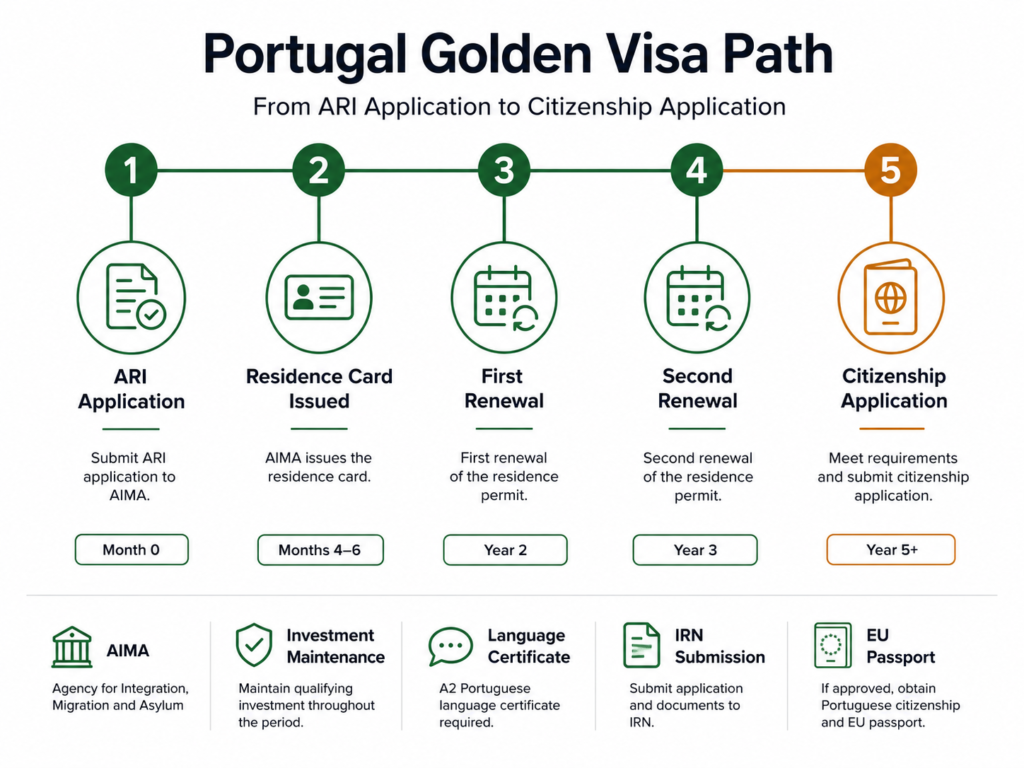
Year 5+: Citizenship Application Window Opens
After five years of legal residency, the applicant may become eligible to apply for portugal citizenship by naturalization. This does not mean approval is automatic.
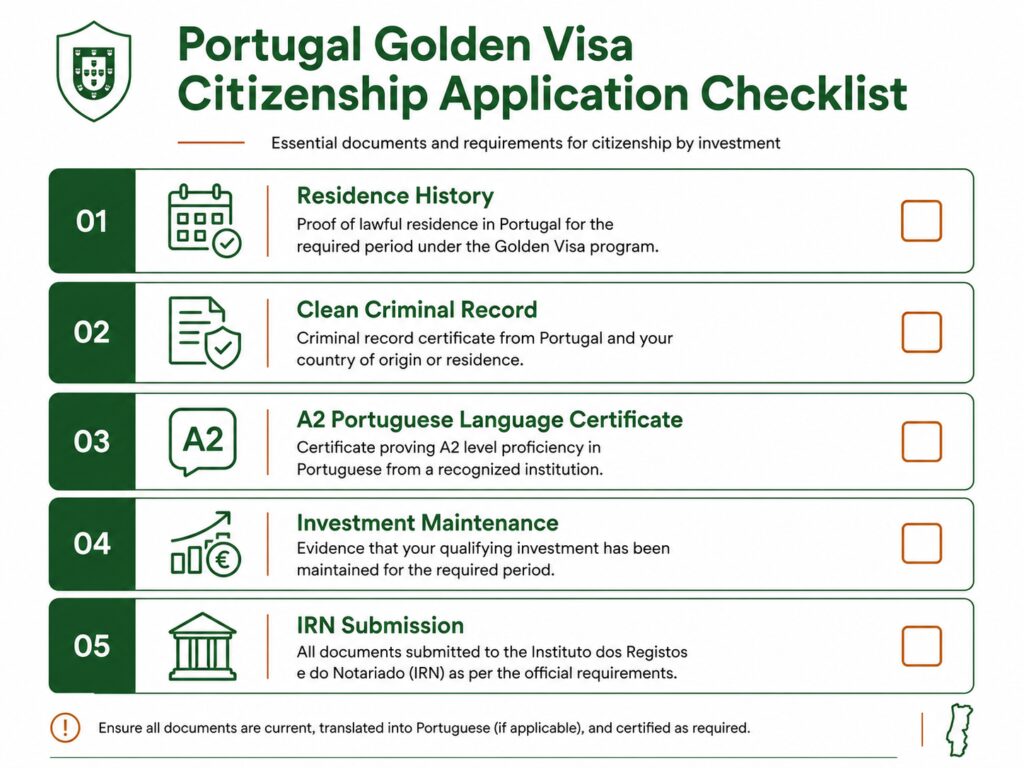
At this stage, the applicant must show that they satisfy Portuguese citizenship requirements. These include legal residence, sufficient knowledge of Portuguese, a clean criminal record, and the absence of issues that would create a legal objection.
The five-year point should be treated as an application window, not a guaranteed passport date.
Requirements to Apply for Portuguese Citizenship
Portuguese citizenship by naturalization is assessed separately from the Golden Visa approval. Holding an ARI permit helps because it establishes legal residency, but it does not remove the need to satisfy nationality requirements.
The main requirements are usually practical, document-based, and evidence-driven.
| Requirement | What It Means |
| 5-year residency | You must have sufficient legal residence under Portuguese rules |
| Clean criminal record | Serious convictions can block naturalization |
| Portuguese language | You must show sufficient Portuguese knowledge |
| Community connection | Your file should show credible links to Portugal |
| Continuous legal residency | Your residence status should remain valid and well documented |
Clean Criminal Record in Portugal and Home Country
A clean criminal record is one of the core citizenship requirements. Portuguese nationality rules focus especially on convictions that would be serious under Portuguese law.
Applicants should expect to provide criminal record certificates from relevant countries, usually including:
- Country of nationality.
- Country of birth, where applicable.
- Countries where the applicant has lived after a certain age.
- Portugal, where required by the process.
The purpose is not only to confirm identity. It is also to show that the applicant does not fall within a legal ground for refusal.
A2 Portuguese Language Certificate
Most adult applicants must show sufficient knowledge of Portuguese. For many Golden Visa investors, this is proven through an A2 Portuguese language certificate or another accepted form of evidence.
A2 is a basic level. It does not require fluency, legal Portuguese, or business negotiation skills. It usually means the applicant can understand and use simple Portuguese in everyday situations.
Still, investors should not underestimate it. Preparing early is easier than trying to pass the test while also gathering police certificates, translations, apostilles, and investment documents.
Proof of Ties to Portuguese Community
For the standard five-year naturalization route, the clearest connection to Portugal is usually legal residence combined with language knowledge and a compliant file. However, applicants should still treat the citizenship file as a serious legal submission, not a formality.
Useful supporting evidence may include:
- Portuguese language certificate.
- Portuguese NIF and tax records.
- Residence card history.
- Proof of time spent in Portugal.
- Portuguese bank account records.
- Family links, school records, or professional ties, where relevant.
- Evidence that the applicant maintained the investment correctly.
For Golden Visa investors who do not live full-time in Portugal, this section needs careful handling. The Golden Visa allows flexibility, but citizenship still requires a credible and complete file.
For more detail on the difference between visa stay rules and nationality expectations, read our guide to physical presence for citizenship.
Continuous Legal Residency
Continuous legal residency means the applicant should avoid gaps in residence status. Renewal planning is therefore not just administrative housekeeping. It protects the future citizenship route.
The investor should keep evidence of:
- Initial residence permit approval.
- Residence card validity periods.
- Renewal submissions.
- Renewal approvals.
- Investment maintenance during the required period.
This is where investment maintenance becomes essential. If the qualifying investment is no longer compliant, the residence permit may be affected, and that can weaken or interrupt the long-term citizenship plan.
The Citizenship Application Process
The citizenship application is not submitted as a Golden Visa renewal. It is a separate naturalization process.
The applicant should prepare the file with a lawyer or authorized representative, especially where documents come from multiple countries. Many delays happen not because the applicant is ineligible, but because the file contains missing certificates, outdated documents, translation issues, or unclear residence evidence.
Submitting Through the IRN Civil Registry
Citizenship applications are handled through the IRN Civil Registry. Applicants may submit through the appropriate nationality channel, and professional representatives can often submit online.
A typical file may include:
- Birth certificate.
- Valid passport or identity document.
- Residence permit information.
- Criminal record certificates.
- Portuguese language evidence.
- Application form or declaration.
- Certified translations where needed.
- Apostilles or consular legalization for foreign documents.
The IRN will assess the file under Portuguese nationality law, including Law 37/81, Portugal’s nationality law. The current law and later amendments should always be checked before submission.
Processing Times and What to Expect
IRN processing time can vary. A complete file can still take time because nationality applications involve legal review, identity checks, document validation, and sometimes requests for additional information.
Applicants should expect three practical realities:
| Reality | What It Means for Applicants |
| No instant passport | Citizenship comes after approval and registration, not merely after filing |
| Document age matters | Some certificates must be recent at submission |
| Follow-up is normal | IRN may ask for clarification or missing documents |
The best way to reduce avoidable delay is to prepare early. By year four, applicants should already understand which documents they need, where each document must come from, and whether translations or apostilles will be required.
Dual Citizenship: Can You Keep Your Original Passport?
Portugal permits dual citizenship. This means a successful applicant can generally become Portuguese without being required by Portugal to give up an existing nationality.
This is one reason the portugal golden visa to citizenship route is attractive to investors from countries that also allow dual nationality. It can create a second nationality option without forcing a clean break from the original passport.
However, applicants must check the law of their current country of nationality. Portugal may allow dual citizenship, but another country may impose restrictions, reporting duties, or consequences when a citizen naturalizes elsewhere.
For most investors, the key question is not only “Does Portugal allow it?” The better question is: “Do both countries allow it, and what tax, military, reporting, or family-law implications follow?”
What the EU Passport Gives You
A Portuguese passport is also an EU passport. Once citizenship is granted and registered, the applicant becomes a Portuguese citizen and, by extension, a citizen of the European Union.
That can provide major long-term advantages:
- The right to live in Portugal permanently.
- The right to live, work, and study across EU member states, subject to applicable rules.
- Access to Portuguese consular protection abroad.
- Visa-free or simplified travel to many countries.
- A stronger long-term family mobility plan.
- A European nationality that can be passed to eligible descendants under applicable rules.
This is why the citizenship route matters. The Golden Visa starts as a residence strategy, but for many families it is really a long-term nationality strategy.
Still, citizenship should never be treated as a guaranteed output. It depends on eligibility, legal compliance, document quality, and the law in force when the application is submitted.
FAQs: Portugal Golden Visa Path to Citizenship
Does the Portugal Golden Visa lead to citizenship?
Yes. The Portugal Golden Visa can lead to citizenship after five years of legal residency, provided the applicant meets Portuguese naturalization requirements. The Golden Visa itself does not grant citizenship automatically. It creates the legal residency basis that may later support a citizenship application.
How many years does it take?
The standard route is based on five years of legal residency. After that period, an eligible applicant may apply for Portuguese citizenship by naturalization. The total passport timeline can be longer because IRN must still process and approve the citizenship application.
What language test do I need?
Most adult applicants need to show sufficient knowledge of Portuguese, commonly through an A2 Portuguese language certificate or another accepted proof. A2 is a basic language level, but applicants should prepare early. It is easier to handle the language requirement before the final citizenship filing period.
Can I hold dual citizenship with a Portuguese passport?
Portugal permits dual citizenship, so Portuguese law generally does not require applicants to give up their existing passport. However, the applicant must also check the rules of their current nationality. Some countries restrict dual citizenship or impose reporting obligations when a citizen acquires another nationality.
Is the Portugal Golden Visa Path to Citizenship Right for You?
The Portugal Golden Visa can be a strong route for investors who want European residency first and a possible Portuguese passport later. The structure is especially attractive for applicants who want a five-year residency pathway without full relocation.
The main point is discipline. You must maintain the investment, renew the residence permit, preserve legal residency, prepare the language requirement, and keep the citizenship file clean.
For investors who want flexibility now and EU citizenship optionality later, the Golden Visa remains one of Portugal’s most important residency routes.
Ready to take the next step?
Book a free initial assessment. We’ll assess your eligibility, walk through the current qualifying routes, and answer your questions with no cost and no commitment.












