
Portugal golden visa

Portugal Golden Visa Low-Density Areas: Map, Eligibility and Investment Benefits

Portugal Golden Visa low-density areas used to matter because they could reduce the minimum real estate rehabilitation threshold to €280,000. That rule created years of search interest around low-density maps, interior regions, and property renovation opportunities.

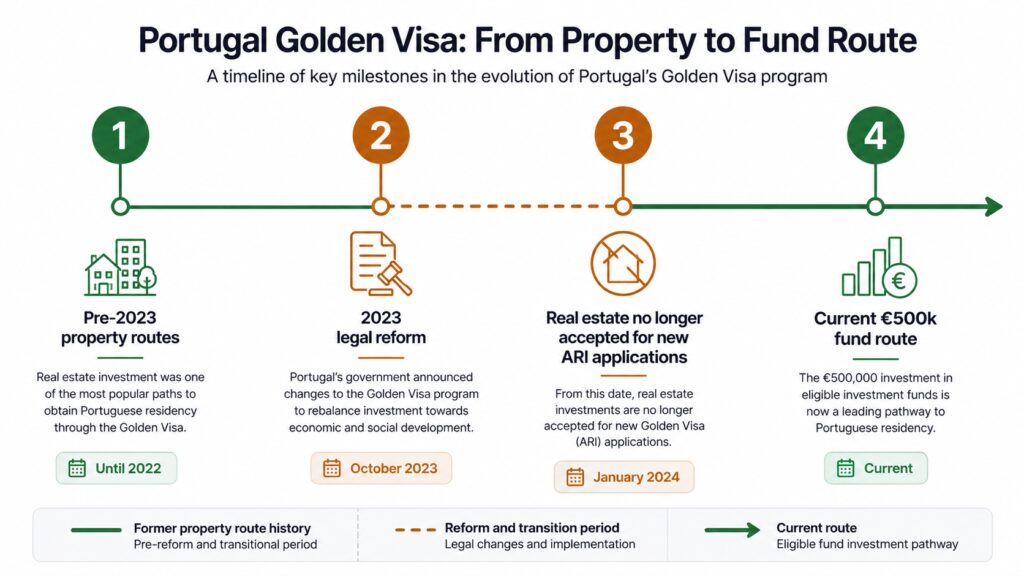
The important point today is different. For new Golden Visa applicants, Portugal no longer accepts real estate purchases or rehabilitation projects as qualifying ARI investments. ARI means Autorização de Residência para Investimento, the formal name of Portugal’s residence permit for investment activity. Low-density classifications still matter for understanding legacy property applications, historical eligibility, and regional investment planning, but they should not be treated as a current real estate Golden Visa route.

Portugal Golden Visa low-density areas map reviewed by investor

What Are Low-Density Areas Under Portugal Golden Visa Rules?

Low-density areas were territories that qualified for reduced investment thresholds under the former real estate-based Golden Visa rules. The classification was intended to direct investment toward less populated or economically weaker regions instead of concentrating all foreign investment in Lisbon, Porto, and prime coastal markets.

For today’s applicants, the low-density concept is mainly useful for understanding what changed and avoiding outdated advice. The current portugal golden visa framework no longer allows new applicants to qualify through real estate acquisition or rehabilitation.

How Low-Density Is Defined by Law

Historically, a low-density area designation was linked to population density and economic output. The usual test looked at whether a NUTS III region had fewer than 100 inhabitants per square kilometre or GDP per capita below 75% of the national average.

NUTS III regions are statistical territorial units used across Portugal and the European Union. Investors could also look at municipal-level classifications, especially where specific parishes or councils had distinct treatment.

For official demographic reference, applicants and advisors should check INE Portugal Population Density Data, published by Statistics Portugal. INE is the official source for population and territorial data, not an immigration consultancy or property agency.

Why Low-Density Areas Get a Lower Investment Threshold

The lower threshold was created to attract capital into regions that faced depopulation, weaker infrastructure, or lower investment activity. The logic was straightforward: if an investor accepted more location risk and renovation complexity, the required investment amount could be lower.

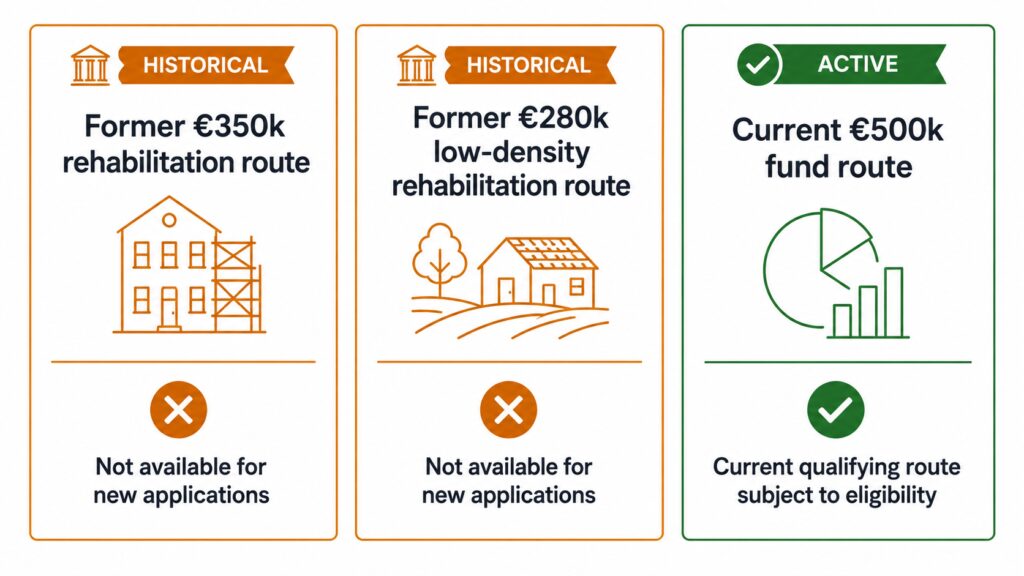
Under the former system, this created a 20% reduction in some real estate thresholds. A rehabilitation investment that was normally discussed at €350,000 could fall to a €280,000 rehabilitation threshold in a qualifying low-density area.

That benefit no longer works for new real estate Golden Visa applications. It may still be relevant for legacy applicants who filed before the 2023 reform, subject to their specific procedural status and legal advice.

The 280000 Rehabilitation Option in Low-Density Areas

The €280,000 option is one of the most misunderstood Portugal Golden Visa topics online. Many pages still describe it as if it were available today, which can mislead investors who are researching the programme for the first time.

The short answer is simple: the 280000 rehabilitation threshold was a real estate-based route. New real estate-based applications are no longer accepted under the current ARI framework.

How It Differs from the Standard 350000 Route

Before the reform, the standard rehabilitation route generally involved a €350,000 minimum investment into qualifying older property, usually combined with renovation work. In eligible low-density areas, that amount could be reduced by 20%, bringing the figure down to €280,000.

Former route Standard threshold Low-density threshold Status for new applicants
Property rehabilitation €350,000 €280,000 Not available for new ARI applications
Property acquisition Higher thresholds applied by location 20% reduction could apply Not available for new ARI applications
Current fund route €500,000 No low-density property discount Available subject to eligibility

Portugal’s Law 56/2023 changed the ARI landscape. The official Diário da República text states that new investment residence applications are not admitted under specified former investment subroutes, while renewals and certain pending applications remain protected under transitional rules. See the official Law 56/2023 text for the legal basis.

Rehabilitation Requirements

Under the old framework, rehabilitation was not simply “buy a cheaper property in a quiet town.” The property generally had to meet rehabilitation criteria, age or urban renewal requirements, and documentation standards.

A compliant file could require:

  1. Proof that the property met the rehabilitation category.
  2. A renovation plan or contractor documentation.
  3. Municipal or planning evidence where required.
  4. Legal due diligence on title, permits, and encumbrances.
  5. Evidence that the investment amount and works met the required threshold.

This is why a low-density property route carried more execution risk than a simple property acquisition. It involved location risk, renovation risk, documentation risk, and timing risk. Today, those issues are mainly relevant to legacy files or non-ARI property investors.
Portugal Golden Visa low-density areas old and current routes compared

Map of Qualifying Low-Density Regions

A Portugal low density areas map can still be useful, but it must be read with the right context. It does not create a current property-based Golden Visa route for new applicants.

Use the map as a historical and regional planning tool. Do not use it as proof that a property still qualifies for a new Golden Visa filing.

Interior Portugal

Interior Portugal included many of the areas most associated with low-density classification. These regions often had lower population density, older building stock, and more limited liquidity than Lisbon, Porto, and high-demand coastal zones.

Commonly discussed interior areas included parts of:

  • Castelo Branco
  • Guarda
  • Bragança
  • Vila Real
  • Viseu
  • Portalegre
  • Beja

The appeal was the lower entry cost. The trade-off was a smaller resale market, weaker rental demand in some municipalities, and more reliance on local project execution.

Silver Coast and Setubal Peninsula

The Silver Coast and Setubal Peninsula require careful treatment because not every coastal or near-coastal area was low-density. Some municipalities attracted investors because they felt close enough to Lisbon or Porto to remain practical, while still appearing on lists used for territorial classification.

This is where mistakes happened often. Investors would assume that a region qualified because it was outside Lisbon, or because a property agent described it as “low density.” That was never enough.

A proper verification process had to check the exact municipality, parish where relevant, NUTS III classification, and the legal rule in force at the time of filing.

FREE LEGAL CONSULTATION

Have a Quick Question?

Our legal team is available Monday–Friday to answer your Portugal Golden Visa questions and help you understand your next steps.

Book Your Free Consultation Message Us on WhatsApp

Alentejo and Algarve Interior

Alentejo was one of the most commonly discussed low-density regions because it combines large rural areas, historic towns, and lower population density. The Algarve interior was also relevant, but investors needed to distinguish inland municipalities from high-demand coastal zones.

Typical examples included inland or lower-density parts of:

  • Alentejo Central
  • Alto Alentejo
  • Baixo Alentejo
  • Algarve interior municipalities such as Alcoutim, Aljezur, Castro Marim, Monchique, and Vila do Bispo

The regional investment logic was clear. These areas could offer lower acquisition prices and urban rehabilitation opportunities. The practical challenge was market depth. A lower purchase price does not automatically mean better investment performance.

Pros and Cons of Low-Density Area Investment

Low-density area investment was never just a cheaper version of Lisbon or Porto. It was a different risk profile.

For investors who were evaluating the old route, the decision depended on whether the lower threshold justified the additional due diligence, renovation, and exit risk.

Lower Entry Cost

The main advantage was the reduced qualifying threshold. For a family seeking EU residency at the lowest possible real estate entry point, the €280,000 route was attractive.

It also helped investors who preferred tangible assets over financial products. A restored property in interior Portugal could serve personal, rental, or long-term holding goals.

That said, low entry cost can hide high operational complexity. Renovation budgets, contractor delays, and resale uncertainty often mattered more than the headline threshold.

Less Developed Infrastructure

Low-density regions can have weaker transport links, fewer international schools, smaller healthcare networks, and fewer professional property managers. These issues do not make the investment bad, but they change the investment profile.

A good property in a smaller municipality may still perform well if there is tourism demand, local employment, or strong cultural appeal. A poorly selected property can remain illiquid for years.

This is why real estate due diligence mattered as much as immigration eligibility. Investors needed both legal confirmation and commercial realism.

Rental Income Potential

Rental income varied widely. Some low-density or interior locations had seasonal tourism potential, especially near heritage towns, nature areas, or established domestic travel routes.

Other locations had limited rental depth. In those cases, the investor depended more on capital preservation, personal use, or long holding periods than rental yield.

For current applicants, this rental discussion should be separated from Golden Visa eligibility. A property may still be a good investment in Portugal, but it does not qualify a new applicant for the Golden Visa through real estate.

How to Verify if a Property Is in a Qualifying Area

For legacy applicants or property investors reviewing old files, verification must happen at the exact property level. A general map is not enough.

A proper review should include:

  1. Exact address and parish confirmation. The property must be checked at municipal and, where relevant, parish level.
  2. NUTS III region verification. Confirm which statistical region applied at the relevant filing date.
  3. Low-density classification evidence. Use official territorial lists and INE demographic data.
  4. Rehabilitation eligibility. Confirm whether the property met the age, location, or urban rehabilitation condition.
  5. Filing date review. Check whether the application was submitted before the 2023 legal reform.
  6. AIMA status check. AIMA means Agency for Integration, Migration and Asylum, the authority that replaced SEF and processes residence procedures. Applicants can refer to the AIMA Low-Density Investment Rules portal for current residence processing context, but legal eligibility should be checked against the law in force for the specific application.

For new applicants, the answer is clearer. A qualifying area does not revive the former property route. The relevant question is which current non-real-estate ARI route fits the investor’s profile.

Low-Density Rehabilitation vs Investment Fund Route

The current comparison is not between Lisbon property and low-density property. For new applicants, the practical comparison is between old property-based research and the current fund route.

The fund investment alternative is now the main route many investors review because it does not require property acquisition, renovation management, or regional location analysis.

Factor Former low-density rehabilitation route Current investment fund route
Minimum amount €280,000 historically €500,000
Asset type Real estate plus rehabilitation CMVM-regulated investment fund
New applicant eligibility No longer available Available subject to eligibility
Management burden High, due to property and renovation Lower, handled through fund manager
Main due diligence focus Title, permits, renovation, location, exit Fund regulation, manager, fees, liquidity, strategy
Regional map needed Yes, historically No for property eligibility

This does not mean the fund route is automatically better for everyone. It means it is the route that aligns with the current programme structure.

Investors who still want Portuguese real estate can buy property separately for lifestyle or portfolio reasons. They should not assume that the purchase supports a new ARI application. For more context on the change, see this real estate route guide.
Portugal Golden Visa low-density areas replaced by current fund route

Wondering if you qualify?
Book a free initial assessment with our team. We’ll confirm your eligibility, outline the current qualifying routes, and answer your questions, no commitment required.
Book a Consultation →

The safest next step is to separate three questions: whether an old application remains valid, whether a property is still worth buying for investment reasons, and whether the Golden Visa can be obtained through a current route.

For most new applicants, the relevant starting point is a full cost breakdown and an assessment of the €500,000 fund route.

FAQs: Portugal Golden Visa Low-Density Areas

What counts as a low-density area for the Portugal Golden Visa?

Historically, a low-density area was usually defined by population density or GDP per capita, often using NUTS III regional classifications. The common benchmark was fewer than 100 inhabitants per square kilometre or GDP per capita below 75% of the national average.

For new applicants, this classification no longer creates a real estate Golden Visa route. It may still matter for legacy applications, pending files, or regional property investment analysis.

How does the 280000 low-density option work?

The 280000 low-density option was a reduced real estate rehabilitation threshold under the former Golden Visa rules. It applied where the property and location met the relevant low-density and rehabilitation requirements.

It is not a current route for new Golden Visa applicants. New applicants should not rely on €280,000 rehabilitation property as a qualifying ARI strategy.

Which regions in Portugal qualify as low-density areas?

Low-density classifications historically covered many parts of interior Portugal, Alentejo, selected Algarve interior municipalities, and some other municipalities or parishes depending on the applicable list. Examples often included parts of Castelo Branco, Guarda, Bragança, Portalegre, Beja, and inland Algarve.

The exact answer depends on the date, territorial classification, municipality, and sometimes parish. Always verify using official data and legal review, not a marketing map.

Is investing in a low-density area a good idea?

It can be a good property investment if the location, purchase price, renovation cost, rental demand, and exit strategy make sense. It should not be judged only by the old Golden Visa threshold.

For new Golden Visa applicants, the better question is whether the property makes sense independently from immigration. If the goal is residency through investment, the current programme should be assessed through eligible non-real-estate routes.

Is a Low-Density Strategy Still Relevant?

Low-density areas remain relevant for understanding the history of the Portugal Golden Visa and for reviewing legacy real estate applications. They are also useful for investors who want to study interior Portugal, regional development, and property renovation outside the major coastal markets.

They should not be treated as a current shortcut into the Golden Visa. For new applicants, the former €280,000 rehabilitation route is no longer the path to ARI approval.

The practical approach is simple: verify whether you are dealing with a legacy file, a pure property investment, or a new Golden Visa application. Each one requires a different strategy.

Ready to take the next step?
Book a free initial assessment. We’ll assess your eligibility, walk through the current qualifying routes, and answer your questions, no cost, no commitment.


Portugal Golden Visa Low-Density Areas: Map, Eligibility and Investment Benefits

Portugal Golden Visa low-density areas used to matter because they could reduce the minimum real estate rehabilitation threshold to €280,000. That rule created years of search interest around low-density maps, interior regions, and property renovation opportunities.

The important point today is different. For new Golden Visa applicants, Portugal no longer accepts real estate purchases or rehabilitation projects as qualifying ARI investments. ARI means Autorização de Residência para Investimento, the formal name of Portugal’s residence permit for investment activity. Low-density classifications still matter for understanding legacy property applications, historical eligibility, and regional investment planning, but they should not be treated as a current real estate Golden Visa route.

Portugal Golden Visa low-density areas map reviewed by investor

What Are Low-Density Areas Under Portugal Golden Visa Rules?

Low-density areas were territories that qualified for reduced investment thresholds under the former real estate-based Golden Visa rules. The classification was intended to direct investment toward less populated or economically weaker regions instead of concentrating all foreign investment in Lisbon, Porto, and prime coastal markets.

For today’s applicants, the low-density concept is mainly useful for understanding what changed and avoiding outdated advice. The current portugal golden visa framework no longer allows new applicants to qualify through real estate acquisition or rehabilitation.

How Low-Density Is Defined by Law

Historically, a low-density area designation was linked to population density and economic output. The usual test looked at whether a NUTS III region had fewer than 100 inhabitants per square kilometre or GDP per capita below 75% of the national average.

NUTS III regions are statistical territorial units used across Portugal and the European Union. Investors could also look at municipal-level classifications, especially where specific parishes or councils had distinct treatment.

For official demographic reference, applicants and advisors should check INE Portugal Population Density Data, published by Statistics Portugal. INE is the official source for population and territorial data, not an immigration consultancy or property agency.

Why Low-Density Areas Get a Lower Investment Threshold

The lower threshold was created to attract capital into regions that faced depopulation, weaker infrastructure, or lower investment activity. The logic was straightforward: if an investor accepted more location risk and renovation complexity, the required investment amount could be lower.

Under the former system, this created a 20% reduction in some real estate thresholds. A rehabilitation investment that was normally discussed at €350,000 could fall to a €280,000 rehabilitation threshold in a qualifying low-density area.

That benefit no longer works for new real estate Golden Visa applications. It may still be relevant for legacy applicants who filed before the 2023 reform, subject to their specific procedural status and legal advice.

The 280000 Rehabilitation Option in Low-Density Areas

The €280,000 option is one of the most misunderstood Portugal Golden Visa topics online. Many pages still describe it as if it were available today, which can mislead investors who are researching the programme for the first time.

The short answer is simple: the 280000 rehabilitation threshold was a real estate-based route. New real estate-based applications are no longer accepted under the current ARI framework.

How It Differs from the Standard 350000 Route

Before the reform, the standard rehabilitation route generally involved a €350,000 minimum investment into qualifying older property, usually combined with renovation work. In eligible low-density areas, that amount could be reduced by 20%, bringing the figure down to €280,000.

Former route Standard threshold Low-density threshold Status for new applicants
Property rehabilitation €350,000 €280,000 Not available for new ARI applications
Property acquisition Higher thresholds applied by location 20% reduction could apply Not available for new ARI applications
Current fund route €500,000 No low-density property discount Available subject to eligibility

Portugal’s Law 56/2023 changed the ARI landscape. The official Diário da República text states that new investment residence applications are not admitted under specified former investment subroutes, while renewals and certain pending applications remain protected under transitional rules. See the official Law 56/2023 text for the legal basis.

Rehabilitation Requirements

Under the old framework, rehabilitation was not simply “buy a cheaper property in a quiet town.” The property generally had to meet rehabilitation criteria, age or urban renewal requirements, and documentation standards.

A compliant file could require:

  1. Proof that the property met the rehabilitation category.
  2. A renovation plan or contractor documentation.
  3. Municipal or planning evidence where required.
  4. Legal due diligence on title, permits, and encumbrances.
  5. Evidence that the investment amount and works met the required threshold.

This is why a low-density property route carried more execution risk than a simple property acquisition. It involved location risk, renovation risk, documentation risk, and timing risk. Today, those issues are mainly relevant to legacy files or non-ARI property investors.

Portugal Golden Visa low-density areas old and current routes compared

Map of Qualifying Low-Density Regions

A Portugal low density areas map can still be useful, but it must be read with the right context. It does not create a current property-based Golden Visa route for new applicants.

Use the map as a historical and regional planning tool. Do not use it as proof that a property still qualifies for a new Golden Visa filing.

Interior Portugal

Interior Portugal included many of the areas most associated with low-density classification. These regions often had lower population density, older building stock, and more limited liquidity than Lisbon, Porto, and high-demand coastal zones.

Commonly discussed interior areas included parts of:

  • Castelo Branco
  • Guarda
  • Bragança
  • Vila Real
  • Viseu
  • Portalegre
  • Beja

The appeal was the lower entry cost. The trade-off was a smaller resale market, weaker rental demand in some municipalities, and more reliance on local project execution.

Silver Coast and Setubal Peninsula

The Silver Coast and Setubal Peninsula require careful treatment because not every coastal or near-coastal area was low-density. Some municipalities attracted investors because they felt close enough to Lisbon or Porto to remain practical, while still appearing on lists used for territorial classification.

This is where mistakes happened often. Investors would assume that a region qualified because it was outside Lisbon, or because a property agent described it as “low density.” That was never enough.

A proper verification process had to check the exact municipality, parish where relevant, NUTS III classification, and the legal rule in force at the time of filing.

FREE LEGAL CONSULTATION

Have a Quick Question?

Our legal team is available Monday–Friday to answer your Portugal Golden Visa questions and help you understand your next steps.

Book Your Free Consultation Message Us on WhatsApp

Alentejo and Algarve Interior

Alentejo was one of the most commonly discussed low-density regions because it combines large rural areas, historic towns, and lower population density. The Algarve interior was also relevant, but investors needed to distinguish inland municipalities from high-demand coastal zones.

Typical examples included inland or lower-density parts of:

  • Alentejo Central
  • Alto Alentejo
  • Baixo Alentejo
  • Algarve interior municipalities such as Alcoutim, Aljezur, Castro Marim, Monchique, and Vila do Bispo

The regional investment logic was clear. These areas could offer lower acquisition prices and urban rehabilitation opportunities. The practical challenge was market depth. A lower purchase price does not automatically mean better investment performance.

Pros and Cons of Low-Density Area Investment

Low-density area investment was never just a cheaper version of Lisbon or Porto. It was a different risk profile.

For investors who were evaluating the old route, the decision depended on whether the lower threshold justified the additional due diligence, renovation, and exit risk.

Lower Entry Cost

The main advantage was the reduced qualifying threshold. For a family seeking EU residency at the lowest possible real estate entry point, the €280,000 route was attractive.

It also helped investors who preferred tangible assets over financial products. A restored property in interior Portugal could serve personal, rental, or long-term holding goals.

That said, low entry cost can hide high operational complexity. Renovation budgets, contractor delays, and resale uncertainty often mattered more than the headline threshold.

Less Developed Infrastructure

Low-density regions can have weaker transport links, fewer international schools, smaller healthcare networks, and fewer professional property managers. These issues do not make the investment bad, but they change the investment profile.

A good property in a smaller municipality may still perform well if there is tourism demand, local employment, or strong cultural appeal. A poorly selected property can remain illiquid for years.

This is why real estate due diligence mattered as much as immigration eligibility. Investors needed both legal confirmation and commercial realism.

Rental Income Potential

Rental income varied widely. Some low-density or interior locations had seasonal tourism potential, especially near heritage towns, nature areas, or established domestic travel routes.

Other locations had limited rental depth. In those cases, the investor depended more on capital preservation, personal use, or long holding periods than rental yield.

For current applicants, this rental discussion should be separated from Golden Visa eligibility. A property may still be a good investment in Portugal, but it does not qualify a new applicant for the Golden Visa through real estate.

How to Verify if a Property Is in a Qualifying Area

For legacy applicants or property investors reviewing old files, verification must happen at the exact property level. A general map is not enough.

A proper review should include:

  1. Exact address and parish confirmation. The property must be checked at municipal and, where relevant, parish level.
  2. NUTS III region verification. Confirm which statistical region applied at the relevant filing date.
  3. Low-density classification evidence. Use official territorial lists and INE demographic data.
  4. Rehabilitation eligibility. Confirm whether the property met the age, location, or urban rehabilitation condition.
  5. Filing date review. Check whether the application was submitted before the 2023 legal reform.
  6. AIMA status check. AIMA means Agency for Integration, Migration and Asylum, the authority that replaced SEF and processes residence procedures. Applicants can refer to the AIMA Low-Density Investment Rules portal for current residence processing context, but legal eligibility should be checked against the law in force for the specific application.

For new applicants, the answer is clearer. A qualifying area does not revive the former property route. The relevant question is which current non-real-estate ARI route fits the investor’s profile.

Low-Density Rehabilitation vs Investment Fund Route

The current comparison is not between Lisbon property and low-density property. For new applicants, the practical comparison is between old property-based research and the current fund route.

The fund investment alternative is now the main route many investors review because it does not require property acquisition, renovation management, or regional location analysis.

Factor Former low-density rehabilitation route Current investment fund route
Minimum amount €280,000 historically €500,000
Asset type Real estate plus rehabilitation CMVM-regulated investment fund
New applicant eligibility No longer available Available subject to eligibility
Management burden High, due to property and renovation Lower, handled through fund manager
Main due diligence focus Title, permits, renovation, location, exit Fund regulation, manager, fees, liquidity, strategy
Regional map needed Yes, historically No for property eligibility

This does not mean the fund route is automatically better for everyone. It means it is the route that aligns with the current programme structure.

Investors who still want Portuguese real estate can buy property separately for lifestyle or portfolio reasons. They should not assume that the purchase supports a new ARI application. For more context on the change, see this real estate route guide.

Portugal Golden Visa low-density areas replaced by current fund route

Wondering if you qualify?
Book a free initial assessment with our team. We’ll confirm your eligibility, outline the current qualifying routes, and answer your questions, no commitment required.
Book a Consultation →

The safest next step is to separate three questions: whether an old application remains valid, whether a property is still worth buying for investment reasons, and whether the Golden Visa can be obtained through a current route.

For most new applicants, the relevant starting point is a full cost breakdown and an assessment of the €500,000 fund route.

FAQs: Portugal Golden Visa Low-Density Areas

What counts as a low-density area for the Portugal Golden Visa?

Historically, a low-density area was usually defined by population density or GDP per capita, often using NUTS III regional classifications. The common benchmark was fewer than 100 inhabitants per square kilometre or GDP per capita below 75% of the national average.

For new applicants, this classification no longer creates a real estate Golden Visa route. It may still matter for legacy applications, pending files, or regional property investment analysis.

How does the 280000 low-density option work?

The 280000 low-density option was a reduced real estate rehabilitation threshold under the former Golden Visa rules. It applied where the property and location met the relevant low-density and rehabilitation requirements.

It is not a current route for new Golden Visa applicants. New applicants should not rely on €280,000 rehabilitation property as a qualifying ARI strategy.

Which regions in Portugal qualify as low-density areas?

Low-density classifications historically covered many parts of interior Portugal, Alentejo, selected Algarve interior municipalities, and some other municipalities or parishes depending on the applicable list. Examples often included parts of Castelo Branco, Guarda, Bragança, Portalegre, Beja, and inland Algarve.

The exact answer depends on the date, territorial classification, municipality, and sometimes parish. Always verify using official data and legal review, not a marketing map.

Is investing in a low-density area a good idea?

It can be a good property investment if the location, purchase price, renovation cost, rental demand, and exit strategy make sense. It should not be judged only by the old Golden Visa threshold.

For new Golden Visa applicants, the better question is whether the property makes sense independently from immigration. If the goal is residency through investment, the current programme should be assessed through eligible non-real-estate routes.

Is a Low-Density Strategy Still Relevant?

Low-density areas remain relevant for understanding the history of the Portugal Golden Visa and for reviewing legacy real estate applications. They are also useful for investors who want to study interior Portugal, regional development, and property renovation outside the major coastal markets.

They should not be treated as a current shortcut into the Golden Visa. For new applicants, the former €280,000 rehabilitation route is no longer the path to ARI approval.

The practical approach is simple: verify whether you are dealing with a legacy file, a pure property investment, or a new Golden Visa application. Each one requires a different strategy.

Ready to take the next step?
Book a free initial assessment. We’ll assess your eligibility, walk through the current qualifying routes, and answer your questions, no cost, no commitment.

Portugal Golden Visa Low-Density Areas: Map, Eligibility and Investment Benefits

Portugal-Golden-Visa-Low-Density-Areas-Map-Eligibility-and-Investment-Benefits
Portugal Golden Visa low-density areas used to matter because they could reduce the minimum real estate rehabilitation threshold to €280,000. That rule created years of search interest around low-density maps, interior regions, and property renovation opportunities.

The important point today is different. For new Golden Visa applicants, Portugal no longer accepts real estate purchases or rehabilitation projects as qualifying ARI investments. ARI means Autorização de Residência para Investimento, the formal name of Portugal’s residence permit for investment activity. Low-density classifications still matter for understanding legacy property applications, historical eligibility, and regional investment planning, but they should not be treated as a current real estate Golden Visa route.

Portugal Golden Visa low-density areas map reviewed by investor

What Are Low-Density Areas Under Portugal Golden Visa Rules?

Low-density areas were territories that qualified for reduced investment thresholds under the former real estate-based Golden Visa rules. The classification was intended to direct investment toward less populated or economically weaker regions instead of concentrating all foreign investment in Lisbon, Porto, and prime coastal markets.

For today’s applicants, the low-density concept is mainly useful for understanding what changed and avoiding outdated advice. The current portugal golden visa framework no longer allows new applicants to qualify through real estate acquisition or rehabilitation.

How Low-Density Is Defined by Law

Historically, a low-density area designation was linked to population density and economic output. The usual test looked at whether a NUTS III region had fewer than 100 inhabitants per square kilometre or GDP per capita below 75% of the national average.

NUTS III regions are statistical territorial units used across Portugal and the European Union. Investors could also look at municipal-level classifications, especially where specific parishes or councils had distinct treatment.

For official demographic reference, applicants and advisors should check INE Portugal Population Density Data, published by Statistics Portugal. INE is the official source for population and territorial data, not an immigration consultancy or property agency.

Why Low-Density Areas Get a Lower Investment Threshold

The lower threshold was created to attract capital into regions that faced depopulation, weaker infrastructure, or lower investment activity. The logic was straightforward: if an investor accepted more location risk and renovation complexity, the required investment amount could be lower.

Under the former system, this created a 20% reduction in some real estate thresholds. A rehabilitation investment that was normally discussed at €350,000 could fall to a €280,000 rehabilitation threshold in a qualifying low-density area.

That benefit no longer works for new real estate Golden Visa applications. It may still be relevant for legacy applicants who filed before the 2023 reform, subject to their specific procedural status and legal advice.

The 280000 Rehabilitation Option in Low-Density Areas

The €280,000 option is one of the most misunderstood Portugal Golden Visa topics online. Many pages still describe it as if it were available today, which can mislead investors who are researching the programme for the first time.

The short answer is simple: the 280000 rehabilitation threshold was a real estate-based route. New real estate-based applications are no longer accepted under the current ARI framework.

How It Differs from the Standard 350000 Route

Before the reform, the standard rehabilitation route generally involved a €350,000 minimum investment into qualifying older property, usually combined with renovation work. In eligible low-density areas, that amount could be reduced by 20%, bringing the figure down to €280,000.

Former route Standard threshold Low-density threshold Status for new applicants
Property rehabilitation €350,000 €280,000 Not available for new ARI applications
Property acquisition Higher thresholds applied by location 20% reduction could apply Not available for new ARI applications
Current fund route €500,000 No low-density property discount Available subject to eligibility

Portugal’s Law 56/2023 changed the ARI landscape. The official Diário da República text states that new investment residence applications are not admitted under specified former investment subroutes, while renewals and certain pending applications remain protected under transitional rules. See the official Law 56/2023 text for the legal basis.

Rehabilitation Requirements

Under the old framework, rehabilitation was not simply “buy a cheaper property in a quiet town.” The property generally had to meet rehabilitation criteria, age or urban renewal requirements, and documentation standards.

A compliant file could require:

  1. Proof that the property met the rehabilitation category.
  2. A renovation plan or contractor documentation.
  3. Municipal or planning evidence where required.
  4. Legal due diligence on title, permits, and encumbrances.
  5. Evidence that the investment amount and works met the required threshold.

This is why a low-density property route carried more execution risk than a simple property acquisition. It involved location risk, renovation risk, documentation risk, and timing risk. Today, those issues are mainly relevant to legacy files or non-ARI property investors.

Portugal Golden Visa low-density areas old and current routes compared

Map of Qualifying Low-Density Regions

A Portugal low density areas map can still be useful, but it must be read with the right context. It does not create a current property-based Golden Visa route for new applicants.

Use the map as a historical and regional planning tool. Do not use it as proof that a property still qualifies for a new Golden Visa filing.

Interior Portugal

Interior Portugal included many of the areas most associated with low-density classification. These regions often had lower population density, older building stock, and more limited liquidity than Lisbon, Porto, and high-demand coastal zones.

Commonly discussed interior areas included parts of:

  • Castelo Branco
  • Guarda
  • Bragança
  • Vila Real
  • Viseu
  • Portalegre
  • Beja

The appeal was the lower entry cost. The trade-off was a smaller resale market, weaker rental demand in some municipalities, and more reliance on local project execution.

Silver Coast and Setubal Peninsula

The Silver Coast and Setubal Peninsula require careful treatment because not every coastal or near-coastal area was low-density. Some municipalities attracted investors because they felt close enough to Lisbon or Porto to remain practical, while still appearing on lists used for territorial classification.

This is where mistakes happened often. Investors would assume that a region qualified because it was outside Lisbon, or because a property agent described it as “low density.” That was never enough.

A proper verification process had to check the exact municipality, parish where relevant, NUTS III classification, and the legal rule in force at the time of filing.

FREE LEGAL CONSULTATION

Have a Quick Question?

Our legal team is available Monday–Friday to answer your Portugal Golden Visa questions and help you understand your next steps.

Book Your Free Consultation Message Us on WhatsApp

Alentejo and Algarve Interior

Alentejo was one of the most commonly discussed low-density regions because it combines large rural areas, historic towns, and lower population density. The Algarve interior was also relevant, but investors needed to distinguish inland municipalities from high-demand coastal zones.

Typical examples included inland or lower-density parts of:

  • Alentejo Central
  • Alto Alentejo
  • Baixo Alentejo
  • Algarve interior municipalities such as Alcoutim, Aljezur, Castro Marim, Monchique, and Vila do Bispo

The regional investment logic was clear. These areas could offer lower acquisition prices and urban rehabilitation opportunities. The practical challenge was market depth. A lower purchase price does not automatically mean better investment performance.

Pros and Cons of Low-Density Area Investment

Low-density area investment was never just a cheaper version of Lisbon or Porto. It was a different risk profile.

For investors who were evaluating the old route, the decision depended on whether the lower threshold justified the additional due diligence, renovation, and exit risk.

Lower Entry Cost

The main advantage was the reduced qualifying threshold. For a family seeking EU residency at the lowest possible real estate entry point, the €280,000 route was attractive.

It also helped investors who preferred tangible assets over financial products. A restored property in interior Portugal could serve personal, rental, or long-term holding goals.

That said, low entry cost can hide high operational complexity. Renovation budgets, contractor delays, and resale uncertainty often mattered more than the headline threshold.

Less Developed Infrastructure

Low-density regions can have weaker transport links, fewer international schools, smaller healthcare networks, and fewer professional property managers. These issues do not make the investment bad, but they change the investment profile.

A good property in a smaller municipality may still perform well if there is tourism demand, local employment, or strong cultural appeal. A poorly selected property can remain illiquid for years.

This is why real estate due diligence mattered as much as immigration eligibility. Investors needed both legal confirmation and commercial realism.

Rental Income Potential

Rental income varied widely. Some low-density or interior locations had seasonal tourism potential, especially near heritage towns, nature areas, or established domestic travel routes.

Other locations had limited rental depth. In those cases, the investor depended more on capital preservation, personal use, or long holding periods than rental yield.

For current applicants, this rental discussion should be separated from Golden Visa eligibility. A property may still be a good investment in Portugal, but it does not qualify a new applicant for the Golden Visa through real estate.

How to Verify if a Property Is in a Qualifying Area

For legacy applicants or property investors reviewing old files, verification must happen at the exact property level. A general map is not enough.

A proper review should include:

  1. Exact address and parish confirmation. The property must be checked at municipal and, where relevant, parish level.
  2. NUTS III region verification. Confirm which statistical region applied at the relevant filing date.
  3. Low-density classification evidence. Use official territorial lists and INE demographic data.
  4. Rehabilitation eligibility. Confirm whether the property met the age, location, or urban rehabilitation condition.
  5. Filing date review. Check whether the application was submitted before the 2023 legal reform.
  6. AIMA status check. AIMA means Agency for Integration, Migration and Asylum, the authority that replaced SEF and processes residence procedures. Applicants can refer to the AIMA Low-Density Investment Rules portal for current residence processing context, but legal eligibility should be checked against the law in force for the specific application.

For new applicants, the answer is clearer. A qualifying area does not revive the former property route. The relevant question is which current non-real-estate ARI route fits the investor’s profile.

Low-Density Rehabilitation vs Investment Fund Route

The current comparison is not between Lisbon property and low-density property. For new applicants, the practical comparison is between old property-based research and the current fund route.

The fund investment alternative is now the main route many investors review because it does not require property acquisition, renovation management, or regional location analysis.

Factor Former low-density rehabilitation route Current investment fund route
Minimum amount €280,000 historically €500,000
Asset type Real estate plus rehabilitation CMVM-regulated investment fund
New applicant eligibility No longer available Available subject to eligibility
Management burden High, due to property and renovation Lower, handled through fund manager
Main due diligence focus Title, permits, renovation, location, exit Fund regulation, manager, fees, liquidity, strategy
Regional map needed Yes, historically No for property eligibility

This does not mean the fund route is automatically better for everyone. It means it is the route that aligns with the current programme structure.

Investors who still want Portuguese real estate can buy property separately for lifestyle or portfolio reasons. They should not assume that the purchase supports a new ARI application. For more context on the change, see this real estate route guide.

Portugal Golden Visa low-density areas replaced by current fund route

Wondering if you qualify?
Book a free initial assessment with our team. We’ll confirm your eligibility, outline the current qualifying routes, and answer your questions, no commitment required.
Book a Consultation →

The safest next step is to separate three questions: whether an old application remains valid, whether a property is still worth buying for investment reasons, and whether the Golden Visa can be obtained through a current route.

For most new applicants, the relevant starting point is a full cost breakdown and an assessment of the €500,000 fund route.

FAQs: Portugal Golden Visa Low-Density Areas

What counts as a low-density area for the Portugal Golden Visa?

Historically, a low-density area was usually defined by population density or GDP per capita, often using NUTS III regional classifications. The common benchmark was fewer than 100 inhabitants per square kilometre or GDP per capita below 75% of the national average.

For new applicants, this classification no longer creates a real estate Golden Visa route. It may still matter for legacy applications, pending files, or regional property investment analysis.

How does the 280000 low-density option work?

The 280000 low-density option was a reduced real estate rehabilitation threshold under the former Golden Visa rules. It applied where the property and location met the relevant low-density and rehabilitation requirements.

It is not a current route for new Golden Visa applicants. New applicants should not rely on €280,000 rehabilitation property as a qualifying ARI strategy.

Which regions in Portugal qualify as low-density areas?

Low-density classifications historically covered many parts of interior Portugal, Alentejo, selected Algarve interior municipalities, and some other municipalities or parishes depending on the applicable list. Examples often included parts of Castelo Branco, Guarda, Bragança, Portalegre, Beja, and inland Algarve.

The exact answer depends on the date, territorial classification, municipality, and sometimes parish. Always verify using official data and legal review, not a marketing map.

Is investing in a low-density area a good idea?

It can be a good property investment if the location, purchase price, renovation cost, rental demand, and exit strategy make sense. It should not be judged only by the old Golden Visa threshold.

For new Golden Visa applicants, the better question is whether the property makes sense independently from immigration. If the goal is residency through investment, the current programme should be assessed through eligible non-real-estate routes.

Is a Low-Density Strategy Still Relevant?

Low-density areas remain relevant for understanding the history of the Portugal Golden Visa and for reviewing legacy real estate applications. They are also useful for investors who want to study interior Portugal, regional development, and property renovation outside the major coastal markets.

They should not be treated as a current shortcut into the Golden Visa. For new applicants, the former €280,000 rehabilitation route is no longer the path to ARI approval.

The practical approach is simple: verify whether you are dealing with a legacy file, a pure property investment, or a new Golden Visa application. Each one requires a different strategy.

Ready to take the next step?
Book a free initial assessment. We’ll assess your eligibility, walk through the current qualifying routes, and answer your questions, no cost, no commitment.

What do you think?
Blog

More Related Articles

top








