
Portugal golden visa

Portugal Golden Visa News: Latest 2026 Updates

Portugal golden visa news in 2026 is no longer about whether the programme still exists. It does. The real questions are now more specific: how AIMA is processing applications, how the new citizenship timeline affects long-term planning, and whether Portugal remains a practical EU residency strategy after the latest legal and tax changes.

The short answer is clear. The Portugal Golden Visa remains open, but the rules around citizenship timing, renewals, and tax planning require closer review than they did a year ago.

Portugal Golden Visa Latest Updates in 2026

The 2026 update is best understood as three separate developments. The ARI residence permit remains available, AIMA has continued changing how applications and renewals are handled, and Portugal has changed the citizenship timeline for naturalisation.

2026 Update What Changed Why It Matters
Programme status ARI remains available for eligible non-EU investors The programme has not closed
Real estate route Real estate still does not qualify after the 2023 reform Investors should avoid outdated property-based advice
AIMA processing Renewals and appointments are increasingly handled through online systems Applicants need to track portal status closely
Citizenship law Naturalisation timelines were extended under the 2026 nationality reform Long-term passport planning now needs legal review
Tax regime NHR has moved into the IFICI framework for eligible new tax residents Tax planning depends on the applicant profile

The important distinction is this: the portugal golden visa is still a residency-by-investment programme. It is not a direct citizenship-by-investment programme. Citizenship may become possible later, subject to the nationality law in force when the applicant applies.

Portugal Golden Visa news 2026 update for investors reviewing ARI changes

Program Status: Is the Golden Visa Still Open?

Yes. The Portugal Golden Visa remains open in 2026 through the ARI, or Autorização de Residência para Investimento, which is the formal name of the residence permit for investment activity.

According to the AIMA official portal, the ARI regime allows eligible third-country nationals to obtain temporary residence through qualifying investment activity, with rights that include residence in Portugal, Schengen circulation, family reunification, and the possibility of later applying for permanent residence or nationality if the legal requirements are met.

What has not returned is the old real estate route. Since the 2023 legislative reform, residential real estate purchases no longer qualify for Portugal Golden Visa purposes. Investors who still see online claims about buying property for a Portugal Golden Visa should treat that content as outdated unless it clearly explains the post-2023 rules.

For most private investors, the main practical route remains a qualifying fund investment, provided the fund structure and investment meet the applicable requirements. Fund selection should be treated as an immigration, legal, and investment due diligence exercise, not simply as a subscription form.

The key takeaway is simple. Programme continuity is intact, but the old real estate-driven version of the programme is not.

AIMA Processing Updates

AIMA, the Agency for Integration, Migration and Asylum, replaced SEF, Serviço de Estrangeiros e Fronteiras, as Portugal’s immigration authority. For Golden Visa applicants, AIMA updates matter because they affect biometric appointments, renewals, document uploads, and communication with the ARI portal.

AIMA has been working through inherited immigration backlogs while also modernising parts of the process. That means investors should expect more digital interaction, but not necessarily instant processing.

Biometric Appointment Wait Times

Biometric appointment changes remain one of the biggest practical issues for ARI applicants in 2026. The biometric appointment is where identity data such as fingerprints and photographs are collected so the residence card can be issued.

There is no single official wait time that applies to every Golden Visa case. Timing can vary based on:

  • Application status
  • Whether the file is new or pending from an earlier stage
  • Whether family members are included
  • Whether updated documents are required
  • AIMA service centre availability
  • Whether the applicant has already attended an in-person appointment

Applicants should not rely on informal estimates from forums or old case studies. A better approach is to track the ARI portal status and work with legal counsel to determine whether AIMA expects further documentation, appointment scheduling, or payment action.

For pending cases, document validity is especially important. Criminal record certificates, passport scans, tax confirmations, proof of investment, and family documentation may need updating before AIMA can move the file forward.

Auto-Renewal Status

The 2026 renewal update is not a universal automatic renewal for every ARI holder. The more accurate description is that AIMA has expanded online renewal handling through its renewals portal.

This matters because some investors assume that an expired or expiring card renews without action. That assumption is risky. AIMA may still require the applicant to submit a request, pay applicable fees, update records, or provide biometric data before the renewed card is issued.

For ARI holders, the safest renewal checklist is:

  1. Check whether the residence card is eligible for online renewal.
  2. Confirm that NIF, address, passport, and contact details are accurate.
  3. Review whether any family members are attached to the same process.
  4. Keep proof of submission and payment.
  5. Watch for AIMA messages about biometrics or document verification.

The renewal process is more digital than before, but it is still an administrative process. Investors should treat it like a deadline-driven legal filing, not a passive update.
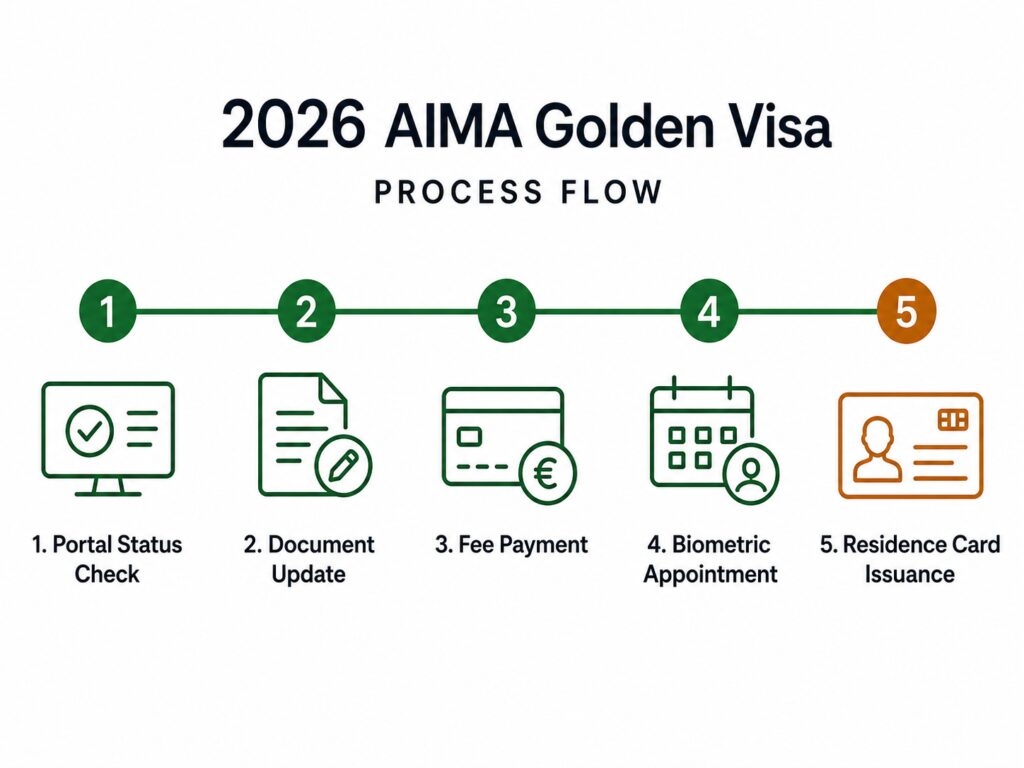
AIMA processing update timeline for Portugal Golden Visa news in 2026

Citizenship Timeline Debate: Where Things Stand

The citizenship timeline debate has been the most important 2026 policy issue for many investors. The Golden Visa still grants residence, but the expected timeline to Portuguese citizenship has changed under the nationality law reform.

Before 2026, many investors planned around a five-year legal residence timeline before applying for naturalisation, subject to language and other legal requirements. In 2026, Portugal moved to longer residence periods for naturalisation.

The updated nationality law published in the Diário da República states that naturalisation requires at least seven years of legal residence for nationals of Portuguese-speaking countries and EU member states, or ten years for nationals of other countries.

For many Golden Visa investors from the United States, the Middle East, China, South Africa, and other non-EU, non-CPLP countries, the relevant planning assumption is therefore no longer five years for citizenship eligibility. It is generally ten years, subject to individual legal advice and any transitional treatment that may apply.

Parliament Vote Recap

The 2026 nationality law change followed parliamentary debate, review, and presidential approval. The Government described the reform as a move toward stricter evidence of a real connection to Portugal, including longer residence periods and additional integration requirements.

The Portuguese Government’s summary described the approved proposal as one that reinforces criteria of effective connection to the national community and extends residence periods.

The political landscape matters because immigration and nationality rules are no longer treated as quiet technical topics. They are now part of broader parliamentary debate about migration, integration, administrative capacity, and national identity.

For investors, this creates a simple practical rule. Do not base a Portugal Golden Visa decision on old citizenship timelines. Base it on the current law, with legal review before applying.

Grandfathering Protections for Existing Applicants

Grandfathering is one of the most sensitive points in 2026. Investors want to know whether people who already applied, already paid fees, or already hold ARI residence cards are protected from the new timeline.

The President’s statement on promulgation noted the importance of ensuring that pending processes are not effectively affected by the legislative change and that legal time counting should not be harmed by state delays. That is an important political and legal signal, but applicants should still avoid assuming a universal outcome without case-specific advice.

In practical terms, existing applicants should ask three questions:

  • Was my ARI application already submitted before the legal change?
  • Was my residence card already issued?
  • If I later apply for nationality, which law and counting method will apply to my file?

These are not questions for general blog content alone. They require legal review of the applicant’s timeline, payment receipts, ARI portal status, residence card dates, and any pending nationality steps.

NHR to IFICI: Tax Regime Transition Update

Tax planning is another major 2026 update. The old NHR, Non-Habitual Resident, regime has been replaced for new applicants by IFICI, the Tax Incentive for Scientific Research and Innovation, for eligible profiles.

This does not mean every Golden Visa investor automatically receives IFICI benefits. Residency status and tax residency are different. A Golden Visa holder may maintain residence rights without becoming Portuguese tax resident if they do not relocate or meet Portuguese tax residence criteria.

For investors who are considering relocating to Portugal, tax planning should happen before the move, not after the first tax filing. The Portuguese Tax and Living Info portal should be used for official tax information, while the applicant’s tax advisor should assess cross-border exposure.

Here is the practical distinction:

Situation Golden Visa Impact Tax Impact
Investor keeps main home outside Portugal Golden Visa can still be maintained if ARI rules are met Portuguese tax residency may not arise automatically
Investor relocates to Portugal Residence permit supports legal stay Tax residency and IFICI eligibility must be reviewed
Investor previously qualified for NHR Existing NHR status may continue under transitional rules Confirm status with tax advisor
New resident in 2026 NHR is generally no longer the planning route IFICI may apply only to eligible profiles

Investors comparing living costs, tax exposure, and relocation plans can also use official European data such as the EU Cost of Living Index, but tax outcomes should not be decided from cost-of-living tables alone.

Portugal Golden Visa

Start Your Portugal Golden Visa Journey

Receive personalized legal guidance from experienced immigration lawyers and discover the most effective pathway to securing your Portugal Golden Visa.

Book Your Free Consultation →
✓ No Obligation   •   ✓ Licensed Lawyers   •   ✓ Confidential Consultation

American and Global Investor Interest in 2026

American investor interest remains an important part of the Portugal Golden Visa conversation in 2026, but the questions have changed.

In earlier years, many US investors focused on EU mobility, Schengen access, political diversification, and a possible five-year citizenship pathway. In 2026, the conversation is more cautious. Investors now ask whether the programme still makes sense if citizenship takes longer.

For many families, the answer may still be yes. The Portugal Golden Visa can still provide:

  • A legal residence permit in Portugal
  • Schengen Area mobility
  • A route to long-term EU optionality
  • A family-inclusive residence strategy
  • Flexibility for people who do not want to relocate immediately

But the value proposition is different from a fast-track passport story. It is now more accurately described as a long-term residence and optionality strategy.

For families comparing daily life, schools, healthcare, housing, and local administration, the full expat living guide is a better next step than reading programme rules in isolation. Residency is the legal structure. Living in Portugal is the practical reality.
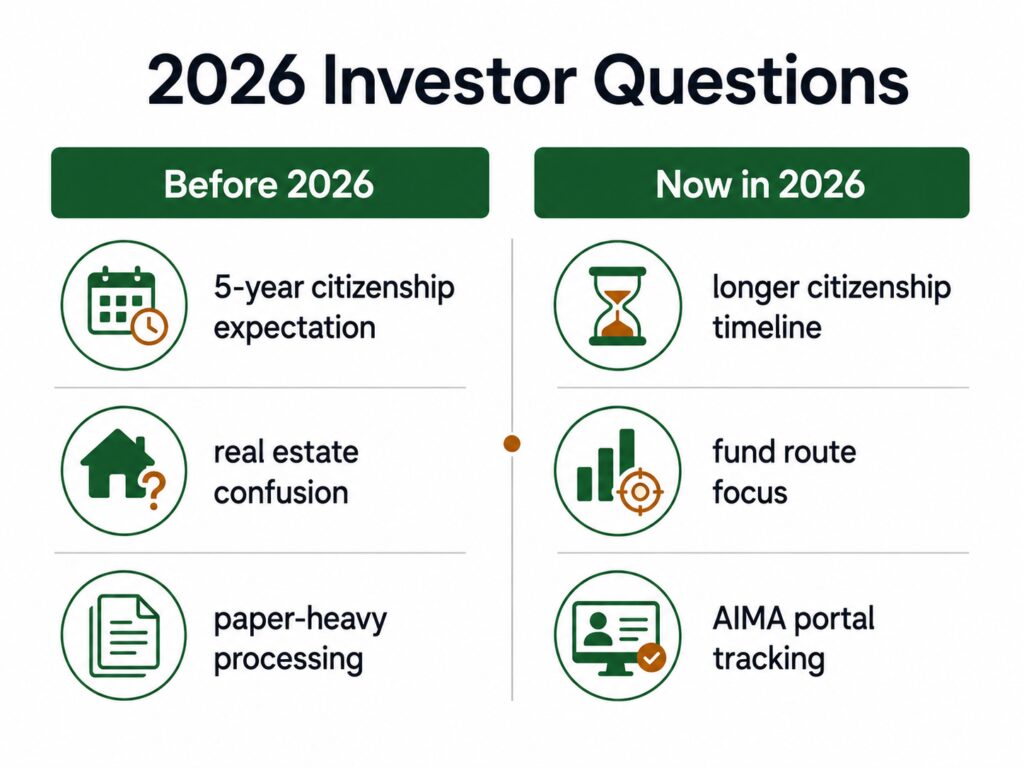
Portugal Golden Visa 2026 investor questions and latest policy updates

What to Watch in the Second Half of 2026

The second half of 2026 will be important because investors need to see how the new legal framework works in practice, not only on paper.

The main issues to watch are:

  1. AIMA processing capacity
    Investors should monitor whether AIMA continues improving renewals, biometric appointment scheduling, and document review timelines.
  2. Nationality law interpretation
    Lawyers will be watching how the new citizenship timeline applies to pending cases, current residence holders, and future applicants.
  3. Grandfathering practice
    The key question is not only what officials say in political statements. It is how registry offices and courts apply the rules in real files.
  4. Fund route supervision
    Investors should continue checking whether the investment vehicle is properly regulated and compatible with ARI rules.
  5. Tax regime clarity
    IFICI will matter for relocating professionals, but it will not apply to every Golden Visa investor. Eligibility must be confirmed before tax residency begins.

The most important investor habit in 2026 is source discipline. Read official sources first, then ask legal and tax advisors how those sources apply to your facts.

FAQs: Portugal Golden Visa News 2026

What is the latest news on the Portugal Golden Visa in 2026?

The latest Portugal Golden Visa news in 2026 is that the ARI programme remains open, but Portugal has changed the citizenship timeline through the nationality law reform. AIMA is also continuing to adjust processing and renewal systems, including greater use of online portals. Investors should separate residency rules from citizenship rules because they are not the same legal step.

Is the Portugal Golden Visa still available in 2026?

Yes. The Portugal Golden Visa remains available in 2026 for eligible non-EU investors through qualifying investment routes. However, real estate purchases no longer qualify after the 2023 reform. Investors should verify the current route, fund structure, and application requirements before committing capital.

What changes have been announced recently?

The most important recent changes relate to the citizenship timeline, AIMA processing systems, ARI renewals, and the transition from NHR to IFICI for eligible new tax residents. The Golden Visa residence permit itself has not disappeared. The bigger change is how investors should plan the long-term path from residence to possible citizenship.

Where can I find official updates?

Official updates should be checked through AIMA, the Diário da República, the Portuguese Government portal, and Portal das Finanças for tax matters. Investors should avoid relying only on forums, old articles, or commercial summaries. Those sources may be useful for context, but official legal and administrative sources should come first.

What This Means for Investors

Portugal remains a serious EU residency option in 2026, but the planning assumptions have changed. The Golden Visa is still open, AIMA is still processing ARI cases, and the fund route remains central for most private investors.

The main caution is the citizenship timeline. Investors who entered the programme expecting a simple five-year passport pathway should review their position carefully. New applicants should treat the programme as a long-term residence strategy first, with citizenship as a later legal possibility subject to the law in force.

Ready to take the next step?
Book a free initial assessment. We’ll assess your eligibility, walk through the current qualifying routes, and answer your questions, no cost, no commitment.


Portugal Golden Visa News: Latest 2026 Updates

Portugal golden visa news in 2026 is no longer about whether the programme still exists. It does. The real questions are now more specific: how AIMA is processing applications, how the new citizenship timeline affects long-term planning, and whether Portugal remains a practical EU residency strategy after the latest legal and tax changes.

The short answer is clear. The Portugal Golden Visa remains open, but the rules around citizenship timing, renewals, and tax planning require closer review than they did a year ago.

Portugal Golden Visa Latest Updates in 2026

The 2026 update is best understood as three separate developments. The ARI residence permit remains available, AIMA has continued changing how applications and renewals are handled, and Portugal has changed the citizenship timeline for naturalisation.

2026 Update What Changed Why It Matters
Programme status ARI remains available for eligible non-EU investors The programme has not closed
Real estate route Real estate still does not qualify after the 2023 reform Investors should avoid outdated property-based advice
AIMA processing Renewals and appointments are increasingly handled through online systems Applicants need to track portal status closely
Citizenship law Naturalisation timelines were extended under the 2026 nationality reform Long-term passport planning now needs legal review
Tax regime NHR has moved into the IFICI framework for eligible new tax residents Tax planning depends on the applicant profile

The important distinction is this: the portugal golden visa is still a residency-by-investment programme. It is not a direct citizenship-by-investment programme. Citizenship may become possible later, subject to the nationality law in force when the applicant applies.

Portugal Golden Visa news 2026 update for investors reviewing ARI changes

Program Status: Is the Golden Visa Still Open?

Yes. The Portugal Golden Visa remains open in 2026 through the ARI, or Autorização de Residência para Investimento, which is the formal name of the residence permit for investment activity.

According to the AIMA official portal, the ARI regime allows eligible third-country nationals to obtain temporary residence through qualifying investment activity, with rights that include residence in Portugal, Schengen circulation, family reunification, and the possibility of later applying for permanent residence or nationality if the legal requirements are met.

What has not returned is the old real estate route. Since the 2023 legislative reform, residential real estate purchases no longer qualify for Portugal Golden Visa purposes. Investors who still see online claims about buying property for a Portugal Golden Visa should treat that content as outdated unless it clearly explains the post-2023 rules.

For most private investors, the main practical route remains a qualifying fund investment, provided the fund structure and investment meet the applicable requirements. Fund selection should be treated as an immigration, legal, and investment due diligence exercise, not simply as a subscription form.

The key takeaway is simple. Programme continuity is intact, but the old real estate-driven version of the programme is not.

AIMA Processing Updates

AIMA, the Agency for Integration, Migration and Asylum, replaced SEF, Serviço de Estrangeiros e Fronteiras, as Portugal’s immigration authority. For Golden Visa applicants, AIMA updates matter because they affect biometric appointments, renewals, document uploads, and communication with the ARI portal.

AIMA has been working through inherited immigration backlogs while also modernising parts of the process. That means investors should expect more digital interaction, but not necessarily instant processing.

Biometric Appointment Wait Times

Biometric appointment changes remain one of the biggest practical issues for ARI applicants in 2026. The biometric appointment is where identity data such as fingerprints and photographs are collected so the residence card can be issued.

There is no single official wait time that applies to every Golden Visa case. Timing can vary based on:

  • Application status
  • Whether the file is new or pending from an earlier stage
  • Whether family members are included
  • Whether updated documents are required
  • AIMA service centre availability
  • Whether the applicant has already attended an in-person appointment

Applicants should not rely on informal estimates from forums or old case studies. A better approach is to track the ARI portal status and work with legal counsel to determine whether AIMA expects further documentation, appointment scheduling, or payment action.

For pending cases, document validity is especially important. Criminal record certificates, passport scans, tax confirmations, proof of investment, and family documentation may need updating before AIMA can move the file forward.

Auto-Renewal Status

The 2026 renewal update is not a universal automatic renewal for every ARI holder. The more accurate description is that AIMA has expanded online renewal handling through its renewals portal.

This matters because some investors assume that an expired or expiring card renews without action. That assumption is risky. AIMA may still require the applicant to submit a request, pay applicable fees, update records, or provide biometric data before the renewed card is issued.

For ARI holders, the safest renewal checklist is:

  1. Check whether the residence card is eligible for online renewal.
  2. Confirm that NIF, address, passport, and contact details are accurate.
  3. Review whether any family members are attached to the same process.
  4. Keep proof of submission and payment.
  5. Watch for AIMA messages about biometrics or document verification.

The renewal process is more digital than before, but it is still an administrative process. Investors should treat it like a deadline-driven legal filing, not a passive update.

AIMA processing update timeline for Portugal Golden Visa news in 2026

Citizenship Timeline Debate: Where Things Stand

The citizenship timeline debate has been the most important 2026 policy issue for many investors. The Golden Visa still grants residence, but the expected timeline to Portuguese citizenship has changed under the nationality law reform.

Before 2026, many investors planned around a five-year legal residence timeline before applying for naturalisation, subject to language and other legal requirements. In 2026, Portugal moved to longer residence periods for naturalisation.

The updated nationality law published in the Diário da República states that naturalisation requires at least seven years of legal residence for nationals of Portuguese-speaking countries and EU member states, or ten years for nationals of other countries.

For many Golden Visa investors from the United States, the Middle East, China, South Africa, and other non-EU, non-CPLP countries, the relevant planning assumption is therefore no longer five years for citizenship eligibility. It is generally ten years, subject to individual legal advice and any transitional treatment that may apply.

Parliament Vote Recap

The 2026 nationality law change followed parliamentary debate, review, and presidential approval. The Government described the reform as a move toward stricter evidence of a real connection to Portugal, including longer residence periods and additional integration requirements.

The Portuguese Government’s summary described the approved proposal as one that reinforces criteria of effective connection to the national community and extends residence periods.

The political landscape matters because immigration and nationality rules are no longer treated as quiet technical topics. They are now part of broader parliamentary debate about migration, integration, administrative capacity, and national identity.

For investors, this creates a simple practical rule. Do not base a Portugal Golden Visa decision on old citizenship timelines. Base it on the current law, with legal review before applying.

Grandfathering Protections for Existing Applicants

Grandfathering is one of the most sensitive points in 2026. Investors want to know whether people who already applied, already paid fees, or already hold ARI residence cards are protected from the new timeline.

The President’s statement on promulgation noted the importance of ensuring that pending processes are not effectively affected by the legislative change and that legal time counting should not be harmed by state delays. That is an important political and legal signal, but applicants should still avoid assuming a universal outcome without case-specific advice.

In practical terms, existing applicants should ask three questions:

  • Was my ARI application already submitted before the legal change?
  • Was my residence card already issued?
  • If I later apply for nationality, which law and counting method will apply to my file?

These are not questions for general blog content alone. They require legal review of the applicant’s timeline, payment receipts, ARI portal status, residence card dates, and any pending nationality steps.

NHR to IFICI: Tax Regime Transition Update

Tax planning is another major 2026 update. The old NHR, Non-Habitual Resident, regime has been replaced for new applicants by IFICI, the Tax Incentive for Scientific Research and Innovation, for eligible profiles.

This does not mean every Golden Visa investor automatically receives IFICI benefits. Residency status and tax residency are different. A Golden Visa holder may maintain residence rights without becoming Portuguese tax resident if they do not relocate or meet Portuguese tax residence criteria.

For investors who are considering relocating to Portugal, tax planning should happen before the move, not after the first tax filing. The Portuguese Tax and Living Info portal should be used for official tax information, while the applicant’s tax advisor should assess cross-border exposure.

Here is the practical distinction:

Situation Golden Visa Impact Tax Impact
Investor keeps main home outside Portugal Golden Visa can still be maintained if ARI rules are met Portuguese tax residency may not arise automatically
Investor relocates to Portugal Residence permit supports legal stay Tax residency and IFICI eligibility must be reviewed
Investor previously qualified for NHR Existing NHR status may continue under transitional rules Confirm status with tax advisor
New resident in 2026 NHR is generally no longer the planning route IFICI may apply only to eligible profiles

Investors comparing living costs, tax exposure, and relocation plans can also use official European data such as the EU Cost of Living Index, but tax outcomes should not be decided from cost-of-living tables alone.

Portugal Golden Visa

Start Your Portugal Golden Visa Journey

Receive personalized legal guidance from experienced immigration lawyers and discover the most effective pathway to securing your Portugal Golden Visa.

Book Your Free Consultation →
✓ No Obligation   •   ✓ Licensed Lawyers   •   ✓ Confidential Consultation

American and Global Investor Interest in 2026

American investor interest remains an important part of the Portugal Golden Visa conversation in 2026, but the questions have changed.

In earlier years, many US investors focused on EU mobility, Schengen access, political diversification, and a possible five-year citizenship pathway. In 2026, the conversation is more cautious. Investors now ask whether the programme still makes sense if citizenship takes longer.

For many families, the answer may still be yes. The Portugal Golden Visa can still provide:

  • A legal residence permit in Portugal
  • Schengen Area mobility
  • A route to long-term EU optionality
  • A family-inclusive residence strategy
  • Flexibility for people who do not want to relocate immediately

But the value proposition is different from a fast-track passport story. It is now more accurately described as a long-term residence and optionality strategy.

For families comparing daily life, schools, healthcare, housing, and local administration, the full expat living guide is a better next step than reading programme rules in isolation. Residency is the legal structure. Living in Portugal is the practical reality.

Portugal Golden Visa 2026 investor questions and latest policy updates

What to Watch in the Second Half of 2026

The second half of 2026 will be important because investors need to see how the new legal framework works in practice, not only on paper.

The main issues to watch are:

  1. AIMA processing capacity
    Investors should monitor whether AIMA continues improving renewals, biometric appointment scheduling, and document review timelines.
  2. Nationality law interpretation
    Lawyers will be watching how the new citizenship timeline applies to pending cases, current residence holders, and future applicants.
  3. Grandfathering practice
    The key question is not only what officials say in political statements. It is how registry offices and courts apply the rules in real files.
  4. Fund route supervision
    Investors should continue checking whether the investment vehicle is properly regulated and compatible with ARI rules.
  5. Tax regime clarity
    IFICI will matter for relocating professionals, but it will not apply to every Golden Visa investor. Eligibility must be confirmed before tax residency begins.

The most important investor habit in 2026 is source discipline. Read official sources first, then ask legal and tax advisors how those sources apply to your facts.

FAQs: Portugal Golden Visa News 2026

What is the latest news on the Portugal Golden Visa in 2026?

The latest Portugal Golden Visa news in 2026 is that the ARI programme remains open, but Portugal has changed the citizenship timeline through the nationality law reform. AIMA is also continuing to adjust processing and renewal systems, including greater use of online portals. Investors should separate residency rules from citizenship rules because they are not the same legal step.

Is the Portugal Golden Visa still available in 2026?

Yes. The Portugal Golden Visa remains available in 2026 for eligible non-EU investors through qualifying investment routes. However, real estate purchases no longer qualify after the 2023 reform. Investors should verify the current route, fund structure, and application requirements before committing capital.

What changes have been announced recently?

The most important recent changes relate to the citizenship timeline, AIMA processing systems, ARI renewals, and the transition from NHR to IFICI for eligible new tax residents. The Golden Visa residence permit itself has not disappeared. The bigger change is how investors should plan the long-term path from residence to possible citizenship.

Where can I find official updates?

Official updates should be checked through AIMA, the Diário da República, the Portuguese Government portal, and Portal das Finanças for tax matters. Investors should avoid relying only on forums, old articles, or commercial summaries. Those sources may be useful for context, but official legal and administrative sources should come first.

What This Means for Investors

Portugal remains a serious EU residency option in 2026, but the planning assumptions have changed. The Golden Visa is still open, AIMA is still processing ARI cases, and the fund route remains central for most private investors.

The main caution is the citizenship timeline. Investors who entered the programme expecting a simple five-year passport pathway should review their position carefully. New applicants should treat the programme as a long-term residence strategy first, with citizenship as a later legal possibility subject to the law in force.

Ready to take the next step?
Book a free initial assessment. We’ll assess your eligibility, walk through the current qualifying routes, and answer your questions, no cost, no commitment.

Portugal Golden Visa News: Latest 2026 Updates

Portugal Golden Visa news 2026 update for investors reviewing ARI changes
Portugal golden visa news in 2026 is no longer about whether the programme still exists. It does. The real questions are now more specific: how AIMA is processing applications, how the new citizenship timeline affects long-term planning, and whether Portugal remains a practical EU residency strategy after the latest legal and tax changes.

The short answer is clear. The Portugal Golden Visa remains open, but the rules around citizenship timing, renewals, and tax planning require closer review than they did a year ago.

Portugal Golden Visa Latest Updates in 2026

The 2026 update is best understood as three separate developments. The ARI residence permit remains available, AIMA has continued changing how applications and renewals are handled, and Portugal has changed the citizenship timeline for naturalisation.

2026 Update What Changed Why It Matters
Programme status ARI remains available for eligible non-EU investors The programme has not closed
Real estate route Real estate still does not qualify after the 2023 reform Investors should avoid outdated property-based advice
AIMA processing Renewals and appointments are increasingly handled through online systems Applicants need to track portal status closely
Citizenship law Naturalisation timelines were extended under the 2026 nationality reform Long-term passport planning now needs legal review
Tax regime NHR has moved into the IFICI framework for eligible new tax residents Tax planning depends on the applicant profile

The important distinction is this: the portugal golden visa is still a residency-by-investment programme. It is not a direct citizenship-by-investment programme. Citizenship may become possible later, subject to the nationality law in force when the applicant applies.

Portugal Golden Visa news 2026 update for investors reviewing ARI changes

Program Status: Is the Golden Visa Still Open?

Yes. The Portugal Golden Visa remains open in 2026 through the ARI, or Autorização de Residência para Investimento, which is the formal name of the residence permit for investment activity.

According to the AIMA official portal, the ARI regime allows eligible third-country nationals to obtain temporary residence through qualifying investment activity, with rights that include residence in Portugal, Schengen circulation, family reunification, and the possibility of later applying for permanent residence or nationality if the legal requirements are met.

What has not returned is the old real estate route. Since the 2023 legislative reform, residential real estate purchases no longer qualify for Portugal Golden Visa purposes. Investors who still see online claims about buying property for a Portugal Golden Visa should treat that content as outdated unless it clearly explains the post-2023 rules.

For most private investors, the main practical route remains a qualifying fund investment, provided the fund structure and investment meet the applicable requirements. Fund selection should be treated as an immigration, legal, and investment due diligence exercise, not simply as a subscription form.

The key takeaway is simple. Programme continuity is intact, but the old real estate-driven version of the programme is not.

AIMA Processing Updates

AIMA, the Agency for Integration, Migration and Asylum, replaced SEF, Serviço de Estrangeiros e Fronteiras, as Portugal’s immigration authority. For Golden Visa applicants, AIMA updates matter because they affect biometric appointments, renewals, document uploads, and communication with the ARI portal.

AIMA has been working through inherited immigration backlogs while also modernising parts of the process. That means investors should expect more digital interaction, but not necessarily instant processing.

Biometric Appointment Wait Times

Biometric appointment changes remain one of the biggest practical issues for ARI applicants in 2026. The biometric appointment is where identity data such as fingerprints and photographs are collected so the residence card can be issued.

There is no single official wait time that applies to every Golden Visa case. Timing can vary based on:

  • Application status
  • Whether the file is new or pending from an earlier stage
  • Whether family members are included
  • Whether updated documents are required
  • AIMA service centre availability
  • Whether the applicant has already attended an in-person appointment

Applicants should not rely on informal estimates from forums or old case studies. A better approach is to track the ARI portal status and work with legal counsel to determine whether AIMA expects further documentation, appointment scheduling, or payment action.

For pending cases, document validity is especially important. Criminal record certificates, passport scans, tax confirmations, proof of investment, and family documentation may need updating before AIMA can move the file forward.

Auto-Renewal Status

The 2026 renewal update is not a universal automatic renewal for every ARI holder. The more accurate description is that AIMA has expanded online renewal handling through its renewals portal.

This matters because some investors assume that an expired or expiring card renews without action. That assumption is risky. AIMA may still require the applicant to submit a request, pay applicable fees, update records, or provide biometric data before the renewed card is issued.

For ARI holders, the safest renewal checklist is:

  1. Check whether the residence card is eligible for online renewal.
  2. Confirm that NIF, address, passport, and contact details are accurate.
  3. Review whether any family members are attached to the same process.
  4. Keep proof of submission and payment.
  5. Watch for AIMA messages about biometrics or document verification.

The renewal process is more digital than before, but it is still an administrative process. Investors should treat it like a deadline-driven legal filing, not a passive update.

AIMA processing update timeline for Portugal Golden Visa news in 2026

Citizenship Timeline Debate: Where Things Stand

The citizenship timeline debate has been the most important 2026 policy issue for many investors. The Golden Visa still grants residence, but the expected timeline to Portuguese citizenship has changed under the nationality law reform.

Before 2026, many investors planned around a five-year legal residence timeline before applying for naturalisation, subject to language and other legal requirements. In 2026, Portugal moved to longer residence periods for naturalisation.

The updated nationality law published in the Diário da República states that naturalisation requires at least seven years of legal residence for nationals of Portuguese-speaking countries and EU member states, or ten years for nationals of other countries.

For many Golden Visa investors from the United States, the Middle East, China, South Africa, and other non-EU, non-CPLP countries, the relevant planning assumption is therefore no longer five years for citizenship eligibility. It is generally ten years, subject to individual legal advice and any transitional treatment that may apply.

Parliament Vote Recap

The 2026 nationality law change followed parliamentary debate, review, and presidential approval. The Government described the reform as a move toward stricter evidence of a real connection to Portugal, including longer residence periods and additional integration requirements.

The Portuguese Government’s summary described the approved proposal as one that reinforces criteria of effective connection to the national community and extends residence periods.

The political landscape matters because immigration and nationality rules are no longer treated as quiet technical topics. They are now part of broader parliamentary debate about migration, integration, administrative capacity, and national identity.

For investors, this creates a simple practical rule. Do not base a Portugal Golden Visa decision on old citizenship timelines. Base it on the current law, with legal review before applying.

Grandfathering Protections for Existing Applicants

Grandfathering is one of the most sensitive points in 2026. Investors want to know whether people who already applied, already paid fees, or already hold ARI residence cards are protected from the new timeline.

The President’s statement on promulgation noted the importance of ensuring that pending processes are not effectively affected by the legislative change and that legal time counting should not be harmed by state delays. That is an important political and legal signal, but applicants should still avoid assuming a universal outcome without case-specific advice.

In practical terms, existing applicants should ask three questions:

  • Was my ARI application already submitted before the legal change?
  • Was my residence card already issued?
  • If I later apply for nationality, which law and counting method will apply to my file?

These are not questions for general blog content alone. They require legal review of the applicant’s timeline, payment receipts, ARI portal status, residence card dates, and any pending nationality steps.

NHR to IFICI: Tax Regime Transition Update

Tax planning is another major 2026 update. The old NHR, Non-Habitual Resident, regime has been replaced for new applicants by IFICI, the Tax Incentive for Scientific Research and Innovation, for eligible profiles.

This does not mean every Golden Visa investor automatically receives IFICI benefits. Residency status and tax residency are different. A Golden Visa holder may maintain residence rights without becoming Portuguese tax resident if they do not relocate or meet Portuguese tax residence criteria.

For investors who are considering relocating to Portugal, tax planning should happen before the move, not after the first tax filing. The Portuguese Tax and Living Info portal should be used for official tax information, while the applicant’s tax advisor should assess cross-border exposure.

Here is the practical distinction:

Situation Golden Visa Impact Tax Impact
Investor keeps main home outside Portugal Golden Visa can still be maintained if ARI rules are met Portuguese tax residency may not arise automatically
Investor relocates to Portugal Residence permit supports legal stay Tax residency and IFICI eligibility must be reviewed
Investor previously qualified for NHR Existing NHR status may continue under transitional rules Confirm status with tax advisor
New resident in 2026 NHR is generally no longer the planning route IFICI may apply only to eligible profiles

Investors comparing living costs, tax exposure, and relocation plans can also use official European data such as the EU Cost of Living Index, but tax outcomes should not be decided from cost-of-living tables alone.

Portugal Golden Visa

Start Your Portugal Golden Visa Journey

Receive personalized legal guidance from experienced immigration lawyers and discover the most effective pathway to securing your Portugal Golden Visa.

Book Your Free Consultation →
✓ No Obligation   •   ✓ Licensed Lawyers   •   ✓ Confidential Consultation

American and Global Investor Interest in 2026

American investor interest remains an important part of the Portugal Golden Visa conversation in 2026, but the questions have changed.

In earlier years, many US investors focused on EU mobility, Schengen access, political diversification, and a possible five-year citizenship pathway. In 2026, the conversation is more cautious. Investors now ask whether the programme still makes sense if citizenship takes longer.

For many families, the answer may still be yes. The Portugal Golden Visa can still provide:

  • A legal residence permit in Portugal
  • Schengen Area mobility
  • A route to long-term EU optionality
  • A family-inclusive residence strategy
  • Flexibility for people who do not want to relocate immediately

But the value proposition is different from a fast-track passport story. It is now more accurately described as a long-term residence and optionality strategy.

For families comparing daily life, schools, healthcare, housing, and local administration, the full expat living guide is a better next step than reading programme rules in isolation. Residency is the legal structure. Living in Portugal is the practical reality.

Portugal Golden Visa 2026 investor questions and latest policy updates

What to Watch in the Second Half of 2026

The second half of 2026 will be important because investors need to see how the new legal framework works in practice, not only on paper.

The main issues to watch are:

  1. AIMA processing capacity
    Investors should monitor whether AIMA continues improving renewals, biometric appointment scheduling, and document review timelines.
  2. Nationality law interpretation
    Lawyers will be watching how the new citizenship timeline applies to pending cases, current residence holders, and future applicants.
  3. Grandfathering practice
    The key question is not only what officials say in political statements. It is how registry offices and courts apply the rules in real files.
  4. Fund route supervision
    Investors should continue checking whether the investment vehicle is properly regulated and compatible with ARI rules.
  5. Tax regime clarity
    IFICI will matter for relocating professionals, but it will not apply to every Golden Visa investor. Eligibility must be confirmed before tax residency begins.

The most important investor habit in 2026 is source discipline. Read official sources first, then ask legal and tax advisors how those sources apply to your facts.

FAQs: Portugal Golden Visa News 2026

What is the latest news on the Portugal Golden Visa in 2026?

The latest Portugal Golden Visa news in 2026 is that the ARI programme remains open, but Portugal has changed the citizenship timeline through the nationality law reform. AIMA is also continuing to adjust processing and renewal systems, including greater use of online portals. Investors should separate residency rules from citizenship rules because they are not the same legal step.

Is the Portugal Golden Visa still available in 2026?

Yes. The Portugal Golden Visa remains available in 2026 for eligible non-EU investors through qualifying investment routes. However, real estate purchases no longer qualify after the 2023 reform. Investors should verify the current route, fund structure, and application requirements before committing capital.

What changes have been announced recently?

The most important recent changes relate to the citizenship timeline, AIMA processing systems, ARI renewals, and the transition from NHR to IFICI for eligible new tax residents. The Golden Visa residence permit itself has not disappeared. The bigger change is how investors should plan the long-term path from residence to possible citizenship.

Where can I find official updates?

Official updates should be checked through AIMA, the Diário da República, the Portuguese Government portal, and Portal das Finanças for tax matters. Investors should avoid relying only on forums, old articles, or commercial summaries. Those sources may be useful for context, but official legal and administrative sources should come first.

What This Means for Investors

Portugal remains a serious EU residency option in 2026, but the planning assumptions have changed. The Golden Visa is still open, AIMA is still processing ARI cases, and the fund route remains central for most private investors.

The main caution is the citizenship timeline. Investors who entered the programme expecting a simple five-year passport pathway should review their position carefully. New applicants should treat the programme as a long-term residence strategy first, with citizenship as a later legal possibility subject to the law in force.

Ready to take the next step?
Book a free initial assessment. We’ll assess your eligibility, walk through the current qualifying routes, and answer your questions, no cost, no commitment.

What do you think?
Blog

More Related Articles

top