
The portugal golden visa gives non-EU investors a route to Portuguese residency, subject to eligibility, while allowing a low physical stay requirement. But if you are thinking beyond the application and asking what day-to-day life actually feels like, this guide covers the practical realities investors should understand before moving.
What Expats and Golden Visa Holders Say About Living in Portugal
Portugal expat life tends to attract people who want European residency without the intensity, cost or pace of larger Western European markets. The country offers a stable legal environment, access to the Schengen Area, strong international connectivity and a lifestyle that feels manageable for families, retirees and globally mobile investors.
For Golden Visa holders, the key distinction is flexibility. The ARI, or Autorização de Residência para Investimento, is the formal Portuguese name for the Golden Visa residence permit. AIMA, the Agency for Integration, Migration and Asylum, manages immigration processing through the AIMA official ARI portal, following the transition from SEF, the former immigration authority.
That flexibility matters. Investors do not need to relocate full-time immediately. Many spend part of the year in Portugal, test different cities, evaluate schools or healthcare, and then decide whether a more permanent move makes sense.
The most common positive feedback from expats is consistent:
- Portugal feels safe and politically stable.
- Daily life is slower than in London, New York, Dubai or São Paulo.
- English is widely spoken in Lisbon, Porto and the Algarve.
- Healthcare and international schools are accessible in major regions.
- Travel within Europe is straightforward through Schengen travel rights.
The common frustrations are also predictable:
- Bureaucracy can be slow.
- Banking as a foreigner takes patience.
- Housing costs have risen in Lisbon, Porto and parts of the Algarve.
- The language barrier becomes more noticeable outside large cities.
- Tax planning needs professional advice, especially after the NHR tax regime changes.
This is why Portugal works best for investors who plan carefully rather than assume every part of expat life will be effortless.
Best Cities and Regions for Expat Life
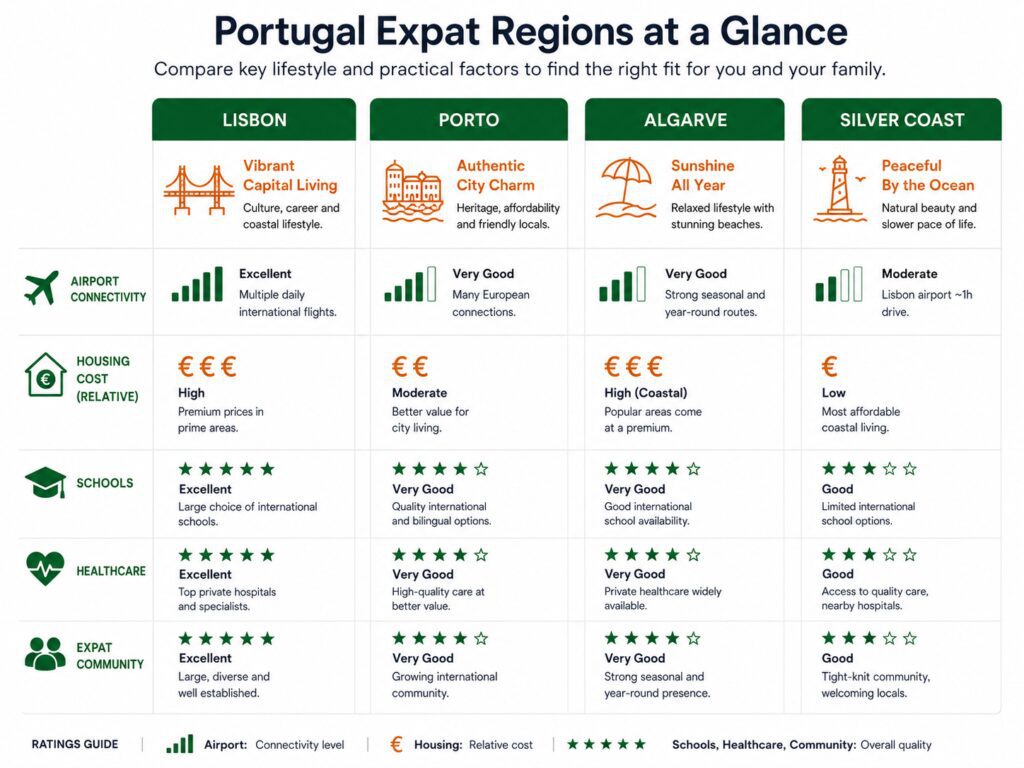
The best place to live in Portugal depends on your family structure, budget, lifestyle and how often you plan to travel. Lisbon, Porto, the Algarve and the Silver Coast all attract foreign residents, but they serve different priorities.
| Region | Best for | Main advantage | Main trade-off |
| Lisbon | Business owners, families, frequent travelers | International schools, airport access, professional networks | Higher housing costs |
| Porto | Investors wanting culture and lower costs | Strong city life with better value than Lisbon | Wetter climate |
| Algarve | Retirees, families, lifestyle-focused expats | Space, beaches, established expat community Portugal | Seasonal variation in some towns |
| Silver Coast | Cost-conscious families and retirees | Lower costs and natural beauty | Less international infrastructure |
Lisbon: Culture Cost and Connectivity
Lisbon is the default choice for many investors moving to Portugal expat life because it offers the strongest mix of connectivity, schools, business services and international community. Lisbon neighborhoods such as Chiado, Príncipe Real, Campo de Ourique, Estrela, Avenidas Novas and Parque das Nações attract different profiles of foreign residents.
The city works especially well for families who need international schools, professionals who travel frequently, and investors who want access to lawyers, tax advisors, private banks and fund managers.
The trade-off is cost. Lisbon is no longer the low-cost capital many expats remember from ten years ago. Rent, school fees and premium services can be high, so investors should compare lifestyle expectations against a realistic cost of living breakdown before choosing the city.
Porto: Affordable and Authentic
Porto offers a strong alternative for investors who want city life without Lisbon’s pricing. Porto neighborhoods such as Foz do Douro, Boavista, Cedofeita and Vila Nova de Gaia are popular with expats who want culture, restaurants, walkability and access to the Douro Valley.
The city has a more traditional feel than Lisbon, while still offering good healthcare, universities, coworking spaces and international flights.
Porto is especially attractive to people who want Portugal for expats without feeling surrounded only by other expats. It is a good fit for investors who value authenticity and lower living costs, but still want urban infrastructure.
Algarve: Sun Space and Expat Community
The Algarve is one of the strongest regions for foreign retirees, semi-retired investors and families seeking more space. Towns such as Lagos, Tavira, Vilamoura, Albufeira and Faro each offer a different version of expat life.
The region has an established expat community Portugal, good private healthcare options, international schools in selected areas and a climate that suits people moving from colder countries.
The Algarve is not only for retirees, but it is especially popular with them. For investors comparing Portugal as a destination for foreign retirees, the Algarve usually appears early in the shortlist because it combines safety, English-speaking services and a slower pace of life.
Silver Coast: Lower Costs Natural Beauty
The Silver Coast appeals to investors who want lower costs, coastal living and less tourist pressure than the Algarve. Areas such as Nazaré, Caldas da Rainha, Óbidos and Peniche offer access to beaches, natural landscapes and growing international communities.
The region can be a strong choice for families or retirees who do not need daily access to a major airport or a large international school network. It is also worth considering for buyers and renters who feel Lisbon and the Algarve have become too expensive.
Safety and Quality of Life
Safety is one of Portugal’s strongest practical advantages. For families, retirees and internationally mobile investors, it often matters more than lifestyle marketing. A country can be beautiful, but if it does not feel safe, the long-term relocation case weakens quickly.
Portugal Global Peace Index Ranking
Portugal consistently ranks highly for peace and safety. In the 2025 Global Peace Index by the Institute for Economics and Peace, Portugal ranked 7th worldwide, according to the Global Peace Index Portugal data.
That ranking reflects a broader safety index picture that many expats notice in daily life. Violent crime is relatively low by international standards, public spaces feel usable, and families often feel comfortable walking in residential areas at night.
Still, safety varies by neighborhood, as it does in every country. Investors should evaluate where they plan to live, not only the country-level ranking.
Healthcare Quality for Foreign Residents
Portugal has a public healthcare system known as the SNS, or Serviço Nacional de Saúde. Foreign residents with proper residency status may access public healthcare, although registration steps and waiting times vary by location.
Many Golden Visa investors use a mixed model:
- Public healthcare SNS for basic access and long-term residency coverage
- Private health insurance for faster appointments
- International clinics in Lisbon, Porto or the Algarve for English-speaking care
- Specialist private hospitals for planned procedures or family care
Healthcare quality is one reason Portugal ranks well in broader European lifestyle discussions. Eurostat tracks quality of life indicators across EU countries through its EU Quality of Life Index, which is useful for comparing life satisfaction, living conditions and wellbeing indicators.
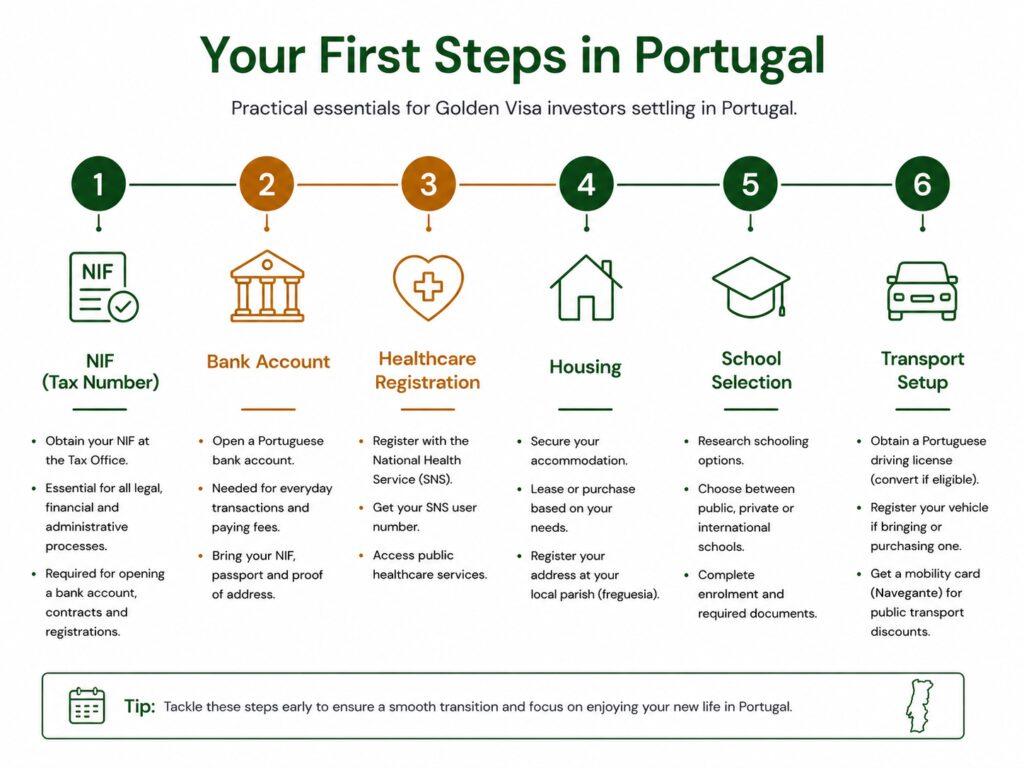
Golden Visa investors should not assume healthcare registration happens automatically. Build it into your relocation checklist alongside tax registration, bank setup and school planning.
Language: Do You Need Portuguese?
You can live comfortably in parts of Portugal with English, especially in Lisbon, Porto and the Algarve. But Portuguese becomes much more important if you plan to integrate, use public services, live outside international areas or apply for citizenship later.
English Proficiency Levels Across Portugal
Portugal has strong English proficiency compared with many European countries. EF’s 2025 English Proficiency Index ranked Portugal 6th globally, with a “very high” proficiency level on the EF English Proficiency Index Portugal profile.
In practical terms, English is common in:
- Hotels, restaurants and tourism-heavy areas
- Private healthcare clinics
- International schools
- Real estate agencies serving foreign buyers
- Law firms, banks and investment service providers
- Central Lisbon, Porto and Algarve towns
The language barrier becomes more visible in government offices, local municipalities, smaller towns and older communities. This is where a Portuguese-speaking lawyer, accountant or relocation advisor becomes useful.
How to Pick Up Basic Portuguese
You do not need perfect Portuguese to settle well, but basic Portuguese changes the experience. It helps with local relationships, service providers, healthcare appointments and day-to-day confidence.
A practical first-year approach looks like this:
- Learn common administrative phrases for banks, tax offices and appointments.
- Practice pronunciation early, because Portuguese sounds different from written Portuguese.
- Use local classes instead of relying only on apps.
- Speak Portuguese in low-pressure situations, such as cafés or shops.
- Keep a bilingual document folder for recurring administrative tasks.
For investors planning citizenship after five years of legal residency, Portuguese language learning should not be treated as an afterthought. It becomes part of the long-term plan.
Practical Realities of Daily Life
Moving to Portugal expat life works best when the practical details are handled early. The quality of life is strong, but the administrative side can surprise investors who are used to faster private-sector systems.
Banking Bureaucracy and Internet Quality
Banking as a foreigner in Portugal usually starts with a NIF, the Portuguese tax identification number. You may also need proof of address, passport identification, source of funds documentation and sometimes a Portuguese representative.
Expect banks to ask detailed questions. This is not unusual. Portugal follows EU anti-money laundering standards, and foreign investors moving funds into Portugal should be ready to document income, assets and investment source.
Internet quality is generally strong in cities and many coastal towns. Fiber coverage is good in urban areas, but rural properties need extra checks before signing a lease or purchase agreement.
| Practical area | What to expect | Investor tip |
| Banking | Detailed onboarding and documentation | Prepare NIF, proof of funds and address evidence |
| Internet | Strong in cities, mixed in rural areas | Check fiber availability before choosing housing |
| Taxes | Requires planning before relocation | Review tax residency before spending long periods in Portugal |
| Schools | Strong options in Lisbon, Porto and Algarve | Apply early, places can be limited |
| Healthcare | Public and private systems available | Register early and keep private insurance if needed |
The NHR tax regime was once a major attraction for new residents, but it has changed significantly. Investors should not rely on old tax articles. Tax residency, foreign income, pensions, dividends and capital gains need current professional advice before relocation.
Driving and Public Transport
Public transport is practical in Lisbon and Porto, especially if you live near metro, train or tram connections. Lisbon has good access to the airport and coastal train lines. Porto has a growing metro network and strong regional access.
Driving in Portugal is useful outside major cities. It becomes almost essential in the Algarve, Silver Coast and rural areas. Roads are generally good, but parking, tolls and narrow historic streets can frustrate newcomers.
Driving in Portugal also requires patience with local rules, insurance, license exchange requirements and toll systems. Investors who plan to split time between countries should clarify whether they need to exchange their driving license based on residency status and nationality.
The Expat Community Scene
Portugal has one of Europe’s most active expat communities, but the experience depends heavily on location. Lisbon feels international and professional. Porto feels more local but increasingly global. The Algarve has one of the most established English-speaking expat scenes in the country. The Silver Coast is quieter, but growing.
The expat community Portugal offers practical advantages:
- Faster recommendations for lawyers, accountants and doctors
- School and childcare referrals
- Local housing advice
- Social networks for spouses and children
- Business and investment introductions
- Help navigating bureaucracy
For Golden Visa investors, this community can make the early months easier. It helps with small decisions that are hard to research from abroad: which neighborhood feels right, which school has availability, which doctor speaks English, which bank branch handles foreign clients efficiently.
But investors should also avoid living only inside the expat bubble. The strongest long-term experience usually comes from combining international support with local integration. Learn basic Portuguese, use local services and spend time outside the most familiar neighborhoods.
For families comparing Portugal immigration options, this distinction matters. A visa gives legal access. Daily life determines whether Portugal actually works for your family.
FAQs: Living in Portugal as an Expat
What is it like to live in Portugal as an expat?
Living in Portugal as an expat is generally calm, safe and practical, especially in Lisbon, Porto, the Algarve and the Silver Coast. Foreign residents often value the climate, healthcare access, international schools, public transport in major cities and Schengen travel rights. The main challenges are bureaucracy, housing costs in popular areas and the language barrier outside international hubs.
Is Portugal safe for foreign residents?
Yes, Portugal is widely considered safe for foreign residents. The country ranked 7th worldwide in the 2025 Global Peace Index, which supports its reputation for stability and low levels of serious violence. As with any country, investors should still assess specific neighborhoods before renting or buying.
Do I need to speak Portuguese to live comfortably?
You can live comfortably in English in Lisbon, Porto and much of the Algarve, especially when using private healthcare, international schools and professional services. However, Portuguese is useful for public administration, local services and deeper integration. If you plan to apply for citizenship after five years of legal residency, Portuguese language learning should be part of your plan.
What are the best cities in Portugal for expats and Golden Visa holders?
Lisbon is best for connectivity, international schools and professional services. Porto works well for investors who want a strong city with lower costs and a more local feel. The Algarve is popular with retirees and families who value space, climate and an established expat community. The Silver Coast is a good option for lower costs and quieter coastal living.
Is Living in Portugal Right for Golden Visa Investors?
Portugal is a strong choice for Golden Visa investors who want EU residency rights, access to Schengen travel and a realistic option for future relocation. It offers safety, international communities, healthcare access and a lifestyle that can work for families, retirees and globally mobile investors.
It is not a country where every practical detail happens instantly. Banking, tax registration, healthcare setup and public administration require patience. That is why the best outcomes usually come from planning before arrival, not improvising after the move.
If you are comparing Portugal for expats against other European residency options, focus on the practical fit: where you would live, how often you would visit, what your family needs and whether the Golden Visa route supports your long-term citizenship or residency strategy.
Ready to take the next step?
Book a free initial assessment. We’ll assess your eligibility, walk through the current qualifying routes, and answer your questions, no cost, no commitment.