
That distinction matters. The Golden Visa is the residency stage. Portuguese citizenship is the naturalization stage. The EU passport comes only after citizenship is approved and the passport is issued.
For investors who want European Union access without relocating full time, this pathway is often the real strategic value of the portugal golden visa.
Yes The Portugal Golden Visa Can Lead to an EU Passport
The Portugal Golden Visa can lead to an EU passport because it creates legal residence in Portugal. After maintaining that residence for the required period, eligible applicants may apply for Portuguese citizenship through naturalization.
The formal Golden Visa residence permit is called ARI, or Autorização de Residência para Investimento. It is processed by AIMA, the Agency for Integration, Migration and Asylum, which replaced SEF, Serviço de Estrangeiros e Fronteiras, in 2023.
AIMA confirms that ARI holders may apply for Portuguese nationality by naturalization once they meet the legal requirements under Portuguese nationality law. You can review the residency framework through the AIMA Naturalization Portal.
How the 5-Year Pathway Works
The pathway is built around 5-year residency. A Golden Visa holder must maintain legal residence status in Portugal during the qualifying period before applying for citizenship.
The basic sequence looks like this:
| Stage | What Happens | Main Authority |
| Golden Visa application | Investor applies for ARI residence | AIMA |
| Residence maintenance | Applicant renews and keeps qualifying status | AIMA |
| Citizenship application | Applicant applies for Portuguese citizenship | IRN |
| Passport stage | Approved citizen applies for Portuguese passport | IRN and passport authorities |
The key point is that the Golden Visa does not directly issue a passport. It creates the legal residence record that can later support a citizenship file.
For a deeper breakdown of requirements, documents, and eligibility steps, see our guide to the full citizenship pathway.
How Powerful Is the Portuguese Passport?
A Portuguese passport is an EU passport. That means it carries two layers of value: international travel access and European Union citizenship rights.
For many investors, this is the reason the Golden Visa is not only a residency product. It is a long-term mobility and family planning strategy.
Visa-Free Access to 186+ Countries
Portuguese passport holders can access a very large number of destinations without applying for a traditional visa in advance. The exact number changes because visa policies, electronic travel authorizations, and passport index methodologies change over time.
For SEO and investor planning, the practical point is simple: the Portuguese passport is consistently ranked among the strongest passports globally, with access commonly described in the 186+ destinations range.
This matters for investors who travel frequently for business, family, or personal planning. A stronger passport can reduce visa friction, shorten travel preparation time, and improve global mobility.
Henley Passport Index Ranking
The Henley Passport Index is a commercial passport ranking that measures passports by the number of destinations their holders can access without a prior visa. It is widely cited in global mobility discussions, but it is not a government source and rankings can change.
The Portuguese passport typically ranks near the top tier because Portugal is an EU member state, part of the Schengen Area, and has broad international travel arrangements.
Investors should treat passport rankings as useful indicators, not legal guarantees. The legal value of citizenship comes from Portuguese nationality and EU citizenship rights, while index scores simply measure travel access at a specific point in time.
What EU Citizenship Actually Unlocks
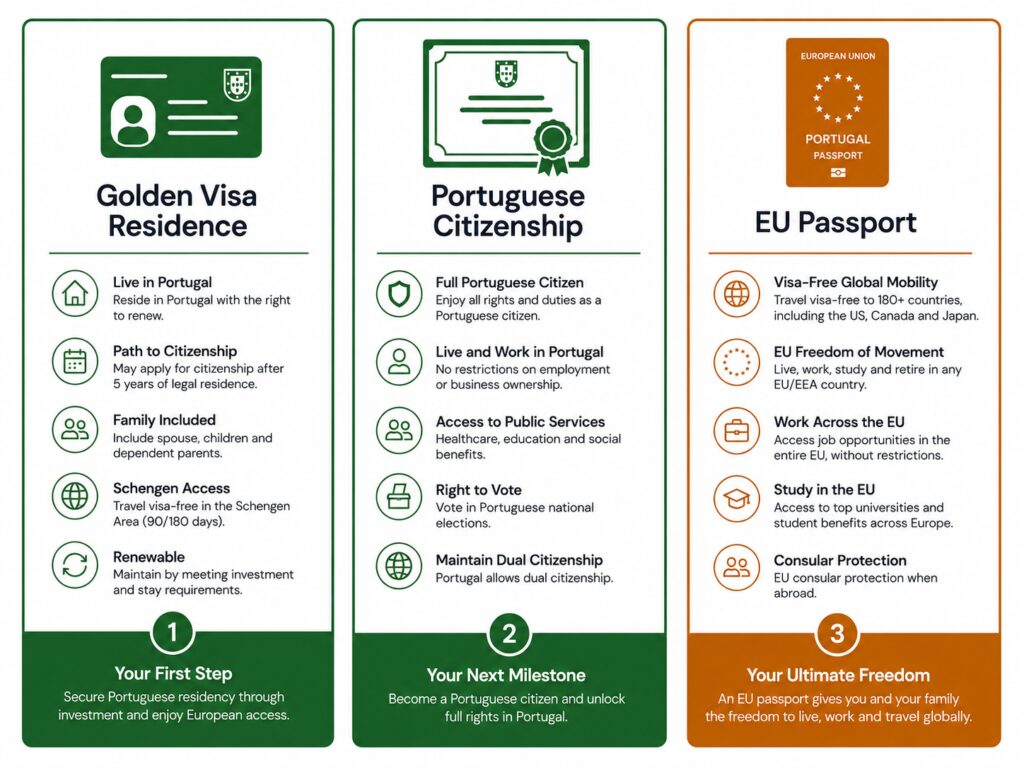
Portuguese citizenship gives the applicant EU citizenship. That is different from holding a residence permit.
A Golden Visa allows residence rights in Portugal and Schengen travel benefits. Portuguese citizenship creates rights as a national of Portugal and, by extension, as a citizen of the European Union.
Live and Work Anywhere in the EU
EU citizenship gives the right to move and reside in other EU countries, subject to the administrative rules of the destination country. This is known as EU freedom of movement.
For investors, this can be a major difference. A Portuguese Golden Visa holder has residence rights in Portugal. A Portuguese citizen can generally live, work, look for work, study, or retire in another EU country under EU rules.
The European Union explains these movement and residence rights through its official EU residence rights guidance.
EU Education Access
An EU passport can also change education planning for families. Children who become Portuguese and EU citizens may access EU education systems as EU nationals, subject to national rules, admissions criteria, and language requirements.
This can matter for families considering:
- University access in Portugal
- Study options in other EU countries
- Long-term relocation planning for children
- Potential fee differences between EU and non-EU applicants
Education rules vary by country and institution. Citizenship does not remove every admissions requirement, but it can materially improve the family’s options.
Healthcare Across the EU
EU citizenship can also support access to healthcare systems across the EU, depending on where the citizen lives, works, studies, or is insured.
This does not mean unlimited healthcare everywhere with no rules. Each country has its own registration and contribution system. Still, EU citizenship gives families a stronger legal basis for accessing national systems than a non-EU passport alone.
For long-term family planning, that legal status can be more important than the travel convenience itself.
The Timeline: Golden Visa to EU Passport
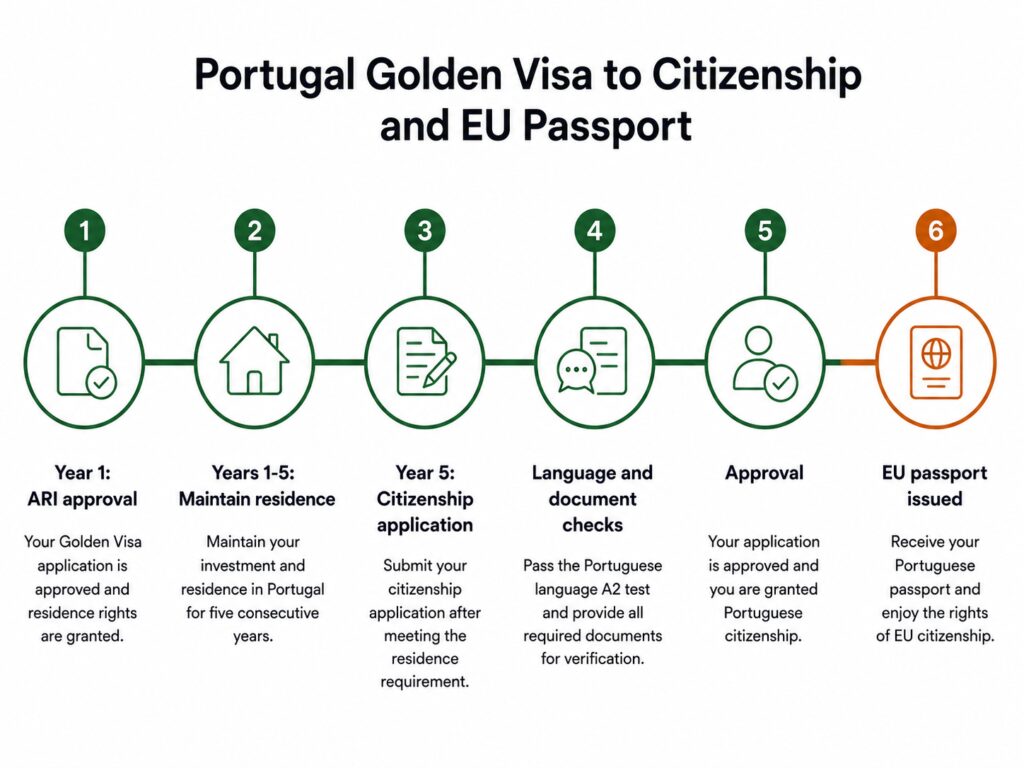
The realistic timeline has three stages: maintaining residence, applying for citizenship, and waiting for approval and passport issuance.
The 2026 citizenship timeline changes are especially important because investors need to understand when the citizenship clock starts and how processing delays may affect the full journey.
Year 1-5: Maintain Residency
During the first five years, the investor must maintain legal residence under the Golden Visa route. This usually includes:
- Keeping the qualifying investment in place
- Renewing the residence permit when required
- Meeting the minimum stay requirement
- Maintaining a clean criminal record
- Keeping documents updated for family members, where included
The Golden Visa is attractive because the minimum stay requirement is low compared with many other residency routes. However, low stay does not mean no obligations. The applicant still needs a compliant file.
Year 5: Apply for Citizenship
After five years of legal residency, an eligible applicant may apply for Portuguese citizenship through naturalization. The application is handled by IRN, Instituto dos Registos e do Notariado, not by AIMA.
The official Portuguese government portal states that foreign nationals may apply for Portuguese nationality after living legally in Portugal for at least five years. Citizenship applications are submitted through the relevant registry channels, and applicants can review official requirements through the IRN Citizenship Application.
Common requirements may include:
- Proof of legal residence
- Valid identification documents
- Criminal record certificates
- Evidence of sufficient connection to Portugal, where required
- Portuguese language knowledge, commonly through an A2 language test
- Payment of government fees
- Correct civil registry documents for the applicant and family members
The exact document list depends on the applicant’s circumstances. A family application, a name discrepancy, or documents issued in multiple countries can add extra work.
Year 6-7: Receive Your Passport
After citizenship is approved, the applicant becomes a Portuguese citizen. Only then can the applicant move to the passport stage.
This is why the phrase “Portugal Golden Visa passport” can be misleading if used too casually. The Golden Visa itself does not grant the passport. The passport follows Portuguese citizenship, and citizenship follows a successful naturalization application.
In practice, many investors should think in terms of a 6 to 7-year overall journey from Golden Visa application to passport issuance. The exact timeline depends on application submission, AIMA processing, renewals, IRN citizenship processing, document quality, and individual circumstances.
Dual Citizenship: Keep Your Original Passport
Portugal generally permits dual citizenship. That means successful applicants are not usually required by Portugal to renounce their original nationality when becoming Portuguese citizens.
This is one reason the portugal citizenship pathway is attractive for investors who want additional mobility without cutting ties to their home country.
Countries That Prohibit Dual Citizenship
The more important question is not only whether Portugal allows dual citizenship. It is whether the applicant’s original country allows it.
Some countries restrict, prohibit, or condition dual citizenship. In those cases, acquiring Portuguese citizenship could affect the applicant’s original nationality.
Investors should always check the law of their current nationality before applying. This is especially important for applicants from countries with strict nationality retention rules, mandatory reporting requirements, or automatic loss provisions.
Most Common Cases Where It Works
Dual citizenship commonly works well for applicants from countries that permit multiple nationalities. For example, many US, Canadian, UK, and Brazilian applicants can often hold Portuguese citizenship while keeping their original passport, subject to their domestic rules.
The practical benefit is flexibility. A family may keep its original national identity and legal ties while adding EU citizenship, Schengen Area access, EU education rights, and stronger global mobility.
Still, nationality planning should be reviewed before the citizenship filing stage, not after approval. Passport strategy is much easier when the legal consequences are checked early.
Is Getting an EU Passport Through Portugal Worth It?
Getting an EU passport through Portugal can be worth it for investors who value long-term optionality more than immediate relocation.
The Golden Visa is not the fastest way to live in Europe full time. Other residency routes may suit applicants who plan to move immediately, work locally, or live in Portugal most of the year. The Golden Visa is better suited to investors who want a low-stay residency route that may later support citizenship.
The strongest use cases are usually:
- Families planning EU education access for children
- Investors who want backup residency in Europe
- Business owners who travel frequently
- Non-EU nationals who want a route to Portuguese citizenship
- Families who want dual citizenship, subject to home-country rules
- Investors who want long-term global mobility through an EU passport
The main tradeoff is time. A Portuguese passport is not granted at the beginning of the journey. The applicant must first maintain legal residence, then apply for citizenship, then wait for the citizenship decision and passport issuance.
That is why the Portugal Golden Visa should be assessed as a structured long-term plan, not a shortcut.
FAQs: Portugal Golden Visa to EU Passport
Can the Portugal Golden Visa really lead to an EU passport?
Yes. The Portugal Golden Visa can lead to an EU passport if the applicant maintains legal residence, meets the five-year eligibility period, satisfies the naturalization requirements, and receives Portuguese citizenship approval. The EU passport comes after Portuguese citizenship, not directly from the Golden Visa permit.
How strong is the Portuguese passport?
The Portuguese passport is one of the stronger passports globally because Portugal is an EU and Schengen Area member state. It offers broad visa-free travel access and, more importantly, EU citizenship rights, including the ability to live, work, and study in other EU countries subject to local rules.
How long does it take to get a Portuguese passport through the Golden Visa?
A realistic overall timeline is often around 6 to 7 years. The applicant must first complete the five-year legal residence period, apply for Portuguese citizenship, wait for the naturalization decision, and then apply for the Portuguese passport after citizenship approval.
Can you hold dual citizenship with a Portuguese passport?
Portugal generally allows dual citizenship, so applicants are not usually required by Portugal to give up their original nationality. However, the applicant must also check whether their current country allows dual citizenship, because some countries restrict or prohibit it.
Is the Portugal Golden Visa Citizenship Path Right for You?
The Portugal Golden Visa citizenship pathway is best understood as a staged route: residence first, citizenship later, passport after approval. It is not instant, but it can be powerful for investors who are planning beyond the next visa renewal.
The value is not only in travel access. It is in EU freedom of movement, family education options, dual citizenship potential, and long-term security for applicants who want a European base without full-time relocation from day one.
For investors comparing routes, the most important question is not only “Can I get a passport?” It is whether the Golden Visa fits your timeline, investment profile, family structure, and long-term nationality planning.
Ready to take the next step?
Book a free initial assessment. We’ll assess your eligibility, walk through the current qualifying routes, and answer your questions, no cost, no commitment.