
This guide explains how US investors may use a Self-Directed IRA, how a 401(k) rollover usually works, what tax rules need attention, and what to ask fund managers before moving capital.

Can You Use an IRA or 401(k) for the Portugal Golden Visa Investment?
US investors often ask whether retirement capital can be used for the Portugal Golden Visa because the current fund route requires a substantial qualifying investment. For applicants with significant retirement assets, using an IRA or former employer 401(k) can look attractive, but it is not a simple bank transfer.
The investment must still satisfy Portugal’s Golden Visa rules, and the retirement account must still comply with US tax and retirement account rules.
Why US Investors Are Looking at Retirement Accounts
Many US investors have more capital inside retirement accounts than in liquid taxable brokerage accounts. A high-net-worth applicant may have a large traditional IRA, Roth IRA, rollover IRA, or former employer 401(k), but may not want to liquidate taxable assets to fund a Portugal residency application.
This is especially common with:
- Former executives with large 401(k) balances
- Entrepreneurs with rollover IRAs
- Investors with a jumbo IRA planning for international diversification
- Families using the Golden Visa as a long-term residency and citizenship strategy
- US citizens who want Schengen Area access without relocating full-time
The appeal is clear. If the account can legally invest in a qualified investment fund, the investor may be able to use retirement capital while keeping the account’s retirement structure intact. That said, the account owner cannot treat retirement funds as personal capital. The IRA or 401(k) structure has rules, and those rules matter.
The Short Answer: Yes, With Conditions
In principle, some US investors can use retirement funds for a Portugal Golden Visa fund investment through a Self-Directed IRA (SDIRA), usually after rolling eligible 401(k) assets into an SDIRA. However, this depends on the retirement plan, custodian, fund acceptance policy, tax profile, and investment documentation.
A workable structure usually requires:
| Requirement | Why it matters |
| Eligible retirement account | Not every 401(k) can be moved while the investor is still employed |
| SDIRA custodian | Standard IRA platforms often do not allow foreign private fund investments |
| Fund acceptance | The Portugal fund must accept SDIRA capital and US investors |
| Clean documentation | Subscription documents must name the IRA or custodian correctly |
| Tax review | FATCA, FBAR, Form 8938, PFIC, and reporting exposure need review |
| Prohibited transaction control | The IRA owner must avoid personal benefit or self-dealing |
The Portugal Golden Visa itself is processed under ARI, or Autorização de Residência para Investimento, the formal investment residence permit. AIMA, the Agency for Integration, Migration and Asylum, handles residence applications, while CMVM, Portugal’s Securities Market Commission, supervises regulated investment funds. Investors should review current golden visa fund investment options before deciding which fund structure can support both Portugal and US requirements.
What Is a Self-Directed IRA (SDIRA)?
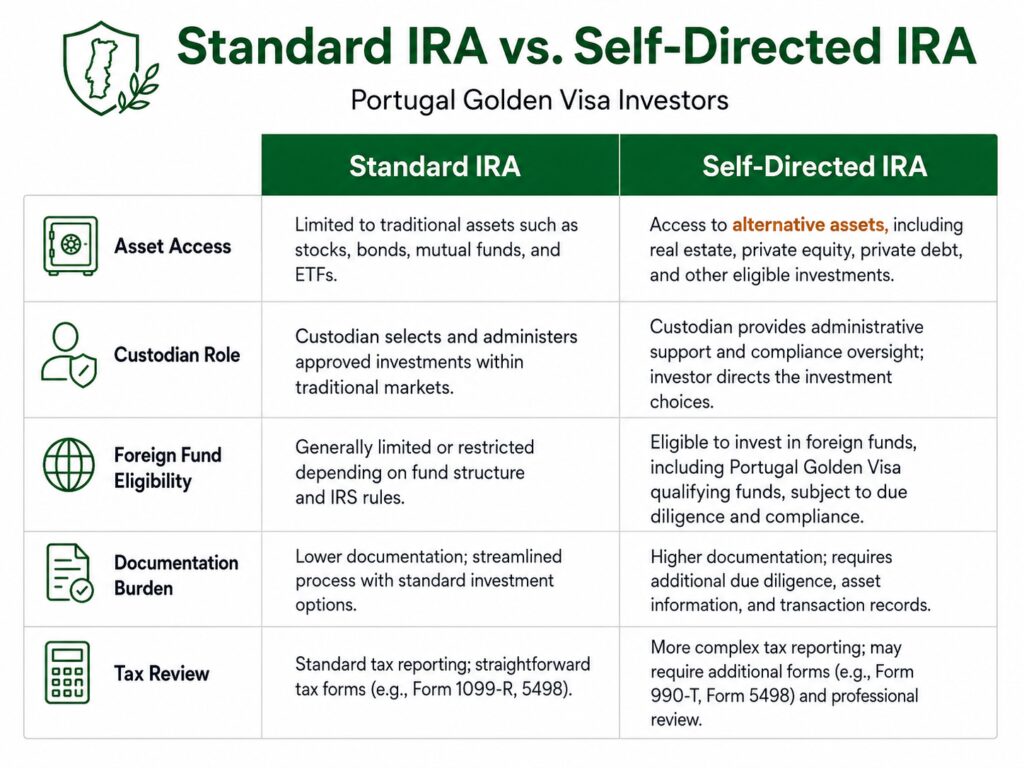
A Self-Directed IRA is an IRA that allows a wider range of assets than a standard brokerage IRA. The key difference is not that it removes IRS rules. It does not. The difference is that the custodian permits alternative assets that typical brokerage platforms do not support.
For Portugal Golden Visa investors, the SDIRA is usually the structure that makes a foreign qualifying fund investment possible.
How It Differs from a Standard IRA
A standard IRA at a large brokerage usually offers publicly traded securities, mutual funds, ETFs, bonds, and cash products. It may not allow subscription into a private foreign investment fund.
An SDIRA may allow alternative investments such as:
- Private funds
- Private equity
- Real estate funds
- Limited partnerships
- Certain foreign investments
- Other non-public assets, subject to custodian policy
This does not mean every SDIRA custodian will accept every Portugal Golden Visa fund. Custodians have their own compliance rules, documentation requirements, asset review procedures, and prohibited asset policies.
The investor also remains responsible for ensuring the structure complies with IRS foreign investment rules. The IRS explains that prohibited transactions can include improper use of IRA assets by the IRA owner or disqualified persons, including self-dealing and certain uses of plan assets for personal benefit. A useful official starting point is the IRS guidance on prohibited transactions.
Finding a Custodian That Allows Foreign Fund Investments
The custodian account is one of the most important parts of the structure. A custodian holds the IRA assets, processes investment documents, and often signs subscription documents on behalf of the IRA.
Before choosing a custodian, ask:
- Do you permit foreign private fund investments?
- Have you handled Portuguese or EU-regulated funds before?
- Can the IRA subscribe to a CMVM-regulated fund?
- Will the subscription be titled in the name of the IRA or custodian?
- What due diligence documents do you require from the fund?
- What are your review timelines?
- What are the annual custody and transaction fees?
- Can you coordinate with US tax counsel and Portuguese fund administrators?
A custodian should not be selected only on price. A low-cost custodian that cannot process the subscription correctly can delay the application or create documentation problems.
How the 401(k) to SDIRA Rollover Works
A 401(k) cannot always invest directly into a Portugal Golden Visa fund. In many cases, the investor first needs to roll eligible 401(k) funds into an SDIRA that allows alternative foreign investments.
This is where retirement account portability matters. The investor must confirm whether the 401(k) is eligible for rollover and whether a direct rollover can preserve the tax-advantaged status of the account.
Step-by-Step Rollover Process
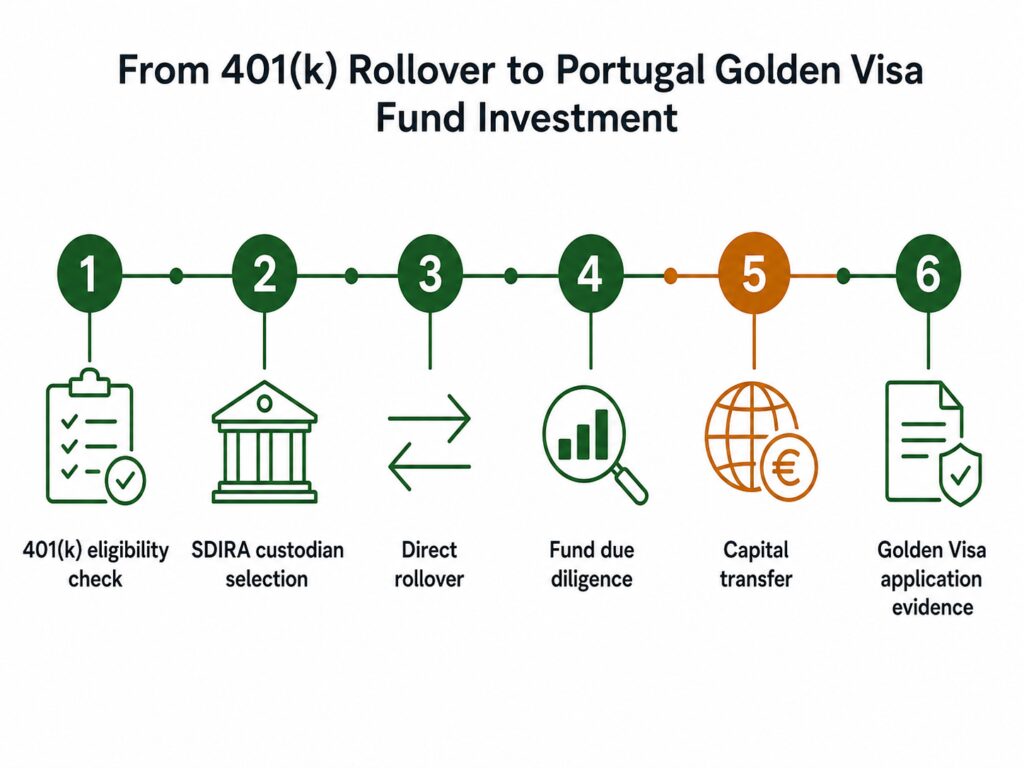
A typical 401(k) rollover path may look like this:
- Confirm eligibility with the 401(k) plan administrator
Not all active employer plans allow in-service rollovers. Former employer plans are often easier to move, but the plan document controls. - Choose an SDIRA custodian
The custodian must allow foreign private fund investments and be comfortable with the subscription documents required by the Portugal fund. - Open the SDIRA account
The account must be established before the rollover can be received. - Request a direct rollover
A direct rollover moves funds from the 401(k) plan to the IRA custodian without the investor personally receiving the money. - Complete fund due diligence
The custodian and investor review the fund documents, regulatory status, and subscription requirements. - Execute the subscription documents
The IRA or custodian, not the individual investor personally, usually needs to be reflected correctly in the investment documentation. - Transfer capital to the fund
The capital transfer must match both the fund’s subscription process and the documentation needed for the Golden Visa application. - Prepare Golden Visa evidence
The investor’s legal team coordinates proof of investment, source of funds, and ARI application documentation.
The US Department of Labor explains that, in many defined contribution plans such as 401(k) plans, participants who leave an employer can often transfer their account balance to another retirement plan or an IRA. The official US Department of Labor retirement account guidelines are a useful starting point, but the actual rollover depends on the plan document.
Timelines and Costs to Expect
The rollover process can be fast or slow depending on the plan administrator, custodian, fund manager, and compliance review. A realistic planning timeline may include several weeks for account opening, rollover processing, fund due diligence, document review, and capital transfer.
Common costs include:
| Cost item | What to expect |
| SDIRA setup fee | One-time account opening cost |
| Annual custody fee | Ongoing fee charged by the custodian |
| Transaction fee | May apply when subscribing to the fund |
| Wire fee | Charged for capital transfer |
| Legal review | US and Portuguese counsel may both be needed |
| Tax advisory fee | Important for reporting and prohibited transaction analysis |
| Fund fees | Depends on the specific qualified investment fund |
Before committing, investors should also review the full cost breakdown of your Golden Visa so the retirement account strategy is considered alongside AIMA fees, professional fees, renewal costs, and family application expenses.
Key US Tax Rules to Understand
Using retirement funds for a Portugal Golden Visa investment is not only an immigration decision. It is also a US tax, retirement account, and reporting decision.
No article can replace personal tax advice here. The correct answer depends on the account type, investor residence, fund structure, reporting thresholds, and whether the investor has other foreign financial assets.
FATCA and FBAR Reporting Requirements
FATCA means the Foreign Account Tax Compliance Act. It created reporting obligations for certain foreign financial assets. Form 8938 is used by certain US taxpayers to report specified foreign financial assets when they exceed the relevant threshold.
FBAR filing is separate. The IRS comparison page explains that Form 8938 does not replace FBAR, and that FBAR, formally FinCEN Form 114, is filed with FinCEN rather than the IRS. Investors should review IRS Foreign Investment and FBAR Rules with a US tax adviser before using foreign investment structures.
The key reporting questions include:
- Does the IRA structure create reportable foreign financial assets?
- Does the investor have signature authority over foreign accounts?
- Does the fund create Form 8938 reporting exposure?
- Are there PFIC or foreign trust reporting issues?
- Does the custodian handle any part of the reporting?
- Does the investor have other foreign accounts that affect FBAR thresholds?
US expat tax obligations can also become relevant if the investor later spends more time abroad or changes tax residency. The Golden Visa does not automatically make a US citizen a Portuguese tax resident, but travel patterns, home, income, and personal facts can matter.
Prohibited Transaction Rules
Prohibited transaction rules are one of the highest-risk areas in an SDIRA strategy. The basic principle is that retirement account assets must be used for the account’s investment purpose, not for the personal benefit of the IRA owner or other disqualified persons.
Problems may arise if the IRA owner:
- Personally receives benefits from IRA-owned assets
- Uses IRA assets as security for a loan
- Causes the IRA to transact with a disqualified person
- Pays personal expenses from IRA funds
- Personally guarantees obligations connected to IRA assets
- Mixes personal and IRA capital incorrectly
This is why the fund subscription, capital transfer, and investor documentation must be reviewed carefully before the money moves. A structure that looks acceptable from a Portugal Golden Visa perspective may still raise US retirement account problems if handled incorrectly.
Working with a US Tax Advisor Who Understands Portugal
The right adviser is not only a US accountant who prepares annual returns. The investor should work with someone who understands IRAs, SDIRAs, foreign private funds, FATCA, FBAR, Form 8938, PFIC issues, and Portugal residency planning.
A strong advisory team usually includes:
- US tax adviser
- SDIRA custodian
- Portugal immigration lawyer
- Fund manager or fund administrator
- Cross-border financial adviser, where appropriate
The goal is to prevent conflicts between the US retirement structure and the Portuguese immigration evidence. Both systems must work at the same time.
Which Portugal Golden Visa Funds Accept SDIRA Capital?
Not every Portugal Golden Visa fund accepts SDIRA capital. Some funds are open to US investors but only through taxable accounts. Others may accept US investors but not retirement account capital. Some may decline US investors entirely because of regulatory, reporting, or administrative reasons.
This is why the fund selection process must start before the rollover is completed.
What to Ask Fund Managers Upfront
Before choosing a fund, ask the manager or distributor:
- Do you accept US investors?
- Do you accept SDIRA capital?
- Have you previously accepted capital from a US IRA custodian?
- Which custodians have you worked with?
- Are your subscription documents compatible with IRA ownership?
- Can the fund provide Golden Visa eligibility evidence?
- Are FATCA forms and US investor documents available?
- What reporting documents will US investors receive?
- Are there any restrictions for retirement account investors?
- What is the expected timing from subscription to investment confirmation?
Investors comparing approved Portugal Golden Visa funds should not assume that “approved” means available for every US retirement account. Golden Visa eligibility, US investor acceptance, and SDIRA acceptance are three separate questions.
CMVM supervises investment funds in Portugal, but supervision does not remove the need for investor due diligence. The CMVM official portal is the appropriate official source for checking Portugal’s securities market regulator and related fund supervision context.
Is Using Retirement Funds for the Golden Visa a Good Idea?
Using retirement funds can be a good idea for some US investors, but it is not automatically better than using taxable capital. The decision depends on liquidity, account type, age, tax profile, investment horizon, risk appetite, and whether the investor wants to keep retirement assets inside a tax-advantaged structure.
It may be worth considering if:
- You have a large former employer 401(k)
- You already use alternative investments in retirement accounts
- You have enough retirement capital to maintain diversification
- You can tolerate illiquidity for the fund holding period
- You have a custodian experienced with foreign private funds
- Your US tax adviser confirms the structure is appropriate
It may not be suitable if:
- You need near-term liquidity
- The retirement account is your primary retirement safety net
- Your 401(k) cannot be rolled over
- The fund does not accept SDIRA capital
- You do not have specialist tax advice
- The fees reduce the investment logic too much
For some investors, taxable capital is cleaner. For others, an SDIRA may be efficient. The important point is to decide after reviewing both the immigration route and the US retirement account consequences.
The right route depends on more than available capital. It depends on whether the fund, custodian, and tax position fit together. For investors comparing broader portugal investment visa options, retirement account funding should be reviewed as one possible structure, not the default answer.
FAQs:
Can I use my IRA or 401(k) to invest in a Portugal Golden Visa fund?
Yes, some US investors may be able to use IRA or 401(k) assets for a Portugal Golden Visa fund investment, usually through a Self-Directed IRA. A 401(k) may first need to be rolled into an SDIRA if the plan allows it. The fund must accept SDIRA capital, the custodian must approve the investment, and the structure must comply with US tax and prohibited transaction rules.
What is a Self-Directed IRA and can it hold foreign investments?
A Self-Directed IRA is an IRA that allows alternative investments beyond standard brokerage assets. Depending on the custodian, it may hold private funds, limited partnerships, and certain foreign investments. The account still remains subject to IRS rules, custodian policies, reporting requirements, and prohibited transaction restrictions.
What are the US tax implications of using retirement funds for the Portugal Golden Visa?
The tax implications can include FATCA review, FBAR analysis, Form 8938 reporting, PFIC questions, prohibited transaction risk, and possible custodian reporting requirements. The answer depends on the account type, fund structure, investor facts, and whether the capital is held directly or through the retirement account. US investors should obtain advice from a tax professional who understands both retirement accounts and foreign investment reporting.
Which Portugal Golden Visa funds are available specifically to US investors using retirement accounts?
There is no universal public list that applies to every US investor and every custodian. Some Portugal Golden Visa funds accept US investors, some accept SDIRA capital, and some may accept neither. Investors should ask each fund manager whether the fund accepts US retirement account capital, which custodians it has worked with, and what documentation it can provide for Golden Visa and US reporting purposes.
Final Takeaway: Build the Structure Before You Move the Money
A Portugal Golden Visa retirement account strategy can be useful, but it must be structured before capital moves. The most important checks are eligibility of the 401(k) rollover, SDIRA custodian acceptance, fund compatibility, tax reporting, and prohibited transaction review.
For US investors, the safest planning sequence is simple: confirm the account structure first, confirm the fund second, then move capital only after the legal and tax teams agree that the documentation works.
Ready to take the next step?
Book a free initial assessment. We’ll assess your eligibility, walk through the current qualifying routes, and answer your questions, no cost, no commitment.












