
The portugal golden visa investment fund route is now the main qualifying option for investors who want Portuguese residency without buying property. Real estate has not qualified for new Golden Visa applications since the 2023 reform, which means fund selection, regulatory checks, and legal due diligence now sit at the centre of the process.
This guide explains how qualifying funds work, what AIMA and CMVM check, what returns investors should and should not expect, and how to evaluate fund options before making a €500,000 commitment.
How the Portugal Golden Visa Investment Fund Route Works
The fund route allows a non-EU investor to qualify for the ARI, Autorização de Residência para Investimento, by making a capital transfer into eligible collective investment units. ARI is the formal name of the Portugal Golden Visa residence permit.
AIMA, the Agency for Integration, Migration and Asylum, processes Golden Visa applications. CMVM, Comissão do Mercado de Valores Mobiliários, supervises Portugal’s securities market and the regulated investment framework.
Under the current AIMA guidance, the fund route requires a capital transfer of at least €500,000 into units of non-real-estate collective investment undertakings. The fund must be constituted under Portuguese law, have a maturity of at least five years at the time of investment, and invest at least 60% of its value in commercial companies headquartered in Portugal.
That is the legal frame. The practical question is whether the fund, the documentation, and the investor’s file can satisfy AIMA fund eligibility.
The Minimum Subscription Amount
The minimum subscription amount for this route is €500,000. This is the qualifying investment threshold, not the full cost of the application.
The investor normally transfers capital to a Portuguese bank account, completes the fund subscription process, and receives evidence of the investment. That evidence becomes part of the ARI application file.
Applicants reviewing the portugal golden visa investment fund route should treat the €500,000 figure as the starting point. Legal fees, government fees, fund entry fees, management fees, tax advice, translation, apostilles, and renewal costs should be budgeted separately.
What Makes a Fund Qualifying?
A qualifying investment fund is not simply any fund available in Portugal. It must meet the legal criteria for the Golden Visa route and produce documentation that supports the ARI application.
A fund should be checked for:
- Portuguese legal structure
- Non-real-estate investment focus
- Minimum five-year maturity at the time of investment
- At least 60% investment in Portuguese commercial companies
- CMVM supervision or registration, where applicable
- Clear subscription documents
- Fund audit and reporting framework
- Evidence acceptable for the AIMA application file
Investors often search for “Portugal Golden Visa approved funds,” but this phrase can be misleading. AIMA does not publish a simple public shopping list of approved funds that guarantees eligibility. A fund may be regulated, professionally managed, and still require a legal eligibility review for ARI purposes.
The Role of CMVM and AIMA
CMVM is Portugal’s securities market regulator. When evaluating investment funds for Portugal Golden Visa purposes, investors should use the CMVM Official Regulator as the starting point for checking regulated entities, fund managers, and official market information.
AIMA is the immigration authority that reviews the residence application. The AIMA Golden Visa Portal is the official source for ARI application rules, documentation, government fees, and residence permit steps.
The distinction matters. CMVM supervision supports the investment’s regulatory credibility. AIMA decides whether the applicant and submitted evidence satisfy the ARI regulation.
Types of Portugal Golden Visa Funds Investors May Consider
Investment funds for Portugal Golden Visa applicants are not all built the same way. The structure, asset class, risk profile, liquidity, fees, and exit strategy can differ significantly.
The right fund is not simply the one with the most attractive return target. It is the one that fits the investor’s risk tolerance, immigration objective, tax position, and five-year holding plan.
Private Equity Funds
A private equity fund typically invests in private companies, growth businesses, buyouts, or sector-specific opportunities. These funds may target capital appreciation over several years rather than annual income.
For Golden Visa investors, the key questions are:
- What companies or sectors does the fund invest in?
- How diversified is the portfolio?
- Who is the fund manager?
- What are the management and performance fees?
- What is the expected holding period?
- What is the exit strategy?
- How often does the fund report to investors?
A private equity fund can offer access to Portuguese business growth, but it may also involve illiquidity. Investors should understand that they may not be able to exit whenever they choose.
Venture Capital Funds
A venture capital fund invests in early-stage or growth-stage companies. These funds may offer higher upside potential, but they usually carry higher risk.
The fund manager’s track record matters. So does the pipeline of companies, the sector focus, the valuation discipline, and the level of follow-on capital available.
For a Golden Visa applicant, venture capital should be evaluated as both an investment decision and an immigration compliance decision. The fund may be interesting financially, but the investor still needs documentation that supports the ARI application.
Open-Ended and Closed-Ended Funds
An open-ended fund generally allows investors to subscribe and redeem units more regularly, subject to the fund rules. A closed-ended fund usually has a fixed term and more limited exit options.
For Golden Visa purposes, many qualifying structures are closed-ended because the ARI route requires a minimum holding horizon. This can support the five-year immigration planning period, but it can also limit liquidity.
Investors should read the fund documents carefully. The issue is not only whether the fund qualifies today. The issue is whether the fund structure remains practical for the full holding period.
Returns, Risks, and Fund Fees
No serious advisor should promise a fixed return from Portugal Golden Visa funds. Fund performance depends on the asset class, market conditions, portfolio execution, fees, exit timing, and the quality of the fund manager.
The Golden Visa gives the investor a residency pathway. It does not remove investment risk.
What Returns Can Investors Expect?
Fund managers may publish target returns, but a target is not a guarantee. The expected return should be treated as an investment assumption, not as a contractual outcome.
Before subscribing, investors should review:
- Historical performance, if available
- Fund strategy
- Target return range
- Fee structure
- Portfolio companies or asset exposure
- Valuation policy
- Independent audit process
- Exit assumptions
- Risk disclosures
A fund with a higher target return usually involves higher risk, reduced liquidity, or more uncertainty around exit timing. A conservative investor may prefer capital preservation and transparency over an aggressive return target.
Fund Fees That Affect Net Return
A fund’s headline return target is not the same as the investor’s net return. Fees can materially affect the final outcome.
Common fund charges may include:
| Fee type | What it means | Why it matters |
| Subscription fee | Entry cost paid when joining the fund | Reduces capital efficiency at the start |
| Management fee | Annual fee paid to the fund manager | Reduces net performance over time |
| Performance fee | Share of upside paid to the manager | Impacts returns when the fund performs well |
| Custody or administration fee | Operational cost of fund administration | Should be visible in fund documents |
| Exit or redemption fee | Cost payable when leaving the fund | Affects final proceeds |
Applicants should compare these fees with the full cost breakdown of the Golden Visa because the fund is only one part of the total budget.
Portfolio Diversification
Portfolio diversification can reduce concentration risk, but it does not eliminate investment risk. A diversified fund may invest across several companies, sectors, or asset types. A concentrated fund may focus on one sector or a small number of businesses.
The right choice depends on the investor’s objectives. Some applicants prefer a conservative, diversified portfolio. Others accept higher risk for the possibility of stronger growth. The immigration objective should not push an investor into a fund that does not match their financial profile.
Investor Suitability
Investor suitability is the process of confirming whether a product is appropriate for the investor’s knowledge, financial situation, risk tolerance, and investment objectives.
This is especially important for US citizens, politically exposed persons, applicants using complex family wealth structures, or investors with assets held through companies or trusts.
A Golden Visa fund may be eligible, but that does not automatically mean it is suitable for every investor.
How to Choose a Qualifying Fund
Selecting a fund should be a structured process. The investor should not begin with a sales brochure. The investor should begin with eligibility, regulation, risk, and documentation.
A practical selection process usually includes the following steps:
- Confirm the investor’s eligibility for Portugal’s residency by investment program.
- Obtain a Portuguese NIF, the tax identification number.
- Open the required bank account, where applicable.
- Shortlist funds that may satisfy ARI regulation.
- Review the fund manager, strategy, term, and fees.
- Confirm CMVM status and regulatory information.
- Review fund documents with legal counsel.
- Check whether the fund can issue AIMA-ready evidence.
- Complete the fund subscription and capital transfer.
- Submit the ARI application through the correct immigration process.
This process protects the applicant from two avoidable mistakes: choosing a fund that does not support the residence application, or choosing a fund that qualifies legally but does not suit the investor financially.
Questions to Ask Before Subscribing
Before making the capital transfer, ask the fund manager and legal team these questions:
- Is the fund structured under Portuguese law?
- Is the fund non-real-estate for ARI purposes?
- What is the fund maturity date?
- Does at least 60% of the fund invest in companies headquartered in Portugal?
- What documentation will be issued after subscription?
- Has the fund supported ARI applications before?
- What are the subscription, management, and performance fees?
- Who audits the fund?
- What is the exit strategy after the holding period?
- What happens if the fund term extends beyond five years?
The answers should be written, not verbal. This is a €500,000 immigration-linked investment. Verbal comfort is not a due diligence process.
Fund Route Compared With Other Portugal Investment Visa Options
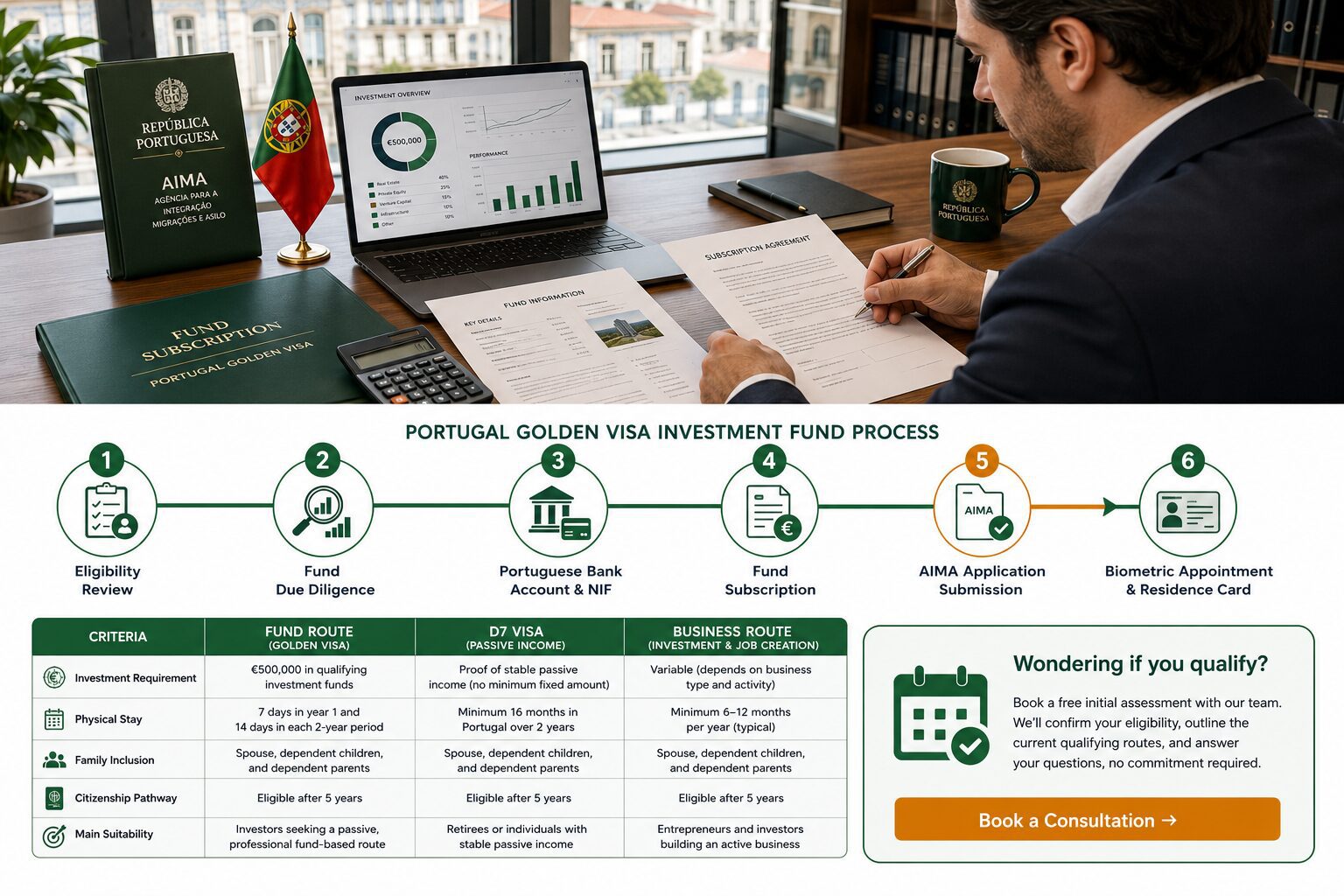
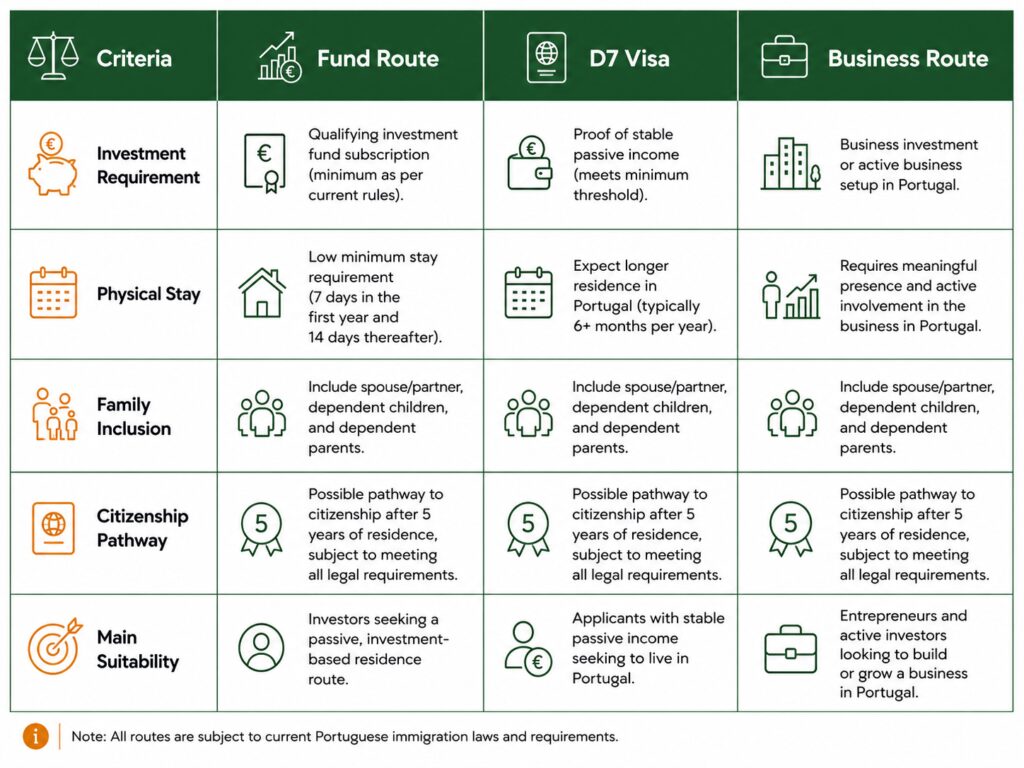
The investment fund route is often compared with the D7 Visa, D8 Digital Nomad Visa, and business investment routes. The right route depends on whether the applicant wants investment-based residence, relocation-based residence, or business activity in Portugal.
The fund route is usually strongest for investors who want:
- Low physical presence in Portugal
- A five-year pathway to citizenship, subject to eligibility
- Family inclusion
- A regulated investment structure
- No requirement to buy or manage property
- No need to relocate full time
Applicants comparing investment visa options in Portugal should focus on lifestyle requirements as much as investment thresholds. A cheaper route may require more physical presence, more tax planning, or a clearer relocation intention.
For investors who are specifically comparing retirement, passive income, or full-time relocation, the Golden Visa is not always the most efficient route. For investors who want optionality, it remains one of Portugal’s most flexible residency pathways.
US Investors, Retirement Funds, and Tax Planning
US citizens can apply for the Portugal Golden Visa, but they should not treat the fund subscription as a simple overseas transfer. US tax reporting, fund classification, retirement account rules, and securities compliance can create additional complexity.
Some investors ask about using your IRA or 401k to invest. This may be possible in some structures, but it requires specialist advice. The investor must confirm whether the retirement account can legally invest, whether the fund accepts that structure, and how US tax reporting will work.
US investors should involve:
- A Portugal immigration lawyer
- A Portuguese tax advisor
- A US tax advisor
- A qualified investment professional
- A retirement account specialist, if using IRA or 401(k) assets
The Golden Visa can support international mobility, but it should not create a tax reporting problem. For US applicants, the tax structure deserves as much attention as the immigration file.
FAQs About Portugal Golden Visa Investment Funds
What are the approved investment funds for the Portugal Golden Visa?
There is no simple public AIMA list that guarantees approval for every investor. A qualifying fund must satisfy the legal criteria for the ARI fund route, including the €500,000 minimum, Portuguese-law structure, non-real-estate focus, minimum five-year maturity, and required investment exposure to Portuguese companies. Investors should verify the fund with legal counsel and check the relevant regulatory information through CMVM.
How do Portugal Golden Visa investment funds work?
The investor subscribes to units in an eligible Portuguese investment fund and transfers at least €500,000. The fund then issues documentation confirming the subscription, which forms part of the ARI application. AIMA reviews the immigration application, while the investment itself remains subject to the fund’s terms, fees, risks, and exit rules.
What returns can I expect from Portugal Golden Visa funds?
Returns vary by fund strategy, asset class, portfolio quality, fees, and market conditions. No return should be treated as guaranteed unless the fund documents legally provide for it, and most funds do not guarantee performance. Investors should review target returns, risk disclosures, audit reports, valuation policy, and exit strategy before subscribing.
Can US citizens use IRA or 401(k) money to invest in a qualifying fund?
Some US investors explore using IRA or 401(k) money, but this requires specialist tax and retirement account advice. The investor must confirm whether the account can invest in the fund, whether the fund accepts the structure, and how US reporting rules apply. US citizens should not transfer retirement assets before receiving qualified legal, tax, and investment guidance.
Is the Portugal Golden Visa Investment Fund Option Right for You?
The Portugal Golden Visa fund route is best suited to investors who want Portuguese residency, Schengen mobility, family inclusion, and a potential citizenship pathway after five years without buying property or relocating full time.
It is not a passive box-ticking exercise. The investor must choose a qualifying investment fund, understand the fund subscription terms, complete proper legal due diligence, and maintain the investment for the required period.
The strongest applications are built before the transfer is made. Confirm eligibility first, review the fund carefully, check the documentation, and make sure the investment suits both your immigration plan and your financial profile.
Ready to take the next step?
Book a free initial assessment. We’ll assess your eligibility, walk through the current qualifying routes, and answer your questions, no cost, no commitment.












