
Portugal golden visa

Portugal Golden Visa Cultural Donation Option: How It Works and Is It Worth It?

The Portugal Golden Visa cultural donation route is one of the lowest-threshold ways to qualify for Portugal’s residency by investment programme, but it is also one of the most misunderstood. The minimum amount is usually €250,000, applied to artistic production or the recovery and maintenance of national cultural heritage. Unlike a fund subscription, this route is usually structured as a non-refundable contribution, so the lower entry point comes with a clear trade-off. This guide explains how the cultural route works, which entities may qualify, what documents matter, and when it may or may not make sense compared with the fund investment route.

What Is the Portugal Golden Visa Cultural Donation Option?

The cultural donation route is part of the ARI, or Autorização de Residência para Investimento, which is the formal name of Portugal’s Golden Visa residence permit. It allows eligible non-EU investors to qualify by supporting artistic production, cultural activity, or national heritage preservation through approved Portuguese entities.

This is not the same as buying a property, subscribing to a private fund, or donating to any cultural organisation of your choice. The route depends on a qualifying cultural purpose, a qualifying recipient, and proper documentation for the immigration file.
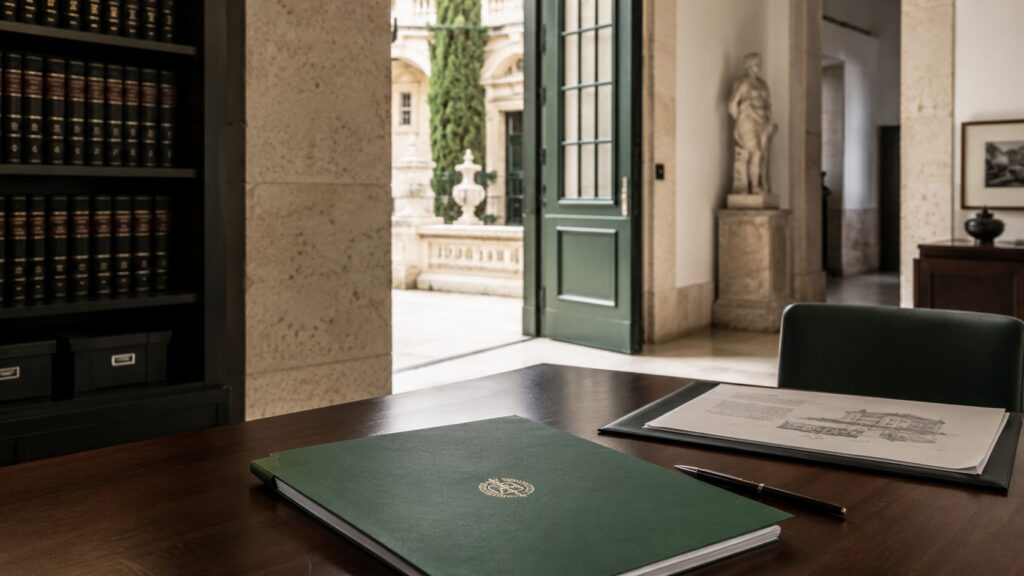
Portugal Golden Visa cultural donation route for arts and heritage support

How It Differs from Investment Routes

The main difference is financial return.

A fund investment is usually designed as a regulated financial investment. The investor subscribes to units in a qualifying fund, holds the investment for the required period, and may later exit according to the fund’s terms.

The cultural donation route works differently. The applicant transfers capital to support cultural production or heritage activity. In most cases, this is a non-refundable donation, not an asset that can be sold later.

That distinction matters because the decision is not just about the minimum amount. It is about the total economic outcome.

Route Minimum threshold Refundable? Return potential Main consideration
Cultural donation €250,000 Usually no Usually no Lower capital outlay
Investment fund €500,000 Potentially yes, subject to fund terms Possible, not guaranteed Higher capital outlay but investment structure
Real estate Not eligible Not applicable Not applicable Removed from Golden Visa eligibility

For investors comparing Portugal’s residency investment program with other European residency routes, the cultural route can look attractive because the headline threshold is lower. The important question is whether the lower initial amount outweighs the lack of capital recovery.

The 250000 Minimum Donation

The standard minimum for the cultural route is €250,000. It must be applied to investment or support for artistic production, or to the recovery or maintenance of Portuguese national cultural heritage.

The legal scope is specific. A qualifying contribution generally needs to involve one of the recognised public, public-interest, municipal, associative, or cultural entities pursuing work in artistic production or heritage preservation.

In plain English, the donation must support an eligible cultural purpose through an eligible Portuguese structure. A private donation to an unrelated museum, gallery, foundation, or arts project will not automatically qualify.

Which Organizations Qualify for the Donation Route?

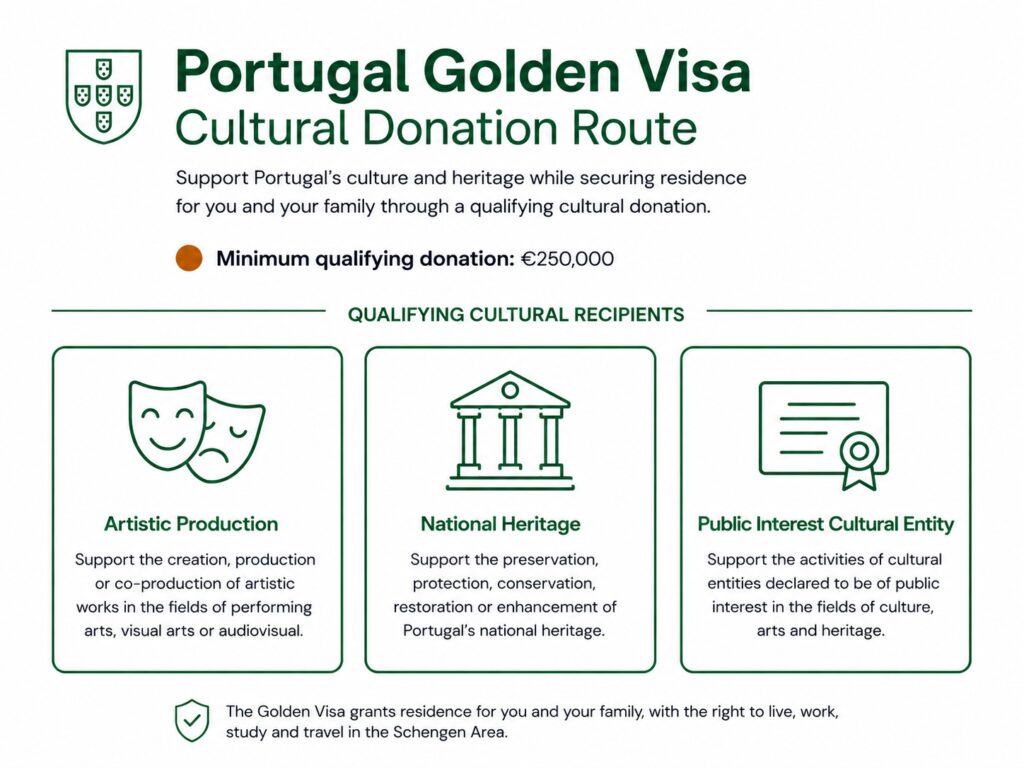
The eligible recipient is one of the most important parts of the Portugal Golden Visa donation option. The route depends on both the cultural purpose and the legal status of the organisation receiving the funds.

Applicants should avoid treating this as a simple charitable donation. The immigration file needs to show that the transfer meets ARI cultural route requirements, that the recipient is eligible, and that the funds were properly received and allocated.

Arts and Cultural Production Entities

The route can apply to cultural production investment or support for artistic activity. This may include work connected to artistic production, cultural programming, or other recognised creative activity.

Possible qualifying areas may include:

  • Artistic production projects
  • Cultural programming
  • Public cultural associations
  • Public or public-interest foundations
  • Municipal or intermunicipal cultural bodies
  • Cultural entities with a recognised public function

The key issue is not whether the project sounds cultural. The key issue is whether it fits the eligible legal framework and can produce the documentation required for the ARI cultural route.

National Heritage and Conservation Projects

The route may also apply to the recovery or maintenance of Portuguese national cultural heritage. This can include heritage conservation, restoration, or preservation work involving recognised public or public-interest entities.

The entity should be able to provide formal documentation showing:

  • The nature of the cultural or heritage project
  • Its public interest or recognised cultural purpose
  • The legal status of the recipient entity
  • The amount received from the applicant
  • Confirmation that the funds support the qualifying project

For applicants who care about cultural impact, the heritage route can be appealing. It allows the investor to support something tangible in Portugal while pursuing residency. But the contribution should still be reviewed with the same seriousness as any other Golden Visa route.

Portugal Golden Visa

Start Your Portugal Golden Visa Journey

Receive personalized legal guidance from experienced immigration lawyers and discover the most effective pathway to securing your Portugal Golden Visa.

Book Your Free Consultation →
✓ No Obligation   •   ✓ Licensed Lawyers   •   ✓ Confidential Consultation

How DGPC Designates Eligible Recipients

The Direção-Geral do Património Cultural, commonly referred to as DGPC, is connected to Portugal’s cultural heritage framework. When the route involves heritage conservation, applicants and advisers often need to examine whether the relevant entity, project, or designation can support the ARI file.

For this reason, the recipient should be checked against official cultural and heritage requirements before funds are transferred. Where heritage preservation is involved, the project should be reviewed through the relevant public cultural framework, including DGPC Cultural Heritage, before the applicant relies on it for a Golden Visa application.

This is where legal due diligence matters. A cultural project may be meaningful and well-run, but that does not automatically make it suitable for ARI purposes.
Eligible entities for Portugal Golden Visa cultural donation option

Step-by-Step: How to Make a Qualifying Cultural Donation

The cultural route should be handled in stages. The mistake to avoid is transferring money before confirming the recipient, documentation, and immigration relevance.

A careful process protects the applicant from two risks: supporting a project that does not qualify, or making a qualifying contribution without the documents needed to prove it.

Choosing a Qualifying Entity

The first step is identifying a qualifying cultural entity or heritage project. This should not be based only on marketing material or informal confirmation.

Before committing funds, the applicant should confirm:

  1. The legal status of the recipient entity
  2. The cultural or heritage purpose of the project
  3. Whether the entity falls within the recognised categories for the ARI cultural route
  4. Whether the recipient can issue the required donation receipt and declarations
  5. Whether the project has any public interest designation or cultural authority confirmation
  6. Whether the contribution amount meets the minimum threshold

This is also the stage where applicants should compare the cultural donation with investment visa options in Portugal, especially if they are deciding between lower capital outlay and possible future capital recovery.

Donation Documentation Required

The documentation is the backbone of the application. A cultural contribution may fail as an immigration strategy if the applicant cannot prove the transfer correctly.

Typical documentation may include:

  • Donation agreement or contribution agreement
  • Proof of transfer from the applicant’s account
  • Donation receipt from the qualifying entity
  • Declaration confirming the purpose of the funds
  • Evidence of the recipient’s legal status
  • Confirmation of the cultural or heritage project
  • Applicant identification documents
  • NIF, the Portuguese tax identification number
  • Bank documentation showing the source and transfer of funds
  • Legal due diligence report, where applicable

The donation receipt is especially important. It should clearly identify the donor, recipient, amount, date, and purpose of the transfer.

Submitting Through the AIMA Portal

AIMA, the Agency for Integration, Migration and Asylum, processes Golden Visa residence applications. The former authority, SEF, or Serviço de Estrangeiros e Fronteiras, was replaced by AIMA in 2023.

After the donation is made and the file is prepared, the applicant or legal representative submits the ARI application through the official process. The AIMA Golden Visa Cultural Route is the relevant official authority reference point for application processing and residency procedures.

The application file usually moves through these stages:

  1. Pre-application document preparation
  2. Donation transfer and receipt collection
  3. Online ARI submission
  4. Application review
  5. Biometric appointment
  6. Residence card issuance, subject to approval

The biometric appointment is the stage where the applicant provides biometric data, such as fingerprints and photographs, as part of the residence permit process.

Is the Cultural Donation Refundable?

In most cases, no. The cultural donation route is usually a non-refundable donation.

This is the single most important point for investors. The route may reduce the minimum capital outlay from €500,000 for a qualifying fund subscription to €250,000 for a cultural contribution, but the donated amount is usually not recoverable.

That means the real comparison is not simply €250,000 versus €500,000. It is:

  • €250,000 contributed with no expected return
  • €500,000 invested in a qualifying fund, with possible future return or loss depending on fund terms and performance

Neither route is risk-free. A fund can lose value, and a donation does not return capital. The right choice depends on the investor’s priority: lower upfront commitment, potential capital recovery, cultural impact, or investment exposure.

Pros and Cons of the Cultural Donation Route

The cultural route can be useful for the right applicant. It is not automatically better because it has a lower threshold, and it is not automatically worse because it is non-refundable.

The right analysis is practical: what does the investor want from the Golden Visa beyond residency?

Benefits: Lower Threshold, No Investment Risk

The clearest advantage is the lower minimum amount. A €250,000 donation can be significantly easier to plan than a €500,000 fund investment.

The second advantage is simplicity of financial exposure. There is no fund performance to monitor, no exit strategy to evaluate, and no market return assumption to analyse.

Key benefits include:

  • Lower qualifying threshold than the fund route
  • No exposure to fund market performance
  • Potential support for Portuguese arts or heritage
  • Same ARI residence framework, subject to eligibility
  • Possible route for applicants focused on residency rather than returns

For investors who want the lowest qualifying amount and do not need the capital back, the cultural route may be worth reviewing.

Drawbacks: No Financial Return

The main drawback is also simple. The donation is generally not returned.

That makes it unsuitable for applicants who want their Golden Visa route to remain part of a wider investment portfolio. If the goal is capital preservation, possible liquidity, and investment upside, the cultural route may feel expensive despite the lower threshold.

Other drawbacks include:

  • Limited availability of suitable cultural projects
  • Need for careful recipient due diligence
  • Documentation sensitivity
  • No financial return in most cases
  • Potential uncertainty around project eligibility or timing

Applicants should also budget for legal fees, translation, certification, government charges, and family member costs. For a wider view of non-investment expenses, see the full cost breakdown.
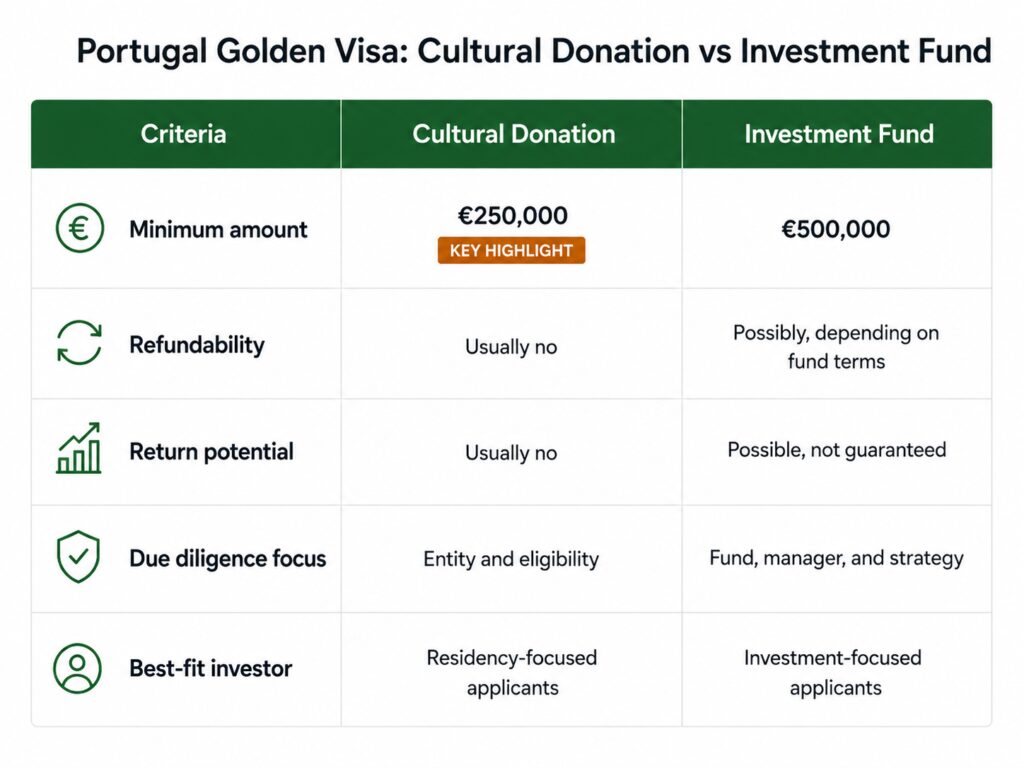
Portugal Golden Visa cultural donation compared with investment fund route

Cultural Donation vs Investment Fund: Which Should You Choose?

The cultural donation route and the investment fund route serve different investor profiles. Both can support a Portugal Golden Visa application when properly structured, but they solve different problems.

If the applicant wants the lowest qualifying threshold and accepts that the contribution is non-refundable, the cultural route may be attractive. If the applicant wants a regulated investment structure with possible future exit value, the fund route may be more appropriate.

Question Cultural donation route Investment fund route
Is the minimum lower? Yes, usually €250,000 No, usually €500,000
Can the capital be returned? Usually no Possibly, depending on fund terms
Is there investment performance risk? Not in the same way Yes
Is due diligence still needed? Yes, on entity and eligibility Yes, on fund, manager, and strategy
Best for Residency-focused applicants Investment-focused applicants

Investors who want to compare both routes should review the investment fund route compared before deciding. The fund route may involve a larger capital commitment, but the structure, regulation, and exit terms may be more suitable for applicants who do not want to treat the Golden Visa cost as a sunk contribution.

The cultural route is best viewed as a strategic residency contribution with cultural impact. It is not a shortcut, and it is not a low-cost version of a fund investment. It is a different route with a different financial logic.

FAQs About the Portugal Golden Visa Cultural Donation

How does the Portugal Golden Visa cultural donation option work?

The Portugal Golden Visa cultural donation option works through a qualifying capital transfer, usually at least €250,000, to support artistic production or the recovery and maintenance of Portuguese national cultural heritage. The contribution must go to an eligible cultural or public-interest entity and must be documented properly for the ARI application. AIMA reviews the residence application after submission through the relevant ARI process.

Is the 250000 cultural donation refundable?

Usually, no. The €250,000 cultural donation is generally treated as a non-refundable donation, not a financial investment that the applicant can later sell or redeem. This is why applicants should compare the lower threshold against the lack of capital recovery before choosing this route.

Which cultural organizations qualify?

Qualifying organisations may include certain public bodies, public institutes, public foundations, private foundations with public utility status, municipal or intermunicipal entities, public cultural associations, and other recognised entities working in artistic production or national heritage preservation. The applicant should confirm the recipient’s eligibility before transferring funds. A meaningful cultural project does not automatically qualify unless it fits the ARI route requirements and can provide proper documentation.

Is the cultural donation route better than the investment fund route?

It depends on the applicant’s financial objective. The cultural donation route may be better for someone who wants a lower qualifying threshold and accepts that the contribution is usually non-refundable. The investment fund route may be better for someone who wants a regulated investment structure, possible future exit value, and a route that fits into a wider wealth strategy.

Is the Portugal Golden Visa Cultural Donation Right for You?

The Portugal Golden Visa cultural donation route can make sense for investors who want a lower qualifying threshold and are comfortable treating the contribution as a non-refundable cost of obtaining residency, subject to eligibility. It can also appeal to applicants who genuinely value supporting Portuguese arts, culture, or national heritage.

It is less suitable for investors who want their Golden Visa route to behave like an investment asset. If capital recovery, portfolio strategy, and exit planning are priorities, the fund route deserves closer review.

The safest next step is to compare the cultural route and fund route side by side before transferring funds. The right answer depends on your capital strategy, family goals, timeline, and tolerance for a non-refundable contribution.

Ready to take the next step?
Book a free initial assessment. We’ll assess your eligibility, walk through the current qualifying routes, and answer your questions, no cost, no commitment.


Portugal Golden Visa Cultural Donation Option: How It Works and Is It Worth It?

The Portugal Golden Visa cultural donation route is one of the lowest-threshold ways to qualify for Portugal’s residency by investment programme, but it is also one of the most misunderstood. The minimum amount is usually €250,000, applied to artistic production or the recovery and maintenance of national cultural heritage. Unlike a fund subscription, this route is usually structured as a non-refundable contribution, so the lower entry point comes with a clear trade-off. This guide explains how the cultural route works, which entities may qualify, what documents matter, and when it may or may not make sense compared with the fund investment route.

What Is the Portugal Golden Visa Cultural Donation Option?

The cultural donation route is part of the ARI, or Autorização de Residência para Investimento, which is the formal name of Portugal’s Golden Visa residence permit. It allows eligible non-EU investors to qualify by supporting artistic production, cultural activity, or national heritage preservation through approved Portuguese entities.

This is not the same as buying a property, subscribing to a private fund, or donating to any cultural organisation of your choice. The route depends on a qualifying cultural purpose, a qualifying recipient, and proper documentation for the immigration file.

Portugal Golden Visa cultural donation route for arts and heritage support

How It Differs from Investment Routes

The main difference is financial return.

A fund investment is usually designed as a regulated financial investment. The investor subscribes to units in a qualifying fund, holds the investment for the required period, and may later exit according to the fund’s terms.

The cultural donation route works differently. The applicant transfers capital to support cultural production or heritage activity. In most cases, this is a non-refundable donation, not an asset that can be sold later.

That distinction matters because the decision is not just about the minimum amount. It is about the total economic outcome.

Route Minimum threshold Refundable? Return potential Main consideration
Cultural donation €250,000 Usually no Usually no Lower capital outlay
Investment fund €500,000 Potentially yes, subject to fund terms Possible, not guaranteed Higher capital outlay but investment structure
Real estate Not eligible Not applicable Not applicable Removed from Golden Visa eligibility

For investors comparing Portugal’s residency investment program with other European residency routes, the cultural route can look attractive because the headline threshold is lower. The important question is whether the lower initial amount outweighs the lack of capital recovery.

The 250000 Minimum Donation

The standard minimum for the cultural route is €250,000. It must be applied to investment or support for artistic production, or to the recovery or maintenance of Portuguese national cultural heritage.

The legal scope is specific. A qualifying contribution generally needs to involve one of the recognised public, public-interest, municipal, associative, or cultural entities pursuing work in artistic production or heritage preservation.

In plain English, the donation must support an eligible cultural purpose through an eligible Portuguese structure. A private donation to an unrelated museum, gallery, foundation, or arts project will not automatically qualify.

Which Organizations Qualify for the Donation Route?

The eligible recipient is one of the most important parts of the Portugal Golden Visa donation option. The route depends on both the cultural purpose and the legal status of the organisation receiving the funds.

Applicants should avoid treating this as a simple charitable donation. The immigration file needs to show that the transfer meets ARI cultural route requirements, that the recipient is eligible, and that the funds were properly received and allocated.

Arts and Cultural Production Entities

The route can apply to cultural production investment or support for artistic activity. This may include work connected to artistic production, cultural programming, or other recognised creative activity.

Possible qualifying areas may include:

  • Artistic production projects
  • Cultural programming
  • Public cultural associations
  • Public or public-interest foundations
  • Municipal or intermunicipal cultural bodies
  • Cultural entities with a recognised public function

The key issue is not whether the project sounds cultural. The key issue is whether it fits the eligible legal framework and can produce the documentation required for the ARI cultural route.

National Heritage and Conservation Projects

The route may also apply to the recovery or maintenance of Portuguese national cultural heritage. This can include heritage conservation, restoration, or preservation work involving recognised public or public-interest entities.

The entity should be able to provide formal documentation showing:

  • The nature of the cultural or heritage project
  • Its public interest or recognised cultural purpose
  • The legal status of the recipient entity
  • The amount received from the applicant
  • Confirmation that the funds support the qualifying project

For applicants who care about cultural impact, the heritage route can be appealing. It allows the investor to support something tangible in Portugal while pursuing residency. But the contribution should still be reviewed with the same seriousness as any other Golden Visa route.

Portugal Golden Visa

Start Your Portugal Golden Visa Journey

Receive personalized legal guidance from experienced immigration lawyers and discover the most effective pathway to securing your Portugal Golden Visa.

Book Your Free Consultation →
✓ No Obligation   •   ✓ Licensed Lawyers   •   ✓ Confidential Consultation

How DGPC Designates Eligible Recipients

The Direção-Geral do Património Cultural, commonly referred to as DGPC, is connected to Portugal’s cultural heritage framework. When the route involves heritage conservation, applicants and advisers often need to examine whether the relevant entity, project, or designation can support the ARI file.

For this reason, the recipient should be checked against official cultural and heritage requirements before funds are transferred. Where heritage preservation is involved, the project should be reviewed through the relevant public cultural framework, including DGPC Cultural Heritage, before the applicant relies on it for a Golden Visa application.

This is where legal due diligence matters. A cultural project may be meaningful and well-run, but that does not automatically make it suitable for ARI purposes.

Eligible entities for Portugal Golden Visa cultural donation option

Step-by-Step: How to Make a Qualifying Cultural Donation

The cultural route should be handled in stages. The mistake to avoid is transferring money before confirming the recipient, documentation, and immigration relevance.

A careful process protects the applicant from two risks: supporting a project that does not qualify, or making a qualifying contribution without the documents needed to prove it.

Choosing a Qualifying Entity

The first step is identifying a qualifying cultural entity or heritage project. This should not be based only on marketing material or informal confirmation.

Before committing funds, the applicant should confirm:

  1. The legal status of the recipient entity
  2. The cultural or heritage purpose of the project
  3. Whether the entity falls within the recognised categories for the ARI cultural route
  4. Whether the recipient can issue the required donation receipt and declarations
  5. Whether the project has any public interest designation or cultural authority confirmation
  6. Whether the contribution amount meets the minimum threshold

This is also the stage where applicants should compare the cultural donation with investment visa options in Portugal, especially if they are deciding between lower capital outlay and possible future capital recovery.

Donation Documentation Required

The documentation is the backbone of the application. A cultural contribution may fail as an immigration strategy if the applicant cannot prove the transfer correctly.

Typical documentation may include:

  • Donation agreement or contribution agreement
  • Proof of transfer from the applicant’s account
  • Donation receipt from the qualifying entity
  • Declaration confirming the purpose of the funds
  • Evidence of the recipient’s legal status
  • Confirmation of the cultural or heritage project
  • Applicant identification documents
  • NIF, the Portuguese tax identification number
  • Bank documentation showing the source and transfer of funds
  • Legal due diligence report, where applicable

The donation receipt is especially important. It should clearly identify the donor, recipient, amount, date, and purpose of the transfer.

Submitting Through the AIMA Portal

AIMA, the Agency for Integration, Migration and Asylum, processes Golden Visa residence applications. The former authority, SEF, or Serviço de Estrangeiros e Fronteiras, was replaced by AIMA in 2023.

After the donation is made and the file is prepared, the applicant or legal representative submits the ARI application through the official process. The AIMA Golden Visa Cultural Route is the relevant official authority reference point for application processing and residency procedures.

The application file usually moves through these stages:

  1. Pre-application document preparation
  2. Donation transfer and receipt collection
  3. Online ARI submission
  4. Application review
  5. Biometric appointment
  6. Residence card issuance, subject to approval

The biometric appointment is the stage where the applicant provides biometric data, such as fingerprints and photographs, as part of the residence permit process.

Is the Cultural Donation Refundable?

In most cases, no. The cultural donation route is usually a non-refundable donation.

This is the single most important point for investors. The route may reduce the minimum capital outlay from €500,000 for a qualifying fund subscription to €250,000 for a cultural contribution, but the donated amount is usually not recoverable.

That means the real comparison is not simply €250,000 versus €500,000. It is:

  • €250,000 contributed with no expected return
  • €500,000 invested in a qualifying fund, with possible future return or loss depending on fund terms and performance

Neither route is risk-free. A fund can lose value, and a donation does not return capital. The right choice depends on the investor’s priority: lower upfront commitment, potential capital recovery, cultural impact, or investment exposure.

Pros and Cons of the Cultural Donation Route

The cultural route can be useful for the right applicant. It is not automatically better because it has a lower threshold, and it is not automatically worse because it is non-refundable.

The right analysis is practical: what does the investor want from the Golden Visa beyond residency?

Benefits: Lower Threshold, No Investment Risk

The clearest advantage is the lower minimum amount. A €250,000 donation can be significantly easier to plan than a €500,000 fund investment.

The second advantage is simplicity of financial exposure. There is no fund performance to monitor, no exit strategy to evaluate, and no market return assumption to analyse.

Key benefits include:

  • Lower qualifying threshold than the fund route
  • No exposure to fund market performance
  • Potential support for Portuguese arts or heritage
  • Same ARI residence framework, subject to eligibility
  • Possible route for applicants focused on residency rather than returns

For investors who want the lowest qualifying amount and do not need the capital back, the cultural route may be worth reviewing.

Drawbacks: No Financial Return

The main drawback is also simple. The donation is generally not returned.

That makes it unsuitable for applicants who want their Golden Visa route to remain part of a wider investment portfolio. If the goal is capital preservation, possible liquidity, and investment upside, the cultural route may feel expensive despite the lower threshold.

Other drawbacks include:

  • Limited availability of suitable cultural projects
  • Need for careful recipient due diligence
  • Documentation sensitivity
  • No financial return in most cases
  • Potential uncertainty around project eligibility or timing

Applicants should also budget for legal fees, translation, certification, government charges, and family member costs. For a wider view of non-investment expenses, see the full cost breakdown.

Portugal Golden Visa cultural donation compared with investment fund route

Cultural Donation vs Investment Fund: Which Should You Choose?

The cultural donation route and the investment fund route serve different investor profiles. Both can support a Portugal Golden Visa application when properly structured, but they solve different problems.

If the applicant wants the lowest qualifying threshold and accepts that the contribution is non-refundable, the cultural route may be attractive. If the applicant wants a regulated investment structure with possible future exit value, the fund route may be more appropriate.

Question Cultural donation route Investment fund route
Is the minimum lower? Yes, usually €250,000 No, usually €500,000
Can the capital be returned? Usually no Possibly, depending on fund terms
Is there investment performance risk? Not in the same way Yes
Is due diligence still needed? Yes, on entity and eligibility Yes, on fund, manager, and strategy
Best for Residency-focused applicants Investment-focused applicants

Investors who want to compare both routes should review the investment fund route compared before deciding. The fund route may involve a larger capital commitment, but the structure, regulation, and exit terms may be more suitable for applicants who do not want to treat the Golden Visa cost as a sunk contribution.

The cultural route is best viewed as a strategic residency contribution with cultural impact. It is not a shortcut, and it is not a low-cost version of a fund investment. It is a different route with a different financial logic.

FAQs About the Portugal Golden Visa Cultural Donation

How does the Portugal Golden Visa cultural donation option work?

The Portugal Golden Visa cultural donation option works through a qualifying capital transfer, usually at least €250,000, to support artistic production or the recovery and maintenance of Portuguese national cultural heritage. The contribution must go to an eligible cultural or public-interest entity and must be documented properly for the ARI application. AIMA reviews the residence application after submission through the relevant ARI process.

Is the 250000 cultural donation refundable?

Usually, no. The €250,000 cultural donation is generally treated as a non-refundable donation, not a financial investment that the applicant can later sell or redeem. This is why applicants should compare the lower threshold against the lack of capital recovery before choosing this route.

Which cultural organizations qualify?

Qualifying organisations may include certain public bodies, public institutes, public foundations, private foundations with public utility status, municipal or intermunicipal entities, public cultural associations, and other recognised entities working in artistic production or national heritage preservation. The applicant should confirm the recipient’s eligibility before transferring funds. A meaningful cultural project does not automatically qualify unless it fits the ARI route requirements and can provide proper documentation.

Is the cultural donation route better than the investment fund route?

It depends on the applicant’s financial objective. The cultural donation route may be better for someone who wants a lower qualifying threshold and accepts that the contribution is usually non-refundable. The investment fund route may be better for someone who wants a regulated investment structure, possible future exit value, and a route that fits into a wider wealth strategy.

Is the Portugal Golden Visa Cultural Donation Right for You?

The Portugal Golden Visa cultural donation route can make sense for investors who want a lower qualifying threshold and are comfortable treating the contribution as a non-refundable cost of obtaining residency, subject to eligibility. It can also appeal to applicants who genuinely value supporting Portuguese arts, culture, or national heritage.

It is less suitable for investors who want their Golden Visa route to behave like an investment asset. If capital recovery, portfolio strategy, and exit planning are priorities, the fund route deserves closer review.

The safest next step is to compare the cultural route and fund route side by side before transferring funds. The right answer depends on your capital strategy, family goals, timeline, and tolerance for a non-refundable contribution.

Ready to take the next step?
Book a free initial assessment. We’ll assess your eligibility, walk through the current qualifying routes, and answer your questions, no cost, no commitment.

Portugal Golden Visa Cultural Donation Option: How It Works and Is It Worth It?

Portugal-Golden-Visa-Cultural-Donation-Option-How-It-Works-and-Is-It-Worth-It
The Portugal Golden Visa cultural donation route is one of the lowest-threshold ways to qualify for Portugal’s residency by investment programme, but it is also one of the most misunderstood. The minimum amount is usually €250,000, applied to artistic production or the recovery and maintenance of national cultural heritage. Unlike a fund subscription, this route is usually structured as a non-refundable contribution, so the lower entry point comes with a clear trade-off. This guide explains how the cultural route works, which entities may qualify, what documents matter, and when it may or may not make sense compared with the fund investment route.

What Is the Portugal Golden Visa Cultural Donation Option?

The cultural donation route is part of the ARI, or Autorização de Residência para Investimento, which is the formal name of Portugal’s Golden Visa residence permit. It allows eligible non-EU investors to qualify by supporting artistic production, cultural activity, or national heritage preservation through approved Portuguese entities.

This is not the same as buying a property, subscribing to a private fund, or donating to any cultural organisation of your choice. The route depends on a qualifying cultural purpose, a qualifying recipient, and proper documentation for the immigration file.

Portugal Golden Visa cultural donation route for arts and heritage support

How It Differs from Investment Routes

The main difference is financial return.

A fund investment is usually designed as a regulated financial investment. The investor subscribes to units in a qualifying fund, holds the investment for the required period, and may later exit according to the fund’s terms.

The cultural donation route works differently. The applicant transfers capital to support cultural production or heritage activity. In most cases, this is a non-refundable donation, not an asset that can be sold later.

That distinction matters because the decision is not just about the minimum amount. It is about the total economic outcome.

Route Minimum threshold Refundable? Return potential Main consideration
Cultural donation €250,000 Usually no Usually no Lower capital outlay
Investment fund €500,000 Potentially yes, subject to fund terms Possible, not guaranteed Higher capital outlay but investment structure
Real estate Not eligible Not applicable Not applicable Removed from Golden Visa eligibility

For investors comparing Portugal’s residency investment program with other European residency routes, the cultural route can look attractive because the headline threshold is lower. The important question is whether the lower initial amount outweighs the lack of capital recovery.

The 250000 Minimum Donation

The standard minimum for the cultural route is €250,000. It must be applied to investment or support for artistic production, or to the recovery or maintenance of Portuguese national cultural heritage.

The legal scope is specific. A qualifying contribution generally needs to involve one of the recognised public, public-interest, municipal, associative, or cultural entities pursuing work in artistic production or heritage preservation.

In plain English, the donation must support an eligible cultural purpose through an eligible Portuguese structure. A private donation to an unrelated museum, gallery, foundation, or arts project will not automatically qualify.

Which Organizations Qualify for the Donation Route?

The eligible recipient is one of the most important parts of the Portugal Golden Visa donation option. The route depends on both the cultural purpose and the legal status of the organisation receiving the funds.

Applicants should avoid treating this as a simple charitable donation. The immigration file needs to show that the transfer meets ARI cultural route requirements, that the recipient is eligible, and that the funds were properly received and allocated.

Arts and Cultural Production Entities

The route can apply to cultural production investment or support for artistic activity. This may include work connected to artistic production, cultural programming, or other recognised creative activity.

Possible qualifying areas may include:

  • Artistic production projects
  • Cultural programming
  • Public cultural associations
  • Public or public-interest foundations
  • Municipal or intermunicipal cultural bodies
  • Cultural entities with a recognised public function

The key issue is not whether the project sounds cultural. The key issue is whether it fits the eligible legal framework and can produce the documentation required for the ARI cultural route.

National Heritage and Conservation Projects

The route may also apply to the recovery or maintenance of Portuguese national cultural heritage. This can include heritage conservation, restoration, or preservation work involving recognised public or public-interest entities.

The entity should be able to provide formal documentation showing:

  • The nature of the cultural or heritage project
  • Its public interest or recognised cultural purpose
  • The legal status of the recipient entity
  • The amount received from the applicant
  • Confirmation that the funds support the qualifying project

For applicants who care about cultural impact, the heritage route can be appealing. It allows the investor to support something tangible in Portugal while pursuing residency. But the contribution should still be reviewed with the same seriousness as any other Golden Visa route.

Portugal Golden Visa

Start Your Portugal Golden Visa Journey

Receive personalized legal guidance from experienced immigration lawyers and discover the most effective pathway to securing your Portugal Golden Visa.

Book Your Free Consultation →
✓ No Obligation   •   ✓ Licensed Lawyers   •   ✓ Confidential Consultation

How DGPC Designates Eligible Recipients

The Direção-Geral do Património Cultural, commonly referred to as DGPC, is connected to Portugal’s cultural heritage framework. When the route involves heritage conservation, applicants and advisers often need to examine whether the relevant entity, project, or designation can support the ARI file.

For this reason, the recipient should be checked against official cultural and heritage requirements before funds are transferred. Where heritage preservation is involved, the project should be reviewed through the relevant public cultural framework, including DGPC Cultural Heritage, before the applicant relies on it for a Golden Visa application.

This is where legal due diligence matters. A cultural project may be meaningful and well-run, but that does not automatically make it suitable for ARI purposes.

Eligible entities for Portugal Golden Visa cultural donation option

Step-by-Step: How to Make a Qualifying Cultural Donation

The cultural route should be handled in stages. The mistake to avoid is transferring money before confirming the recipient, documentation, and immigration relevance.

A careful process protects the applicant from two risks: supporting a project that does not qualify, or making a qualifying contribution without the documents needed to prove it.

Choosing a Qualifying Entity

The first step is identifying a qualifying cultural entity or heritage project. This should not be based only on marketing material or informal confirmation.

Before committing funds, the applicant should confirm:

  1. The legal status of the recipient entity
  2. The cultural or heritage purpose of the project
  3. Whether the entity falls within the recognised categories for the ARI cultural route
  4. Whether the recipient can issue the required donation receipt and declarations
  5. Whether the project has any public interest designation or cultural authority confirmation
  6. Whether the contribution amount meets the minimum threshold

This is also the stage where applicants should compare the cultural donation with investment visa options in Portugal, especially if they are deciding between lower capital outlay and possible future capital recovery.

Donation Documentation Required

The documentation is the backbone of the application. A cultural contribution may fail as an immigration strategy if the applicant cannot prove the transfer correctly.

Typical documentation may include:

  • Donation agreement or contribution agreement
  • Proof of transfer from the applicant’s account
  • Donation receipt from the qualifying entity
  • Declaration confirming the purpose of the funds
  • Evidence of the recipient’s legal status
  • Confirmation of the cultural or heritage project
  • Applicant identification documents
  • NIF, the Portuguese tax identification number
  • Bank documentation showing the source and transfer of funds
  • Legal due diligence report, where applicable

The donation receipt is especially important. It should clearly identify the donor, recipient, amount, date, and purpose of the transfer.

Submitting Through the AIMA Portal

AIMA, the Agency for Integration, Migration and Asylum, processes Golden Visa residence applications. The former authority, SEF, or Serviço de Estrangeiros e Fronteiras, was replaced by AIMA in 2023.

After the donation is made and the file is prepared, the applicant or legal representative submits the ARI application through the official process. The AIMA Golden Visa Cultural Route is the relevant official authority reference point for application processing and residency procedures.

The application file usually moves through these stages:

  1. Pre-application document preparation
  2. Donation transfer and receipt collection
  3. Online ARI submission
  4. Application review
  5. Biometric appointment
  6. Residence card issuance, subject to approval

The biometric appointment is the stage where the applicant provides biometric data, such as fingerprints and photographs, as part of the residence permit process.

Is the Cultural Donation Refundable?

In most cases, no. The cultural donation route is usually a non-refundable donation.

This is the single most important point for investors. The route may reduce the minimum capital outlay from €500,000 for a qualifying fund subscription to €250,000 for a cultural contribution, but the donated amount is usually not recoverable.

That means the real comparison is not simply €250,000 versus €500,000. It is:

  • €250,000 contributed with no expected return
  • €500,000 invested in a qualifying fund, with possible future return or loss depending on fund terms and performance

Neither route is risk-free. A fund can lose value, and a donation does not return capital. The right choice depends on the investor’s priority: lower upfront commitment, potential capital recovery, cultural impact, or investment exposure.

Pros and Cons of the Cultural Donation Route

The cultural route can be useful for the right applicant. It is not automatically better because it has a lower threshold, and it is not automatically worse because it is non-refundable.

The right analysis is practical: what does the investor want from the Golden Visa beyond residency?

Benefits: Lower Threshold, No Investment Risk

The clearest advantage is the lower minimum amount. A €250,000 donation can be significantly easier to plan than a €500,000 fund investment.

The second advantage is simplicity of financial exposure. There is no fund performance to monitor, no exit strategy to evaluate, and no market return assumption to analyse.

Key benefits include:

  • Lower qualifying threshold than the fund route
  • No exposure to fund market performance
  • Potential support for Portuguese arts or heritage
  • Same ARI residence framework, subject to eligibility
  • Possible route for applicants focused on residency rather than returns

For investors who want the lowest qualifying amount and do not need the capital back, the cultural route may be worth reviewing.

Drawbacks: No Financial Return

The main drawback is also simple. The donation is generally not returned.

That makes it unsuitable for applicants who want their Golden Visa route to remain part of a wider investment portfolio. If the goal is capital preservation, possible liquidity, and investment upside, the cultural route may feel expensive despite the lower threshold.

Other drawbacks include:

  • Limited availability of suitable cultural projects
  • Need for careful recipient due diligence
  • Documentation sensitivity
  • No financial return in most cases
  • Potential uncertainty around project eligibility or timing

Applicants should also budget for legal fees, translation, certification, government charges, and family member costs. For a wider view of non-investment expenses, see the full cost breakdown.

Portugal Golden Visa cultural donation compared with investment fund route

Cultural Donation vs Investment Fund: Which Should You Choose?

The cultural donation route and the investment fund route serve different investor profiles. Both can support a Portugal Golden Visa application when properly structured, but they solve different problems.

If the applicant wants the lowest qualifying threshold and accepts that the contribution is non-refundable, the cultural route may be attractive. If the applicant wants a regulated investment structure with possible future exit value, the fund route may be more appropriate.

Question Cultural donation route Investment fund route
Is the minimum lower? Yes, usually €250,000 No, usually €500,000
Can the capital be returned? Usually no Possibly, depending on fund terms
Is there investment performance risk? Not in the same way Yes
Is due diligence still needed? Yes, on entity and eligibility Yes, on fund, manager, and strategy
Best for Residency-focused applicants Investment-focused applicants

Investors who want to compare both routes should review the investment fund route compared before deciding. The fund route may involve a larger capital commitment, but the structure, regulation, and exit terms may be more suitable for applicants who do not want to treat the Golden Visa cost as a sunk contribution.

The cultural route is best viewed as a strategic residency contribution with cultural impact. It is not a shortcut, and it is not a low-cost version of a fund investment. It is a different route with a different financial logic.

FAQs About the Portugal Golden Visa Cultural Donation

How does the Portugal Golden Visa cultural donation option work?

The Portugal Golden Visa cultural donation option works through a qualifying capital transfer, usually at least €250,000, to support artistic production or the recovery and maintenance of Portuguese national cultural heritage. The contribution must go to an eligible cultural or public-interest entity and must be documented properly for the ARI application. AIMA reviews the residence application after submission through the relevant ARI process.

Is the 250000 cultural donation refundable?

Usually, no. The €250,000 cultural donation is generally treated as a non-refundable donation, not a financial investment that the applicant can later sell or redeem. This is why applicants should compare the lower threshold against the lack of capital recovery before choosing this route.

Which cultural organizations qualify?

Qualifying organisations may include certain public bodies, public institutes, public foundations, private foundations with public utility status, municipal or intermunicipal entities, public cultural associations, and other recognised entities working in artistic production or national heritage preservation. The applicant should confirm the recipient’s eligibility before transferring funds. A meaningful cultural project does not automatically qualify unless it fits the ARI route requirements and can provide proper documentation.

Is the cultural donation route better than the investment fund route?

It depends on the applicant’s financial objective. The cultural donation route may be better for someone who wants a lower qualifying threshold and accepts that the contribution is usually non-refundable. The investment fund route may be better for someone who wants a regulated investment structure, possible future exit value, and a route that fits into a wider wealth strategy.

Is the Portugal Golden Visa Cultural Donation Right for You?

The Portugal Golden Visa cultural donation route can make sense for investors who want a lower qualifying threshold and are comfortable treating the contribution as a non-refundable cost of obtaining residency, subject to eligibility. It can also appeal to applicants who genuinely value supporting Portuguese arts, culture, or national heritage.

It is less suitable for investors who want their Golden Visa route to behave like an investment asset. If capital recovery, portfolio strategy, and exit planning are priorities, the fund route deserves closer review.

The safest next step is to compare the cultural route and fund route side by side before transferring funds. The right answer depends on your capital strategy, family goals, timeline, and tolerance for a non-refundable contribution.

Ready to take the next step?
Book a free initial assessment. We’ll assess your eligibility, walk through the current qualifying routes, and answer your questions, no cost, no commitment.

What do you think?
Blog

More Related Articles

top








