

Both options can provide Schengen Area access, family residency, and a long-term European base. The better choice depends on your investment preference, tax position, citizenship expectations, and how much physical connection you are willing to build with the country.
Portugal Golden Visa vs Greece Golden Visa: Quick Comparison Table
The fastest way to compare both programmes is to look at the practical investor questions first: cost, stay requirement, asset type, citizenship route, and long-term flexibility.
| Factor | Portugal Golden Visa | Greece Golden Visa |
| Main 2026 investment focus | Investment funds, cultural support, research, job creation, business routes | Real estate, plus selected financial routes |
| Common minimum investment | €500,000 for qualifying non-real-estate investment funds | €250,000, €400,000, or €800,000 depending on property type and location |
| Real estate route | No longer qualifies for new ARI applications | Still available under updated thresholds |
| Stay requirement | Low stay requirement, commonly planned around 7 days per year | No minimum stay requirement for permit renewal |
| Schengen Area access | Yes, as a Portuguese resident | Yes, as a Greek resident |
| Citizenship route | Possible by naturalisation, subject to the current nationality law | Possible after long-term residence and integration |
| Best suited for | Investors who prefer regulated funds and a Portugal-based long-term strategy | Investors who want EU residency through property ownership |
The short answer: Greece usually wins on property access and lower entry points. Portugal may be stronger for investors who prefer regulated fund exposure, a more financial-services-led structure, and a structured route through the portugal golden visa.

Minimum Investment Requirements
Minimum investment is usually the first point investors compare. It matters, but it does not tell the full story.
Portugal and Greece now differ most clearly in the asset class. Portugal removed real estate from new Golden Visa eligibility, while Greece kept real estate but raised thresholds in high-demand areas.
Portugal Investment Routes in 2026
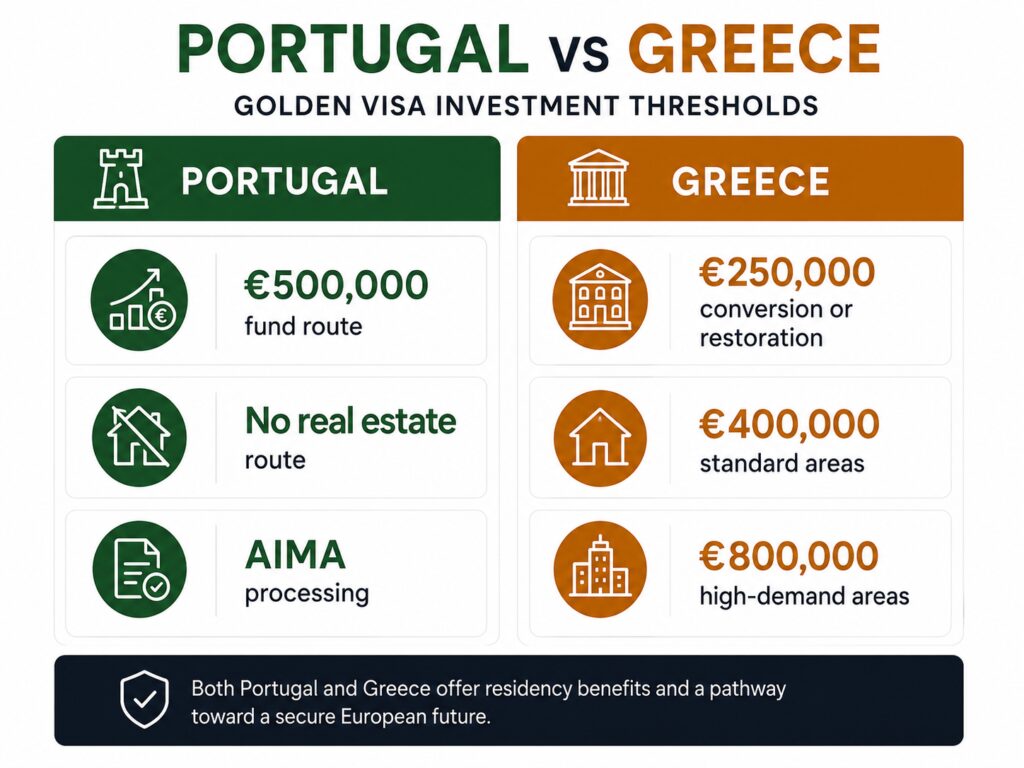
Portugal’s ARI, or Autorização de Residência para Investimento, is the formal residence permit for investment activity. In 2026, the main practical route for many non-EU investors is a €500,000 investment in qualifying non-real-estate collective investment funds.
The AIMA official portal lists current ARI routes, including investment funds, cultural support, research activity, job creation, and business capital routes. AIMA is the Agency for Integration, Migration and Asylum, the authority that replaced SEF and now processes immigration residence matters in Portugal.
For many investors comparing golden visa Greece vs Portugal, the Portugal route is attractive because it avoids direct property management. The investor does not need to choose tenants, manage maintenance, or handle local rental rules. The trade-off is that fund due diligence becomes central.
Key Portugal points:
- €500,000 is the common qualifying fund investment threshold.
- The fund must be non-real-estate.
- Fund maturity and investment composition must meet legal requirements.
- The investment should be reviewed carefully by legal and financial professionals.
- Real estate purchases no longer qualify for new Portugal Golden Visa applications.
For investors who want a closer cost view, the Portugal Golden Visa cost breakdown explains the wider expense picture beyond the investment itself.
Greece Investment Routes in 2026
The Greek Golden Visa remains strongly tied to property. That is the main reason Greece still attracts investors who want a tangible real estate asset.
According to the official Enterprise Greece update, the real estate threshold is now €800,000 in high-demand areas such as greater Athens, greater Thessaloniki, Mykonos, Santorini, and islands with more than 3,100 residents. In other areas, the threshold is generally €400,000. Certain property conversion or restoration cases can still qualify at €250,000 under specific conditions through the Enterprise Greece Golden Visa update.
Greece may therefore be cheaper than Portugal in some narrow cases, especially if the investor can use the €250,000 conversion or restoration route. But in prime real estate zones, Greece can be more expensive than Portugal’s €500,000 fund route.
Key Greece points:
- €800,000 applies in selected high-demand locations.
- €400,000 applies in many other areas.
- €250,000 may apply to qualifying conversion or restoration projects.
- Real estate must meet specific legal and property conditions.
- Property ownership remains the main appeal of the Greek route.
Processing Times Compared
Processing time is one of the hardest points to compare because official timelines and real-life experience can differ.
Portugal has faced delays since the transition from SEF, Serviço de Estrangeiros e Fronteiras, to AIMA. Applicants should expect multiple stages: document preparation, online submission, biometric appointment, review, approval, and residence card issuance.
For Portugal, a realistic investor timeline often includes:
- Structuring the investment and opening a bank account
- Obtaining a NIF, the Portuguese tax identification number
- Completing fund due diligence
- Submitting the ARI application
- Waiting for biometric appointment scheduling
- Attending biometrics in Portugal
- Waiting for card issuance
Greece can often feel more direct because the real estate purchase and residence permit application are closely linked. But Greece also depends on property due diligence, notary work, land registry checks, biometric appointment scheduling, and local authority processing.
For a non-EU investor, the comparison is practical: Portugal can be more document-heavy and fund-driven, while Greece can be more property-transaction-driven. Neither should be treated as instant.
Minimum Stay Requirements
This is one of the clearest differences in the portugal greece golden visa comparison.
Portugal has a low physical stay requirement. AIMA states that ARI holders must stay in Portugal for at least 7 days in the first year and 14 days in subsequent two-year periods. In practice, many investors describe this as roughly seven days per year.
Greece is more flexible for investors who want residency without regular visits. The Greek Golden Visa generally does not require minimum physical stay to renew the residence permit, provided the qualifying investment is maintained and renewal conditions are met.
| Requirement | Portugal | Greece |
| Stay needed to maintain permit | Yes, low stay requirement | Generally no minimum stay |
| Biometrics | Required | Required |
| Citizenship impact | Physical and legal residence matter | Strong physical residence and integration matter |
| Best for non-relocating investors | Strong, but requires some Portugal presence | Very strong for pure residency flexibility |
This is where Greece may appeal more to investors who only want a backup residence permit. Portugal may appeal more to investors who are willing to keep a light but real connection with the country.
Path to Citizenship: Which Is Faster?
Citizenship is where many older comparisons between Portugal and Greece become outdated.
Portugal used to be widely described as a five-year citizenship pathway. In 2026, the nationality law changed. That means any article that still says “Portugal citizenship in five years” without qualification should be treated carefully.
Portugal Citizenship Timeline
Under Portugal’s updated nationality framework, naturalisation rules now require longer legal residence periods for many applicants. The current Diário da República text refers to seven years for nationals of Portuguese-speaking countries and EU citizens, and 10 years for nationals of other countries, subject to the full legal requirements.
That does not remove the value of Portugal residency. It does change the citizenship planning conversation.
Portugal may still be attractive because the ARI residence permit can support long-term legal residence, and the country permits dual citizenship. But investors should now plan around the updated legal timeline rather than relying on the older five-year assumption.
For a deeper citizenship-focused view, read more about the path to Portuguese citizenship.
Greece Citizenship Timeline
Greek citizenship is possible, but it is not usually the main reason investors choose Greece Golden Visa.
Greece generally requires a stronger real-life connection for citizenship. Long-term residence, language, integration, and genuine ties matter. A Greek Golden Visa may help establish legal residence, but simply holding the permit without living in Greece is unlikely to support a strong citizenship case.
In practical terms:
- Portugal may still offer a structured long-term route, but the timeline is now longer for many investors.
- Greece offers a strong residency route, but citizenship usually requires deeper relocation and integration.
- If citizenship is the priority, legal advice should come before the investment decision.
Tax Benefits Compared
Tax can change the result of the comparison. The cheapest Golden Visa on paper may not be the best option if the investor’s tax exposure becomes inefficient.
Tax residency is separate from immigration residency. Holding a Golden Visa does not automatically make someone tax resident. Actual residence days, family ties, income source, and domestic tax rules all matter.
Portugal NHR Regime
Portugal’s original NHR, or Non-Habitual Resident regime, has changed. The Portuguese Tax Authority explains that the original NHR regime was repealed from 1 January 2024 and replaced by a new tax incentive for scientific research and innovation through the Portal das Finanças NHR guidance.
This matters because many older Portugal Golden Visa comparisons still mention NHR as if it were broadly available to new applicants. That is no longer safe.
Portugal may still offer tax advantages for the right profile, especially highly qualified professionals or specific eligible activities. But a passive investor should not assume automatic access to the old NHR benefits.
Greece Non-Dom Tax Regime
Greece has its own non-dom tax regime for qualifying individuals who transfer tax residence to Greece. The Greek tax authority, AADE, describes alternative taxation for foreign-source income under Article 5A in its official guidance for Greeks abroad and non-residents.
For high-net-worth investors, Greece’s non-dom regime can be relevant because it may allow a fixed annual tax approach on foreign income, subject to eligibility and investment conditions. This is not the same as simply holding a Golden Visa. The investor must assess immigration, tax residency, and wealth planning together.
The clean comparison is this:
| Tax point | Portugal | Greece |
| Old NHR availability | Closed for most new applicants, transitional cases only | Not applicable |
| New tax incentive | More targeted and profession-linked | Not applicable |
| Non-dom style regime | Not in the same format as Greece | Available for qualifying taxpayers |
| Best for passive investors | Needs careful tax review | Potentially attractive for HNW tax planning |
Passport Strength Comparison
Both Portugal and Greece are EU member states. Both passports are strong, and both support EU citizenship rights if the applicant eventually naturalises.
In day-to-day travel terms, the difference between the two passports is not usually decisive. Third-party passport rankings may place them very close together, and rankings change over time. For actual entry rules, investors should always check the destination country’s official rules or a government travel source such as the U.S. Department of State travel portal.
The more important question is not “which passport is stronger?” It is “which country gives me a more realistic route to citizenship based on my lifestyle?”
For most investors:
- Portugal may be stronger if they are willing to build a structured long-term connection.
- Greece may be stronger if they mainly want renewable EU residency through real estate.
- Both require serious planning if the end goal is an EU passport.
Which Golden Visa Is Better for Your Situation?
There is no universal winner in the greece vs portugal golden visa decision. The better route depends on what the investor wants the programme to do.
Choose Portugal if you want:
- A fund-based or business-based structure
- A regulated investment route instead of direct property ownership
- A long-term Portugal strategy
- A low but real connection with the country
- A structured plan for residence, tax, and possible citizenship
Choose Greece if you want:
- A real estate route
- A lower possible entry point through specific qualifying property projects
- No minimum stay requirement for residence renewal
- A tangible asset in Greece
- A strong backup residence option without immediate relocation
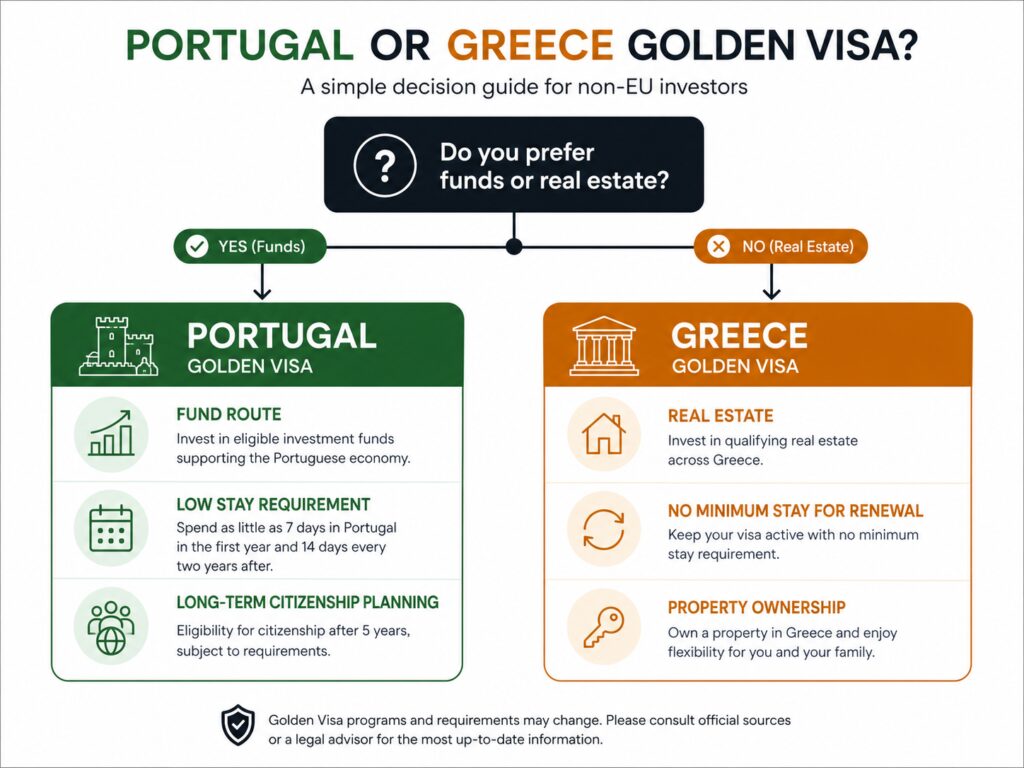
For investors still comparing multiple European residency options, the right next step is not to choose the cheapest headline threshold. It is to compare the full structure: investment type, exit flexibility, government timelines, tax exposure, family needs, and citizenship expectations.
You can also review other visa comparison guides if you are deciding between investment migration and income-based residence routes.
FAQs: Portugal vs Greece Golden Visa
Which is cheaper, Portugal or Greece Golden Visa?
Greece can be cheaper if the investor qualifies for a €250,000 real estate conversion or restoration route. However, in many prime Greek locations, the threshold is now €800,000, which is higher than Portugal’s common €500,000 qualifying fund route. The right comparison should include taxes, legal fees, property costs, fund fees, renewal costs, and exit strategy.
Which Golden Visa leads to citizenship faster?
This changed in 2026. Portugal’s nationality rules now require longer legal residence periods for many applicants, so the old five-year answer is no longer reliable for every nationality. Greece may allow naturalisation after long-term residence, but it usually requires stronger physical presence, language ability, and integration. Investors should treat citizenship as a legal strategy, not an automatic programme benefit.
How do the minimum stay requirements compare?
Portugal has a low stay requirement, commonly planned around seven days per year, based on AIMA’s ARI rules. Greece generally has no minimum stay requirement to renew the Golden Visa residence permit, provided the investment and renewal conditions are maintained. For citizenship, however, physical residence matters much more in both countries.
Which country has a stronger passport?
Portugal and Greece both have strong EU passports. In practical terms, the difference is usually small compared with the bigger question: which country offers the more realistic citizenship route for your personal situation? Passport rankings change, while naturalisation rules, tax residence, and integration requirements have a more direct impact on your long-term plan.
Is Portugal Golden Visa vs Greece Golden Visa Right for You?
The portugal golden visa vs greece comparison comes down to one core difference: Portugal is now mainly a regulated investment and long-term residency strategy, while Greece remains a property-led residency route.
If you want real estate and maximum flexibility around physical stay, Greece may be the stronger option. If you prefer a non-real-estate investment structure and want to build a Portugal-based residence strategy, Portugal may be the better fit.
Neither route should be selected from a headline minimum investment alone. The correct decision depends on your nationality, family plan, tax position, liquidity, investment preference, and citizenship expectations.
Ready to take the next step?
Book a free initial assessment. We’ll assess your eligibility, walk through the current qualifying routes, and answer your questions, no cost, no commitment.












