
Portugal golden visa

Portugal Golden Visa Tax Benefits: NHR, Capital Gains and US Tax Explained

That distinction matters. A well-structured Portugal plan can support residency, Schengen access, family security, and a future citizenship pathway, but the tax result depends on where you live, how long you stay, what income you receive, and whether you qualify for a special tax regime such as IFICI.

This guide explains the tax treatment investors usually ask about first: NHR, IFICI, capital gains, annual obligations, and the additional rules that apply to US citizens.

Tax Benefits of the Portugal Golden Visa

The Portugal Golden Visa can be tax-efficient, but not because the residence permit itself creates a special tax exemption. The main benefit is flexibility: investors can hold Portuguese residency while spending limited time in Portugal, which may help them avoid becoming Portuguese tax residents if their personal circumstances support that position.

The Golden Visa is formally known as ARI (Autorização de Residência para Investimento). Applications are processed by AIMA official portal, the Agency for Integration, Migration and Asylum, which replaced SEF, Serviço de Estrangeiros e Fronteiras, in 2023.

The key tax point is simple:

Issue Golden Visa Position
Residence permit Granted through eligible investment, subject to approval
Minimum stay 7 days per year in Portugal
Tax residency Not automatic
NHR or IFICI access Not automatic
Portuguese tax filing Depends on tax residency and Portuguese-source income
US tax filing Still applies to US citizens and residents

For many investors, the attraction is not a guaranteed tax break. It is the ability to secure residency without relocating full-time.

That is why the Portugal Golden Visa programme should be planned alongside tax advice, not after the investment has already been made.

ortugal Golden Visa tax benefits explained for international investors in 2026

Are Tax Benefits Automatic with the Golden Visa?

No. The Golden Visa does not automatically make you eligible for NHR, IFICI, foreign-source income exemption, or reduced capital gains tax.

A Golden Visa holder can remain a non-tax resident of Portugal if they do not meet Portuguese tax residency rules. Under the Portuguese Personal Income Tax Code, an individual may become tax resident if they spend more than 183 days in Portugal during a relevant 12-month period, or if they maintain a home in Portugal in conditions suggesting habitual residence.

This is where the 183-day rule matters. Spending seven days a year in Portugal may satisfy the Golden Visa residence requirement, but spending over 183 days may create a different tax result.

Tax residency also depends on facts beyond the calendar. These may include:

  • Where your main home is located
  • Where your spouse and children live
  • Where your business or employment is managed
  • Where your investment income is sourced
  • Whether you maintain a habitual residence in Portugal
  • Whether a double taxation agreement applies

The Golden Visa gives residency rights. Tax residency is a separate analysis.

The NHR Regime (Now IFICI): What It Is and Who Qualifies

The old NHR Non-Habitual Resident regime was one of the reasons Portugal became popular with international investors, retirees, entrepreneurs, and globally mobile families. It offered a 10-year tax framework for qualifying new tax residents, with preferential treatment for certain Portuguese and foreign-source income.

That regime changed. For new applicants, NHR was repealed from 1 January 2024 and replaced by IFICI, the Tax Incentive for Scientific Research and Innovation. The Portuguese Tax and Customs Authority describes IFICI as a tax benefit designed to attract talent and support scientific research and innovation in Portugal.

The practical result is important: IFICI is narrower than the old NHR regime. It is not a general expat investor tax regime.

10-Year Flat Tax on Foreign Income

This phrase is often used imprecisely. Under the old NHR system, qualifying individuals could benefit from a 10-year special tax framework, but not all foreign income was automatically taxed at a flat rate.

Under IFICI, the central benefit is generally a 20% special tax rate on eligible Portuguese employment or self-employment income connected to qualifying activities. It is aimed at highly qualified professionals, scientific research, innovation, technology, education, and certain strategic sectors.

For Golden Visa investors, this means two things:

  1. Holding a Golden Visa does not qualify you for IFICI by itself.
  2. Passive investment alone will usually not be enough.

A fund investor who spends limited time in Portugal and does not work in an eligible Portuguese role may not benefit from IFICI. A founder, director, researcher, professor, technology specialist, or qualified professional may have a stronger case, depending on the specific role and registration requirements.

The correct question is not “Does the Golden Visa give me IFICI?” It is “Will my Portuguese tax residency and professional activity qualify under IFICI?”

Exempt Foreign Pension and Dividend Income

Investors should be careful with older articles about Portugal’s NHR regime. Some describe broad foreign-source income exemptions that no longer apply in the same way for new arrivals.

Under the old NHR system, certain foreign-source income could receive favourable treatment, subject to source-country taxation rules, treaty provisions, and Portuguese reporting. Foreign pensions were also treated differently over time, including a 10% flat tax treatment for many cases after changes made before the regime ended.

Under IFICI, the treatment is more targeted. It is not designed mainly for retirees, passive investors, or pension income planning.

For dividend tax and pension income tax, the correct treatment depends on:

  • Whether you are Portuguese tax resident
  • Whether the income is Portuguese-source or foreign-source
  • Whether a double taxation agreement applies
  • Whether the source jurisdiction is considered favourable or blacklisted
  • Whether you qualify for NHR transitional treatment or IFICI
  • Whether your home country taxes worldwide income

A Golden Visa investor with foreign dividends, pensions, or portfolio income should get advice before becoming Portuguese tax resident. The tax result can change significantly once Portugal becomes the country taxing worldwide income.

Portugal Golden Visa

Start Your Portugal Golden Visa Journey

Receive personalized legal guidance from experienced immigration lawyers and discover the most effective pathway to securing your Portugal Golden Visa.

Book Your Free Consultation →
✓ No Obligation   •   ✓ Licensed Lawyers   •   ✓ Confidential Consultation

NHR vs IFICI: What Changed in 2024-2026

The change from NHR to IFICI is one of the most important tax developments for Golden Visa investors.

Feature Old NHR Regime Current IFICI Regime
Main purpose Attract foreign residents, professionals, retirees, and investors Attract talent, research, innovation, and qualified work
Availability for new applicants Closed, except transitional cases Available subject to narrower eligibility
Duration Up to 10 years Up to 10 years
Portuguese employment income Preferential treatment for qualifying activities 20% rate for eligible activities
Passive investor access Broader under old planning models More limited
Pension focus Historically relevant for retirees Not the main focus
Golden Visa link Not automatic Not automatic

Existing NHR holders may continue under their approved 10-year period. Applicants who were covered by transitional rules may also have specific rights depending on timing and documentation.

For everyone else, IFICI is now the main special regime to consider, and it requires careful eligibility review.
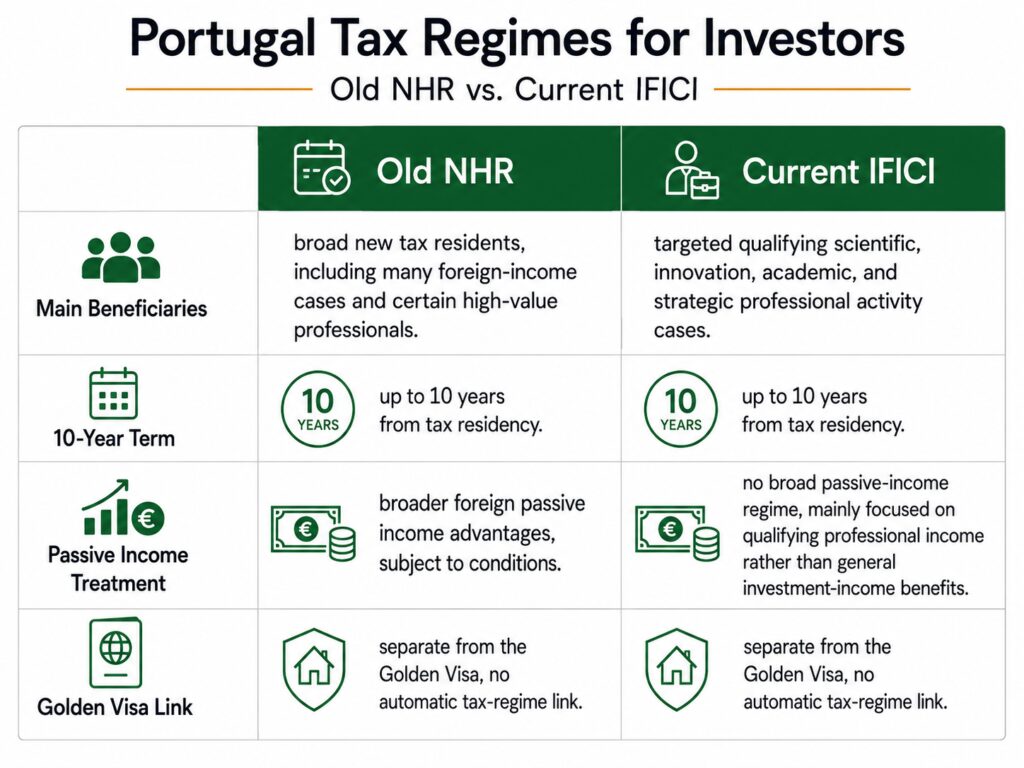
NHR and IFICI tax comparison for Portugal Golden Visa investors

Capital Gains Tax on Golden Visa Investments

Capital gains tax Portugal rules depend on the asset, the investor’s tax residency position, the holding structure, and the source of the gain. The Golden Visa does not remove capital gains tax by itself.

Most current Golden Visa applicants use the fund route because residential real estate has not qualified for new Golden Visa applications since the 2023 reform. That makes fund taxation more relevant than property taxation for new investors.

Fund Investment Gains

The current qualifying route is generally a €500,000 investment in a CMVM-regulated investment fund. CMVM means Portugal’s Securities Market Commission, the authority that supervises regulated investment funds.

Investors reviewing qualifying fund investment options should evaluate both immigration eligibility and tax treatment. A fund may be suitable for Golden Visa purposes, but its distributions, dividends, capital gains, withholding position, and reporting obligations need separate review.

Possible tax events may include:

  • Dividend distributions from the fund
  • Redemption of fund units
  • Sale of fund units
  • Capital gains on exit
  • Currency conversion gains or losses
  • Reporting of foreign accounts or financial assets in the investor’s home country

For Portuguese tax residents, capital gains and investment income may fall within Portuguese tax rules. For non-residents, the treatment depends on whether the gain is Portuguese-source, how the fund is structured, and whether an exemption or treaty position applies.

For US citizens, the analysis can be more complex because Portuguese fund units may also create US reporting issues. That does not mean the fund route is unsuitable. It means the investor should coordinate immigration counsel, Portuguese tax advice, and US tax advice before subscribing.

Property Gains Where Applicable

New Golden Visa applicants cannot rely on residential property purchases as a qualifying route. However, property tax still matters in two situations:

  1. Legacy Golden Visa investors who qualified through property before the rules changed.
  2. Investors who buy Portuguese property separately from their Golden Visa investment.

In those cases, IMI property tax, stamp duty, notary fees, rental income tax, and capital gains tax may become relevant.

A property sale can trigger Portuguese capital gains tax depending on whether the seller is resident or non-resident, the property type, the cost basis, allowable expenses, and whether any reinvestment relief applies.

Property taxation should not be treated as a Golden Visa footnote. If property is part of the investor’s wider Portugal plan, it should be modelled separately from the residency application.

Annual Tax Obligations for Golden Visa Holders

A Golden Visa holder does not automatically have to file a full Portuguese tax return every year. The obligation depends on tax residency and Portuguese-source income.

The most common scenarios are:

Scenario Likely Portuguese Tax Position
Golden Visa holder spends 7 days per year in Portugal and earns no Portuguese income Usually no full resident tax filing, subject to advice
Golden Visa holder becomes Portuguese tax resident May need to report worldwide income
Golden Visa holder owns Portuguese rental property Portuguese tax filing likely required
Golden Visa holder receives Portuguese-source dividends or gains Portuguese reporting or withholding may apply
Golden Visa holder qualifies for IFICI Registration and annual reporting must be managed carefully

Portuguese tax residents generally report worldwide income. Foreign-source income may need to be declared even when a treaty or special regime affects the final tax due.

Investors should also keep records for:

  • NIF registration
  • Portuguese bank account activity
  • Fund subscription documents
  • Dividend statements
  • Capital gains calculations
  • Proof of tax residency outside Portugal
  • Double taxation agreement claims
  • Professional tax advice received

The NIF, Portuguese tax identification number, is required for applicants and is also central to banking, investment subscription, and tax registration.

US Citizens: Special Tax Considerations

US citizens face a different planning problem from many other Golden Visa investors. The United States taxes citizens and resident aliens on worldwide income, even when they live abroad or hold residency in another country.

That means a Portugal Golden Visa can create Portuguese residency rights, but it does not remove IRS obligations.

A US investor should look at Portugal and US tax together before investing.

FATCA and FBAR Obligations

FATCA, the Foreign Account Tax Compliance Act, can require certain US taxpayers to report foreign financial assets. FBAR, the Report of Foreign Bank and Financial Accounts, can require reporting foreign financial accounts when the aggregate value exceeds the applicable threshold.

The IRS guidance for US citizens and residents abroad confirms that US citizens and residents abroad generally remain subject to US filing rules. The IRS FBAR page also explains that certain foreign bank, brokerage, and mutual fund accounts may need to be reported.

For Golden Visa fund investors, the key questions are:

  • Does the Portuguese investment fund create US reporting obligations?
  • Does the Portuguese bank account trigger FBAR reporting?
  • Does the fund create PFIC-related US tax complexity?
  • How are dividends, redemptions, and capital gains reported in the US?
  • Can foreign tax credits reduce double taxation?

This is not a reason to avoid Portugal. It is a reason to plan before transferring funds.

The US-Portugal Tax Treaty

The US-Portugal tax treaty can help reduce or allocate taxing rights in certain cases, but it does not cancel US filing obligations. A treaty may affect dividends, interest, pensions, capital gains, and double taxation outcomes, but the result depends on the income type and the investor’s tax residency.

For US investors, the goal is usually not to eliminate all tax. The goal is to prevent poor structuring, duplicated taxation, missed disclosures, and avoidable reporting problems.

US citizens should also review:

  • Foreign tax credit planning
  • Treaty residency tie-breaker rules
  • Portuguese tax residency exposure
  • FBAR and FATCA reporting
  • Fund classification under US tax law
  • State tax residency, where relevant

This is one of the main reasons US investors should not treat immigration planning and tax planning as separate projects.
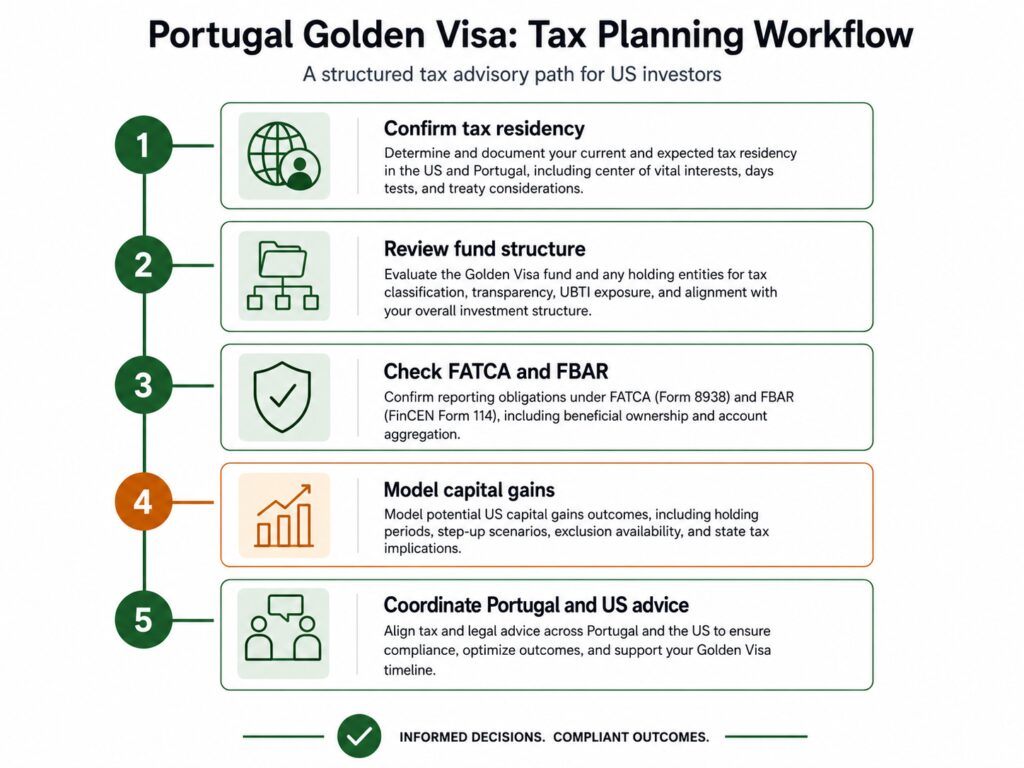
US tax planning steps for Portugal Golden Visa fund investors

Is Portugal Still Tax-Friendly for Investors in 2026?

Portugal can still be tax-friendly for the right investor, but the answer is more selective than it was under the old NHR regime. The country remains attractive because of its Golden Visa structure, limited stay requirement, Schengen access, citizenship pathway after 5 years of legal residency, and the possibility of careful tax planning.

But the easy headline version of Portugal tax planning is outdated.

In 2026, investors should separate three questions:

  1. Can I qualify for the Golden Visa?
    This depends on making an eligible investment, usually through a CMVM-regulated fund route.
  2. Will I become Portuguese tax resident?
    This depends on time spent in Portugal, home availability, personal circumstances, and tax treaty rules.
  3. Can I access IFICI or another favourable tax position?
    This depends on professional activity, registration timing, and eligibility.

For investors who want residency without full relocation, Portugal can remain efficient because the Golden Visa requires only 7 days per year. For investors who plan to move, work, retire, or restructure global income through Portugal, tax advice is essential.

The strongest candidates are usually those who plan before becoming resident, review the fund tax treatment before subscribing, and coordinate Portugal with their home-country obligations.

If you are comparing routes, Portugal investment residency solutions can help you understand how the Golden Visa fits beside other immigration options. Investors still deciding between passive residency and relocation should also review how the Golden Visa compares to the D7.

FAQs About Portugal Golden Visa Tax Benefits

What are the tax benefits of the Portugal Golden Visa?

The main tax benefit is flexibility, not an automatic exemption. The Golden Visa allows eligible investors to maintain Portuguese residency with a minimum stay of 7 days per year, which may help them avoid Portuguese tax residency if they do not otherwise meet the residency tests. Investors who become Portuguese tax residents may be able to explore IFICI or treaty-based planning, subject to eligibility.

Does the Golden Visa give access to the NHR tax regime?

No. The Golden Visa does not automatically give access to NHR or IFICI. The old NHR regime was repealed for new applicants from 1 January 2024, with transitional protection for some existing or qualifying applicants. IFICI is now the relevant special regime, but it is narrower and mainly aimed at qualified work, research, innovation, and strategic professional activities.

What are the tax implications for US citizens?

US citizens generally remain subject to US tax filing obligations on worldwide income, even if they hold Portuguese residency or live abroad. They may also need to consider FATCA, FBAR, foreign tax credits, treaty rules, and possible US treatment of Portuguese fund investments. A US investor should review the structure with both Portuguese and US tax advisors before transferring funds.

Do I need to pay capital gains tax in Portugal on my golden visa investment?

Possibly. Capital gains tax depends on whether you are Portuguese tax resident, the type of investment, the fund structure, the source of the gain, and whether a treaty or exemption applies. A Golden Visa fund investment does not automatically remove capital gains tax. The tax position should be reviewed before subscription and again before exit.

Is Portugal Golden Visa Tax Planning Right for You?

The Portugal Golden Visa remains one of Europe’s most flexible residency-by-investment routes, but tax planning is now more technical than many older guides suggest. NHR is no longer generally open to new applicants, IFICI is narrower, and capital gains treatment depends on the investor’s actual tax position.

For non-US investors, the main question is usually whether Portugal will become the country of tax residence. For US investors, the question is broader because US worldwide taxation, FATCA, FBAR, and treaty planning remain relevant even after securing Portuguese residency.

The best time to review tax exposure is before you invest, before you become Portuguese tax resident, and before you restructure income or assets around Portugal.

Ready to take the next step?
Book a free initial assessment. We’ll assess your eligibility, walk through the current qualifying routes, and answer your questions — no cost, no commitment.


Portugal Golden Visa Tax Benefits: NHR, Capital Gains and US Tax Explained

That distinction matters. A well-structured Portugal plan can support residency, Schengen access, family security, and a future citizenship pathway, but the tax result depends on where you live, how long you stay, what income you receive, and whether you qualify for a special tax regime such as IFICI.

This guide explains the tax treatment investors usually ask about first: NHR, IFICI, capital gains, annual obligations, and the additional rules that apply to US citizens.

Tax Benefits of the Portugal Golden Visa

The Portugal Golden Visa can be tax-efficient, but not because the residence permit itself creates a special tax exemption. The main benefit is flexibility: investors can hold Portuguese residency while spending limited time in Portugal, which may help them avoid becoming Portuguese tax residents if their personal circumstances support that position.

The Golden Visa is formally known as ARI (Autorização de Residência para Investimento). Applications are processed by AIMA official portal, the Agency for Integration, Migration and Asylum, which replaced SEF, Serviço de Estrangeiros e Fronteiras, in 2023.

The key tax point is simple:

Issue Golden Visa Position
Residence permit Granted through eligible investment, subject to approval
Minimum stay 7 days per year in Portugal
Tax residency Not automatic
NHR or IFICI access Not automatic
Portuguese tax filing Depends on tax residency and Portuguese-source income
US tax filing Still applies to US citizens and residents

For many investors, the attraction is not a guaranteed tax break. It is the ability to secure residency without relocating full-time.

That is why the Portugal Golden Visa programme should be planned alongside tax advice, not after the investment has already been made.

ortugal Golden Visa tax benefits explained for international investors in 2026

Are Tax Benefits Automatic with the Golden Visa?

No. The Golden Visa does not automatically make you eligible for NHR, IFICI, foreign-source income exemption, or reduced capital gains tax.

A Golden Visa holder can remain a non-tax resident of Portugal if they do not meet Portuguese tax residency rules. Under the Portuguese Personal Income Tax Code, an individual may become tax resident if they spend more than 183 days in Portugal during a relevant 12-month period, or if they maintain a home in Portugal in conditions suggesting habitual residence.

This is where the 183-day rule matters. Spending seven days a year in Portugal may satisfy the Golden Visa residence requirement, but spending over 183 days may create a different tax result.

Tax residency also depends on facts beyond the calendar. These may include:

  • Where your main home is located
  • Where your spouse and children live
  • Where your business or employment is managed
  • Where your investment income is sourced
  • Whether you maintain a habitual residence in Portugal
  • Whether a double taxation agreement applies

The Golden Visa gives residency rights. Tax residency is a separate analysis.

The NHR Regime (Now IFICI): What It Is and Who Qualifies

The old NHR Non-Habitual Resident regime was one of the reasons Portugal became popular with international investors, retirees, entrepreneurs, and globally mobile families. It offered a 10-year tax framework for qualifying new tax residents, with preferential treatment for certain Portuguese and foreign-source income.

That regime changed. For new applicants, NHR was repealed from 1 January 2024 and replaced by IFICI, the Tax Incentive for Scientific Research and Innovation. The Portuguese Tax and Customs Authority describes IFICI as a tax benefit designed to attract talent and support scientific research and innovation in Portugal.

The practical result is important: IFICI is narrower than the old NHR regime. It is not a general expat investor tax regime.

10-Year Flat Tax on Foreign Income

This phrase is often used imprecisely. Under the old NHR system, qualifying individuals could benefit from a 10-year special tax framework, but not all foreign income was automatically taxed at a flat rate.

Under IFICI, the central benefit is generally a 20% special tax rate on eligible Portuguese employment or self-employment income connected to qualifying activities. It is aimed at highly qualified professionals, scientific research, innovation, technology, education, and certain strategic sectors.

For Golden Visa investors, this means two things:

  1. Holding a Golden Visa does not qualify you for IFICI by itself.
  2. Passive investment alone will usually not be enough.

A fund investor who spends limited time in Portugal and does not work in an eligible Portuguese role may not benefit from IFICI. A founder, director, researcher, professor, technology specialist, or qualified professional may have a stronger case, depending on the specific role and registration requirements.

The correct question is not “Does the Golden Visa give me IFICI?” It is “Will my Portuguese tax residency and professional activity qualify under IFICI?”

Exempt Foreign Pension and Dividend Income

Investors should be careful with older articles about Portugal’s NHR regime. Some describe broad foreign-source income exemptions that no longer apply in the same way for new arrivals.

Under the old NHR system, certain foreign-source income could receive favourable treatment, subject to source-country taxation rules, treaty provisions, and Portuguese reporting. Foreign pensions were also treated differently over time, including a 10% flat tax treatment for many cases after changes made before the regime ended.

Under IFICI, the treatment is more targeted. It is not designed mainly for retirees, passive investors, or pension income planning.

For dividend tax and pension income tax, the correct treatment depends on:

  • Whether you are Portuguese tax resident
  • Whether the income is Portuguese-source or foreign-source
  • Whether a double taxation agreement applies
  • Whether the source jurisdiction is considered favourable or blacklisted
  • Whether you qualify for NHR transitional treatment or IFICI
  • Whether your home country taxes worldwide income

A Golden Visa investor with foreign dividends, pensions, or portfolio income should get advice before becoming Portuguese tax resident. The tax result can change significantly once Portugal becomes the country taxing worldwide income.

Portugal Golden Visa

Start Your Portugal Golden Visa Journey

Receive personalized legal guidance from experienced immigration lawyers and discover the most effective pathway to securing your Portugal Golden Visa.

Book Your Free Consultation →
✓ No Obligation   •   ✓ Licensed Lawyers   •   ✓ Confidential Consultation

NHR vs IFICI: What Changed in 2024-2026

The change from NHR to IFICI is one of the most important tax developments for Golden Visa investors.

Feature Old NHR Regime Current IFICI Regime
Main purpose Attract foreign residents, professionals, retirees, and investors Attract talent, research, innovation, and qualified work
Availability for new applicants Closed, except transitional cases Available subject to narrower eligibility
Duration Up to 10 years Up to 10 years
Portuguese employment income Preferential treatment for qualifying activities 20% rate for eligible activities
Passive investor access Broader under old planning models More limited
Pension focus Historically relevant for retirees Not the main focus
Golden Visa link Not automatic Not automatic

Existing NHR holders may continue under their approved 10-year period. Applicants who were covered by transitional rules may also have specific rights depending on timing and documentation.

For everyone else, IFICI is now the main special regime to consider, and it requires careful eligibility review.

NHR and IFICI tax comparison for Portugal Golden Visa investors

Capital Gains Tax on Golden Visa Investments

Capital gains tax Portugal rules depend on the asset, the investor’s tax residency position, the holding structure, and the source of the gain. The Golden Visa does not remove capital gains tax by itself.

Most current Golden Visa applicants use the fund route because residential real estate has not qualified for new Golden Visa applications since the 2023 reform. That makes fund taxation more relevant than property taxation for new investors.

Fund Investment Gains

The current qualifying route is generally a €500,000 investment in a CMVM-regulated investment fund. CMVM means Portugal’s Securities Market Commission, the authority that supervises regulated investment funds.

Investors reviewing qualifying fund investment options should evaluate both immigration eligibility and tax treatment. A fund may be suitable for Golden Visa purposes, but its distributions, dividends, capital gains, withholding position, and reporting obligations need separate review.

Possible tax events may include:

  • Dividend distributions from the fund
  • Redemption of fund units
  • Sale of fund units
  • Capital gains on exit
  • Currency conversion gains or losses
  • Reporting of foreign accounts or financial assets in the investor’s home country

For Portuguese tax residents, capital gains and investment income may fall within Portuguese tax rules. For non-residents, the treatment depends on whether the gain is Portuguese-source, how the fund is structured, and whether an exemption or treaty position applies.

For US citizens, the analysis can be more complex because Portuguese fund units may also create US reporting issues. That does not mean the fund route is unsuitable. It means the investor should coordinate immigration counsel, Portuguese tax advice, and US tax advice before subscribing.

Property Gains Where Applicable

New Golden Visa applicants cannot rely on residential property purchases as a qualifying route. However, property tax still matters in two situations:

  1. Legacy Golden Visa investors who qualified through property before the rules changed.
  2. Investors who buy Portuguese property separately from their Golden Visa investment.

In those cases, IMI property tax, stamp duty, notary fees, rental income tax, and capital gains tax may become relevant.

A property sale can trigger Portuguese capital gains tax depending on whether the seller is resident or non-resident, the property type, the cost basis, allowable expenses, and whether any reinvestment relief applies.

Property taxation should not be treated as a Golden Visa footnote. If property is part of the investor’s wider Portugal plan, it should be modelled separately from the residency application.

Annual Tax Obligations for Golden Visa Holders

A Golden Visa holder does not automatically have to file a full Portuguese tax return every year. The obligation depends on tax residency and Portuguese-source income.

The most common scenarios are:

Scenario Likely Portuguese Tax Position
Golden Visa holder spends 7 days per year in Portugal and earns no Portuguese income Usually no full resident tax filing, subject to advice
Golden Visa holder becomes Portuguese tax resident May need to report worldwide income
Golden Visa holder owns Portuguese rental property Portuguese tax filing likely required
Golden Visa holder receives Portuguese-source dividends or gains Portuguese reporting or withholding may apply
Golden Visa holder qualifies for IFICI Registration and annual reporting must be managed carefully

Portuguese tax residents generally report worldwide income. Foreign-source income may need to be declared even when a treaty or special regime affects the final tax due.

Investors should also keep records for:

  • NIF registration
  • Portuguese bank account activity
  • Fund subscription documents
  • Dividend statements
  • Capital gains calculations
  • Proof of tax residency outside Portugal
  • Double taxation agreement claims
  • Professional tax advice received

The NIF, Portuguese tax identification number, is required for applicants and is also central to banking, investment subscription, and tax registration.

US Citizens: Special Tax Considerations

US citizens face a different planning problem from many other Golden Visa investors. The United States taxes citizens and resident aliens on worldwide income, even when they live abroad or hold residency in another country.

That means a Portugal Golden Visa can create Portuguese residency rights, but it does not remove IRS obligations.

A US investor should look at Portugal and US tax together before investing.

FATCA and FBAR Obligations

FATCA, the Foreign Account Tax Compliance Act, can require certain US taxpayers to report foreign financial assets. FBAR, the Report of Foreign Bank and Financial Accounts, can require reporting foreign financial accounts when the aggregate value exceeds the applicable threshold.

The IRS guidance for US citizens and residents abroad confirms that US citizens and residents abroad generally remain subject to US filing rules. The IRS FBAR page also explains that certain foreign bank, brokerage, and mutual fund accounts may need to be reported.

For Golden Visa fund investors, the key questions are:

  • Does the Portuguese investment fund create US reporting obligations?
  • Does the Portuguese bank account trigger FBAR reporting?
  • Does the fund create PFIC-related US tax complexity?
  • How are dividends, redemptions, and capital gains reported in the US?
  • Can foreign tax credits reduce double taxation?

This is not a reason to avoid Portugal. It is a reason to plan before transferring funds.

The US-Portugal Tax Treaty

The US-Portugal tax treaty can help reduce or allocate taxing rights in certain cases, but it does not cancel US filing obligations. A treaty may affect dividends, interest, pensions, capital gains, and double taxation outcomes, but the result depends on the income type and the investor’s tax residency.

For US investors, the goal is usually not to eliminate all tax. The goal is to prevent poor structuring, duplicated taxation, missed disclosures, and avoidable reporting problems.

US citizens should also review:

  • Foreign tax credit planning
  • Treaty residency tie-breaker rules
  • Portuguese tax residency exposure
  • FBAR and FATCA reporting
  • Fund classification under US tax law
  • State tax residency, where relevant

This is one of the main reasons US investors should not treat immigration planning and tax planning as separate projects.

US tax planning steps for Portugal Golden Visa fund investors

Is Portugal Still Tax-Friendly for Investors in 2026?

Portugal can still be tax-friendly for the right investor, but the answer is more selective than it was under the old NHR regime. The country remains attractive because of its Golden Visa structure, limited stay requirement, Schengen access, citizenship pathway after 5 years of legal residency, and the possibility of careful tax planning.

But the easy headline version of Portugal tax planning is outdated.

In 2026, investors should separate three questions:

  1. Can I qualify for the Golden Visa?
    This depends on making an eligible investment, usually through a CMVM-regulated fund route.
  2. Will I become Portuguese tax resident?
    This depends on time spent in Portugal, home availability, personal circumstances, and tax treaty rules.
  3. Can I access IFICI or another favourable tax position?
    This depends on professional activity, registration timing, and eligibility.

For investors who want residency without full relocation, Portugal can remain efficient because the Golden Visa requires only 7 days per year. For investors who plan to move, work, retire, or restructure global income through Portugal, tax advice is essential.

The strongest candidates are usually those who plan before becoming resident, review the fund tax treatment before subscribing, and coordinate Portugal with their home-country obligations.

If you are comparing routes, Portugal investment residency solutions can help you understand how the Golden Visa fits beside other immigration options. Investors still deciding between passive residency and relocation should also review how the Golden Visa compares to the D7.

FAQs About Portugal Golden Visa Tax Benefits

What are the tax benefits of the Portugal Golden Visa?

The main tax benefit is flexibility, not an automatic exemption. The Golden Visa allows eligible investors to maintain Portuguese residency with a minimum stay of 7 days per year, which may help them avoid Portuguese tax residency if they do not otherwise meet the residency tests. Investors who become Portuguese tax residents may be able to explore IFICI or treaty-based planning, subject to eligibility.

Does the Golden Visa give access to the NHR tax regime?

No. The Golden Visa does not automatically give access to NHR or IFICI. The old NHR regime was repealed for new applicants from 1 January 2024, with transitional protection for some existing or qualifying applicants. IFICI is now the relevant special regime, but it is narrower and mainly aimed at qualified work, research, innovation, and strategic professional activities.

What are the tax implications for US citizens?

US citizens generally remain subject to US tax filing obligations on worldwide income, even if they hold Portuguese residency or live abroad. They may also need to consider FATCA, FBAR, foreign tax credits, treaty rules, and possible US treatment of Portuguese fund investments. A US investor should review the structure with both Portuguese and US tax advisors before transferring funds.

Do I need to pay capital gains tax in Portugal on my golden visa investment?

Possibly. Capital gains tax depends on whether you are Portuguese tax resident, the type of investment, the fund structure, the source of the gain, and whether a treaty or exemption applies. A Golden Visa fund investment does not automatically remove capital gains tax. The tax position should be reviewed before subscription and again before exit.

Is Portugal Golden Visa Tax Planning Right for You?

The Portugal Golden Visa remains one of Europe’s most flexible residency-by-investment routes, but tax planning is now more technical than many older guides suggest. NHR is no longer generally open to new applicants, IFICI is narrower, and capital gains treatment depends on the investor’s actual tax position.

For non-US investors, the main question is usually whether Portugal will become the country of tax residence. For US investors, the question is broader because US worldwide taxation, FATCA, FBAR, and treaty planning remain relevant even after securing Portuguese residency.

The best time to review tax exposure is before you invest, before you become Portuguese tax resident, and before you restructure income or assets around Portugal.

Ready to take the next step?
Book a free initial assessment. We’ll assess your eligibility, walk through the current qualifying routes, and answer your questions — no cost, no commitment.

Portugal Golden Visa Tax Benefits: NHR, Capital Gains and US Tax Explained

Portugal-Golden-Visa-Tax-Benefits-NHR-Capital-Gains-and-US-Tax-Explained
That distinction matters. A well-structured Portugal plan can support residency, Schengen access, family security, and a future citizenship pathway, but the tax result depends on where you live, how long you stay, what income you receive, and whether you qualify for a special tax regime such as IFICI.

This guide explains the tax treatment investors usually ask about first: NHR, IFICI, capital gains, annual obligations, and the additional rules that apply to US citizens.

Tax Benefits of the Portugal Golden Visa

The Portugal Golden Visa can be tax-efficient, but not because the residence permit itself creates a special tax exemption. The main benefit is flexibility: investors can hold Portuguese residency while spending limited time in Portugal, which may help them avoid becoming Portuguese tax residents if their personal circumstances support that position.

The Golden Visa is formally known as ARI (Autorização de Residência para Investimento). Applications are processed by AIMA official portal, the Agency for Integration, Migration and Asylum, which replaced SEF, Serviço de Estrangeiros e Fronteiras, in 2023.

The key tax point is simple:

Issue Golden Visa Position
Residence permit Granted through eligible investment, subject to approval
Minimum stay 7 days per year in Portugal
Tax residency Not automatic
NHR or IFICI access Not automatic
Portuguese tax filing Depends on tax residency and Portuguese-source income
US tax filing Still applies to US citizens and residents

For many investors, the attraction is not a guaranteed tax break. It is the ability to secure residency without relocating full-time.

That is why the Portugal Golden Visa programme should be planned alongside tax advice, not after the investment has already been made.

ortugal Golden Visa tax benefits explained for international investors in 2026

Are Tax Benefits Automatic with the Golden Visa?

No. The Golden Visa does not automatically make you eligible for NHR, IFICI, foreign-source income exemption, or reduced capital gains tax.

A Golden Visa holder can remain a non-tax resident of Portugal if they do not meet Portuguese tax residency rules. Under the Portuguese Personal Income Tax Code, an individual may become tax resident if they spend more than 183 days in Portugal during a relevant 12-month period, or if they maintain a home in Portugal in conditions suggesting habitual residence.

This is where the 183-day rule matters. Spending seven days a year in Portugal may satisfy the Golden Visa residence requirement, but spending over 183 days may create a different tax result.

Tax residency also depends on facts beyond the calendar. These may include:

  • Where your main home is located
  • Where your spouse and children live
  • Where your business or employment is managed
  • Where your investment income is sourced
  • Whether you maintain a habitual residence in Portugal
  • Whether a double taxation agreement applies

The Golden Visa gives residency rights. Tax residency is a separate analysis.

The NHR Regime (Now IFICI): What It Is and Who Qualifies

The old NHR Non-Habitual Resident regime was one of the reasons Portugal became popular with international investors, retirees, entrepreneurs, and globally mobile families. It offered a 10-year tax framework for qualifying new tax residents, with preferential treatment for certain Portuguese and foreign-source income.

That regime changed. For new applicants, NHR was repealed from 1 January 2024 and replaced by IFICI, the Tax Incentive for Scientific Research and Innovation. The Portuguese Tax and Customs Authority describes IFICI as a tax benefit designed to attract talent and support scientific research and innovation in Portugal.

The practical result is important: IFICI is narrower than the old NHR regime. It is not a general expat investor tax regime.

10-Year Flat Tax on Foreign Income

This phrase is often used imprecisely. Under the old NHR system, qualifying individuals could benefit from a 10-year special tax framework, but not all foreign income was automatically taxed at a flat rate.

Under IFICI, the central benefit is generally a 20% special tax rate on eligible Portuguese employment or self-employment income connected to qualifying activities. It is aimed at highly qualified professionals, scientific research, innovation, technology, education, and certain strategic sectors.

For Golden Visa investors, this means two things:

  1. Holding a Golden Visa does not qualify you for IFICI by itself.
  2. Passive investment alone will usually not be enough.

A fund investor who spends limited time in Portugal and does not work in an eligible Portuguese role may not benefit from IFICI. A founder, director, researcher, professor, technology specialist, or qualified professional may have a stronger case, depending on the specific role and registration requirements.

The correct question is not “Does the Golden Visa give me IFICI?” It is “Will my Portuguese tax residency and professional activity qualify under IFICI?”

Exempt Foreign Pension and Dividend Income

Investors should be careful with older articles about Portugal’s NHR regime. Some describe broad foreign-source income exemptions that no longer apply in the same way for new arrivals.

Under the old NHR system, certain foreign-source income could receive favourable treatment, subject to source-country taxation rules, treaty provisions, and Portuguese reporting. Foreign pensions were also treated differently over time, including a 10% flat tax treatment for many cases after changes made before the regime ended.

Under IFICI, the treatment is more targeted. It is not designed mainly for retirees, passive investors, or pension income planning.

For dividend tax and pension income tax, the correct treatment depends on:

  • Whether you are Portuguese tax resident
  • Whether the income is Portuguese-source or foreign-source
  • Whether a double taxation agreement applies
  • Whether the source jurisdiction is considered favourable or blacklisted
  • Whether you qualify for NHR transitional treatment or IFICI
  • Whether your home country taxes worldwide income

A Golden Visa investor with foreign dividends, pensions, or portfolio income should get advice before becoming Portuguese tax resident. The tax result can change significantly once Portugal becomes the country taxing worldwide income.

Portugal Golden Visa

Start Your Portugal Golden Visa Journey

Receive personalized legal guidance from experienced immigration lawyers and discover the most effective pathway to securing your Portugal Golden Visa.

Book Your Free Consultation →
✓ No Obligation   •   ✓ Licensed Lawyers   •   ✓ Confidential Consultation

NHR vs IFICI: What Changed in 2024-2026

The change from NHR to IFICI is one of the most important tax developments for Golden Visa investors.

Feature Old NHR Regime Current IFICI Regime
Main purpose Attract foreign residents, professionals, retirees, and investors Attract talent, research, innovation, and qualified work
Availability for new applicants Closed, except transitional cases Available subject to narrower eligibility
Duration Up to 10 years Up to 10 years
Portuguese employment income Preferential treatment for qualifying activities 20% rate for eligible activities
Passive investor access Broader under old planning models More limited
Pension focus Historically relevant for retirees Not the main focus
Golden Visa link Not automatic Not automatic

Existing NHR holders may continue under their approved 10-year period. Applicants who were covered by transitional rules may also have specific rights depending on timing and documentation.

For everyone else, IFICI is now the main special regime to consider, and it requires careful eligibility review.

NHR and IFICI tax comparison for Portugal Golden Visa investors

Capital Gains Tax on Golden Visa Investments

Capital gains tax Portugal rules depend on the asset, the investor’s tax residency position, the holding structure, and the source of the gain. The Golden Visa does not remove capital gains tax by itself.

Most current Golden Visa applicants use the fund route because residential real estate has not qualified for new Golden Visa applications since the 2023 reform. That makes fund taxation more relevant than property taxation for new investors.

Fund Investment Gains

The current qualifying route is generally a €500,000 investment in a CMVM-regulated investment fund. CMVM means Portugal’s Securities Market Commission, the authority that supervises regulated investment funds.

Investors reviewing qualifying fund investment options should evaluate both immigration eligibility and tax treatment. A fund may be suitable for Golden Visa purposes, but its distributions, dividends, capital gains, withholding position, and reporting obligations need separate review.

Possible tax events may include:

  • Dividend distributions from the fund
  • Redemption of fund units
  • Sale of fund units
  • Capital gains on exit
  • Currency conversion gains or losses
  • Reporting of foreign accounts or financial assets in the investor’s home country

For Portuguese tax residents, capital gains and investment income may fall within Portuguese tax rules. For non-residents, the treatment depends on whether the gain is Portuguese-source, how the fund is structured, and whether an exemption or treaty position applies.

For US citizens, the analysis can be more complex because Portuguese fund units may also create US reporting issues. That does not mean the fund route is unsuitable. It means the investor should coordinate immigration counsel, Portuguese tax advice, and US tax advice before subscribing.

Property Gains Where Applicable

New Golden Visa applicants cannot rely on residential property purchases as a qualifying route. However, property tax still matters in two situations:

  1. Legacy Golden Visa investors who qualified through property before the rules changed.
  2. Investors who buy Portuguese property separately from their Golden Visa investment.

In those cases, IMI property tax, stamp duty, notary fees, rental income tax, and capital gains tax may become relevant.

A property sale can trigger Portuguese capital gains tax depending on whether the seller is resident or non-resident, the property type, the cost basis, allowable expenses, and whether any reinvestment relief applies.

Property taxation should not be treated as a Golden Visa footnote. If property is part of the investor’s wider Portugal plan, it should be modelled separately from the residency application.

Annual Tax Obligations for Golden Visa Holders

A Golden Visa holder does not automatically have to file a full Portuguese tax return every year. The obligation depends on tax residency and Portuguese-source income.

The most common scenarios are:

Scenario Likely Portuguese Tax Position
Golden Visa holder spends 7 days per year in Portugal and earns no Portuguese income Usually no full resident tax filing, subject to advice
Golden Visa holder becomes Portuguese tax resident May need to report worldwide income
Golden Visa holder owns Portuguese rental property Portuguese tax filing likely required
Golden Visa holder receives Portuguese-source dividends or gains Portuguese reporting or withholding may apply
Golden Visa holder qualifies for IFICI Registration and annual reporting must be managed carefully

Portuguese tax residents generally report worldwide income. Foreign-source income may need to be declared even when a treaty or special regime affects the final tax due.

Investors should also keep records for:

  • NIF registration
  • Portuguese bank account activity
  • Fund subscription documents
  • Dividend statements
  • Capital gains calculations
  • Proof of tax residency outside Portugal
  • Double taxation agreement claims
  • Professional tax advice received

The NIF, Portuguese tax identification number, is required for applicants and is also central to banking, investment subscription, and tax registration.

US Citizens: Special Tax Considerations

US citizens face a different planning problem from many other Golden Visa investors. The United States taxes citizens and resident aliens on worldwide income, even when they live abroad or hold residency in another country.

That means a Portugal Golden Visa can create Portuguese residency rights, but it does not remove IRS obligations.

A US investor should look at Portugal and US tax together before investing.

FATCA and FBAR Obligations

FATCA, the Foreign Account Tax Compliance Act, can require certain US taxpayers to report foreign financial assets. FBAR, the Report of Foreign Bank and Financial Accounts, can require reporting foreign financial accounts when the aggregate value exceeds the applicable threshold.

The IRS guidance for US citizens and residents abroad confirms that US citizens and residents abroad generally remain subject to US filing rules. The IRS FBAR page also explains that certain foreign bank, brokerage, and mutual fund accounts may need to be reported.

For Golden Visa fund investors, the key questions are:

  • Does the Portuguese investment fund create US reporting obligations?
  • Does the Portuguese bank account trigger FBAR reporting?
  • Does the fund create PFIC-related US tax complexity?
  • How are dividends, redemptions, and capital gains reported in the US?
  • Can foreign tax credits reduce double taxation?

This is not a reason to avoid Portugal. It is a reason to plan before transferring funds.

The US-Portugal Tax Treaty

The US-Portugal tax treaty can help reduce or allocate taxing rights in certain cases, but it does not cancel US filing obligations. A treaty may affect dividends, interest, pensions, capital gains, and double taxation outcomes, but the result depends on the income type and the investor’s tax residency.

For US investors, the goal is usually not to eliminate all tax. The goal is to prevent poor structuring, duplicated taxation, missed disclosures, and avoidable reporting problems.

US citizens should also review:

  • Foreign tax credit planning
  • Treaty residency tie-breaker rules
  • Portuguese tax residency exposure
  • FBAR and FATCA reporting
  • Fund classification under US tax law
  • State tax residency, where relevant

This is one of the main reasons US investors should not treat immigration planning and tax planning as separate projects.

US tax planning steps for Portugal Golden Visa fund investors

Is Portugal Still Tax-Friendly for Investors in 2026?

Portugal can still be tax-friendly for the right investor, but the answer is more selective than it was under the old NHR regime. The country remains attractive because of its Golden Visa structure, limited stay requirement, Schengen access, citizenship pathway after 5 years of legal residency, and the possibility of careful tax planning.

But the easy headline version of Portugal tax planning is outdated.

In 2026, investors should separate three questions:

  1. Can I qualify for the Golden Visa?
    This depends on making an eligible investment, usually through a CMVM-regulated fund route.
  2. Will I become Portuguese tax resident?
    This depends on time spent in Portugal, home availability, personal circumstances, and tax treaty rules.
  3. Can I access IFICI or another favourable tax position?
    This depends on professional activity, registration timing, and eligibility.

For investors who want residency without full relocation, Portugal can remain efficient because the Golden Visa requires only 7 days per year. For investors who plan to move, work, retire, or restructure global income through Portugal, tax advice is essential.

The strongest candidates are usually those who plan before becoming resident, review the fund tax treatment before subscribing, and coordinate Portugal with their home-country obligations.

If you are comparing routes, Portugal investment residency solutions can help you understand how the Golden Visa fits beside other immigration options. Investors still deciding between passive residency and relocation should also review how the Golden Visa compares to the D7.

FAQs About Portugal Golden Visa Tax Benefits

What are the tax benefits of the Portugal Golden Visa?

The main tax benefit is flexibility, not an automatic exemption. The Golden Visa allows eligible investors to maintain Portuguese residency with a minimum stay of 7 days per year, which may help them avoid Portuguese tax residency if they do not otherwise meet the residency tests. Investors who become Portuguese tax residents may be able to explore IFICI or treaty-based planning, subject to eligibility.

Does the Golden Visa give access to the NHR tax regime?

No. The Golden Visa does not automatically give access to NHR or IFICI. The old NHR regime was repealed for new applicants from 1 January 2024, with transitional protection for some existing or qualifying applicants. IFICI is now the relevant special regime, but it is narrower and mainly aimed at qualified work, research, innovation, and strategic professional activities.

What are the tax implications for US citizens?

US citizens generally remain subject to US tax filing obligations on worldwide income, even if they hold Portuguese residency or live abroad. They may also need to consider FATCA, FBAR, foreign tax credits, treaty rules, and possible US treatment of Portuguese fund investments. A US investor should review the structure with both Portuguese and US tax advisors before transferring funds.

Do I need to pay capital gains tax in Portugal on my golden visa investment?

Possibly. Capital gains tax depends on whether you are Portuguese tax resident, the type of investment, the fund structure, the source of the gain, and whether a treaty or exemption applies. A Golden Visa fund investment does not automatically remove capital gains tax. The tax position should be reviewed before subscription and again before exit.

Is Portugal Golden Visa Tax Planning Right for You?

The Portugal Golden Visa remains one of Europe’s most flexible residency-by-investment routes, but tax planning is now more technical than many older guides suggest. NHR is no longer generally open to new applicants, IFICI is narrower, and capital gains treatment depends on the investor’s actual tax position.

For non-US investors, the main question is usually whether Portugal will become the country of tax residence. For US investors, the question is broader because US worldwide taxation, FATCA, FBAR, and treaty planning remain relevant even after securing Portuguese residency.

The best time to review tax exposure is before you invest, before you become Portuguese tax resident, and before you restructure income or assets around Portugal.

Ready to take the next step?
Book a free initial assessment. We’ll assess your eligibility, walk through the current qualifying routes, and answer your questions — no cost, no commitment.

What do you think?
Blog

More Related Articles

top








