

Portugal golden visa

Portugal Golden Visa Citizenship Changes: Timeline Updates for 2025-2026

The portugal golden visa citizenship changes in 2025 and 2026 have changed the way investors should think about the route from residency to nationality. For years, the key assumption was simple: maintain legal residency for five years, then apply for Portuguese citizenship if you meet the naturalization requirements. That assumption is no longer safe for new planning. The Golden Visa still offers Portuguese residency, Schengen mobility and a citizenship pathway, but the timeline now needs a more careful legal reading.

What Is Changing in Portugal Golden Visa Citizenship Timeline?

The core change is not to the residence permit itself. It is to the citizenship stage that may follow after holding legal residency in Portugal.

For Golden Visa investors, this distinction matters. The ARI, or Autorização de Residência para Investimento, is the residence permit. Portuguese nationality is a separate legal process handled later, usually through IRN, the Portuguese Civil Registry.

The Proposed Extension from 5 to 7-10 Years

The main proposal was to move away from Portugal’s previous five-year naturalization rule. Under the new framework, the timeline is longer:

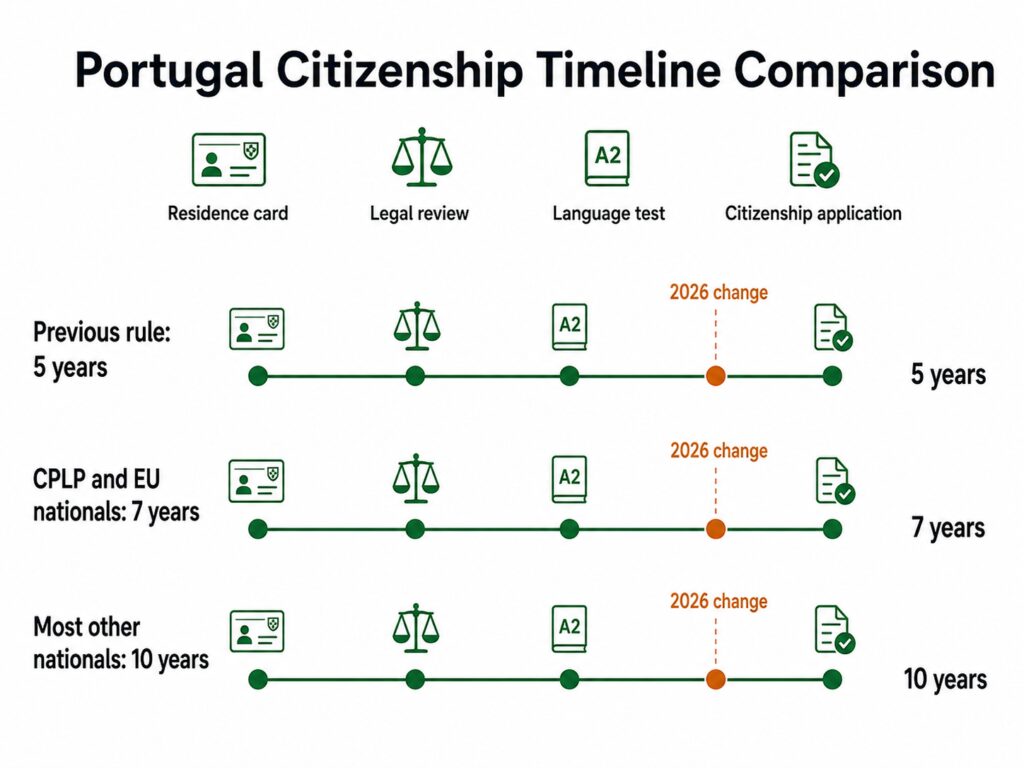
Applicant category Previous general rule New naturalization timeline
Nationals of Portuguese-speaking countries 5 years 7 years
EU nationals 5 years 7 years
Most other non-EU nationals 5 years 10 years

For most Golden Visa investors from the United States, United Kingdom, China, South Africa, the Middle East and similar non-EU markets, the practical planning number is now 10 years, not five.

That does not mean the Golden Visa has stopped working as a residency route. It means the citizenship expectation has changed.
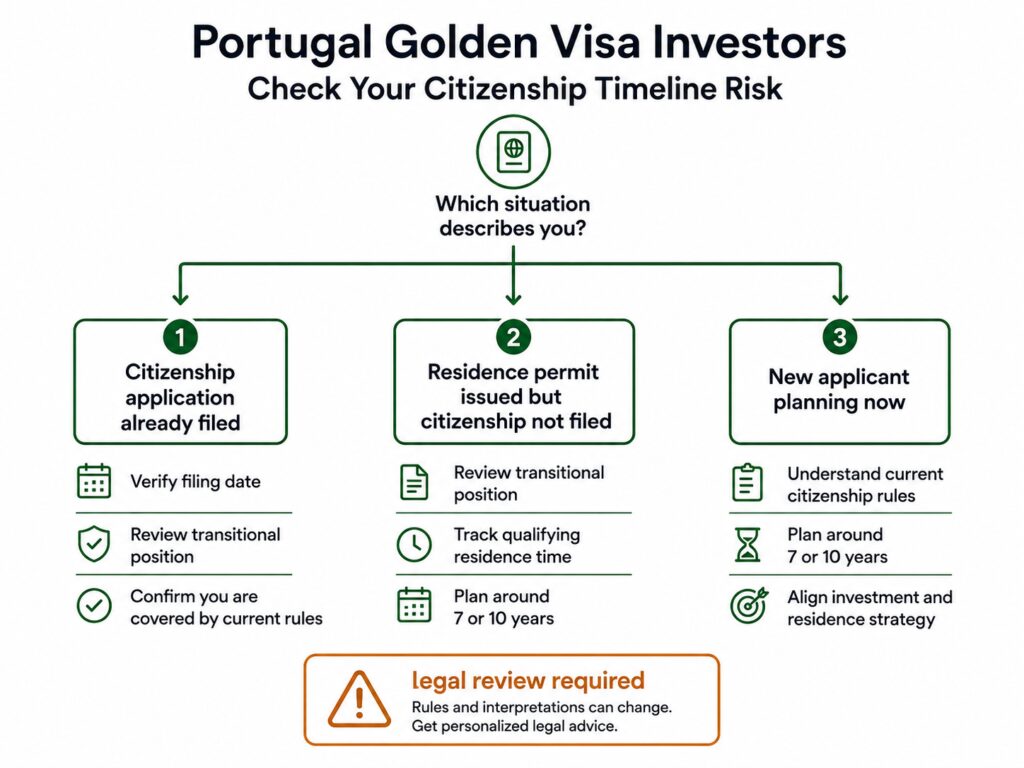
portugal-golden-visa-citizenship-changes-2026

What Parliament Voted On in 2025

Portugal’s government announced the nationality law reform in June 2025. The proposal introduced stricter requirements for naturalization, including a longer residence period, more integration requirements and changes to how the residency clock would be calculated.

The parliamentary process then moved through several stages:

Stage What happened Investor relevance
June 2025 Government announced stricter nationality rules Investors first saw the 7-year and 10-year proposal
October 2025 Parliament approved an earlier version of the decree The reform became a serious legal risk, not just a political idea
December 2025 Constitutional review and presidential veto affected parts of the text Some provisions were revised before becoming final
May 2026 Final law was promulgated, published and entered into force Investors must now plan around the new timeline

The important point is that the 2025 vote started the formal legislative path. The final legal position became clearer only after constitutional review, presidential action and publication of the final law.

Current Law vs Proposed Changes

The citizenship timeline debate can be confusing because investors often read older Golden Visa content that still says “five years to citizenship.” That was accurate under the previous law, but it is no longer the full picture for new applicants.

The Golden Visa still creates legal residency. The question is how long that residency must be held before a citizenship application can be submitted.

Portugal Golden Visa

Start Your Portugal Golden Visa Journey

Receive personalized legal guidance from experienced immigration lawyers and discover the most effective pathway to securing your Portugal Golden Visa.

Book Your Free Consultation →
✓ No Obligation   •   ✓ Licensed Lawyers   •   ✓ Confidential Consultation

What the Law Says Now (5-Year Rule)

Before the 2026 reform, Portuguese nationality law generally allowed foreign residents to apply for naturalization after five years of legal residence, provided they met the other requirements.

Those requirements included:

  • Being an adult or legally emancipated
  • Having legal residence in Portugal for at least five years
  • Showing sufficient knowledge of Portuguese
  • Having a clean enough criminal record under Portuguese law
  • Not representing a security threat

This is why older Golden Visa material often describes a five-year pathway. It was based on the previous version of Portuguese nationality law.

Investors who want a broader explanation of the previous route can review this path to Portuguese citizenship before comparing it with the new rules.

What the New Proposal Would Mean

The reform became law in 2026. For new planning, the naturalization timeline is now longer than the historic five-year rule.

The new law says applicants must generally show legal residence for:

  • 7 years for nationals of Portuguese-speaking countries and EU member states
  • 10 years for nationals of other countries

The law also adds or strengthens integration-related requirements. These include knowledge of Portuguese language and culture, knowledge of rights and duties connected with Portuguese nationality, and a formal declaration of adherence to democratic rule-of-law principles.

For Golden Visa investors, the practical effect is simple: the residence permit may still be attractive, but citizenship planning must be more conservative.

Residency applications remain connected to AIMA, the Agency for Integration, Migration and Asylum. Citizenship and nationality files are a separate matter, with civil registry functions connected to the Portuguese Civil Registry.
portugal-citizenship-timeline-5-7-10-years

Will Existing Applicants Be Grandfathered?

This is the most important question for investors who already started the process. It is also the area where careless wording can create false confidence.

“Existing applicant” can mean different things. Someone who has submitted a Golden Visa residence file is not necessarily in the same legal position as someone who has already submitted a citizenship application.

What Grandfathering Means in Practice

Grandfathering means that an older legal rule continues to apply to people who entered the process before a new rule took effect.

In this context, the investor question is:

If I started under the five-year understanding, can I still apply for citizenship after five years?

The strongest protection usually applies to citizenship applications already submitted before the new law entered into force. These are pending nationality files, not merely residency applications.

For Golden Visa holders who have legal residency but have not yet submitted a citizenship application, the position may be different. They may be affected by the new 7-year or 10-year rule unless specific transitional protection applies to their circumstances.

That is why investors should avoid assuming that “I applied for the Golden Visa before the law changed” automatically means “I keep the old citizenship timeline.”

How to Check If You Are Protected

To check whether you may be protected, review the exact procedural stage you reached before the law changed.

Use this checklist:

Question Why it matters
Did you only submit a Golden Visa application to AIMA? That is a residency step, not a citizenship filing
Did AIMA issue your residence card? This confirms legal residence, but not necessarily protection under the old nationality rule
Did you submit a citizenship application to IRN before the law entered into force? This is the strongest indicator of possible protection
Do you have proof of submission and payment? You need documentary evidence, not just an intention to apply
Has a lawyer reviewed your dates and filing status? Transitional rules depend on timing and legal interpretation

AIMA remains relevant to the residency side of the process. Investors should still monitor the AIMA Citizenship Guidance and official residency updates, but they should treat nationality filing as a separate legal process.

For a more complete explanation of how the Golden Visa residence permit connects to naturalization, see the full citizenship guide.

The Constitutional Court Role

The Constitutional Court became important because parts of the 2025 nationality reform were challenged before becoming final.

The Court reviewed several provisions, including rules connected to pending applications, criminal requirements and the effect of administrative delays. Some provisions were found unconstitutional. This led to a presidential veto of the earlier decree and forced the legislature to revise the text.

For investors, the Constitutional Court role matters for three reasons.

First, it shows that the law was not politically simple. The 5-year vs 10-year debate involved legal certainty, legitimate expectations and trust in the state.

Second, it shows that pending applications and administrative delay were sensitive issues. This matters because Golden Visa investors are often exposed to processing delays that they cannot control.

Third, it shows that political risk is now part of Golden Visa planning. The residence permit may still be valid, but the citizenship pathway can be affected by nationality law changes during the holding period.

The final version of the law was published in the official gazette, the Diário da República, and investors should rely on official text rather than outdated summaries.

How This Affects Your Investment Decision

The Portugal Golden Visa decision now needs to be separated into two questions.

The first question is whether the residence permit itself still gives you what you need. For many investors, the answer may still be yes. The Golden Visa can still support legal residency, family planning, Schengen mobility and long-term optionality.

The second question is whether the citizenship timeline still matches your goals. That answer may have changed.

If your main reason for applying was a five-year path to a Portuguese passport, you need to reassess. A 10-year citizenship timeline changes the investment logic, especially for investors comparing Portugal with other European residency routes.

However, the programme may still be suitable if your goals include:

  • A regulated Portuguese residency route
  • Long-term EU optionality
  • Family inclusion
  • Schengen Area access
  • A future citizenship route, even if longer than before
  • Diversification of residency status outside your home country

The key is to stop treating the Golden Visa as a guaranteed five-year passport strategy. It is better understood as a residency-by-investment route with a longer and more politically sensitive citizenship pathway.

Investors reviewing broader legal changes can compare this topic with all 2026 law changes explained.

FAQs: Portugal Citizenship Timeline Changes 2026

Is Portugal extending the citizenship timeline to 10 years?

Yes, for most non-EU and non-CPLP applicants, Portugal’s revised nationality law extends the naturalization residence period to 10 years. Nationals of Portuguese-speaking countries and EU member states are generally subject to a 7-year period. This replaces the previous general five-year rule for new planning.

Will the citizenship timeline change affect existing applicants?

It depends on what “existing applicant” means. A person who already submitted a citizenship application before the new law entered into force may be in a stronger position than someone who only holds, or has applied for, a Golden Visa residence permit. Golden Visa holders should review their exact filing date, residence status and nationality application status with legal counsel.

What did Portugal parliament vote on in 2025?

In 2025, Parliament approved an earlier decree to amend Portuguese nationality law, including longer residence periods for naturalization and stricter integration requirements. Parts of that reform then went through constitutional review and presidential veto. A revised version later became law in 2026.

What does grandfathering mean for existing Golden Visa holders?

Grandfathering means an older rule continues to apply to certain people even after a new law takes effect. For Golden Visa holders, the critical issue is whether they had already reached a protected procedural stage before the new nationality law entered into force. Holding a residence permit is not always the same as having a pending citizenship application.

Is the Portugal Golden Visa Still Worth Considering After the Citizenship Changes?

The Portugal Golden Visa still has value, but the value proposition is different from the old five-year citizenship narrative. Investors should now assess it primarily as a residency and long-term planning tool, not a short citizenship shortcut.

The most important takeaway is timing. If you are already in the process, check whether you have any transitional protection. If you are a new applicant, plan around the current 7-year or 10-year citizenship framework rather than outdated five-year assumptions.

Legal clarity matters more than speed. A serious investor should build the decision around current law, documented filing dates and a realistic view of political risk.

Ready to take the next step?
Book a free initial assessment. We’ll assess your eligibility, walk through the current qualifying routes, and answer your questions, no cost, no commitment.


Portugal Golden Visa Citizenship Changes: Timeline Updates for 2025-2026

The portugal golden visa citizenship changes in 2025 and 2026 have changed the way investors should think about the route from residency to nationality. For years, the key assumption was simple: maintain legal residency for five years, then apply for Portuguese citizenship if you meet the naturalization requirements. That assumption is no longer safe for new planning. The Golden Visa still offers Portuguese residency, Schengen mobility and a citizenship pathway, but the timeline now needs a more careful legal reading.

What Is Changing in Portugal Golden Visa Citizenship Timeline?

The core change is not to the residence permit itself. It is to the citizenship stage that may follow after holding legal residency in Portugal.

For Golden Visa investors, this distinction matters. The ARI, or Autorização de Residência para Investimento, is the residence permit. Portuguese nationality is a separate legal process handled later, usually through IRN, the Portuguese Civil Registry.

The Proposed Extension from 5 to 7-10 Years

The main proposal was to move away from Portugal’s previous five-year naturalization rule. Under the new framework, the timeline is longer:

Applicant category Previous general rule New naturalization timeline
Nationals of Portuguese-speaking countries 5 years 7 years
EU nationals 5 years 7 years
Most other non-EU nationals 5 years 10 years

For most Golden Visa investors from the United States, United Kingdom, China, South Africa, the Middle East and similar non-EU markets, the practical planning number is now 10 years, not five.

That does not mean the Golden Visa has stopped working as a residency route. It means the citizenship expectation has changed.

portugal-golden-visa-citizenship-changes-2026

What Parliament Voted On in 2025

Portugal’s government announced the nationality law reform in June 2025. The proposal introduced stricter requirements for naturalization, including a longer residence period, more integration requirements and changes to how the residency clock would be calculated.

The parliamentary process then moved through several stages:

Stage What happened Investor relevance
June 2025 Government announced stricter nationality rules Investors first saw the 7-year and 10-year proposal
October 2025 Parliament approved an earlier version of the decree The reform became a serious legal risk, not just a political idea
December 2025 Constitutional review and presidential veto affected parts of the text Some provisions were revised before becoming final
May 2026 Final law was promulgated, published and entered into force Investors must now plan around the new timeline

The important point is that the 2025 vote started the formal legislative path. The final legal position became clearer only after constitutional review, presidential action and publication of the final law.

Current Law vs Proposed Changes

The citizenship timeline debate can be confusing because investors often read older Golden Visa content that still says “five years to citizenship.” That was accurate under the previous law, but it is no longer the full picture for new applicants.

The Golden Visa still creates legal residency. The question is how long that residency must be held before a citizenship application can be submitted.

Portugal Golden Visa

Start Your Portugal Golden Visa Journey

Receive personalized legal guidance from experienced immigration lawyers and discover the most effective pathway to securing your Portugal Golden Visa.

Book Your Free Consultation →
✓ No Obligation   •   ✓ Licensed Lawyers   •   ✓ Confidential Consultation

What the Law Says Now (5-Year Rule)

Before the 2026 reform, Portuguese nationality law generally allowed foreign residents to apply for naturalization after five years of legal residence, provided they met the other requirements.

Those requirements included:

  • Being an adult or legally emancipated
  • Having legal residence in Portugal for at least five years
  • Showing sufficient knowledge of Portuguese
  • Having a clean enough criminal record under Portuguese law
  • Not representing a security threat

This is why older Golden Visa material often describes a five-year pathway. It was based on the previous version of Portuguese nationality law.

Investors who want a broader explanation of the previous route can review this path to Portuguese citizenship before comparing it with the new rules.

What the New Proposal Would Mean

The reform became law in 2026. For new planning, the naturalization timeline is now longer than the historic five-year rule.

The new law says applicants must generally show legal residence for:

  • 7 years for nationals of Portuguese-speaking countries and EU member states
  • 10 years for nationals of other countries

The law also adds or strengthens integration-related requirements. These include knowledge of Portuguese language and culture, knowledge of rights and duties connected with Portuguese nationality, and a formal declaration of adherence to democratic rule-of-law principles.

For Golden Visa investors, the practical effect is simple: the residence permit may still be attractive, but citizenship planning must be more conservative.

Residency applications remain connected to AIMA, the Agency for Integration, Migration and Asylum. Citizenship and nationality files are a separate matter, with civil registry functions connected to the Portuguese Civil Registry.

portugal-citizenship-timeline-5-7-10-years

Will Existing Applicants Be Grandfathered?

This is the most important question for investors who already started the process. It is also the area where careless wording can create false confidence.

“Existing applicant” can mean different things. Someone who has submitted a Golden Visa residence file is not necessarily in the same legal position as someone who has already submitted a citizenship application.

What Grandfathering Means in Practice

Grandfathering means that an older legal rule continues to apply to people who entered the process before a new rule took effect.

In this context, the investor question is:

If I started under the five-year understanding, can I still apply for citizenship after five years?

The strongest protection usually applies to citizenship applications already submitted before the new law entered into force. These are pending nationality files, not merely residency applications.

For Golden Visa holders who have legal residency but have not yet submitted a citizenship application, the position may be different. They may be affected by the new 7-year or 10-year rule unless specific transitional protection applies to their circumstances.

That is why investors should avoid assuming that “I applied for the Golden Visa before the law changed” automatically means “I keep the old citizenship timeline.”

How to Check If You Are Protected

To check whether you may be protected, review the exact procedural stage you reached before the law changed.

Use this checklist:

Question Why it matters
Did you only submit a Golden Visa application to AIMA? That is a residency step, not a citizenship filing
Did AIMA issue your residence card? This confirms legal residence, but not necessarily protection under the old nationality rule
Did you submit a citizenship application to IRN before the law entered into force? This is the strongest indicator of possible protection
Do you have proof of submission and payment? You need documentary evidence, not just an intention to apply
Has a lawyer reviewed your dates and filing status? Transitional rules depend on timing and legal interpretation

AIMA remains relevant to the residency side of the process. Investors should still monitor the AIMA Citizenship Guidance and official residency updates, but they should treat nationality filing as a separate legal process.

For a more complete explanation of how the Golden Visa residence permit connects to naturalization, see the full citizenship guide.

The Constitutional Court Role

The Constitutional Court became important because parts of the 2025 nationality reform were challenged before becoming final.

The Court reviewed several provisions, including rules connected to pending applications, criminal requirements and the effect of administrative delays. Some provisions were found unconstitutional. This led to a presidential veto of the earlier decree and forced the legislature to revise the text.

For investors, the Constitutional Court role matters for three reasons.

First, it shows that the law was not politically simple. The 5-year vs 10-year debate involved legal certainty, legitimate expectations and trust in the state.

Second, it shows that pending applications and administrative delay were sensitive issues. This matters because Golden Visa investors are often exposed to processing delays that they cannot control.

Third, it shows that political risk is now part of Golden Visa planning. The residence permit may still be valid, but the citizenship pathway can be affected by nationality law changes during the holding period.

The final version of the law was published in the official gazette, the Diário da República, and investors should rely on official text rather than outdated summaries.

How This Affects Your Investment Decision

The Portugal Golden Visa decision now needs to be separated into two questions.

The first question is whether the residence permit itself still gives you what you need. For many investors, the answer may still be yes. The Golden Visa can still support legal residency, family planning, Schengen mobility and long-term optionality.

The second question is whether the citizenship timeline still matches your goals. That answer may have changed.

If your main reason for applying was a five-year path to a Portuguese passport, you need to reassess. A 10-year citizenship timeline changes the investment logic, especially for investors comparing Portugal with other European residency routes.

However, the programme may still be suitable if your goals include:

  • A regulated Portuguese residency route
  • Long-term EU optionality
  • Family inclusion
  • Schengen Area access
  • A future citizenship route, even if longer than before
  • Diversification of residency status outside your home country

The key is to stop treating the Golden Visa as a guaranteed five-year passport strategy. It is better understood as a residency-by-investment route with a longer and more politically sensitive citizenship pathway.

Investors reviewing broader legal changes can compare this topic with all 2026 law changes explained.

FAQs: Portugal Citizenship Timeline Changes 2026

Is Portugal extending the citizenship timeline to 10 years?

Yes, for most non-EU and non-CPLP applicants, Portugal’s revised nationality law extends the naturalization residence period to 10 years. Nationals of Portuguese-speaking countries and EU member states are generally subject to a 7-year period. This replaces the previous general five-year rule for new planning.

Will the citizenship timeline change affect existing applicants?

It depends on what “existing applicant” means. A person who already submitted a citizenship application before the new law entered into force may be in a stronger position than someone who only holds, or has applied for, a Golden Visa residence permit. Golden Visa holders should review their exact filing date, residence status and nationality application status with legal counsel.

What did Portugal parliament vote on in 2025?

In 2025, Parliament approved an earlier decree to amend Portuguese nationality law, including longer residence periods for naturalization and stricter integration requirements. Parts of that reform then went through constitutional review and presidential veto. A revised version later became law in 2026.

What does grandfathering mean for existing Golden Visa holders?

Grandfathering means an older rule continues to apply to certain people even after a new law takes effect. For Golden Visa holders, the critical issue is whether they had already reached a protected procedural stage before the new nationality law entered into force. Holding a residence permit is not always the same as having a pending citizenship application.

Is the Portugal Golden Visa Still Worth Considering After the Citizenship Changes?

The Portugal Golden Visa still has value, but the value proposition is different from the old five-year citizenship narrative. Investors should now assess it primarily as a residency and long-term planning tool, not a short citizenship shortcut.

The most important takeaway is timing. If you are already in the process, check whether you have any transitional protection. If you are a new applicant, plan around the current 7-year or 10-year citizenship framework rather than outdated five-year assumptions.

Legal clarity matters more than speed. A serious investor should build the decision around current law, documented filing dates and a realistic view of political risk.

Ready to take the next step?
Book a free initial assessment. We’ll assess your eligibility, walk through the current qualifying routes, and answer your questions, no cost, no commitment.

Portugal Golden Visa Citizenship Changes: Timeline Updates for 2025-2026

Portugal-Golden-Visa-Citizenship-Timeline-Changes-2025-2026-What-Investors-Must-Know
The portugal golden visa citizenship changes in 2025 and 2026 have changed the way investors should think about the route from residency to nationality. For years, the key assumption was simple: maintain legal residency for five years, then apply for Portuguese citizenship if you meet the naturalization requirements. That assumption is no longer safe for new planning. The Golden Visa still offers Portuguese residency, Schengen mobility and a citizenship pathway, but the timeline now needs a more careful legal reading.

What Is Changing in Portugal Golden Visa Citizenship Timeline?

The core change is not to the residence permit itself. It is to the citizenship stage that may follow after holding legal residency in Portugal.

For Golden Visa investors, this distinction matters. The ARI, or Autorização de Residência para Investimento, is the residence permit. Portuguese nationality is a separate legal process handled later, usually through IRN, the Portuguese Civil Registry.

The Proposed Extension from 5 to 7-10 Years

The main proposal was to move away from Portugal’s previous five-year naturalization rule. Under the new framework, the timeline is longer:

Applicant category Previous general rule New naturalization timeline
Nationals of Portuguese-speaking countries 5 years 7 years
EU nationals 5 years 7 years
Most other non-EU nationals 5 years 10 years

For most Golden Visa investors from the United States, United Kingdom, China, South Africa, the Middle East and similar non-EU markets, the practical planning number is now 10 years, not five.

That does not mean the Golden Visa has stopped working as a residency route. It means the citizenship expectation has changed.

portugal-golden-visa-citizenship-changes-2026

What Parliament Voted On in 2025

Portugal’s government announced the nationality law reform in June 2025. The proposal introduced stricter requirements for naturalization, including a longer residence period, more integration requirements and changes to how the residency clock would be calculated.

The parliamentary process then moved through several stages:

Stage What happened Investor relevance
June 2025 Government announced stricter nationality rules Investors first saw the 7-year and 10-year proposal
October 2025 Parliament approved an earlier version of the decree The reform became a serious legal risk, not just a political idea
December 2025 Constitutional review and presidential veto affected parts of the text Some provisions were revised before becoming final
May 2026 Final law was promulgated, published and entered into force Investors must now plan around the new timeline

The important point is that the 2025 vote started the formal legislative path. The final legal position became clearer only after constitutional review, presidential action and publication of the final law.

Current Law vs Proposed Changes

The citizenship timeline debate can be confusing because investors often read older Golden Visa content that still says “five years to citizenship.” That was accurate under the previous law, but it is no longer the full picture for new applicants.

The Golden Visa still creates legal residency. The question is how long that residency must be held before a citizenship application can be submitted.

Portugal Golden Visa

Start Your Portugal Golden Visa Journey

Receive personalized legal guidance from experienced immigration lawyers and discover the most effective pathway to securing your Portugal Golden Visa.

Book Your Free Consultation →
✓ No Obligation   •   ✓ Licensed Lawyers   •   ✓ Confidential Consultation

What the Law Says Now (5-Year Rule)

Before the 2026 reform, Portuguese nationality law generally allowed foreign residents to apply for naturalization after five years of legal residence, provided they met the other requirements.

Those requirements included:

  • Being an adult or legally emancipated
  • Having legal residence in Portugal for at least five years
  • Showing sufficient knowledge of Portuguese
  • Having a clean enough criminal record under Portuguese law
  • Not representing a security threat

This is why older Golden Visa material often describes a five-year pathway. It was based on the previous version of Portuguese nationality law.

Investors who want a broader explanation of the previous route can review this path to Portuguese citizenship before comparing it with the new rules.

What the New Proposal Would Mean

The reform became law in 2026. For new planning, the naturalization timeline is now longer than the historic five-year rule.

The new law says applicants must generally show legal residence for:

  • 7 years for nationals of Portuguese-speaking countries and EU member states
  • 10 years for nationals of other countries

The law also adds or strengthens integration-related requirements. These include knowledge of Portuguese language and culture, knowledge of rights and duties connected with Portuguese nationality, and a formal declaration of adherence to democratic rule-of-law principles.

For Golden Visa investors, the practical effect is simple: the residence permit may still be attractive, but citizenship planning must be more conservative.

Residency applications remain connected to AIMA, the Agency for Integration, Migration and Asylum. Citizenship and nationality files are a separate matter, with civil registry functions connected to the Portuguese Civil Registry.

portugal-citizenship-timeline-5-7-10-years

Will Existing Applicants Be Grandfathered?

This is the most important question for investors who already started the process. It is also the area where careless wording can create false confidence.

“Existing applicant” can mean different things. Someone who has submitted a Golden Visa residence file is not necessarily in the same legal position as someone who has already submitted a citizenship application.

What Grandfathering Means in Practice

Grandfathering means that an older legal rule continues to apply to people who entered the process before a new rule took effect.

In this context, the investor question is:

If I started under the five-year understanding, can I still apply for citizenship after five years?

The strongest protection usually applies to citizenship applications already submitted before the new law entered into force. These are pending nationality files, not merely residency applications.

For Golden Visa holders who have legal residency but have not yet submitted a citizenship application, the position may be different. They may be affected by the new 7-year or 10-year rule unless specific transitional protection applies to their circumstances.

That is why investors should avoid assuming that “I applied for the Golden Visa before the law changed” automatically means “I keep the old citizenship timeline.”

How to Check If You Are Protected

To check whether you may be protected, review the exact procedural stage you reached before the law changed.

Use this checklist:

Question Why it matters
Did you only submit a Golden Visa application to AIMA? That is a residency step, not a citizenship filing
Did AIMA issue your residence card? This confirms legal residence, but not necessarily protection under the old nationality rule
Did you submit a citizenship application to IRN before the law entered into force? This is the strongest indicator of possible protection
Do you have proof of submission and payment? You need documentary evidence, not just an intention to apply
Has a lawyer reviewed your dates and filing status? Transitional rules depend on timing and legal interpretation

AIMA remains relevant to the residency side of the process. Investors should still monitor the AIMA Citizenship Guidance and official residency updates, but they should treat nationality filing as a separate legal process.

For a more complete explanation of how the Golden Visa residence permit connects to naturalization, see the full citizenship guide.

The Constitutional Court Role

The Constitutional Court became important because parts of the 2025 nationality reform were challenged before becoming final.

The Court reviewed several provisions, including rules connected to pending applications, criminal requirements and the effect of administrative delays. Some provisions were found unconstitutional. This led to a presidential veto of the earlier decree and forced the legislature to revise the text.

For investors, the Constitutional Court role matters for three reasons.

First, it shows that the law was not politically simple. The 5-year vs 10-year debate involved legal certainty, legitimate expectations and trust in the state.

Second, it shows that pending applications and administrative delay were sensitive issues. This matters because Golden Visa investors are often exposed to processing delays that they cannot control.

Third, it shows that political risk is now part of Golden Visa planning. The residence permit may still be valid, but the citizenship pathway can be affected by nationality law changes during the holding period.

The final version of the law was published in the official gazette, the Diário da República, and investors should rely on official text rather than outdated summaries.

How This Affects Your Investment Decision

The Portugal Golden Visa decision now needs to be separated into two questions.

The first question is whether the residence permit itself still gives you what you need. For many investors, the answer may still be yes. The Golden Visa can still support legal residency, family planning, Schengen mobility and long-term optionality.

The second question is whether the citizenship timeline still matches your goals. That answer may have changed.

If your main reason for applying was a five-year path to a Portuguese passport, you need to reassess. A 10-year citizenship timeline changes the investment logic, especially for investors comparing Portugal with other European residency routes.

However, the programme may still be suitable if your goals include:

  • A regulated Portuguese residency route
  • Long-term EU optionality
  • Family inclusion
  • Schengen Area access
  • A future citizenship route, even if longer than before
  • Diversification of residency status outside your home country

The key is to stop treating the Golden Visa as a guaranteed five-year passport strategy. It is better understood as a residency-by-investment route with a longer and more politically sensitive citizenship pathway.

Investors reviewing broader legal changes can compare this topic with all 2026 law changes explained.

FAQs: Portugal Citizenship Timeline Changes 2026

Is Portugal extending the citizenship timeline to 10 years?

Yes, for most non-EU and non-CPLP applicants, Portugal’s revised nationality law extends the naturalization residence period to 10 years. Nationals of Portuguese-speaking countries and EU member states are generally subject to a 7-year period. This replaces the previous general five-year rule for new planning.

Will the citizenship timeline change affect existing applicants?

It depends on what “existing applicant” means. A person who already submitted a citizenship application before the new law entered into force may be in a stronger position than someone who only holds, or has applied for, a Golden Visa residence permit. Golden Visa holders should review their exact filing date, residence status and nationality application status with legal counsel.

What did Portugal parliament vote on in 2025?

In 2025, Parliament approved an earlier decree to amend Portuguese nationality law, including longer residence periods for naturalization and stricter integration requirements. Parts of that reform then went through constitutional review and presidential veto. A revised version later became law in 2026.

What does grandfathering mean for existing Golden Visa holders?

Grandfathering means an older rule continues to apply to certain people even after a new law takes effect. For Golden Visa holders, the critical issue is whether they had already reached a protected procedural stage before the new nationality law entered into force. Holding a residence permit is not always the same as having a pending citizenship application.

Is the Portugal Golden Visa Still Worth Considering After the Citizenship Changes?

The Portugal Golden Visa still has value, but the value proposition is different from the old five-year citizenship narrative. Investors should now assess it primarily as a residency and long-term planning tool, not a short citizenship shortcut.

The most important takeaway is timing. If you are already in the process, check whether you have any transitional protection. If you are a new applicant, plan around the current 7-year or 10-year citizenship framework rather than outdated five-year assumptions.

Legal clarity matters more than speed. A serious investor should build the decision around current law, documented filing dates and a realistic view of political risk.

Ready to take the next step?
Book a free initial assessment. We’ll assess your eligibility, walk through the current qualifying routes, and answer your questions, no cost, no commitment.

What do you think?
Blog

More Related Articles

top








