

The programme is still active. What changed is the route, the risk profile, and the level of due diligence required before committing capital. This guide explains what changed, what remains available, and how investors should read the latest rules before applying.
Portugal Golden Visa: Key Changes in 2023 2025 and 2026
The Portugal Golden Visa did not close. It went through a structural reset.
The most important shift came through Law 56/2023, part of the wider housing reform package. That law removed the real estate route for new ARI applications. ARI means Autorização de Residência para Investimento, the formal Portuguese name for the Golden Visa residence permit.
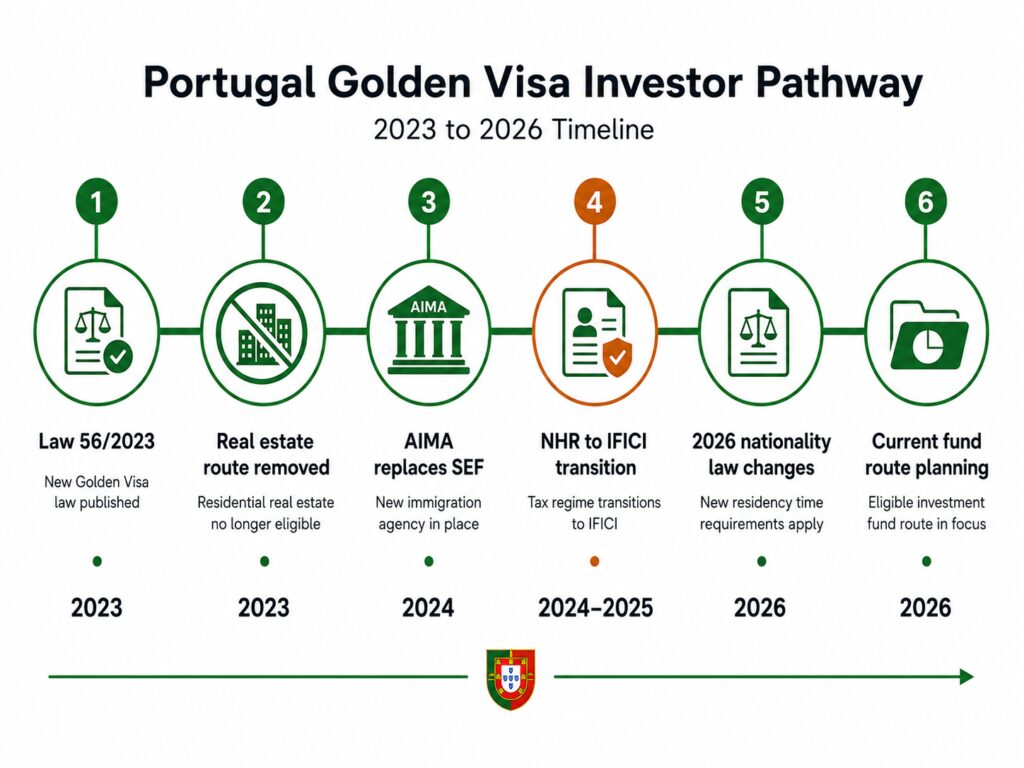
Here is the practical timeline investors need to understand:
| Year | Change | Investor Impact |
| 2023 | Law 56/2023 removed real estate routes for new Golden Visa applications | Property purchase no longer qualifies for new investors |
| 2023 | AIMA replaced SEF for immigration administration | Applicants deal with a new agency structure and transition delays |
| 2024 to 2025 | NHR transitioned toward IFICI | Tax planning became more selective and less automatic |
| 2026 | Nationality law changes entered into force | Citizenship planning now requires careful legal review |
| 2026 | Programme remains active | The fund route remains the main practical route for most investors |
For new applicants, the main point is simple: the portugal golden visa program is still a residency-by-investment route, but it is now built around regulated investment rather than property acquisition.
That makes the due diligence process more important. Investors are no longer asking, “Which property should I buy?” They are asking, “Which regulated investment route meets the law, fits my risk profile, and can be held for the required period?”

Law 56/2023: The Real Estate Route Removal
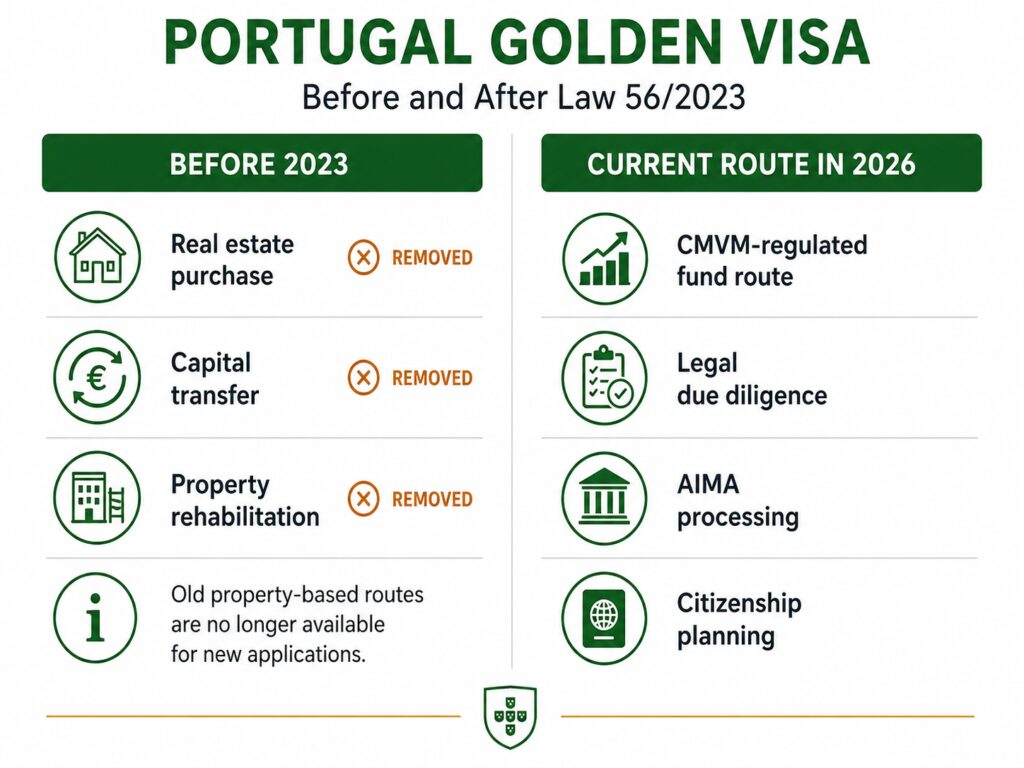
Law 56/2023 is the legal change that reshaped the Golden Visa. It ended new applications based on several old routes, including direct property investment and certain real estate-linked structures.
The official law is published in the Portuguese Official Gazette Law 56/2023, where the ARI reform removed new applications under the former real estate-linked subparagraphs and preserved renewals and pending applications under transition rules.
What Changed and When
Before Law 56/2023, many investors used Portuguese real estate to qualify for the Golden Visa. That route was popular because it was easy to understand: buy qualifying property, maintain the investment, and apply for residence.
That changed in 2023.
The real estate route removal means:
- New applicants can no longer qualify through residential or commercial property purchase.
- New applicants cannot rely on real estate rehabilitation as a qualifying Golden Visa route.
- Existing permit holders and pending applicants may have protection depending on their filing status and facts.
- Renewals remain possible for qualifying investors who entered under the previous legal framework.
This is where the grandfathering clause becomes important. Law 56/2023 did not simply erase existing cases. It preserved renewals and certain pending requests, subject to the legal conditions in force when those applications were submitted.
For investors who applied before the reform, the key question is not whether the programme still exists. The key question is whether their application, renewal, or family reunification request falls inside the transition protection.
Which Investment Routes Remain
For most private investors in 2026, the practical route is the regulated fund route.
The fund route generally requires a minimum qualifying investment of €500,000 into a qualifying non-real-estate investment fund. The fund must be structured under Portuguese law, meet the required holding period, and satisfy the programme criteria.
The biggest change is not just that real estate disappeared. It is that the investor now needs to evaluate:
- Fund regulation and CMVM supervision
- Investment strategy and asset exposure
- Fund maturity and exit terms
- Legal eligibility under the ARI framework
- Source of funds documentation
- Investor suitability
This is why the fund route expansion changed the tone of the process. It is less property-led and more investment-led. Investors should treat it as a regulated financial decision first and an immigration step second.
A simple comparison helps:
| Old Investor Question | Current Investor Question |
| Which property qualifies? | Which regulated fund qualifies? |
| Is the property in an eligible region? | Does the fund meet ARI and CMVM requirements? |
| Can I rent the property? | What is the fund strategy and exit timeline? |
| What taxes apply to the property? | What fund fees, liquidity terms, and risks apply? |
The minimum investment update investors should know is that the real estate threshold is no longer the relevant benchmark for new applications. For most applicants, the relevant planning figure is the €500,000 fund subscription, plus legal, government, tax, and due diligence costs.
AIMA Replaces SEF: What This Means for Applicants
AIMA means Agency for Integration, Migration and Asylum. It replaced SEF, Serviço de Estrangeiros e Fronteiras, for administrative immigration functions.
For Golden Visa applicants, this matters because applications, appointments, residence card issuance, and administrative communication now sit within a newer institutional structure. The AIMA Official Updates portal is the key official reference point for immigration administration.
The change from SEF to AIMA did not cancel the Portugal Golden Visa. It changed the authority managing the process.
Applicants should expect three practical effects:
- Administrative transition
A new agency structure often means new internal systems, process adjustments, and backlogs. Investors should build realistic timing into their plans. - More documentation discipline
AIMA processing makes complete, well-organised documentation essential. Weak files cost time. - Greater need for professional follow-up
The application is not only an investment transaction. It is an immigration file, a compliance file, and often a family file.
AIMA’s role also affects citizenship planning because residence history and legal status are central to later naturalisation eligibility.
NHR to IFICI: The Tax Regime Transition
The NHR to IFICI transition is separate from the Golden Visa law, but investors often confuse the two.
NHR, the Non-Habitual Resident tax regime, was historically one of Portugal’s major attractions for internationally mobile individuals. The old NHR regime is no longer generally available to new entrants in the same way. Portugal introduced IFICI, the Incentive for Scientific Research and Innovation, as a more targeted tax incentive.
The official tax framework for IFICI appears under Article 58-A of the Tax Benefits Statute on the Portuguese Tax Authority portal.
For Golden Visa investors, the important point is this:
The Golden Visa gives residence rights. It does not automatically give a tax benefit.
Tax treatment depends on whether the investor becomes tax resident in Portugal, their income type, their nationality, applicable tax treaties, and eligibility for any available regime. A Golden Visa holder who spends only the minimum stay in Portugal may not become tax resident. A family that relocates full-time may face a different analysis.
Investors should separate the questions:
| Question | Belongs To |
| Can I qualify for residency through investment? | Golden Visa law |
| Will I become tax resident in Portugal? | Tax residency rules |
| Can I access IFICI? | Portuguese tax incentive rules |
| Will my home country tax me anyway? | Cross-border tax planning |
This is especially important for US investors, UK residents, Canadians, Brazilians, South Africans, and other globally taxed or treaty-sensitive applicants. A tax advisor should review the structure before residency decisions are made.
Citizenship Timeline Debate: 5 vs 10 Years
The citizenship timeline is now one of the most important issues in the Portugal Golden Visa discussion.
Historically, many Golden Visa investors understood the pathway as a five-year legal residency route toward eligibility for Portuguese citizenship. That created strong appeal because Portugal allowed dual citizenship and offered a potential EU passport pathway without full relocation.
In 2026, the citizenship conversation changed.
Portugal approved changes to the nationality framework. The Ministry of Justice confirmed that the new nationality law entered into force on 19 May 2026 and introduced more demanding naturalisation criteria through new nationality law rules.
This is not the same thing as closing the Golden Visa. The residence programme and the nationality rules are connected, but they are not identical.
Where the Legislation Stands in 2026
As of June 2026, investors should treat the citizenship pathway as a legal planning issue that needs individual review.
The programme can still provide residency. However, the timeline for naturalisation may be affected by the new nationality law, the applicant’s nationality, filing date, residence title history, and whether a citizenship application was already pending before the new rules entered into force.
The Portuguese Government also noted that Parliament approved the new nationality law on 1 April 2026 after a legislative process that included a constitutional court ruling and amendments to the earlier bill. The Government described the reform as strengthening effective ties to the Portuguese community.
For investors, the safe interpretation is this:
- Do not assume old five-year citizenship guidance still applies to every case.
- Do not assume the Golden Visa itself has been cancelled.
- Do not treat citizenship timing as a marketing claim.
- Review your nationality, residence card dates, and filing strategy with counsel.
For deeper planning, investors should read more about citizenship timeline changes before assuming a final passport timeline.
Grandfathering: Are Existing Applicants Protected?
Grandfathering is not one single rule that protects every investor in the same way. It depends on the legal change being discussed.
For Law 56/2023, existing Golden Visa renewals and certain pending applications received transition protection. That matters for investors who entered through routes that later closed.
For the 2026 nationality law, the analysis is different. The Ministry of Justice stated that the new provisions apply only to requests submitted after entry into force. That is helpful for pending nationality procedures, but it does not automatically answer every question for Golden Visa holders who have not yet applied for citizenship.
This distinction matters:
| Situation | Likely Issue to Review |
| Existing Golden Visa permit holder | Renewal position and future citizenship timeline |
| Pending Golden Visa application from before Law 56/2023 | Transition protection under ARI reform |
| New investor in 2026 | Current qualifying fund route and future nationality rules |
| Citizenship application already filed before 19 May 2026 | Whether prior law applies to that pending procedure |
| Investor not yet eligible for citizenship | New nationality timeline and criteria |
The safest advice is not to rely on headlines. A headline may say “5 years,” “7 years,” or “10 years.” Your actual position depends on the specific law, filing date, and status of your residence or nationality process.
Is the Portugal Golden Visa Program Safe to Invest In?
The better question is not whether the programme is “safe.” The better question is whether the investor understands the legal and political risk before applying.
Portugal has kept the Golden Visa programme active, but it has changed the rules. That creates two realities at the same time:
- The programme has continuity because new applications remain possible through qualifying investment routes.
- The programme has political risk because Portugal has already shown willingness to reform investment migration rules.
A cautious investor should not see political risk as a reason to ignore the programme. They should see it as a reason to structure the application correctly.
Key risk areas include:
- Legal eligibility risk
The investment must qualify under the current ARI rules. Outdated real estate advice is a major red flag. - Fund selection risk
A fund may be regulated and still carry commercial risk. Regulation does not remove market exposure, liquidity limits, or exit uncertainty. - Processing risk
AIMA transition and administrative capacity can affect timing. - Citizenship timing risk
The residency permit and citizenship application are separate stages. Investors should not treat citizenship as automatic. - Tax planning risk
IFICI is not the old NHR regime. Relocation decisions should be reviewed before they create tax residency consequences.
This is where a full comparison of the pros and cons of investing becomes useful. The programme still offers meaningful benefits, but only for investors who understand the current rules rather than the pre-2023 version.
Latest News and Updates in 2026
As of 21 June 2026, the Portugal Golden Visa remains active for new investors, but the programme is narrower than it was before Law 56/2023.
The current update investors need to know is:
| Area | Current Position in 2026 |
| Programme status | Active |
| Real estate route | Removed for new applications |
| Main practical route | €500,000 regulated investment fund route |
| Immigration authority | AIMA |
| Tax regime | NHR largely replaced by IFICI for new qualifying taxpayers |
| Citizenship | New nationality rules in force from 19 May 2026 |
| Dual citizenship | Portugal continues to permit dual citizenship, subject to the applicant’s home country rules |
| Minimum stay | Seven days per year remains the core Golden Visa residency obligation |
The best investment migration decisions in 2026 start with three checks:
- Check the current qualifying route
Do not rely on old property-based guidance. - Check your citizenship timeline
Nationality law changes may affect your long-term plan. - Check your tax position
Residence rights and tax residence are not the same thing.
FAQs: Portugal Golden Visa Changes 2025-2026
What are the biggest changes to the Portugal Golden Visa in 2025 and 2026?
The biggest changes are the continued effect of Law 56/2023, the shift from SEF to AIMA administration, the NHR to IFICI tax transition, and the 2026 nationality law changes affecting citizenship planning. Real estate no longer qualifies for new Golden Visa applications. The programme remains active, but investors now need stronger legal, fund, and tax due diligence.
Is the Portugal Golden Visa program still active in 2026?
Yes, the Portugal Golden Visa programme is still active in 2026. The important point is that the qualifying routes changed. New investors should not rely on real estate-based advice because the current practical route for most applicants is the regulated fund route.
How did Law 56/2023 change the Golden Visa?
Law 56/2023 removed new Golden Visa applications based on real estate and certain old investment categories. It also preserved renewals and certain pending applications under transition rules. This means the programme continued, but the route changed from property-led investment to regulated investment structures.
What is the current status of the program?
The programme remains open, but it is more selective and more compliance-driven than before. AIMA handles immigration administration, real estate is no longer available for new applications, and citizenship planning must now account for the 2026 nationality law changes. Investors should confirm eligibility before transferring funds or choosing an investment vehicle.
Conclusion: How Investors Should Read Portugal Golden Visa Changes in 2026
The Portugal Golden Visa remains a serious residency-by-investment option, but it is no longer the same programme many investors researched before 2023. The real estate route removal, AIMA transition, IFICI tax shift, and citizenship timeline extension have changed the planning process.
The main lesson is simple: do not evaluate the programme using outdated articles, old property thresholds, or generic citizenship promises. In 2026, the right approach is legal eligibility first, investment due diligence second, and citizenship planning third.
For investors who want EU residency without full relocation, the programme can still be relevant. The decision now requires sharper advice, cleaner documentation, and a realistic understanding of political risk and programme continuity.
Ready to take the next step?
Book a free initial assessment. We’ll assess your eligibility, walk through the current qualifying routes, and answer your questions, no cost, no commitment.












