

Portugal golden visa

Portugal Golden Visa Pros and Cons: Is It Worth It in 2026?

Portugal Golden Visa pros and cons look different in 2026 than they did before Portugal removed real estate from the programme. The permit still offers a powerful combination of EU residency, Schengen mobility, family inclusion, and a citizenship pathway. But it also comes with real costs, processing delays, fund liquidity issues, and political risk.

This guide gives a direct assessment of the advantages, disadvantages, and practical risks so you can decide whether the portugal golden visa is still worth considering.

Portugal Golden Visa: The Main Benefits

The Portugal Golden Visa is not attractive because it is simple. It is attractive because it gives non-EU investors a route to Portuguese residency without requiring full relocation.

The key question is whether those benefits justify the investment, time, and uncertainty involved.

EU Residency with Minimal Stay Requirements

One of the strongest advantages of Portugal Golden Visa residency is minimum stay flexibility. Investors do not need to move to Portugal full-time to keep the permit active.

The official ARI (Autorização de Residência para Investimento) framework, published by AIMA official portal, states that ARI holders may reside in Portugal and must meet minimum stay rules during the validity of the permit.

For global investors, this matters.

You can keep your primary business, family home, and tax base elsewhere while still maintaining a legal residence permit in Portugal, subject to eligibility and compliance. That is very different from residence visas that require genuine relocation.

This is one of the main reasons Portugal’s residency investment program remains relevant for investors who want optionality rather than immediate migration.

Schengen Area Travel Freedom

The Golden Visa allows the holder to travel through the Schengen Area without applying for separate short-stay visas. For non-EU citizens who regularly visit Europe for business, family, education, or investment, this can be a major practical benefit.

The European Union’s Schengen framework is based on shared rules for crossing external and internal borders, as set out in the Schengen Borders Code.

For investors from countries with limited visa-free European access, this benefit can be more valuable than it first appears.

It reduces friction. It also reduces the uncertainty of repeated visa applications.

Path to Portuguese Citizenship and EU Passport

The Golden Visa can lead to Portuguese citizenship after five years of legal residency, provided the applicant meets the legal requirements at the time of application. These typically include lawful residence, a clean criminal record, and Portuguese language knowledge at the required level.

This citizenship timeline is one of the programme’s strongest long-term advantages.

Portuguese citizenship can eventually provide access to an EU passport, which gives broader rights than a residence permit. Residency gives you legal status in Portugal. Citizenship gives you a different level of permanence.

That distinction matters.

A Golden Visa is not an instant EU passport. It is a structured pathway that may lead there if the applicant remains compliant and qualifies under Portuguese nationality law.

NHR Tax Benefits

The NHR tax regime used to be one of the most discussed advantages of Portugal residency. In 2026, this point needs careful explanation.

The old Non-Habitual Resident regime is no longer a broad, automatic benefit for most new applicants. Portugal introduced the IFICI tax incentive, formally the Incentive for Scientific Research and Innovation, under Article 58-A of the Portuguese tax benefits statute. The official Portal das Finanças IFICI rules show that the incentive applies only to specific qualifying activities and conditions.

That means investors should not assume that Golden Visa approval creates tax advantages by itself.

The benefit is still relevant, but only with proper tax planning. For some applicants, Portugal may offer a suitable tax residency framework. For others, the Golden Visa is mainly a residency and citizenship planning tool, not a tax strategy.

Family Inclusion Rights

Family inclusion is another major advantage of Portugal Golden Visa residency.

A qualifying investor may usually include close family members under one application structure, subject to documentation and dependency rules. This can include:

  • Spouse or legal partner
  • Dependent children
  • Adult children who are financially dependent and studying
  • Parents who meet age or dependency requirements

This makes the programme especially relevant for families planning education, mobility, and long-term security.

For many applicants, the investment is not only about personal access to Portugal. It is about giving the family a legal foothold in Europe.

Education and Healthcare Access

Golden Visa residence can support access to Portugal’s education and healthcare environment, depending on the family’s residence status, actual location, and registration steps.

For families with children, this can be a strategic benefit. Portugal offers access to European schools, universities, and private education options. For older applicants, the ability to establish a residence base in a stable EU country can also matter.

This does not mean every family will immediately relocate.

It means they have the option.

Portugal Golden Visa benefits including Schengen travel and family inclusion

Portugal Golden Visa: The Drawbacks

The disadvantages of Portugal Golden Visa residency are not small details. They affect cost, timing, investment access, and long-term planning.

A serious investor should understand these points before starting.

High Minimum Investment

The most obvious disadvantage is the qualifying investment threshold.

For most private investors, the fund route requires a significant capital commitment. The programme is not designed for applicants who are simply looking for the cheapest way to live in Portugal.

The real cost also goes beyond the investment amount. Applicants need to plan for:

  • Legal fees
  • Fund subscription costs
  • Document preparation
  • Certified translations
  • Government fees
  • Renewal costs
  • Travel for biometrics
  • Tax and investment advice

Anyone evaluating the programme should review the full cost breakdown before comparing it with alternatives.

A Golden Visa can be worth the cost, but only if the benefits match the investor’s goals.

AIMA Processing Delays and Backlogs

AIMA processing delays are one of the most practical disadvantages in 2026.

AIMA, the Agency for Integration, Migration and Asylum, replaced SEF (Serviço de Estrangeiros e Fronteiras) in 2023. The transition created administrative pressure, and many applicants have experienced slow processing, delayed biometric appointments, and uncertainty around timelines.

This does not mean the programme is unusable. It means investors should plan conservatively.

A timeline that looks clean on paper can feel much longer in practice when documents, appointments, renewals, and family applications are involved.

This is one reason experienced legal support matters.

Fund Liquidity Restrictions

The fund investment route can create a liquidity issue.

Golden Visa investors must understand that qualifying funds are not the same as a normal brokerage account. A fund may have a fixed term, limited redemption rights, and exit conditions that depend on the fund structure.

This creates several questions:

Issue Why It Matters
Fund maturity The fund timeline may be longer than the investor expects
Redemption rights Early exit may be restricted or unavailable
Asset strategy Performance depends on the fund’s underlying investments
Regulatory status The fund must meet Portuguese Golden Visa rules
Exit planning Liquidity should be reviewed before subscription

Fund liquidity is not only an investment issue. It is also a residency planning issue.

If the investor exits too early or chooses a non-qualifying structure, the permit strategy may be affected.

Legal and Professional Costs

Legal fees are another disadvantage, although they are often necessary.

Golden Visa applications involve immigration law, document review, fund due diligence, tax planning, and compliance. A low-cost process may become expensive if documents are rejected or the investment structure is not suitable.

Professional costs may include:

  • Immigration lawyer fees
  • Tax advisor fees
  • Fund due diligence review
  • Certified translations
  • Apostilles and notarisation
  • Bank account and NIF support
  • Renewal support

These costs should not be treated as optional afterthoughts.

For a €500,000 investment decision, professional review is part of risk control.

Risk of Program Changes

Portugal has already changed the Golden Visa programme in major ways. Real estate no longer qualifies for new applications, and political debate around investment migration remains active across Europe.

This creates political risk.

Future programme changes could affect investment routes, processing rules, renewal procedures, or citizenship requirements. Existing applicants may receive transitional protection depending on the law, but that should never be assumed without legal advice.

This is where timing matters.

The more important the citizenship pathway is to your plan, the more carefully you should evaluate programme stability before applying.

Who Is the Portugal Golden Visa Best Suited For?

The Portugal Golden Visa is best suited for investors who want optionality, not immediate relocation.

It is usually a strong fit for people who:

  • Have sufficient liquid capital for the qualifying investment and fees
  • Want European residency without moving full-time
  • Value Schengen travel freedom
  • Want a possible citizenship pathway after five years
  • Need family inclusion under one residence strategy
  • Can tolerate processing delays
  • Understand fund investment risk
  • Are comfortable holding capital for several years

It is usually not the best fit for people who want the lowest-cost Portugal visa.

For applicants who plan to live in Portugal full-time and can show passive income, the D7 route may be more relevant. Investors comparing options should review how the Golden Visa compares to the D7 before deciding.

The Golden Visa is a strategic residency tool. It is not the universal answer for every applicant.

What Could Go Wrong: Honest Risk Assessment

A good Golden Visa plan should include a risk assessment before the investment is made.

The most common risks are not dramatic. They are practical.

Risk What It Means How to Reduce It
Processing delays AIMA appointments or approvals may take longer than expected Build a conservative timeline
Fund liquidity Capital may be locked for years Review fund terms before investing
Legal errors Weak documentation can delay or harm the application Use specialist legal review
Programme changes Rules may change during the holding period Apply with current law and monitor updates
Tax misunderstanding NHR or IFICI benefits may not apply Get tax advice before becoming resident
Family documentation issues Dependency or relationship proof may be challenged Prepare documents early
Citizenship assumptions Residency does not guarantee citizenship Plan around legal requirements

The biggest mistake is treating the Golden Visa as a purchase.

It is not. It is a regulated immigration process attached to a qualifying investment.
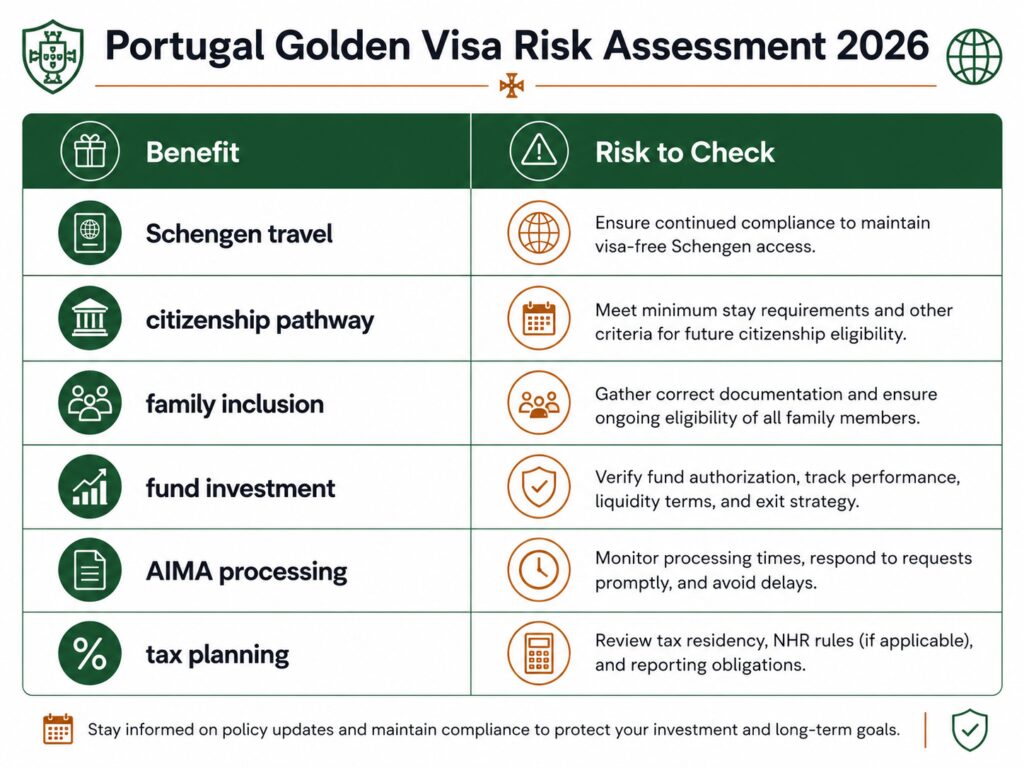
Portugal Golden Visa risks and benefits checklist for 2026 investors

Is the Portugal Golden Visa Still Worth It in 2026?

The Portugal Golden Visa can still be worth it in 2026, but only for the right applicant.

It is strongest for non-EU investors who want European residency, Schengen mobility, family inclusion, and a possible Portuguese citizenship pathway without moving to Portugal full-time. It is weaker for applicants who want low upfront costs, fast processing, or full liquidity.

The advantages are real. So are the disadvantages.

A useful way to decide is to compare the Golden Visa against your real objective.

Objective Is the Golden Visa a Good Fit?
EU residency without full relocation Yes, usually strong
Cheapest way to live in Portugal No, other visas may fit better
Schengen travel flexibility Yes, strong
Immediate citizenship No, it is a pathway, not instant citizenship
Family security planning Yes, often strong
Short-term investment liquidity No, fund routes may restrict exit
Low administrative burden Not always, due to processing and documentation

For investors comparing European options, it can also help to review how Portugal compares to Greece. Greece may appeal to property-focused investors, while Portugal may appeal more to those focused on the citizenship timeline and minimal stay structure.

The programme remains valuable because it solves a specific problem: how to secure a European residence base without relocating immediately.

But it should be approached as a long-term legal and investment decision, not a quick transaction.

FAQs: Portugal Golden Visa Pros and Cons

Is the Portugal Golden Visa worth it in 2026?

Yes, the Portugal Golden Visa can be worth it in 2026 for non-EU investors who want European residency, Schengen travel freedom, family inclusion, and a possible path to Portuguese citizenship. It is less suitable for applicants seeking a low-cost visa or fast processing. The value depends on whether the benefits justify the investment, legal fees, fund risk, and AIMA timeline.

What are the main disadvantages?

The main disadvantages are the high minimum investment, AIMA processing delays, legal and professional costs, fund liquidity restrictions, and political risk around future programme changes. Applicants should also avoid assuming that tax benefits apply automatically. The Golden Visa is valuable, but it requires careful planning.

What are the biggest benefits for non-EU citizens?

The biggest benefits are legal residency in Portugal, Schengen Area travel freedom, minimum stay flexibility, family inclusion, and a possible path to Portuguese citizenship after five years of legal residency. For non-EU citizens who want a European base without moving full-time, these benefits can be significant.

What are the risks of the program being changed or cancelled?

The risk is real because Portugal has already changed the Golden Visa rules, including removing real estate as a qualifying route for new applications. Future changes could affect investment routes, application procedures, fees, or citizenship planning. Applicants should work from the current law, apply with proper documentation, and avoid relying on assumptions about future political decisions.

Ready to take the next step?
Book a free initial assessment. We’ll assess your eligibility, walk through the current qualifying routes, and answer your questions, no cost, no commitment.


Portugal Golden Visa Pros and Cons: Is It Worth It in 2026?

Portugal Golden Visa pros and cons look different in 2026 than they did before Portugal removed real estate from the programme. The permit still offers a powerful combination of EU residency, Schengen mobility, family inclusion, and a citizenship pathway. But it also comes with real costs, processing delays, fund liquidity issues, and political risk.

This guide gives a direct assessment of the advantages, disadvantages, and practical risks so you can decide whether the portugal golden visa is still worth considering.

Portugal Golden Visa: The Main Benefits

The Portugal Golden Visa is not attractive because it is simple. It is attractive because it gives non-EU investors a route to Portuguese residency without requiring full relocation.

The key question is whether those benefits justify the investment, time, and uncertainty involved.

EU Residency with Minimal Stay Requirements

One of the strongest advantages of Portugal Golden Visa residency is minimum stay flexibility. Investors do not need to move to Portugal full-time to keep the permit active.

The official ARI (Autorização de Residência para Investimento) framework, published by AIMA official portal, states that ARI holders may reside in Portugal and must meet minimum stay rules during the validity of the permit.

For global investors, this matters.

You can keep your primary business, family home, and tax base elsewhere while still maintaining a legal residence permit in Portugal, subject to eligibility and compliance. That is very different from residence visas that require genuine relocation.

This is one of the main reasons Portugal’s residency investment program remains relevant for investors who want optionality rather than immediate migration.

Schengen Area Travel Freedom

The Golden Visa allows the holder to travel through the Schengen Area without applying for separate short-stay visas. For non-EU citizens who regularly visit Europe for business, family, education, or investment, this can be a major practical benefit.

The European Union’s Schengen framework is based on shared rules for crossing external and internal borders, as set out in the Schengen Borders Code.

For investors from countries with limited visa-free European access, this benefit can be more valuable than it first appears.

It reduces friction. It also reduces the uncertainty of repeated visa applications.

Path to Portuguese Citizenship and EU Passport

The Golden Visa can lead to Portuguese citizenship after five years of legal residency, provided the applicant meets the legal requirements at the time of application. These typically include lawful residence, a clean criminal record, and Portuguese language knowledge at the required level.

This citizenship timeline is one of the programme’s strongest long-term advantages.

Portuguese citizenship can eventually provide access to an EU passport, which gives broader rights than a residence permit. Residency gives you legal status in Portugal. Citizenship gives you a different level of permanence.

That distinction matters.

A Golden Visa is not an instant EU passport. It is a structured pathway that may lead there if the applicant remains compliant and qualifies under Portuguese nationality law.

NHR Tax Benefits

The NHR tax regime used to be one of the most discussed advantages of Portugal residency. In 2026, this point needs careful explanation.

The old Non-Habitual Resident regime is no longer a broad, automatic benefit for most new applicants. Portugal introduced the IFICI tax incentive, formally the Incentive for Scientific Research and Innovation, under Article 58-A of the Portuguese tax benefits statute. The official Portal das Finanças IFICI rules show that the incentive applies only to specific qualifying activities and conditions.

That means investors should not assume that Golden Visa approval creates tax advantages by itself.

The benefit is still relevant, but only with proper tax planning. For some applicants, Portugal may offer a suitable tax residency framework. For others, the Golden Visa is mainly a residency and citizenship planning tool, not a tax strategy.

Family Inclusion Rights

Family inclusion is another major advantage of Portugal Golden Visa residency.

A qualifying investor may usually include close family members under one application structure, subject to documentation and dependency rules. This can include:

  • Spouse or legal partner
  • Dependent children
  • Adult children who are financially dependent and studying
  • Parents who meet age or dependency requirements

This makes the programme especially relevant for families planning education, mobility, and long-term security.

For many applicants, the investment is not only about personal access to Portugal. It is about giving the family a legal foothold in Europe.

Education and Healthcare Access

Golden Visa residence can support access to Portugal’s education and healthcare environment, depending on the family’s residence status, actual location, and registration steps.

For families with children, this can be a strategic benefit. Portugal offers access to European schools, universities, and private education options. For older applicants, the ability to establish a residence base in a stable EU country can also matter.

This does not mean every family will immediately relocate.

It means they have the option.

Portugal Golden Visa benefits including Schengen travel and family inclusion

Portugal Golden Visa: The Drawbacks

The disadvantages of Portugal Golden Visa residency are not small details. They affect cost, timing, investment access, and long-term planning.

A serious investor should understand these points before starting.

High Minimum Investment

The most obvious disadvantage is the qualifying investment threshold.

For most private investors, the fund route requires a significant capital commitment. The programme is not designed for applicants who are simply looking for the cheapest way to live in Portugal.

The real cost also goes beyond the investment amount. Applicants need to plan for:

  • Legal fees
  • Fund subscription costs
  • Document preparation
  • Certified translations
  • Government fees
  • Renewal costs
  • Travel for biometrics
  • Tax and investment advice

Anyone evaluating the programme should review the full cost breakdown before comparing it with alternatives.

A Golden Visa can be worth the cost, but only if the benefits match the investor’s goals.

AIMA Processing Delays and Backlogs

AIMA processing delays are one of the most practical disadvantages in 2026.

AIMA, the Agency for Integration, Migration and Asylum, replaced SEF (Serviço de Estrangeiros e Fronteiras) in 2023. The transition created administrative pressure, and many applicants have experienced slow processing, delayed biometric appointments, and uncertainty around timelines.

This does not mean the programme is unusable. It means investors should plan conservatively.

A timeline that looks clean on paper can feel much longer in practice when documents, appointments, renewals, and family applications are involved.

This is one reason experienced legal support matters.

Fund Liquidity Restrictions

The fund investment route can create a liquidity issue.

Golden Visa investors must understand that qualifying funds are not the same as a normal brokerage account. A fund may have a fixed term, limited redemption rights, and exit conditions that depend on the fund structure.

This creates several questions:

Issue Why It Matters
Fund maturity The fund timeline may be longer than the investor expects
Redemption rights Early exit may be restricted or unavailable
Asset strategy Performance depends on the fund’s underlying investments
Regulatory status The fund must meet Portuguese Golden Visa rules
Exit planning Liquidity should be reviewed before subscription

Fund liquidity is not only an investment issue. It is also a residency planning issue.

If the investor exits too early or chooses a non-qualifying structure, the permit strategy may be affected.

Legal and Professional Costs

Legal fees are another disadvantage, although they are often necessary.

Golden Visa applications involve immigration law, document review, fund due diligence, tax planning, and compliance. A low-cost process may become expensive if documents are rejected or the investment structure is not suitable.

Professional costs may include:

  • Immigration lawyer fees
  • Tax advisor fees
  • Fund due diligence review
  • Certified translations
  • Apostilles and notarisation
  • Bank account and NIF support
  • Renewal support

These costs should not be treated as optional afterthoughts.

For a €500,000 investment decision, professional review is part of risk control.

Risk of Program Changes

Portugal has already changed the Golden Visa programme in major ways. Real estate no longer qualifies for new applications, and political debate around investment migration remains active across Europe.

This creates political risk.

Future programme changes could affect investment routes, processing rules, renewal procedures, or citizenship requirements. Existing applicants may receive transitional protection depending on the law, but that should never be assumed without legal advice.

This is where timing matters.

The more important the citizenship pathway is to your plan, the more carefully you should evaluate programme stability before applying.

Who Is the Portugal Golden Visa Best Suited For?

The Portugal Golden Visa is best suited for investors who want optionality, not immediate relocation.

It is usually a strong fit for people who:

  • Have sufficient liquid capital for the qualifying investment and fees
  • Want European residency without moving full-time
  • Value Schengen travel freedom
  • Want a possible citizenship pathway after five years
  • Need family inclusion under one residence strategy
  • Can tolerate processing delays
  • Understand fund investment risk
  • Are comfortable holding capital for several years

It is usually not the best fit for people who want the lowest-cost Portugal visa.

For applicants who plan to live in Portugal full-time and can show passive income, the D7 route may be more relevant. Investors comparing options should review how the Golden Visa compares to the D7 before deciding.

The Golden Visa is a strategic residency tool. It is not the universal answer for every applicant.

What Could Go Wrong: Honest Risk Assessment

A good Golden Visa plan should include a risk assessment before the investment is made.

The most common risks are not dramatic. They are practical.

Risk What It Means How to Reduce It
Processing delays AIMA appointments or approvals may take longer than expected Build a conservative timeline
Fund liquidity Capital may be locked for years Review fund terms before investing
Legal errors Weak documentation can delay or harm the application Use specialist legal review
Programme changes Rules may change during the holding period Apply with current law and monitor updates
Tax misunderstanding NHR or IFICI benefits may not apply Get tax advice before becoming resident
Family documentation issues Dependency or relationship proof may be challenged Prepare documents early
Citizenship assumptions Residency does not guarantee citizenship Plan around legal requirements

The biggest mistake is treating the Golden Visa as a purchase.

It is not. It is a regulated immigration process attached to a qualifying investment.

Portugal Golden Visa risks and benefits checklist for 2026 investors

Is the Portugal Golden Visa Still Worth It in 2026?

The Portugal Golden Visa can still be worth it in 2026, but only for the right applicant.

It is strongest for non-EU investors who want European residency, Schengen mobility, family inclusion, and a possible Portuguese citizenship pathway without moving to Portugal full-time. It is weaker for applicants who want low upfront costs, fast processing, or full liquidity.

The advantages are real. So are the disadvantages.

A useful way to decide is to compare the Golden Visa against your real objective.

Objective Is the Golden Visa a Good Fit?
EU residency without full relocation Yes, usually strong
Cheapest way to live in Portugal No, other visas may fit better
Schengen travel flexibility Yes, strong
Immediate citizenship No, it is a pathway, not instant citizenship
Family security planning Yes, often strong
Short-term investment liquidity No, fund routes may restrict exit
Low administrative burden Not always, due to processing and documentation

For investors comparing European options, it can also help to review how Portugal compares to Greece. Greece may appeal to property-focused investors, while Portugal may appeal more to those focused on the citizenship timeline and minimal stay structure.

The programme remains valuable because it solves a specific problem: how to secure a European residence base without relocating immediately.

But it should be approached as a long-term legal and investment decision, not a quick transaction.

FAQs: Portugal Golden Visa Pros and Cons

Is the Portugal Golden Visa worth it in 2026?

Yes, the Portugal Golden Visa can be worth it in 2026 for non-EU investors who want European residency, Schengen travel freedom, family inclusion, and a possible path to Portuguese citizenship. It is less suitable for applicants seeking a low-cost visa or fast processing. The value depends on whether the benefits justify the investment, legal fees, fund risk, and AIMA timeline.

What are the main disadvantages?

The main disadvantages are the high minimum investment, AIMA processing delays, legal and professional costs, fund liquidity restrictions, and political risk around future programme changes. Applicants should also avoid assuming that tax benefits apply automatically. The Golden Visa is valuable, but it requires careful planning.

What are the biggest benefits for non-EU citizens?

The biggest benefits are legal residency in Portugal, Schengen Area travel freedom, minimum stay flexibility, family inclusion, and a possible path to Portuguese citizenship after five years of legal residency. For non-EU citizens who want a European base without moving full-time, these benefits can be significant.

What are the risks of the program being changed or cancelled?

The risk is real because Portugal has already changed the Golden Visa rules, including removing real estate as a qualifying route for new applications. Future changes could affect investment routes, application procedures, fees, or citizenship planning. Applicants should work from the current law, apply with proper documentation, and avoid relying on assumptions about future political decisions.

Ready to take the next step?
Book a free initial assessment. We’ll assess your eligibility, walk through the current qualifying routes, and answer your questions, no cost, no commitment.

Portugal Golden Visa Pros and Cons: Is It Worth It in 2026?

Portugal-Golden-Visa-Pros-and-Cons-Is-It-Worth-It-in-2026
Portugal Golden Visa pros and cons look different in 2026 than they did before Portugal removed real estate from the programme. The permit still offers a powerful combination of EU residency, Schengen mobility, family inclusion, and a citizenship pathway. But it also comes with real costs, processing delays, fund liquidity issues, and political risk.

This guide gives a direct assessment of the advantages, disadvantages, and practical risks so you can decide whether the portugal golden visa is still worth considering.

Portugal Golden Visa: The Main Benefits

The Portugal Golden Visa is not attractive because it is simple. It is attractive because it gives non-EU investors a route to Portuguese residency without requiring full relocation.

The key question is whether those benefits justify the investment, time, and uncertainty involved.

EU Residency with Minimal Stay Requirements

One of the strongest advantages of Portugal Golden Visa residency is minimum stay flexibility. Investors do not need to move to Portugal full-time to keep the permit active.

The official ARI (Autorização de Residência para Investimento) framework, published by AIMA official portal, states that ARI holders may reside in Portugal and must meet minimum stay rules during the validity of the permit.

For global investors, this matters.

You can keep your primary business, family home, and tax base elsewhere while still maintaining a legal residence permit in Portugal, subject to eligibility and compliance. That is very different from residence visas that require genuine relocation.

This is one of the main reasons Portugal’s residency investment program remains relevant for investors who want optionality rather than immediate migration.

Schengen Area Travel Freedom

The Golden Visa allows the holder to travel through the Schengen Area without applying for separate short-stay visas. For non-EU citizens who regularly visit Europe for business, family, education, or investment, this can be a major practical benefit.

The European Union’s Schengen framework is based on shared rules for crossing external and internal borders, as set out in the Schengen Borders Code.

For investors from countries with limited visa-free European access, this benefit can be more valuable than it first appears.

It reduces friction. It also reduces the uncertainty of repeated visa applications.

Path to Portuguese Citizenship and EU Passport

The Golden Visa can lead to Portuguese citizenship after five years of legal residency, provided the applicant meets the legal requirements at the time of application. These typically include lawful residence, a clean criminal record, and Portuguese language knowledge at the required level.

This citizenship timeline is one of the programme’s strongest long-term advantages.

Portuguese citizenship can eventually provide access to an EU passport, which gives broader rights than a residence permit. Residency gives you legal status in Portugal. Citizenship gives you a different level of permanence.

That distinction matters.

A Golden Visa is not an instant EU passport. It is a structured pathway that may lead there if the applicant remains compliant and qualifies under Portuguese nationality law.

NHR Tax Benefits

The NHR tax regime used to be one of the most discussed advantages of Portugal residency. In 2026, this point needs careful explanation.

The old Non-Habitual Resident regime is no longer a broad, automatic benefit for most new applicants. Portugal introduced the IFICI tax incentive, formally the Incentive for Scientific Research and Innovation, under Article 58-A of the Portuguese tax benefits statute. The official Portal das Finanças IFICI rules show that the incentive applies only to specific qualifying activities and conditions.

That means investors should not assume that Golden Visa approval creates tax advantages by itself.

The benefit is still relevant, but only with proper tax planning. For some applicants, Portugal may offer a suitable tax residency framework. For others, the Golden Visa is mainly a residency and citizenship planning tool, not a tax strategy.

Family Inclusion Rights

Family inclusion is another major advantage of Portugal Golden Visa residency.

A qualifying investor may usually include close family members under one application structure, subject to documentation and dependency rules. This can include:

  • Spouse or legal partner
  • Dependent children
  • Adult children who are financially dependent and studying
  • Parents who meet age or dependency requirements

This makes the programme especially relevant for families planning education, mobility, and long-term security.

For many applicants, the investment is not only about personal access to Portugal. It is about giving the family a legal foothold in Europe.

Education and Healthcare Access

Golden Visa residence can support access to Portugal’s education and healthcare environment, depending on the family’s residence status, actual location, and registration steps.

For families with children, this can be a strategic benefit. Portugal offers access to European schools, universities, and private education options. For older applicants, the ability to establish a residence base in a stable EU country can also matter.

This does not mean every family will immediately relocate.

It means they have the option.

Portugal Golden Visa benefits including Schengen travel and family inclusion

Portugal Golden Visa: The Drawbacks

The disadvantages of Portugal Golden Visa residency are not small details. They affect cost, timing, investment access, and long-term planning.

A serious investor should understand these points before starting.

High Minimum Investment

The most obvious disadvantage is the qualifying investment threshold.

For most private investors, the fund route requires a significant capital commitment. The programme is not designed for applicants who are simply looking for the cheapest way to live in Portugal.

The real cost also goes beyond the investment amount. Applicants need to plan for:

  • Legal fees
  • Fund subscription costs
  • Document preparation
  • Certified translations
  • Government fees
  • Renewal costs
  • Travel for biometrics
  • Tax and investment advice

Anyone evaluating the programme should review the full cost breakdown before comparing it with alternatives.

A Golden Visa can be worth the cost, but only if the benefits match the investor’s goals.

AIMA Processing Delays and Backlogs

AIMA processing delays are one of the most practical disadvantages in 2026.

AIMA, the Agency for Integration, Migration and Asylum, replaced SEF (Serviço de Estrangeiros e Fronteiras) in 2023. The transition created administrative pressure, and many applicants have experienced slow processing, delayed biometric appointments, and uncertainty around timelines.

This does not mean the programme is unusable. It means investors should plan conservatively.

A timeline that looks clean on paper can feel much longer in practice when documents, appointments, renewals, and family applications are involved.

This is one reason experienced legal support matters.

Fund Liquidity Restrictions

The fund investment route can create a liquidity issue.

Golden Visa investors must understand that qualifying funds are not the same as a normal brokerage account. A fund may have a fixed term, limited redemption rights, and exit conditions that depend on the fund structure.

This creates several questions:

Issue Why It Matters
Fund maturity The fund timeline may be longer than the investor expects
Redemption rights Early exit may be restricted or unavailable
Asset strategy Performance depends on the fund’s underlying investments
Regulatory status The fund must meet Portuguese Golden Visa rules
Exit planning Liquidity should be reviewed before subscription

Fund liquidity is not only an investment issue. It is also a residency planning issue.

If the investor exits too early or chooses a non-qualifying structure, the permit strategy may be affected.

Legal and Professional Costs

Legal fees are another disadvantage, although they are often necessary.

Golden Visa applications involve immigration law, document review, fund due diligence, tax planning, and compliance. A low-cost process may become expensive if documents are rejected or the investment structure is not suitable.

Professional costs may include:

  • Immigration lawyer fees
  • Tax advisor fees
  • Fund due diligence review
  • Certified translations
  • Apostilles and notarisation
  • Bank account and NIF support
  • Renewal support

These costs should not be treated as optional afterthoughts.

For a €500,000 investment decision, professional review is part of risk control.

Risk of Program Changes

Portugal has already changed the Golden Visa programme in major ways. Real estate no longer qualifies for new applications, and political debate around investment migration remains active across Europe.

This creates political risk.

Future programme changes could affect investment routes, processing rules, renewal procedures, or citizenship requirements. Existing applicants may receive transitional protection depending on the law, but that should never be assumed without legal advice.

This is where timing matters.

The more important the citizenship pathway is to your plan, the more carefully you should evaluate programme stability before applying.

Who Is the Portugal Golden Visa Best Suited For?

The Portugal Golden Visa is best suited for investors who want optionality, not immediate relocation.

It is usually a strong fit for people who:

  • Have sufficient liquid capital for the qualifying investment and fees
  • Want European residency without moving full-time
  • Value Schengen travel freedom
  • Want a possible citizenship pathway after five years
  • Need family inclusion under one residence strategy
  • Can tolerate processing delays
  • Understand fund investment risk
  • Are comfortable holding capital for several years

It is usually not the best fit for people who want the lowest-cost Portugal visa.

For applicants who plan to live in Portugal full-time and can show passive income, the D7 route may be more relevant. Investors comparing options should review how the Golden Visa compares to the D7 before deciding.

The Golden Visa is a strategic residency tool. It is not the universal answer for every applicant.

What Could Go Wrong: Honest Risk Assessment

A good Golden Visa plan should include a risk assessment before the investment is made.

The most common risks are not dramatic. They are practical.

Risk What It Means How to Reduce It
Processing delays AIMA appointments or approvals may take longer than expected Build a conservative timeline
Fund liquidity Capital may be locked for years Review fund terms before investing
Legal errors Weak documentation can delay or harm the application Use specialist legal review
Programme changes Rules may change during the holding period Apply with current law and monitor updates
Tax misunderstanding NHR or IFICI benefits may not apply Get tax advice before becoming resident
Family documentation issues Dependency or relationship proof may be challenged Prepare documents early
Citizenship assumptions Residency does not guarantee citizenship Plan around legal requirements

The biggest mistake is treating the Golden Visa as a purchase.

It is not. It is a regulated immigration process attached to a qualifying investment.

Portugal Golden Visa risks and benefits checklist for 2026 investors

Is the Portugal Golden Visa Still Worth It in 2026?

The Portugal Golden Visa can still be worth it in 2026, but only for the right applicant.

It is strongest for non-EU investors who want European residency, Schengen mobility, family inclusion, and a possible Portuguese citizenship pathway without moving to Portugal full-time. It is weaker for applicants who want low upfront costs, fast processing, or full liquidity.

The advantages are real. So are the disadvantages.

A useful way to decide is to compare the Golden Visa against your real objective.

Objective Is the Golden Visa a Good Fit?
EU residency without full relocation Yes, usually strong
Cheapest way to live in Portugal No, other visas may fit better
Schengen travel flexibility Yes, strong
Immediate citizenship No, it is a pathway, not instant citizenship
Family security planning Yes, often strong
Short-term investment liquidity No, fund routes may restrict exit
Low administrative burden Not always, due to processing and documentation

For investors comparing European options, it can also help to review how Portugal compares to Greece. Greece may appeal to property-focused investors, while Portugal may appeal more to those focused on the citizenship timeline and minimal stay structure.

The programme remains valuable because it solves a specific problem: how to secure a European residence base without relocating immediately.

But it should be approached as a long-term legal and investment decision, not a quick transaction.

FAQs: Portugal Golden Visa Pros and Cons

Is the Portugal Golden Visa worth it in 2026?

Yes, the Portugal Golden Visa can be worth it in 2026 for non-EU investors who want European residency, Schengen travel freedom, family inclusion, and a possible path to Portuguese citizenship. It is less suitable for applicants seeking a low-cost visa or fast processing. The value depends on whether the benefits justify the investment, legal fees, fund risk, and AIMA timeline.

What are the main disadvantages?

The main disadvantages are the high minimum investment, AIMA processing delays, legal and professional costs, fund liquidity restrictions, and political risk around future programme changes. Applicants should also avoid assuming that tax benefits apply automatically. The Golden Visa is valuable, but it requires careful planning.

What are the biggest benefits for non-EU citizens?

The biggest benefits are legal residency in Portugal, Schengen Area travel freedom, minimum stay flexibility, family inclusion, and a possible path to Portuguese citizenship after five years of legal residency. For non-EU citizens who want a European base without moving full-time, these benefits can be significant.

What are the risks of the program being changed or cancelled?

The risk is real because Portugal has already changed the Golden Visa rules, including removing real estate as a qualifying route for new applications. Future changes could affect investment routes, application procedures, fees, or citizenship planning. Applicants should work from the current law, apply with proper documentation, and avoid relying on assumptions about future political decisions.

Ready to take the next step?
Book a free initial assessment. We’ll assess your eligibility, walk through the current qualifying routes, and answer your questions, no cost, no commitment.

What do you think?
Blog

More Related Articles

top








