Portugal golden visa

What Is the Portugal Golden Visa and How Does It Work?

What is the Portugal Golden Visa? It is Portugal’s residency by investment programme for eligible non-EU nationals who want legal residence in Portugal, Schengen Area mobility, family inclusion, and a possible EU passport pathway after five years.

The formal name is ARI, or Autorização de Residência para Investimento, which means Residence Permit for Investment Activity. The programme is not a direct passport purchase, and it is not a relocation visa in the usual sense. It is an investor visa that allows qualified applicants to obtain Portuguese residence by making and maintaining an eligible investment.

This guide explains how the programme works in 2026, who can apply, which routes remain available, and what rights a successful applicant receives.

What Is the Portugal Golden Visa (ARI)?

The Portugal Golden Visa is a legal residence permit for investment activity. It gives qualified investors and eligible family members the right to live in Portugal while keeping a low physical presence requirement.

For many applicants, the appeal is not full relocation. It is optionality: a regulated route to EU residency, Schengen travel, and the possibility of Portuguese citizenship after meeting the legal residency period and nationality requirements.

A Brief History of the Program

Portugal introduced the ARI scheme in 2012 to attract foreign investment from outside the European Union. Since then, the programme has changed several times, especially after the 2023 reform that removed real estate purchases from the list of qualifying routes.

That change created most of today’s confusion. Older articles still discuss residential property investments, commercial-to-residential conversions, and renovation thresholds. Those routes no longer represent the current programme.

Today, investors should treat the portugal golden visa program as a regulated investment residency route, not a real estate purchase route.

Who Is It Designed For?

The programme is designed for a non-EU national who wants Portuguese residence without becoming a full-time resident immediately.

It is often used by:

  • Investors seeking a long-term EU residency base
  • Families planning future education or relocation options
  • Business owners who want Schengen Area access
  • Applicants who want a 5-year citizenship pathway
  • High-net-worth individuals seeking a legal Plan B in Europe

The Golden Visa is not designed for someone who mainly wants to move to Portugal quickly on the basis of passive income. That applicant may need to compare other options, including how the Golden Visa compares to the D7 route.

FREE LEGAL CONSULTATION

Have a Quick Question?

Our legal team is available Monday–Friday to answer your Portugal Golden Visa questions and help you understand your next steps.

Book Your Free Consultation Message Us on WhatsApp

How the Portugal Golden Visa Works

The process is structured around one central idea: make a qualifying investment, apply for ARI residence, renew the permit while maintaining eligibility, and later apply for citizenship if the legal conditions are met.

The exact timeline depends on document preparation, application processing, biometric appointment availability, and the applicant’s personal circumstances.

Step 1: Make a Qualifying Investment

The applicant must first choose a qualifying investment route. For most private investors, the main commercial route is a minimum investment in an eligible fund.

A qualifying fund investment normally involves a transfer of at least €500,000 into eligible units of non-real-estate collective investment undertakings under Portuguese rules. Investors should review the fund structure, maturity, manager credentials, portfolio exposure, and exit conditions before committing capital.

The official ARI framework is listed by AIMA Official Golden Visa Info, the Agency for Integration, Migration and Asylum that processes residence applications.

Step 2: Apply for Residency

After the investment and document preparation, the applicant submits the ARI application through the relevant process. AIMA, or the Agency for Integration, Migration and Asylum, replaced SEF, the former Serviço de Estrangeiros e Fronteiras, in 2023.

Typical application preparation includes:

  1. Getting a NIF, the Portuguese tax identification number
  2. Opening a Portuguese bank account
  3. Completing investment due diligence
  4. Transferring funds to the qualifying investment
  5. Collecting criminal record certificates and civil documents
  6. Preparing translated and apostilled documents where required
  7. Submitting the application and awaiting processing

The ARI process is document-heavy. A missing certificate or an outdated document can delay the file more than the investment itself.

Step 3: Renew and Maintain

Once approved, the applicant must maintain the qualifying investment and comply with the physical stay requirement. The core stay requirement is low compared with many residence routes: 7 days in the first year and 14 days in each following two-year period under the ARI framework.

Renewal also matters. The investor must keep the qualifying investment, maintain a clean compliance record, and submit renewal documentation when required.

This is where the Golden Visa differs from a simple entry visa. It is a residence permit that must be maintained properly over time.

Step 4: Apply for Citizenship After 5 Years

The Golden Visa can support a 5-year citizenship pathway. After five years of legal residency, the applicant may apply for Portuguese citizenship, subject to the nationality requirements in force at the time.

Citizenship is not automatic. The applicant must usually meet requirements such as legal residence, clean criminal record standards, and Portuguese language knowledge at the required level.

The benefit is that the Golden Visa can preserve optionality. The investor can maintain residence with limited stay obligations while working toward future eligibility for citizenship.
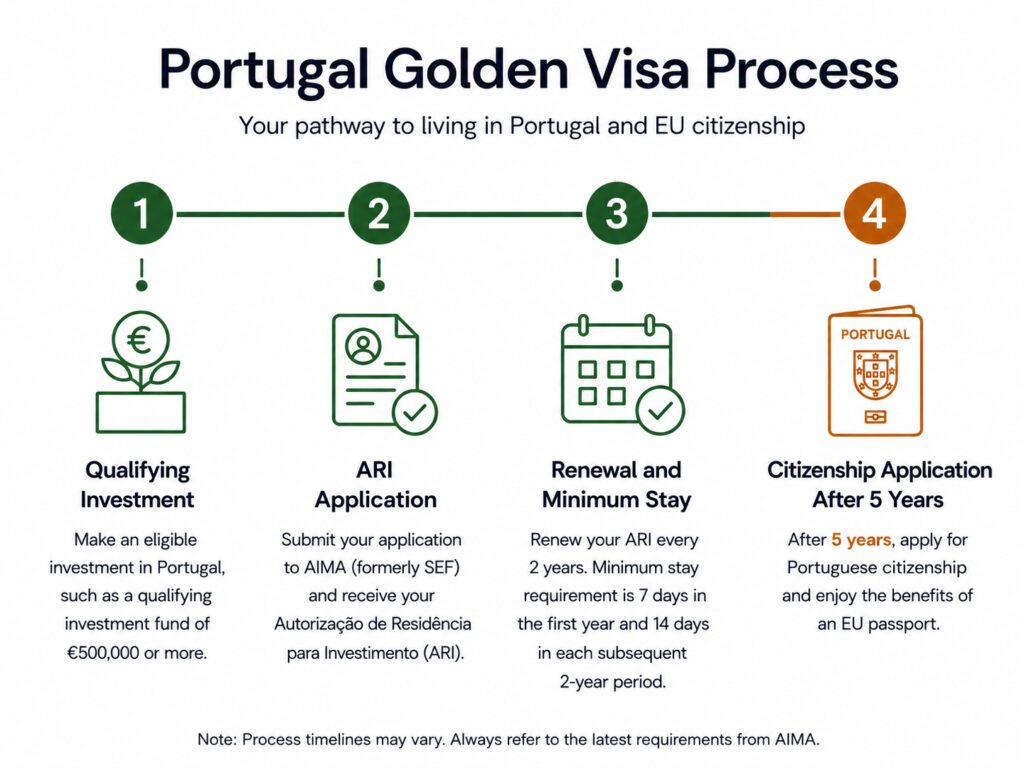
Portugal Golden Visa explained through ARI application and citizenship steps

Who Can Apply?

Eligibility starts with nationality and investment capacity. The programme is for third-country nationals, meaning people who are not citizens of Portugal, the EU, EEA, Andorra, or Switzerland.

Applicants also need to meet document, background, and investment requirements. The investment alone does not guarantee approval.

Non-EU Nationals Only

The Golden Visa is available to eligible non-EU nationals. A citizen of an EU member state does not need the ARI route because EU citizens already have freedom of movement rights within the EU.

The applicant must generally show:

  • Valid passport
  • Clean criminal record documentation
  • Proof of qualifying investment
  • Proof of lawful source of funds
  • Health insurance or coverage where required
  • Compliance with Portuguese immigration and investment rules

Before choosing a route, investors should review the eligibility requirements in detail. A strong application begins before the money moves.

FREE LEGAL CONSULTATION

Have a Quick Question?

Our legal team is available Monday–Friday to answer your Portugal Golden Visa questions and help you understand your next steps.

Book Your Free Consultation Message Us on WhatsApp

No Age or Income Restrictions

The Portugal Golden Visa does not work like a passive income visa. It is based mainly on qualifying investment activity rather than salary, pension income, or monthly passive income.

That means there is no standard income threshold in the same way a retirement or passive income visa may require one. However, applicants still need to prove lawful funds, satisfy background checks, and complete the investment correctly.

Tax planning should also be reviewed separately. The Golden Visa is a residence route, not a tax regime. Do not confuse it with the former NHR regime or any replacement tax framework.

What Investment Routes Are Available?

The current Golden Visa is no longer a real estate residency programme. The practical focus has shifted to regulated investment and other non-property routes.

The table below gives a simple overview of the main routes investors usually ask about.

Route Typical Minimum Best Suited For Key Point
Investment fund route €500,000 Private investors seeking a structured investment route Must be eligible under ARI rules and not focused on real estate
Cultural donation route €250,000 Philanthropic or culture-focused applicants Narrower route with specific eligible institutions
Job creation route 10 jobs or company route conditions Business operators creating employment in Portugal Requires real operating substance

Investment Fund Route

The fund route is the main option for many international investors in 2026. It usually involves investing at least €500,000 into eligible non-real-estate collective investment structures.

This is where due diligence matters. The fund must be suitable for ARI purposes, and investors should review the manager, strategy, maturity, fees, liquidity, and risk profile.

Investors comparing the investment options available should not look only at the headline minimum. The real question is whether the route is eligible, properly documented, and aligned with the investor’s timeline.

Cultural Donation Route

The cultural donation route can involve a lower qualifying amount, often associated with support for artistic production or the recovery and maintenance of national cultural heritage. It is not the same as an investment fund and may not offer the same capital preservation logic.

This route can be attractive for applicants who want a philanthropic or cultural contribution structure. It requires careful confirmation of the eligible recipient and documentation.

It should not be chosen only because the headline amount looks lower. The route must fit the applicant’s goals, risk tolerance, and evidence requirements.

Job Creation Route

The job creation route focuses on employment and business substance in Portugal. The classic structure involves creating at least 10 jobs, while company capitalisation routes can include job creation or job maintenance conditions.

This route suits business operators more than passive investors. It requires operational planning, payroll responsibility, and long-term compliance.

An investor who wants a simpler, documentable route will usually find the fund route easier to evaluate than a job creation structure.

What Rights Does the Golden Visa Give You?

The Golden Visa gives residence rights in Portugal, Schengen travel access, and family inclusion. It does not automatically give citizenship, tax residence advantages, or guaranteed investment returns.

The value of the programme is legal optionality. It gives the applicant a regulated base in Portugal without requiring immediate full relocation.

Legal Residency in Portugal

Successful ARI applicants receive legal residence in Portugal. According to AIMA, ARI holders may reside and work in Portugal, subject to the conditions of the permit.

This means the Golden Visa is more than a travel document. It is a residence permit that can support a longer-term connection with Portugal.

For families, it can also create future planning options around education, lifestyle, retirement, or relocation.

Schengen Area Travel

Golden Visa holders can travel within the Schengen Area without needing a separate Schengen visa for short stays. The European Commission Schengen Area page states that Schengen is composed of 29 countries.

For investors from visa-restricted countries, this benefit can be significant. It simplifies travel for business meetings, family visits, and short stays across much of Europe.

It should still be understood correctly. The Golden Visa gives residence in Portugal and Schengen mobility rights, not unlimited residence rights in every EU country.

Family Inclusion

Family inclusion is one of the strongest parts of the programme. A main applicant can usually include eligible family members under one application structure.

Eligible relatives may include:

  • Spouse or legal partner
  • Dependent children
  • Adult children who remain dependent and meet study-related conditions
  • Parents above the qualifying age threshold
  • Financially dependent parents in certain cases

Family documentation must be prepared carefully. Marriage certificates, birth certificates, dependency evidence, and student records may all matter.
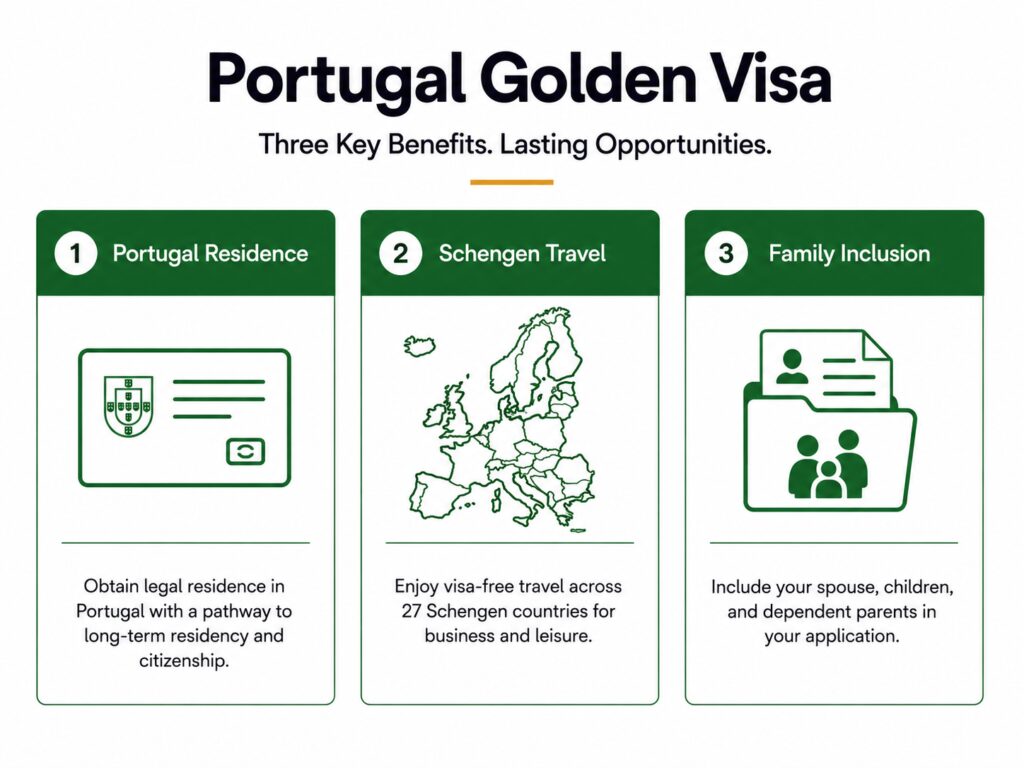
Portugal Golden Visa rights include residence Schengen travel and family inclusion

Wondering if you qualify?
Book a free initial assessment with our team. We’ll confirm your eligibility, outline the current qualifying routes, and answer your questions, no commitment required.
Book a Consultation →

Is the Portugal Golden Visa Still Active in 2026?

Yes, the Portugal Golden Visa is still active in 2026. What changed is the list of qualifying routes.

The biggest point to understand is simple: real estate is no longer a qualifying route. Applicants reading older content should be careful, because many pages still describe property-based structures that no longer apply.

Current applicants usually focus on non-real-estate investment structures, especially eligible fund routes. AIMA continues to publish ARI information, and broader European residence permit data can be checked through EU Residency by Investment Statistics and related EU migration data resources.

For practical planning, the key question is not whether the programme exists. It is whether your preferred route, documentation, investment structure, and family profile fit the current rules.

FAQs: What Is the Portugal Golden Visa

What is the Portugal Golden Visa program?

The Portugal Golden Visa program is a residency by investment route formally known as ARI, or Autorização de Residência para Investimento. It allows eligible non-EU nationals to apply for Portuguese residence after making a qualifying investment. The programme can also support family inclusion, Schengen travel, and a citizenship application after five years of legal residency, subject to legal requirements.

Who can apply?

Eligible non-EU nationals can apply, provided they meet the investment, documentation, background check, and eligibility requirements. EU, EEA, Andorran, Swiss, and Portuguese nationals are not the target applicants for this route. Family members may be included if they meet the relevant dependency and relationship requirements.

How does the Portugal Golden Visa lead to citizenship?

The Golden Visa can lead to citizenship after five years of legal residency in Portugal, provided the applicant meets the nationality requirements in force at the time of application. These requirements may include maintaining legal residence, meeting language standards, and satisfying criminal record conditions. Citizenship is not automatic, but the Golden Visa can form the residency basis for a later application.

Is the Portugal Golden Visa still available in 2026?

Yes, the Portugal Golden Visa is still available in 2026. The programme changed after the 2023 reform, especially because real estate investment no longer qualifies. Current applicants should focus on eligible non-real-estate routes, including fund investment and other qualifying investment routes where suitable.

Is the Portugal Golden Visa Right for You?

The Portugal Golden Visa is best suited to investors who want Portuguese residence, Schengen Area mobility, family inclusion, and a possible EU passport pathway without relocating full-time at the start.

The most important point is that the programme must be approached as a regulated legal and investment process. The investment route, source of funds, document preparation, and renewal strategy all need to work together.

For most private investors, the first step is to confirm whether a fund-based route or another eligible option fits their profile. The ARI scheme Portugal can be powerful, but only when it is structured correctly from the beginning.

Ready to take the next step?
Book a free initial assessment. We’ll assess your eligibility, walk through the current qualifying routes, and answer your questions, no cost, no commitment.


What Is the Portugal Golden Visa and How Does It Work?

What is the Portugal Golden Visa? It is Portugal’s residency by investment programme for eligible non-EU nationals who want legal residence in Portugal, Schengen Area mobility, family inclusion, and a possible EU passport pathway after five years.

The formal name is ARI, or Autorização de Residência para Investimento, which means Residence Permit for Investment Activity. The programme is not a direct passport purchase, and it is not a relocation visa in the usual sense. It is an investor visa that allows qualified applicants to obtain Portuguese residence by making and maintaining an eligible investment.

This guide explains how the programme works in 2026, who can apply, which routes remain available, and what rights a successful applicant receives.

What Is the Portugal Golden Visa (ARI)?

The Portugal Golden Visa is a legal residence permit for investment activity. It gives qualified investors and eligible family members the right to live in Portugal while keeping a low physical presence requirement.

For many applicants, the appeal is not full relocation. It is optionality: a regulated route to EU residency, Schengen travel, and the possibility of Portuguese citizenship after meeting the legal residency period and nationality requirements.

A Brief History of the Program

Portugal introduced the ARI scheme in 2012 to attract foreign investment from outside the European Union. Since then, the programme has changed several times, especially after the 2023 reform that removed real estate purchases from the list of qualifying routes.

That change created most of today’s confusion. Older articles still discuss residential property investments, commercial-to-residential conversions, and renovation thresholds. Those routes no longer represent the current programme.

Today, investors should treat the portugal golden visa program as a regulated investment residency route, not a real estate purchase route.

Who Is It Designed For?

The programme is designed for a non-EU national who wants Portuguese residence without becoming a full-time resident immediately.

It is often used by:

  • Investors seeking a long-term EU residency base
  • Families planning future education or relocation options
  • Business owners who want Schengen Area access
  • Applicants who want a 5-year citizenship pathway
  • High-net-worth individuals seeking a legal Plan B in Europe

The Golden Visa is not designed for someone who mainly wants to move to Portugal quickly on the basis of passive income. That applicant may need to compare other options, including how the Golden Visa compares to the D7 route.

FREE LEGAL CONSULTATION

Have a Quick Question?

Our legal team is available Monday–Friday to answer your Portugal Golden Visa questions and help you understand your next steps.

Book Your Free Consultation Message Us on WhatsApp

How the Portugal Golden Visa Works

The process is structured around one central idea: make a qualifying investment, apply for ARI residence, renew the permit while maintaining eligibility, and later apply for citizenship if the legal conditions are met.

The exact timeline depends on document preparation, application processing, biometric appointment availability, and the applicant’s personal circumstances.

Step 1: Make a Qualifying Investment

The applicant must first choose a qualifying investment route. For most private investors, the main commercial route is a minimum investment in an eligible fund.

A qualifying fund investment normally involves a transfer of at least €500,000 into eligible units of non-real-estate collective investment undertakings under Portuguese rules. Investors should review the fund structure, maturity, manager credentials, portfolio exposure, and exit conditions before committing capital.

The official ARI framework is listed by AIMA Official Golden Visa Info, the Agency for Integration, Migration and Asylum that processes residence applications.

Step 2: Apply for Residency

After the investment and document preparation, the applicant submits the ARI application through the relevant process. AIMA, or the Agency for Integration, Migration and Asylum, replaced SEF, the former Serviço de Estrangeiros e Fronteiras, in 2023.

Typical application preparation includes:

  1. Getting a NIF, the Portuguese tax identification number
  2. Opening a Portuguese bank account
  3. Completing investment due diligence
  4. Transferring funds to the qualifying investment
  5. Collecting criminal record certificates and civil documents
  6. Preparing translated and apostilled documents where required
  7. Submitting the application and awaiting processing

The ARI process is document-heavy. A missing certificate or an outdated document can delay the file more than the investment itself.

Step 3: Renew and Maintain

Once approved, the applicant must maintain the qualifying investment and comply with the physical stay requirement. The core stay requirement is low compared with many residence routes: 7 days in the first year and 14 days in each following two-year period under the ARI framework.

Renewal also matters. The investor must keep the qualifying investment, maintain a clean compliance record, and submit renewal documentation when required.

This is where the Golden Visa differs from a simple entry visa. It is a residence permit that must be maintained properly over time.

Step 4: Apply for Citizenship After 5 Years

The Golden Visa can support a 5-year citizenship pathway. After five years of legal residency, the applicant may apply for Portuguese citizenship, subject to the nationality requirements in force at the time.

Citizenship is not automatic. The applicant must usually meet requirements such as legal residence, clean criminal record standards, and Portuguese language knowledge at the required level.

The benefit is that the Golden Visa can preserve optionality. The investor can maintain residence with limited stay obligations while working toward future eligibility for citizenship.

Portugal Golden Visa explained through ARI application and citizenship steps

Who Can Apply?

Eligibility starts with nationality and investment capacity. The programme is for third-country nationals, meaning people who are not citizens of Portugal, the EU, EEA, Andorra, or Switzerland.

Applicants also need to meet document, background, and investment requirements. The investment alone does not guarantee approval.

Non-EU Nationals Only

The Golden Visa is available to eligible non-EU nationals. A citizen of an EU member state does not need the ARI route because EU citizens already have freedom of movement rights within the EU.

The applicant must generally show:

  • Valid passport
  • Clean criminal record documentation
  • Proof of qualifying investment
  • Proof of lawful source of funds
  • Health insurance or coverage where required
  • Compliance with Portuguese immigration and investment rules

Before choosing a route, investors should review the eligibility requirements in detail. A strong application begins before the money moves.

FREE LEGAL CONSULTATION

Have a Quick Question?

Our legal team is available Monday–Friday to answer your Portugal Golden Visa questions and help you understand your next steps.

Book Your Free Consultation Message Us on WhatsApp

No Age or Income Restrictions

The Portugal Golden Visa does not work like a passive income visa. It is based mainly on qualifying investment activity rather than salary, pension income, or monthly passive income.

That means there is no standard income threshold in the same way a retirement or passive income visa may require one. However, applicants still need to prove lawful funds, satisfy background checks, and complete the investment correctly.

Tax planning should also be reviewed separately. The Golden Visa is a residence route, not a tax regime. Do not confuse it with the former NHR regime or any replacement tax framework.

What Investment Routes Are Available?

The current Golden Visa is no longer a real estate residency programme. The practical focus has shifted to regulated investment and other non-property routes.

The table below gives a simple overview of the main routes investors usually ask about.

Route Typical Minimum Best Suited For Key Point
Investment fund route €500,000 Private investors seeking a structured investment route Must be eligible under ARI rules and not focused on real estate
Cultural donation route €250,000 Philanthropic or culture-focused applicants Narrower route with specific eligible institutions
Job creation route 10 jobs or company route conditions Business operators creating employment in Portugal Requires real operating substance

Investment Fund Route

The fund route is the main option for many international investors in 2026. It usually involves investing at least €500,000 into eligible non-real-estate collective investment structures.

This is where due diligence matters. The fund must be suitable for ARI purposes, and investors should review the manager, strategy, maturity, fees, liquidity, and risk profile.

Investors comparing the investment options available should not look only at the headline minimum. The real question is whether the route is eligible, properly documented, and aligned with the investor’s timeline.

Cultural Donation Route

The cultural donation route can involve a lower qualifying amount, often associated with support for artistic production or the recovery and maintenance of national cultural heritage. It is not the same as an investment fund and may not offer the same capital preservation logic.

This route can be attractive for applicants who want a philanthropic or cultural contribution structure. It requires careful confirmation of the eligible recipient and documentation.

It should not be chosen only because the headline amount looks lower. The route must fit the applicant’s goals, risk tolerance, and evidence requirements.

Job Creation Route

The job creation route focuses on employment and business substance in Portugal. The classic structure involves creating at least 10 jobs, while company capitalisation routes can include job creation or job maintenance conditions.

This route suits business operators more than passive investors. It requires operational planning, payroll responsibility, and long-term compliance.

An investor who wants a simpler, documentable route will usually find the fund route easier to evaluate than a job creation structure.

What Rights Does the Golden Visa Give You?

The Golden Visa gives residence rights in Portugal, Schengen travel access, and family inclusion. It does not automatically give citizenship, tax residence advantages, or guaranteed investment returns.

The value of the programme is legal optionality. It gives the applicant a regulated base in Portugal without requiring immediate full relocation.

Legal Residency in Portugal

Successful ARI applicants receive legal residence in Portugal. According to AIMA, ARI holders may reside and work in Portugal, subject to the conditions of the permit.

This means the Golden Visa is more than a travel document. It is a residence permit that can support a longer-term connection with Portugal.

For families, it can also create future planning options around education, lifestyle, retirement, or relocation.

Schengen Area Travel

Golden Visa holders can travel within the Schengen Area without needing a separate Schengen visa for short stays. The European Commission Schengen Area page states that Schengen is composed of 29 countries.

For investors from visa-restricted countries, this benefit can be significant. It simplifies travel for business meetings, family visits, and short stays across much of Europe.

It should still be understood correctly. The Golden Visa gives residence in Portugal and Schengen mobility rights, not unlimited residence rights in every EU country.

Family Inclusion

Family inclusion is one of the strongest parts of the programme. A main applicant can usually include eligible family members under one application structure.

Eligible relatives may include:

  • Spouse or legal partner
  • Dependent children
  • Adult children who remain dependent and meet study-related conditions
  • Parents above the qualifying age threshold
  • Financially dependent parents in certain cases

Family documentation must be prepared carefully. Marriage certificates, birth certificates, dependency evidence, and student records may all matter.

Portugal Golden Visa rights include residence Schengen travel and family inclusion

Wondering if you qualify?
Book a free initial assessment with our team. We’ll confirm your eligibility, outline the current qualifying routes, and answer your questions, no commitment required.
Book a Consultation →

Is the Portugal Golden Visa Still Active in 2026?

Yes, the Portugal Golden Visa is still active in 2026. What changed is the list of qualifying routes.

The biggest point to understand is simple: real estate is no longer a qualifying route. Applicants reading older content should be careful, because many pages still describe property-based structures that no longer apply.

Current applicants usually focus on non-real-estate investment structures, especially eligible fund routes. AIMA continues to publish ARI information, and broader European residence permit data can be checked through EU Residency by Investment Statistics and related EU migration data resources.

For practical planning, the key question is not whether the programme exists. It is whether your preferred route, documentation, investment structure, and family profile fit the current rules.

FAQs: What Is the Portugal Golden Visa

What is the Portugal Golden Visa program?

The Portugal Golden Visa program is a residency by investment route formally known as ARI, or Autorização de Residência para Investimento. It allows eligible non-EU nationals to apply for Portuguese residence after making a qualifying investment. The programme can also support family inclusion, Schengen travel, and a citizenship application after five years of legal residency, subject to legal requirements.

Who can apply?

Eligible non-EU nationals can apply, provided they meet the investment, documentation, background check, and eligibility requirements. EU, EEA, Andorran, Swiss, and Portuguese nationals are not the target applicants for this route. Family members may be included if they meet the relevant dependency and relationship requirements.

How does the Portugal Golden Visa lead to citizenship?

The Golden Visa can lead to citizenship after five years of legal residency in Portugal, provided the applicant meets the nationality requirements in force at the time of application. These requirements may include maintaining legal residence, meeting language standards, and satisfying criminal record conditions. Citizenship is not automatic, but the Golden Visa can form the residency basis for a later application.

Is the Portugal Golden Visa still available in 2026?

Yes, the Portugal Golden Visa is still available in 2026. The programme changed after the 2023 reform, especially because real estate investment no longer qualifies. Current applicants should focus on eligible non-real-estate routes, including fund investment and other qualifying investment routes where suitable.

Is the Portugal Golden Visa Right for You?

The Portugal Golden Visa is best suited to investors who want Portuguese residence, Schengen Area mobility, family inclusion, and a possible EU passport pathway without relocating full-time at the start.

The most important point is that the programme must be approached as a regulated legal and investment process. The investment route, source of funds, document preparation, and renewal strategy all need to work together.

For most private investors, the first step is to confirm whether a fund-based route or another eligible option fits their profile. The ARI scheme Portugal can be powerful, but only when it is structured correctly from the beginning.

Ready to take the next step?
Book a free initial assessment. We’ll assess your eligibility, walk through the current qualifying routes, and answer your questions, no cost, no commitment.

What Is the Portugal Golden Visa and How Does It Work?

What is the Portugal Golden Visa explained for non-EU investors
What is the Portugal Golden Visa? It is Portugal’s residency by investment programme for eligible non-EU nationals who want legal residence in Portugal, Schengen Area mobility, family inclusion, and a possible EU passport pathway after five years.

The formal name is ARI, or Autorização de Residência para Investimento, which means Residence Permit for Investment Activity. The programme is not a direct passport purchase, and it is not a relocation visa in the usual sense. It is an investor visa that allows qualified applicants to obtain Portuguese residence by making and maintaining an eligible investment.

This guide explains how the programme works in 2026, who can apply, which routes remain available, and what rights a successful applicant receives.

What Is the Portugal Golden Visa (ARI)?

The Portugal Golden Visa is a legal residence permit for investment activity. It gives qualified investors and eligible family members the right to live in Portugal while keeping a low physical presence requirement.

For many applicants, the appeal is not full relocation. It is optionality: a regulated route to EU residency, Schengen travel, and the possibility of Portuguese citizenship after meeting the legal residency period and nationality requirements.

A Brief History of the Program

Portugal introduced the ARI scheme in 2012 to attract foreign investment from outside the European Union. Since then, the programme has changed several times, especially after the 2023 reform that removed real estate purchases from the list of qualifying routes.

That change created most of today’s confusion. Older articles still discuss residential property investments, commercial-to-residential conversions, and renovation thresholds. Those routes no longer represent the current programme.

Today, investors should treat the portugal golden visa program as a regulated investment residency route, not a real estate purchase route.

Who Is It Designed For?

The programme is designed for a non-EU national who wants Portuguese residence without becoming a full-time resident immediately.

It is often used by:

  • Investors seeking a long-term EU residency base
  • Families planning future education or relocation options
  • Business owners who want Schengen Area access
  • Applicants who want a 5-year citizenship pathway
  • High-net-worth individuals seeking a legal Plan B in Europe

The Golden Visa is not designed for someone who mainly wants to move to Portugal quickly on the basis of passive income. That applicant may need to compare other options, including how the Golden Visa compares to the D7 route.

FREE LEGAL CONSULTATION

Have a Quick Question?

Our legal team is available Monday–Friday to answer your Portugal Golden Visa questions and help you understand your next steps.

Book Your Free Consultation Message Us on WhatsApp

How the Portugal Golden Visa Works

The process is structured around one central idea: make a qualifying investment, apply for ARI residence, renew the permit while maintaining eligibility, and later apply for citizenship if the legal conditions are met.

The exact timeline depends on document preparation, application processing, biometric appointment availability, and the applicant’s personal circumstances.

Step 1: Make a Qualifying Investment

The applicant must first choose a qualifying investment route. For most private investors, the main commercial route is a minimum investment in an eligible fund.

A qualifying fund investment normally involves a transfer of at least €500,000 into eligible units of non-real-estate collective investment undertakings under Portuguese rules. Investors should review the fund structure, maturity, manager credentials, portfolio exposure, and exit conditions before committing capital.

The official ARI framework is listed by AIMA Official Golden Visa Info, the Agency for Integration, Migration and Asylum that processes residence applications.

Step 2: Apply for Residency

After the investment and document preparation, the applicant submits the ARI application through the relevant process. AIMA, or the Agency for Integration, Migration and Asylum, replaced SEF, the former Serviço de Estrangeiros e Fronteiras, in 2023.

Typical application preparation includes:

  1. Getting a NIF, the Portuguese tax identification number
  2. Opening a Portuguese bank account
  3. Completing investment due diligence
  4. Transferring funds to the qualifying investment
  5. Collecting criminal record certificates and civil documents
  6. Preparing translated and apostilled documents where required
  7. Submitting the application and awaiting processing

The ARI process is document-heavy. A missing certificate or an outdated document can delay the file more than the investment itself.

Step 3: Renew and Maintain

Once approved, the applicant must maintain the qualifying investment and comply with the physical stay requirement. The core stay requirement is low compared with many residence routes: 7 days in the first year and 14 days in each following two-year period under the ARI framework.

Renewal also matters. The investor must keep the qualifying investment, maintain a clean compliance record, and submit renewal documentation when required.

This is where the Golden Visa differs from a simple entry visa. It is a residence permit that must be maintained properly over time.

Step 4: Apply for Citizenship After 5 Years

The Golden Visa can support a 5-year citizenship pathway. After five years of legal residency, the applicant may apply for Portuguese citizenship, subject to the nationality requirements in force at the time.

Citizenship is not automatic. The applicant must usually meet requirements such as legal residence, clean criminal record standards, and Portuguese language knowledge at the required level.

The benefit is that the Golden Visa can preserve optionality. The investor can maintain residence with limited stay obligations while working toward future eligibility for citizenship.

Portugal Golden Visa explained through ARI application and citizenship steps

Who Can Apply?

Eligibility starts with nationality and investment capacity. The programme is for third-country nationals, meaning people who are not citizens of Portugal, the EU, EEA, Andorra, or Switzerland.

Applicants also need to meet document, background, and investment requirements. The investment alone does not guarantee approval.

Non-EU Nationals Only

The Golden Visa is available to eligible non-EU nationals. A citizen of an EU member state does not need the ARI route because EU citizens already have freedom of movement rights within the EU.

The applicant must generally show:

  • Valid passport
  • Clean criminal record documentation
  • Proof of qualifying investment
  • Proof of lawful source of funds
  • Health insurance or coverage where required
  • Compliance with Portuguese immigration and investment rules

Before choosing a route, investors should review the eligibility requirements in detail. A strong application begins before the money moves.

FREE LEGAL CONSULTATION

Have a Quick Question?

Our legal team is available Monday–Friday to answer your Portugal Golden Visa questions and help you understand your next steps.

Book Your Free Consultation Message Us on WhatsApp

No Age or Income Restrictions

The Portugal Golden Visa does not work like a passive income visa. It is based mainly on qualifying investment activity rather than salary, pension income, or monthly passive income.

That means there is no standard income threshold in the same way a retirement or passive income visa may require one. However, applicants still need to prove lawful funds, satisfy background checks, and complete the investment correctly.

Tax planning should also be reviewed separately. The Golden Visa is a residence route, not a tax regime. Do not confuse it with the former NHR regime or any replacement tax framework.

What Investment Routes Are Available?

The current Golden Visa is no longer a real estate residency programme. The practical focus has shifted to regulated investment and other non-property routes.

The table below gives a simple overview of the main routes investors usually ask about.

Route Typical Minimum Best Suited For Key Point
Investment fund route €500,000 Private investors seeking a structured investment route Must be eligible under ARI rules and not focused on real estate
Cultural donation route €250,000 Philanthropic or culture-focused applicants Narrower route with specific eligible institutions
Job creation route 10 jobs or company route conditions Business operators creating employment in Portugal Requires real operating substance

Investment Fund Route

The fund route is the main option for many international investors in 2026. It usually involves investing at least €500,000 into eligible non-real-estate collective investment structures.

This is where due diligence matters. The fund must be suitable for ARI purposes, and investors should review the manager, strategy, maturity, fees, liquidity, and risk profile.

Investors comparing the investment options available should not look only at the headline minimum. The real question is whether the route is eligible, properly documented, and aligned with the investor’s timeline.

Cultural Donation Route

The cultural donation route can involve a lower qualifying amount, often associated with support for artistic production or the recovery and maintenance of national cultural heritage. It is not the same as an investment fund and may not offer the same capital preservation logic.

This route can be attractive for applicants who want a philanthropic or cultural contribution structure. It requires careful confirmation of the eligible recipient and documentation.

It should not be chosen only because the headline amount looks lower. The route must fit the applicant’s goals, risk tolerance, and evidence requirements.

Job Creation Route

The job creation route focuses on employment and business substance in Portugal. The classic structure involves creating at least 10 jobs, while company capitalisation routes can include job creation or job maintenance conditions.

This route suits business operators more than passive investors. It requires operational planning, payroll responsibility, and long-term compliance.

An investor who wants a simpler, documentable route will usually find the fund route easier to evaluate than a job creation structure.

What Rights Does the Golden Visa Give You?

The Golden Visa gives residence rights in Portugal, Schengen travel access, and family inclusion. It does not automatically give citizenship, tax residence advantages, or guaranteed investment returns.

The value of the programme is legal optionality. It gives the applicant a regulated base in Portugal without requiring immediate full relocation.

Legal Residency in Portugal

Successful ARI applicants receive legal residence in Portugal. According to AIMA, ARI holders may reside and work in Portugal, subject to the conditions of the permit.

This means the Golden Visa is more than a travel document. It is a residence permit that can support a longer-term connection with Portugal.

For families, it can also create future planning options around education, lifestyle, retirement, or relocation.

Schengen Area Travel

Golden Visa holders can travel within the Schengen Area without needing a separate Schengen visa for short stays. The European Commission Schengen Area page states that Schengen is composed of 29 countries.

For investors from visa-restricted countries, this benefit can be significant. It simplifies travel for business meetings, family visits, and short stays across much of Europe.

It should still be understood correctly. The Golden Visa gives residence in Portugal and Schengen mobility rights, not unlimited residence rights in every EU country.

Family Inclusion

Family inclusion is one of the strongest parts of the programme. A main applicant can usually include eligible family members under one application structure.

Eligible relatives may include:

  • Spouse or legal partner
  • Dependent children
  • Adult children who remain dependent and meet study-related conditions
  • Parents above the qualifying age threshold
  • Financially dependent parents in certain cases

Family documentation must be prepared carefully. Marriage certificates, birth certificates, dependency evidence, and student records may all matter.

Portugal Golden Visa rights include residence Schengen travel and family inclusion

Wondering if you qualify?
Book a free initial assessment with our team. We’ll confirm your eligibility, outline the current qualifying routes, and answer your questions, no commitment required.
Book a Consultation →

Is the Portugal Golden Visa Still Active in 2026?

Yes, the Portugal Golden Visa is still active in 2026. What changed is the list of qualifying routes.

The biggest point to understand is simple: real estate is no longer a qualifying route. Applicants reading older content should be careful, because many pages still describe property-based structures that no longer apply.

Current applicants usually focus on non-real-estate investment structures, especially eligible fund routes. AIMA continues to publish ARI information, and broader European residence permit data can be checked through EU Residency by Investment Statistics and related EU migration data resources.

For practical planning, the key question is not whether the programme exists. It is whether your preferred route, documentation, investment structure, and family profile fit the current rules.

FAQs: What Is the Portugal Golden Visa

What is the Portugal Golden Visa program?

The Portugal Golden Visa program is a residency by investment route formally known as ARI, or Autorização de Residência para Investimento. It allows eligible non-EU nationals to apply for Portuguese residence after making a qualifying investment. The programme can also support family inclusion, Schengen travel, and a citizenship application after five years of legal residency, subject to legal requirements.

Who can apply?

Eligible non-EU nationals can apply, provided they meet the investment, documentation, background check, and eligibility requirements. EU, EEA, Andorran, Swiss, and Portuguese nationals are not the target applicants for this route. Family members may be included if they meet the relevant dependency and relationship requirements.

How does the Portugal Golden Visa lead to citizenship?

The Golden Visa can lead to citizenship after five years of legal residency in Portugal, provided the applicant meets the nationality requirements in force at the time of application. These requirements may include maintaining legal residence, meeting language standards, and satisfying criminal record conditions. Citizenship is not automatic, but the Golden Visa can form the residency basis for a later application.

Is the Portugal Golden Visa still available in 2026?

Yes, the Portugal Golden Visa is still available in 2026. The programme changed after the 2023 reform, especially because real estate investment no longer qualifies. Current applicants should focus on eligible non-real-estate routes, including fund investment and other qualifying investment routes where suitable.

Is the Portugal Golden Visa Right for You?

The Portugal Golden Visa is best suited to investors who want Portuguese residence, Schengen Area mobility, family inclusion, and a possible EU passport pathway without relocating full-time at the start.

The most important point is that the programme must be approached as a regulated legal and investment process. The investment route, source of funds, document preparation, and renewal strategy all need to work together.

For most private investors, the first step is to confirm whether a fund-based route or another eligible option fits their profile. The ARI scheme Portugal can be powerful, but only when it is structured correctly from the beginning.

Ready to take the next step?
Book a free initial assessment. We’ll assess your eligibility, walk through the current qualifying routes, and answer your questions, no cost, no commitment.

What do you think?
Blog

More Related Articles

top