The key question is not only how many visas Portugal has issued. It is who applied, where the capital came from, how issuance changed after the law reform, and what the numbers suggest for future applicants.
This guide breaks down the available AIMA statistical data, SEF historical data, top nationalities, total capital raised, and the economic impact of the ARI programme.
Portugal Golden Visa by the Numbers: Key Statistics
The Portugal Golden Visa is formally known as ARI, or Autorização de Residência para Investimento. ARI means residence permit for investment activity.
AIMA, the Agency for Integration, Migration and Asylum, now processes residence applications. AIMA replaced SEF, the Serviço de Estrangeiros e Fronteiras, in 2023. Historical statistics before that transition are mostly based on SEF historical data, while newer annual issuance data comes from AIMA reports.
For investors who want a wider overview of what the program is and how it works, the statistics are useful because they show how demand has changed, not just what the legal rules say.

Total Visas Issued Since 2012
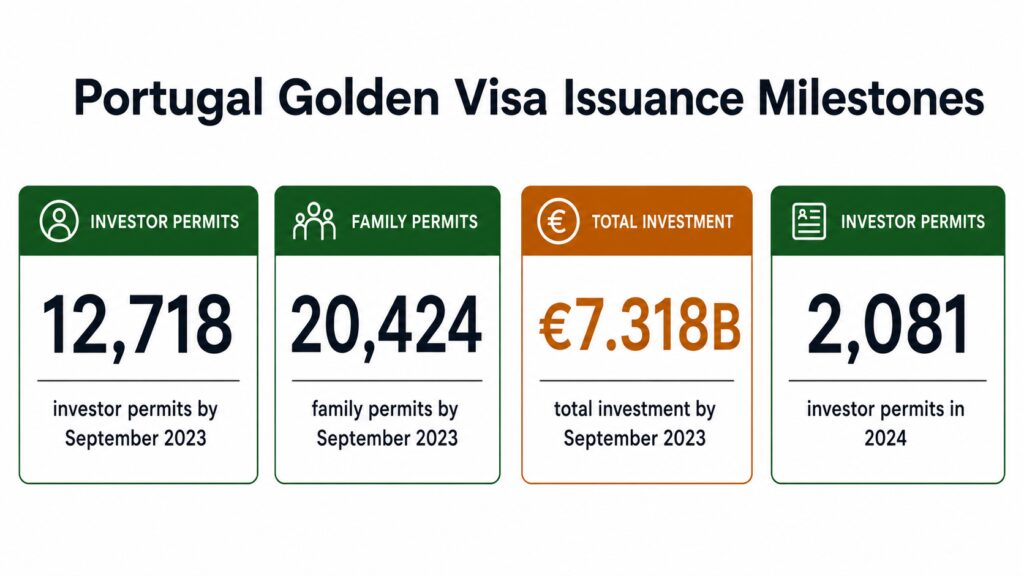
The ARI regime entered into force in October 2012. Official SEF cumulative data through September 2023 recorded:
| Metric | Official cumulative figure to September 2023 |
| Main investor ARI residence permits | 12,718 |
| Family member residence permits | 20,424 |
| Total investment attracted | €7.318 billion |
AIMA’s 2024 Migration and Asylum Report then recorded 2,081 additional ARI investor residence permits in 2024, plus 2,909 family reunification permits linked to ARI.
That means the officially confirmed minimum, combining the September 2023 cumulative baseline with the 2024 AIMA annual figure, is:
| Category | Confirmed minimum figure |
| Main investor ARI permits | 14,799+ |
| Family member permits | 23,333+ |
| Total beneficiaries | 38,132+ |
This should be read carefully. AIMA has not presented every historical ARI figure in one single end-of-2024 cumulative table in the same format as the old SEF monthly PDFs. For that reason, the safest way to present the number is as a confirmed minimum based on the last official SEF cumulative series plus the published AIMA annual figure.
Annual Issuance Trends
The Golden Visa did not grow in a straight line. The pattern reflects legislation, administrative capacity, investor demand, and the change from SEF to AIMA.
The broad trend looks like this:
- 2012 to 2015: Early adoption period, led mainly by Chinese investors.
- 2016 to 2020: Expansion period, with wider international awareness.
- 2021 to 2022: Strong demand, helped by investors preparing before rule changes.
- 2023: Transition year, because Law 56/2023 removed real estate from eligible Golden Visa investments.
- 2024: AIMA reported 2,081 ARI investor residence permits and 2,909 family permits, showing that the programme remained active after the reform.
The important point is that lower or uneven annual issuance does not necessarily mean lower demand. Some years reflect processing bottlenecks, biometric appointment timing, legal transition, or delayed approvals rather than only new application volume.
Which Countries Are the Top Golden Visa Applicants?
Nationality data is one of the clearest indicators of how the programme’s audience has changed. Early demand was heavily led by China. More recent AIMA statistical data shows stronger diversification, especially from the United States, India, Turkey, South Africa, and the United Kingdom.
This matters because the portugal golden visa program is no longer only a property-driven mobility product. It now attracts investors who are comparing tax exposure, fund regulation, family planning, backup residency, and a five-year citizenship pathway.
China Brazil and the US Lead the Rankings
Historically, Chinese investors dominated the ARI programme. SEF cumulative data through July 2023 listed China as the largest source nationality by a significant margin, followed by Brazil and the United States among the major applicant groups.
The 2024 data shows a different annual ranking:
| 2024 ranking | Nationality | ARI permits issued |
| 1 | United States | 406 |
| 2 | China | 296 |
| 3 | Russia | 248 |
| 4 | United Kingdom | 147 |
| 5 | India | 140 |
| 6 | Turkey | 128 |
| 7 | South Africa | 100 |
| 8 | Brazil | 98 |
The United States leading the 2024 annual table is especially important. It suggests that American investors are using the programme less as a real estate entry point and more as a long-term residency, optionality, and family planning structure.
Brazil remains important historically, but its role in Golden Visa statistics should not be confused with wider Brazilian migration to Portugal. Brazil is also a major source of residents through other visa and residence categories, so Golden Visa data represents only one part of a much larger migration picture.
Emerging Markets: South Africa India Turkey
South Africa, India, and Turkey are now important markets to watch.
Their demand is driven by different motivations:
- South African investors often focus on family security, currency diversification, and European mobility.
- Indian investors often evaluate Portugal as part of a wider EU access and education strategy.
- Turkish investors often compare Portugal with other European residence-by-investment options, especially when planning for business flexibility and family mobility.
In 2024, AIMA data showed 140 ARI permits for Indian investors, 128 for Turkish investors, and 100 for South African investors. Those numbers are smaller than the US and China totals, but they show that the applicant base is no longer concentrated in only one or two nationalities.
Investment Capital Raised Through the Program
The Portugal Golden Visa record is also an investment record. From October 2012 to September 2023, SEF’s cumulative statistics reported more than €7.318 billion in total investment through the ARI programme.
That capital was not evenly distributed across all routes. For most of the programme’s history, real estate dominated.
Total Capital Attracted
The historic capital figure is significant for three reasons.
First, it shows that the programme was one of Portugal’s largest residence-by-investment channels for foreign capital over the last decade.
Second, it explains why the 2023 law change mattered. A programme that had attracted billions through property purchases was redesigned so that real estate no longer qualified.
Third, it helps explain why current applicants should not rely on older online content. A page written before 2023 may still describe property purchase as a qualifying route, but that is no longer accurate for new Golden Visa applications.
For current applicants, the numbers need to be read alongside the law changes affecting issuance numbers, especially the removal of real estate from the list of qualifying investments.
Investment by Route (Real Estate vs Funds)
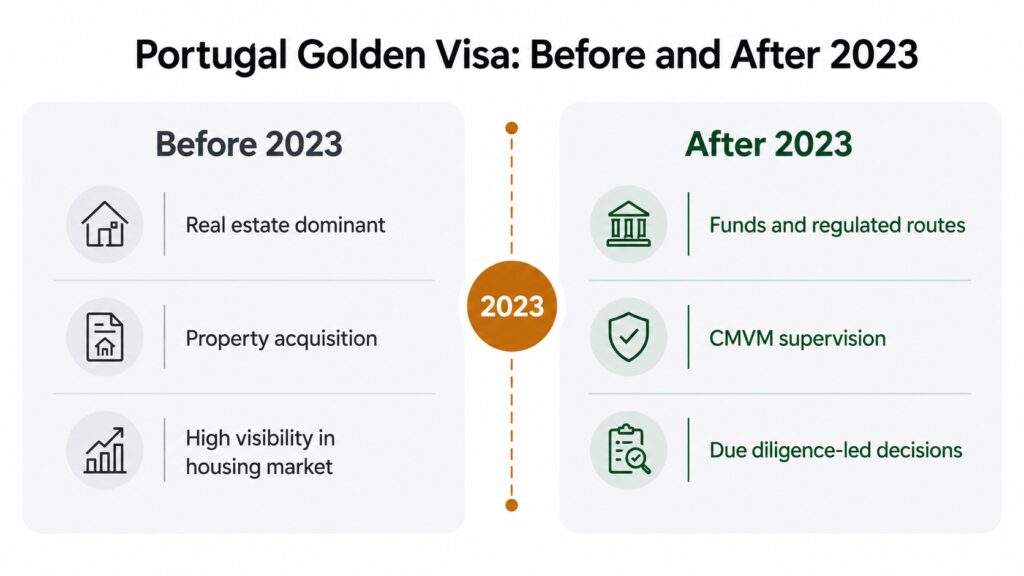
Before the 2023 reform, real estate was the dominant route by both approvals and investment volume. SEF data from 2023 showed that the overwhelming majority of ARI approvals were still linked to property acquisition.
That changed after the law reform.
New real estate purchases no longer qualify for the Portugal Golden Visa. The current investor conversation has shifted toward regulated fund participation, cultural support, scientific research, job creation, and qualifying business investment. For most private investors comparing scalable options, CMVM-regulated investment funds now receive the most attention.
CMVM means Portugal’s Securities Market Commission. It supervises regulated investment funds in Portugal. In a post-real-estate Golden Visa market, that regulatory oversight matters because applicants are not only choosing an immigration route. They are choosing a financial product that must be assessed through due diligence.
The difference between the old and new phases is clear:
| Period | Dominant investment route | What changed |
| 2012 to 2023 | Real estate acquisition | Property purchases drove most capital inflow |
| After 2023 reform | Regulated non-real-estate routes | Investors moved toward funds and other qualifying capital routes |
| Current market focus | CMVM-regulated funds | Due diligence and fund selection became central |
How Numbers Changed After the 2023 Law Change
The 2023 law change did not close the Golden Visa. It changed the investment logic behind it.
Older applicants could often evaluate the programme through property location, price thresholds, rental potential, and resale strategy. New applicants must now evaluate fund structure, manager credibility, regulatory status, investment policy, exit timeline, and the connection between the investment and ARI eligibility.
Decline in Real Estate Applications
The decline in real estate applications was a legal consequence, not a temporary market dip. Real estate was removed from the list of qualifying Golden Visa investments for new applications.
That changed the type of investor entering the programme.
The earlier version attracted many applicants who wanted to combine residency with property ownership. The newer version is more focused on investors who want EU residency and a citizenship pathway while keeping their qualifying capital in a regulated investment vehicle rather than a property asset.
The economic effect is also different. Real estate-driven Golden Visa inflows were visible in property markets, especially in Lisbon, Porto, and coastal regions. Fund-based inflows are less visible on the street but may be more targeted toward corporate capital, venture capital, or other qualifying Portuguese investment structures.
Growth in Fund Route Applications
The fund route has become more central because it fits the post-2023 structure of the programme.
A qualifying fund route usually appeals to investors who want:
- A regulated investment structure
- Professional fund management
- A clearer non-real-estate route
- Potential diversification across Portuguese companies or projects
- A route that aligns with the current ARI framework
That does not mean every fund is suitable. Investors still need legal due diligence, fund due diligence, source-of-funds documentation, and a clear understanding of fees, liquidity terms, and exit assumptions.
The best applicants do not ask only whether a fund qualifies. They ask whether it remains compliant, well-managed, properly documented, and suitable for their personal risk profile.
Economic Impact of the Portugal Golden Visa
The Golden Visa economic impact is easiest to see through the total capital raised. More than €7.318 billion was recorded through the ARI programme by September 2023, before the full post-reform period had time to show its own investment pattern.
But economic impact should not be measured only by headline capital inflow.
The programme also affected:
- Legal and advisory services
- Banking and compliance activity
- Fund management and capital markets
- Property demand before the 2023 reform
- Family relocation planning
- Portugal’s international investor profile
The European debate around residence-by-investment programmes also matters. The European Commission has raised concerns about investor citizenship and residence schemes, especially around transparency, due diligence, security, money laundering, tax evasion, and corruption. That does not mean Portugal’s programme is closed, but it does explain why regulation, documentation, and independent oversight have become more important.
Applicants should therefore read Portugal Golden Visa numbers in two ways. The statistics show demand and economic contribution. They also show why the programme has moved toward stricter scrutiny and more regulated investment channels.
The official AIMA Statistical Reports are the most important source for annual residence data, while wider EU context can be reviewed through EU Investment Migration Data and EU-level analysis of residence-by-investment schemes.
FAQs About Portugal Golden Visa Statistics
How many Portugal Golden Visas have been issued in total?
Official SEF cumulative data through September 2023 recorded 12,718 main investor ARI permits and 20,424 family member permits. AIMA then reported 2,081 ARI investor residence permits and 2,909 family reunification permits in 2024. Based on those official published figures, the confirmed minimum is more than 14,799 main investor permits and more than 23,333 family permits, although AIMA has not published all historical data in one single end-of-2024 cumulative ARI table.
Which countries have the most Golden Visa holders?
Historically, China has been the largest nationality in Portugal Golden Visa statistics, followed by major applicant groups such as Brazil, the United States, Turkey, and South Africa. In 2024 annual AIMA data, the United States led with 406 ARI permits, followed by China with 296, Russia with 248, the United Kingdom with 147, India with 140, Turkey with 128, South Africa with 100, and Brazil with 98.
How much investment has the program attracted?
SEF cumulative statistics through September 2023 reported total ARI investment of approximately €7.318 billion. Most of that historical capital was linked to real estate before the 2023 reform. After the reform, real estate no longer qualifies for new applications, so future capital statistics are expected to reflect a stronger role for fund and other non-real-estate routes.
How have numbers changed since 2023?
The numbers changed because the programme’s legal structure changed. Real estate was removed from the qualifying investment routes, which reduced the relevance of property-led applications and shifted attention toward regulated fund investments and other qualifying non-real-estate options. AIMA’s 2024 data still recorded 2,081 main investor ARI permits and 2,909 family permits, showing that the programme remained active after the reform.
Is the Portugal Golden Visa Statistics Trend Positive for Investors?
The statistics show a programme that has not disappeared, but has matured. Portugal’s Golden Visa is no longer the real estate-heavy route that dominated the market from 2012 to 2023. It is now a more regulated, documentation-heavy, and fund-focused residency route.
For investors, that is not necessarily negative. It means the decision has shifted from property selection to investment due diligence, legal eligibility, source-of-funds documentation, and long-term planning.
The safest conclusion is simple: the Portugal Golden Visa remains active, but the numbers must be read through the post-2023 rules. Applicants should not rely on old real estate-based assumptions when evaluating the programme today.
Ready to take the next step?
Book a free initial assessment. We’ll assess your eligibility, walk through the current qualifying routes, and answer your questions, with no cost and no commitment.