

Portugal golden visa

Portugal Golden Visa for Indians: Full Eligibility and Application Guide

The portugal golden visa for indians is available to Indian nationals because India is outside the European Union, which makes Indian passport holders eligible as third-country applicants. The key question is not whether Indians can apply. It is whether the investment, remittance, documentation and tax planning can be structured correctly from India.

For Indian investors, the Portugal Golden Visa is not only an immigration application. It also involves Reserve Bank of India rules, source-of-funds documentation, foreign remittance planning, tax residency analysis and a Portuguese investment structure. This guide explains the full eligibility path, cost expectations in Indian rupees, and the steps Indian applicants should prepare before applying.

Can Indian Nationals Apply for the Portugal Golden Visa?

Yes. Indian nationals can apply for the Portugal Golden Visa if they meet the programme requirements, make a qualifying investment and pass the required background and documentation checks.

The formal name of the programme is ARI (Autorização de Residência para Investimento), which means Residence Permit for Investment. Applications are handled by AIMA Application Portal, Portugal’s Agency for Integration, Migration and Asylum, which replaced SEF, the former immigration authority, in 2023.

Indian applicants usually need to prepare:

  • A valid Indian passport
  • A clean police clearance certificate
  • Apostilled and translated civil documents
  • A Portuguese NIF number
  • A Portuguese bank account
  • Financial proof showing lawful source of funds
  • Evidence of the qualifying investment
  • Health insurance, where applicable
  • Biometrics after AIMA appointment scheduling

The Golden Visa is designed for non-EU nationals who want Portuguese residency through investment. It does not require full-time relocation, which is why it is often attractive to Indian investors who want EU optionality while keeping business, family or professional ties in India.

Portugal Golden Visa for Indians application documents and investor planning

Why India Is a Growing Source Market for Portugal ARI

Indian interest in Portugal residency has grown because the programme fits a specific need: access to Europe without requiring immediate relocation.

For Indian families and investors, the main reasons are practical:

Investor priority Why Portugal appeals
EU mobility Residence in Portugal supports Schengen travel access
Family planning Spouse, dependent children and qualifying parents may be included
Education Children may benefit from future European study options
Business flexibility Investors can maintain Indian operations while holding EU residency
Citizenship pathway Legal residency can support a future citizenship application, subject to eligibility
Lower stay burden Portugal requires limited physical presence compared with many residence routes

Most Indian applicants are not trying to move to Portugal next month. They want a structured Plan B, a European base, and a route that may support long-term citizenship planning if they meet the conditions over time.

That is why the right starting point is not the investment alone. It is the full eligibility review. A good first step is to compare your documents against the Portugal Golden Visa eligibility checklist before moving funds.

Eligibility Requirements for Indian Applicants

Indian applicants must satisfy both Portuguese immigration rules and Indian outbound remittance requirements. These two systems do not replace each other. They operate in parallel.

Portugal wants to see that the investor qualifies for ARI. Indian banks and regulators want to see that the outward remittance is permitted and properly documented.

Police Clearance Certificate and Apostille

Indian applicants need a police clearance certificate to support the Portuguese residency application. This document is used to show that the applicant does not have a disqualifying criminal record.

For Portugal Golden Visa purposes, Indian applicants should usually prepare:

  1. Police clearance certificate from India
  2. Apostille or proper legalisation, depending on the document route
  3. Certified translation into Portuguese, where required
  4. Passport copies and civil documents
  5. Proof that the certificate is recent enough for the application stage

The timing matters. A police clearance certificate that is valid when collected may become too old by the time the application is submitted or reviewed. Indian applicants should coordinate document timing with their lawyer instead of collecting every document too early.

RBI and FEMA: Can You Remit Funds Freely?

Indian residents must consider RBI and FEMA rules before sending investment funds abroad.

The Reserve Bank of India (RBI) regulates foreign exchange movement from India. FEMA, the Foreign Exchange Management Act, is the legal framework that governs foreign remittances and overseas financial transactions by Indian residents.

Under the Liberalised Remittance Scheme, resident individuals are generally allowed to remit up to USD 250,000 per financial year for permitted transactions through authorised dealer banks. Applicants should review the Reserve Bank of India Foreign Remittance Rules with their bank and tax advisor before transferring Golden Visa funds.

This is a major planning point. A Portugal Golden Visa fund investment is usually EUR 500,000, which may exceed the annual LRS limit for one Indian resident depending on the EUR/USD rate and the timing of the transfer.

Possible planning issues include:

  • Whether one applicant can remit the full amount in one financial year
  • Whether family members can legally participate in remittance planning
  • Whether the investment must be funded only by the main applicant
  • Whether prior RBI approval is needed for a specific structure
  • Whether the transaction is permissible under LRS and FEMA
  • Whether tax collected at source or bank documentation applies

Do not treat this as a basic international bank transfer. Indian outbound remittance planning should be completed before choosing the fund subscription timeline.

Proof of Source of Funds

Portugal Golden Visa applicants must show that their investment funds are lawful and traceable. For Indian investors, this often requires a structured financial file.

Common source-of-funds documents may include:

  • Indian income tax returns
  • Salary records or business income records
  • Company dividend documentation
  • Sale deed for property proceeds
  • Bank statements showing fund history
  • Investment redemption statements
  • Gift deeds, if family funding is used
  • CA certificate or accountant statement
  • Foreign remittance forms and bank advice documents

The goal is not only to show that money exists. The goal is to show how the funds were earned, where they were held, and how they moved from India into the Portuguese investment structure.

Weak source-of-funds documentation can delay the application. It can also create issues with banks, fund administrators and compliance teams before the AIMA stage even begins.
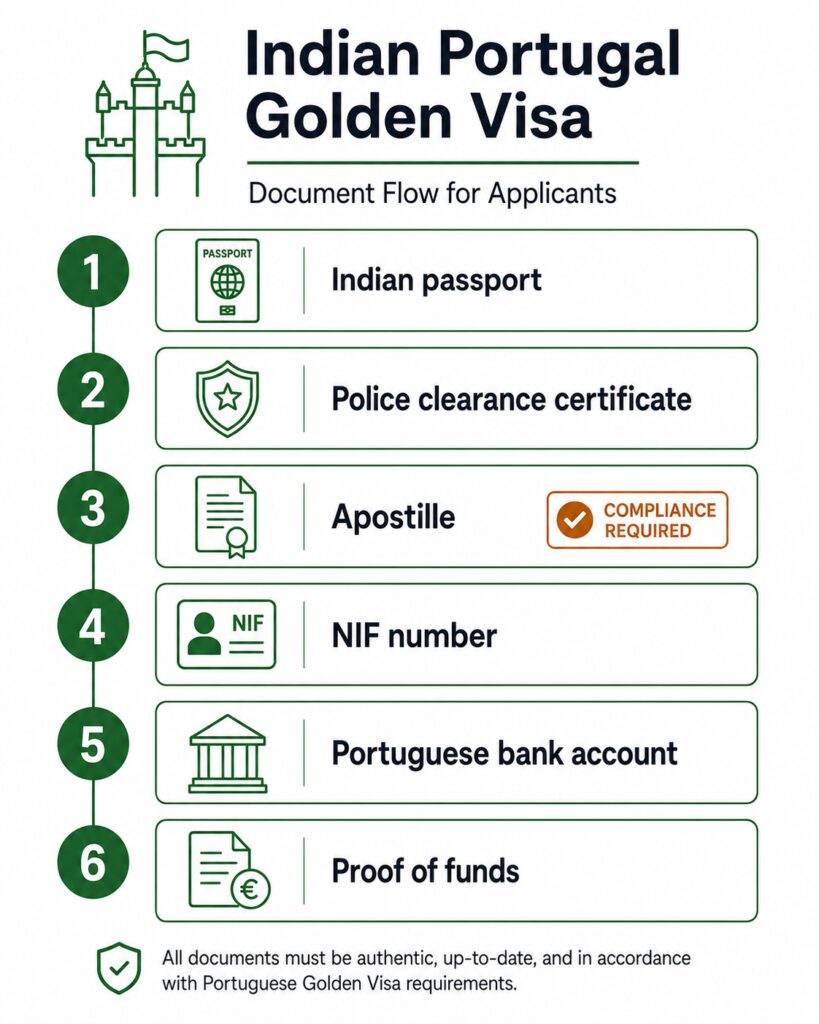
Portugal Golden Visa requirements for Indians document checklist

Investment Options for Indian Investors

Indian applicants should choose the investment route only after checking eligibility, remittance capacity and compliance requirements. The right option depends on whether the investor wants a recoverable investment structure, a simpler contribution route, or a route that fits their risk profile.

Real estate no longer qualifies for the Portugal Golden Visa. Indian investors who read older content about buying property for Golden Visa eligibility should treat that information as outdated.

Investment Fund Route

The investment fund route is the most common route for Indian investors because it is structured, regulated and easier to document than more unusual alternatives.

Under this route, the applicant invests in qualifying Portuguese investment funds. The fund structure is supervised by CMVM, Portugal’s Securities Market Commission. The investment must meet programme requirements, including the qualifying investment threshold and holding period.

Indian investors often prefer this route because:

  • It has a clear investment framework
  • It does not require property acquisition
  • It can be documented through fund subscription records
  • It may fit family wealth planning better than a non-refundable donation
  • It allows investors to compare regulated fund strategies before committing

Before subscribing, applicants should review the fund documents carefully. Fund selection is not only an immigration decision. It is also a financial decision involving risk, liquidity, management fees and exit timing.

Investors comparing the fund route can review Portugal Golden Visa Portugal investment residency options before choosing the structure.

FREE LEGAL CONSULTATION

Have a Quick Question?

Our legal team is available Monday–Friday to answer your Portugal Golden Visa questions and help you understand your next steps.

Book Your Free Consultation Message Us on WhatsApp

Cultural Donation Route

Portugal also recognises a cultural support route under ARI rules, subject to the correct legal and institutional conditions. This route generally involves a lower headline contribution than the investment fund route, but it is usually non-refundable.

That distinction matters. A fund investment may carry investment risk, but it remains an investment asset. A cultural donation is typically a contribution, not capital you expect to recover.

Indian applicants should examine:

Factor Fund route Cultural donation route
Capital type Investment Usually non-refundable contribution
Headline amount Usually higher Usually lower
Recoverability Depends on fund performance and exit Usually not recoverable
Compliance review Fund, bank and immigration checks Recipient eligibility and donation proof
Investor profile Wealth planning and residency Simpler contribution, if suitable

The cultural route can be relevant in some cases, but Indian investors should not choose it based only on the lower headline amount. The real question is whether the route is available, properly documented and suitable for the applicant’s long-term plan.

Cost Breakdown in Indian Rupees

The portugal golden visa cost in indian rupees changes with the EUR/INR exchange rate, bank spreads and transfer costs. For planning, the figures below use the European Central Bank reference rate of EUR 1 = INR 108.1675, published on 19 June 2026.

These are planning estimates only. Banks, fund administrators and foreign exchange providers may apply different rates and fees.

Cost item Euro amount Approximate INR
EUR 250,000 cultural contribution €250,000 ₹2.70 crore
EUR 500,000 fund investment €500,000 ₹5.41 crore
€10,000 professional or admin cost €10,000 ₹10.82 lakh
€25,000 professional or admin cost €25,000 ₹27.04 lakh
€50,000 buffer for fees and family costs €50,000 ₹54.08 lakh

For most Indian investors considering the fund route, a realistic planning budget should include:

  • EUR 500,000 qualifying investment
  • Government application and residence permit fees
  • Legal fees
  • Fund subscription and onboarding charges
  • Bank account opening costs
  • Document apostille and translation costs
  • Travel for biometrics
  • Family member fees, if dependants are included
  • Tax and remittance advice in India
  • Portuguese tax advice before residency decisions

A single applicant using the fund route should usually plan beyond the EUR 500,000 figure. A family application requires a larger budget because each dependent may add government, legal, documentation and logistics costs.

For a detailed fee planning page, compare the full Portugal Golden Visa cost breakdown before finalising the family application structure.

Tax Implications for Indian Citizens

Tax planning is one of the most important parts of the Portugal Golden Visa for Indian investors. Residency by investment does not automatically mean Portuguese tax residency, but the wrong relocation or stay pattern can create tax consequences.

Indian citizens should review tax issues in both countries before changing residence, spending long periods in Portugal or moving income streams.

India-Portugal Double Tax Avoidance Treaty

India and Portugal have a double taxation agreement that helps determine how certain categories of income may be taxed when both countries are involved. The Indian Ministry of External Affairs lists the India-Portugal treaty and the amending protocol in its official treaty database.

This treaty can matter for:

  • Dividends
  • Interest
  • Capital gains
  • Business income
  • Employment income
  • Pension income
  • Tax residency disputes

A Golden Visa applicant should not assume the treaty removes all taxation. A tax treaty usually allocates taxing rights and may reduce double taxation, but the result depends on residence status, income type, source country and documentation.

Indian investors should get advice before moving investment income, pension income, company dividends or family wealth structures into a Portugal-connected plan.

NHR Regime and Indian Income

NHR Portugal used to be a major tax planning topic for foreign residents. Indian applicants should not assume old NHR summaries still apply to new arrivals.

The correct approach is to review current Portuguese tax rules at the time of relocation. This is especially important for Indian applicants with:

  • Business income from India
  • Dividend income from Indian companies
  • Rental income from Indian property
  • Capital gains from listed or unlisted assets
  • Trust, family office or holding company structures
  • Foreign portfolio income
  • Retirement or pension income

The Golden Visa itself is a residence permit. It is not a tax ruling. Holding the permit and becoming a tax resident are different questions.

Step-by-Step Application Guide from India

Indian applicants should treat the process as a sequence. Trying to open accounts, transfer funds and apostille documents at the same time often creates delays.

A practical process looks like this:

  1. Confirm eligibility as a non-EU national
    Review passport validity, criminal record status, family composition and investment capacity.
  2. Map the Indian remittance plan
    Speak with your authorised dealer bank and tax advisor about RBI, FEMA, LRS limits and documentation.
  3. Apply for a Portuguese NIF number
    The NIF number is the Portuguese tax identification number. It is usually needed before opening a bank account and completing the investment.
  4. Open a Portuguese bank account
    The bank will request KYC documents, source-of-funds proof and personal identification records.
  5. Choose the investment route
    Most Indian applicants review the investment fund route first, then compare whether any alternative route is suitable.
  6. Complete fund subscription or qualifying contribution
    This stage includes compliance checks, transfer documentation and proof of investment.
  7. Prepare the document file
    Collect the Indian passport, police clearance certificate, apostille, translations, financial proof, civil documents and application forms.
  8. Submit the ARI application
    Your lawyer submits the application through the relevant AIMA process and monitors review requests.
  9. Attend the biometric appointment
    AIMA schedules biometric data collection. Indian applicants should plan travel and timing carefully.
  10. Receive residence card after approval
    After approval and fee payment, the applicant receives the residence permit card, subject to administrative processing.
  11. Maintain investment and compliance
    Keep the qualifying investment, track renewals, preserve documents and plan the five-year pathway carefully.
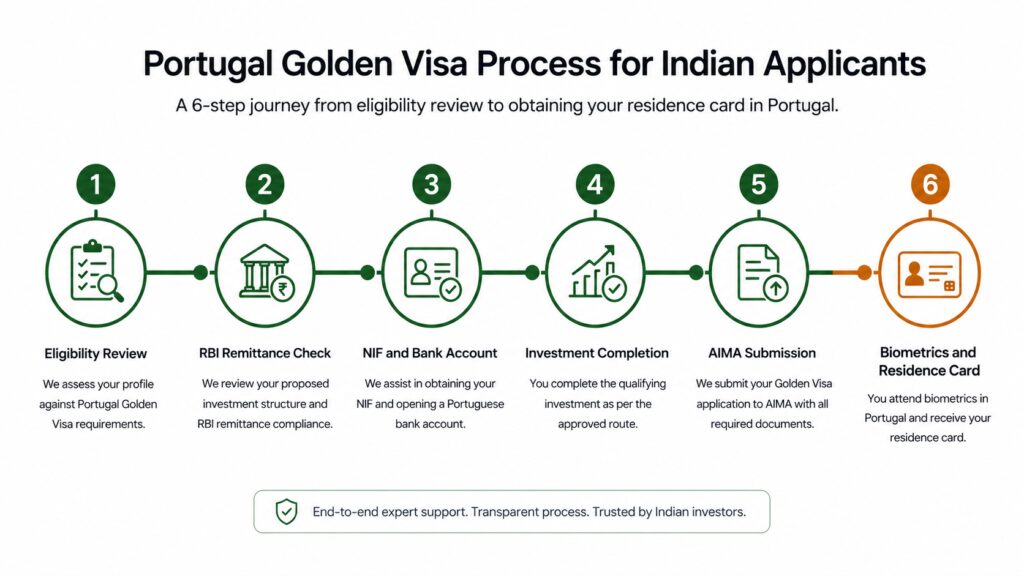
Portugal Golden Visa for Indian investors application process timeline

FAQs: Portugal Golden Visa for Indians

Can Indian nationals apply for the Portugal Golden Visa?

Yes. Indian nationals can apply for the Portugal Golden Visa because Indian passport holders are non-EU nationals. They must meet the ARI eligibility rules, make a qualifying investment, provide a clean police clearance certificate, prove lawful source of funds and complete the AIMA application process.

What is the India-Portugal tax treaty?

The India-Portugal tax treaty is a double taxation agreement between India and Portugal. It helps determine how certain income categories may be taxed when an individual or business has connections to both countries. It does not remove the need for tax advice, because the outcome depends on residence status, income type and the applicant’s personal structure.

Are there RBI restrictions on remitting funds?

Yes. Indian residents must consider RBI and FEMA rules before transferring funds abroad. Under the Liberalised Remittance Scheme, resident individuals generally have a USD 250,000 annual remittance limit for permitted transactions, so a Golden Visa investment may require careful timing, documentation and bank approval. Applicants should confirm the remittance structure with an authorised dealer bank before transferring money.

What is the Portugal Golden Visa cost in Indian rupees?

Using an illustrative ECB reference rate of EUR 1 = INR 108.1675, a EUR 500,000 fund investment equals approximately ₹5.41 crore. This does not include legal fees, government fees, bank charges, foreign exchange spreads, travel, translations, apostille costs or family member expenses. The final rupee cost changes with the exchange rate and the size of the family application.

Is the Portugal Golden Visa Right for Indian Investors?

The Portugal Golden Visa can be a strong option for Indian investors who want European residency, family inclusion and a long-term pathway to Portuguese citizenship without committing to immediate full-time relocation. The programme is especially relevant for applicants who can document their source of funds clearly and plan the remittance process before selecting the investment route.

The main risk for Indian applicants is not eligibility in principle. It is poor coordination. RBI rules, FEMA compliance, Portuguese banking checks, AIMA documentation and tax planning all need to work together.

For Indian investors, the best application starts before the money moves. Confirm eligibility, map the remittance plan, review the investment structure and prepare the document file before making a commitment.

Ready to take the next step?
Book a free initial assessment. We’ll assess your eligibility, walk through the current qualifying routes, and answer your questions, no cost, no commitment.


Portugal Golden Visa for Indians: Full Eligibility and Application Guide

The portugal golden visa for indians is available to Indian nationals because India is outside the European Union, which makes Indian passport holders eligible as third-country applicants. The key question is not whether Indians can apply. It is whether the investment, remittance, documentation and tax planning can be structured correctly from India.

For Indian investors, the Portugal Golden Visa is not only an immigration application. It also involves Reserve Bank of India rules, source-of-funds documentation, foreign remittance planning, tax residency analysis and a Portuguese investment structure. This guide explains the full eligibility path, cost expectations in Indian rupees, and the steps Indian applicants should prepare before applying.

Can Indian Nationals Apply for the Portugal Golden Visa?

Yes. Indian nationals can apply for the Portugal Golden Visa if they meet the programme requirements, make a qualifying investment and pass the required background and documentation checks.

The formal name of the programme is ARI (Autorização de Residência para Investimento), which means Residence Permit for Investment. Applications are handled by AIMA Application Portal, Portugal’s Agency for Integration, Migration and Asylum, which replaced SEF, the former immigration authority, in 2023.

Indian applicants usually need to prepare:

  • A valid Indian passport
  • A clean police clearance certificate
  • Apostilled and translated civil documents
  • A Portuguese NIF number
  • A Portuguese bank account
  • Financial proof showing lawful source of funds
  • Evidence of the qualifying investment
  • Health insurance, where applicable
  • Biometrics after AIMA appointment scheduling

The Golden Visa is designed for non-EU nationals who want Portuguese residency through investment. It does not require full-time relocation, which is why it is often attractive to Indian investors who want EU optionality while keeping business, family or professional ties in India.

Portugal Golden Visa for Indians application documents and investor planning

Why India Is a Growing Source Market for Portugal ARI

Indian interest in Portugal residency has grown because the programme fits a specific need: access to Europe without requiring immediate relocation.

For Indian families and investors, the main reasons are practical:

Investor priority Why Portugal appeals
EU mobility Residence in Portugal supports Schengen travel access
Family planning Spouse, dependent children and qualifying parents may be included
Education Children may benefit from future European study options
Business flexibility Investors can maintain Indian operations while holding EU residency
Citizenship pathway Legal residency can support a future citizenship application, subject to eligibility
Lower stay burden Portugal requires limited physical presence compared with many residence routes

Most Indian applicants are not trying to move to Portugal next month. They want a structured Plan B, a European base, and a route that may support long-term citizenship planning if they meet the conditions over time.

That is why the right starting point is not the investment alone. It is the full eligibility review. A good first step is to compare your documents against the Portugal Golden Visa eligibility checklist before moving funds.

Eligibility Requirements for Indian Applicants

Indian applicants must satisfy both Portuguese immigration rules and Indian outbound remittance requirements. These two systems do not replace each other. They operate in parallel.

Portugal wants to see that the investor qualifies for ARI. Indian banks and regulators want to see that the outward remittance is permitted and properly documented.

Police Clearance Certificate and Apostille

Indian applicants need a police clearance certificate to support the Portuguese residency application. This document is used to show that the applicant does not have a disqualifying criminal record.

For Portugal Golden Visa purposes, Indian applicants should usually prepare:

  1. Police clearance certificate from India
  2. Apostille or proper legalisation, depending on the document route
  3. Certified translation into Portuguese, where required
  4. Passport copies and civil documents
  5. Proof that the certificate is recent enough for the application stage

The timing matters. A police clearance certificate that is valid when collected may become too old by the time the application is submitted or reviewed. Indian applicants should coordinate document timing with their lawyer instead of collecting every document too early.

RBI and FEMA: Can You Remit Funds Freely?

Indian residents must consider RBI and FEMA rules before sending investment funds abroad.

The Reserve Bank of India (RBI) regulates foreign exchange movement from India. FEMA, the Foreign Exchange Management Act, is the legal framework that governs foreign remittances and overseas financial transactions by Indian residents.

Under the Liberalised Remittance Scheme, resident individuals are generally allowed to remit up to USD 250,000 per financial year for permitted transactions through authorised dealer banks. Applicants should review the Reserve Bank of India Foreign Remittance Rules with their bank and tax advisor before transferring Golden Visa funds.

This is a major planning point. A Portugal Golden Visa fund investment is usually EUR 500,000, which may exceed the annual LRS limit for one Indian resident depending on the EUR/USD rate and the timing of the transfer.

Possible planning issues include:

  • Whether one applicant can remit the full amount in one financial year
  • Whether family members can legally participate in remittance planning
  • Whether the investment must be funded only by the main applicant
  • Whether prior RBI approval is needed for a specific structure
  • Whether the transaction is permissible under LRS and FEMA
  • Whether tax collected at source or bank documentation applies

Do not treat this as a basic international bank transfer. Indian outbound remittance planning should be completed before choosing the fund subscription timeline.

Proof of Source of Funds

Portugal Golden Visa applicants must show that their investment funds are lawful and traceable. For Indian investors, this often requires a structured financial file.

Common source-of-funds documents may include:

  • Indian income tax returns
  • Salary records or business income records
  • Company dividend documentation
  • Sale deed for property proceeds
  • Bank statements showing fund history
  • Investment redemption statements
  • Gift deeds, if family funding is used
  • CA certificate or accountant statement
  • Foreign remittance forms and bank advice documents

The goal is not only to show that money exists. The goal is to show how the funds were earned, where they were held, and how they moved from India into the Portuguese investment structure.

Weak source-of-funds documentation can delay the application. It can also create issues with banks, fund administrators and compliance teams before the AIMA stage even begins.

Portugal Golden Visa requirements for Indians document checklist

Investment Options for Indian Investors

Indian applicants should choose the investment route only after checking eligibility, remittance capacity and compliance requirements. The right option depends on whether the investor wants a recoverable investment structure, a simpler contribution route, or a route that fits their risk profile.

Real estate no longer qualifies for the Portugal Golden Visa. Indian investors who read older content about buying property for Golden Visa eligibility should treat that information as outdated.

Investment Fund Route

The investment fund route is the most common route for Indian investors because it is structured, regulated and easier to document than more unusual alternatives.

Under this route, the applicant invests in qualifying Portuguese investment funds. The fund structure is supervised by CMVM, Portugal’s Securities Market Commission. The investment must meet programme requirements, including the qualifying investment threshold and holding period.

Indian investors often prefer this route because:

  • It has a clear investment framework
  • It does not require property acquisition
  • It can be documented through fund subscription records
  • It may fit family wealth planning better than a non-refundable donation
  • It allows investors to compare regulated fund strategies before committing

Before subscribing, applicants should review the fund documents carefully. Fund selection is not only an immigration decision. It is also a financial decision involving risk, liquidity, management fees and exit timing.

Investors comparing the fund route can review Portugal Golden Visa Portugal investment residency options before choosing the structure.

FREE LEGAL CONSULTATION

Have a Quick Question?

Our legal team is available Monday–Friday to answer your Portugal Golden Visa questions and help you understand your next steps.

Book Your Free Consultation Message Us on WhatsApp

Cultural Donation Route

Portugal also recognises a cultural support route under ARI rules, subject to the correct legal and institutional conditions. This route generally involves a lower headline contribution than the investment fund route, but it is usually non-refundable.

That distinction matters. A fund investment may carry investment risk, but it remains an investment asset. A cultural donation is typically a contribution, not capital you expect to recover.

Indian applicants should examine:

Factor Fund route Cultural donation route
Capital type Investment Usually non-refundable contribution
Headline amount Usually higher Usually lower
Recoverability Depends on fund performance and exit Usually not recoverable
Compliance review Fund, bank and immigration checks Recipient eligibility and donation proof
Investor profile Wealth planning and residency Simpler contribution, if suitable

The cultural route can be relevant in some cases, but Indian investors should not choose it based only on the lower headline amount. The real question is whether the route is available, properly documented and suitable for the applicant’s long-term plan.

Cost Breakdown in Indian Rupees

The portugal golden visa cost in indian rupees changes with the EUR/INR exchange rate, bank spreads and transfer costs. For planning, the figures below use the European Central Bank reference rate of EUR 1 = INR 108.1675, published on 19 June 2026.

These are planning estimates only. Banks, fund administrators and foreign exchange providers may apply different rates and fees.

Cost item Euro amount Approximate INR
EUR 250,000 cultural contribution €250,000 ₹2.70 crore
EUR 500,000 fund investment €500,000 ₹5.41 crore
€10,000 professional or admin cost €10,000 ₹10.82 lakh
€25,000 professional or admin cost €25,000 ₹27.04 lakh
€50,000 buffer for fees and family costs €50,000 ₹54.08 lakh

For most Indian investors considering the fund route, a realistic planning budget should include:

  • EUR 500,000 qualifying investment
  • Government application and residence permit fees
  • Legal fees
  • Fund subscription and onboarding charges
  • Bank account opening costs
  • Document apostille and translation costs
  • Travel for biometrics
  • Family member fees, if dependants are included
  • Tax and remittance advice in India
  • Portuguese tax advice before residency decisions

A single applicant using the fund route should usually plan beyond the EUR 500,000 figure. A family application requires a larger budget because each dependent may add government, legal, documentation and logistics costs.

For a detailed fee planning page, compare the full Portugal Golden Visa cost breakdown before finalising the family application structure.

Tax Implications for Indian Citizens

Tax planning is one of the most important parts of the Portugal Golden Visa for Indian investors. Residency by investment does not automatically mean Portuguese tax residency, but the wrong relocation or stay pattern can create tax consequences.

Indian citizens should review tax issues in both countries before changing residence, spending long periods in Portugal or moving income streams.

India-Portugal Double Tax Avoidance Treaty

India and Portugal have a double taxation agreement that helps determine how certain categories of income may be taxed when both countries are involved. The Indian Ministry of External Affairs lists the India-Portugal treaty and the amending protocol in its official treaty database.

This treaty can matter for:

  • Dividends
  • Interest
  • Capital gains
  • Business income
  • Employment income
  • Pension income
  • Tax residency disputes

A Golden Visa applicant should not assume the treaty removes all taxation. A tax treaty usually allocates taxing rights and may reduce double taxation, but the result depends on residence status, income type, source country and documentation.

Indian investors should get advice before moving investment income, pension income, company dividends or family wealth structures into a Portugal-connected plan.

NHR Regime and Indian Income

NHR Portugal used to be a major tax planning topic for foreign residents. Indian applicants should not assume old NHR summaries still apply to new arrivals.

The correct approach is to review current Portuguese tax rules at the time of relocation. This is especially important for Indian applicants with:

  • Business income from India
  • Dividend income from Indian companies
  • Rental income from Indian property
  • Capital gains from listed or unlisted assets
  • Trust, family office or holding company structures
  • Foreign portfolio income
  • Retirement or pension income

The Golden Visa itself is a residence permit. It is not a tax ruling. Holding the permit and becoming a tax resident are different questions.

Step-by-Step Application Guide from India

Indian applicants should treat the process as a sequence. Trying to open accounts, transfer funds and apostille documents at the same time often creates delays.

A practical process looks like this:

  1. Confirm eligibility as a non-EU national
    Review passport validity, criminal record status, family composition and investment capacity.
  2. Map the Indian remittance plan
    Speak with your authorised dealer bank and tax advisor about RBI, FEMA, LRS limits and documentation.
  3. Apply for a Portuguese NIF number
    The NIF number is the Portuguese tax identification number. It is usually needed before opening a bank account and completing the investment.
  4. Open a Portuguese bank account
    The bank will request KYC documents, source-of-funds proof and personal identification records.
  5. Choose the investment route
    Most Indian applicants review the investment fund route first, then compare whether any alternative route is suitable.
  6. Complete fund subscription or qualifying contribution
    This stage includes compliance checks, transfer documentation and proof of investment.
  7. Prepare the document file
    Collect the Indian passport, police clearance certificate, apostille, translations, financial proof, civil documents and application forms.
  8. Submit the ARI application
    Your lawyer submits the application through the relevant AIMA process and monitors review requests.
  9. Attend the biometric appointment
    AIMA schedules biometric data collection. Indian applicants should plan travel and timing carefully.
  10. Receive residence card after approval
    After approval and fee payment, the applicant receives the residence permit card, subject to administrative processing.
  11. Maintain investment and compliance
    Keep the qualifying investment, track renewals, preserve documents and plan the five-year pathway carefully.

Portugal Golden Visa for Indian investors application process timeline

FAQs: Portugal Golden Visa for Indians

Can Indian nationals apply for the Portugal Golden Visa?

Yes. Indian nationals can apply for the Portugal Golden Visa because Indian passport holders are non-EU nationals. They must meet the ARI eligibility rules, make a qualifying investment, provide a clean police clearance certificate, prove lawful source of funds and complete the AIMA application process.

What is the India-Portugal tax treaty?

The India-Portugal tax treaty is a double taxation agreement between India and Portugal. It helps determine how certain income categories may be taxed when an individual or business has connections to both countries. It does not remove the need for tax advice, because the outcome depends on residence status, income type and the applicant’s personal structure.

Are there RBI restrictions on remitting funds?

Yes. Indian residents must consider RBI and FEMA rules before transferring funds abroad. Under the Liberalised Remittance Scheme, resident individuals generally have a USD 250,000 annual remittance limit for permitted transactions, so a Golden Visa investment may require careful timing, documentation and bank approval. Applicants should confirm the remittance structure with an authorised dealer bank before transferring money.

What is the Portugal Golden Visa cost in Indian rupees?

Using an illustrative ECB reference rate of EUR 1 = INR 108.1675, a EUR 500,000 fund investment equals approximately ₹5.41 crore. This does not include legal fees, government fees, bank charges, foreign exchange spreads, travel, translations, apostille costs or family member expenses. The final rupee cost changes with the exchange rate and the size of the family application.

Is the Portugal Golden Visa Right for Indian Investors?

The Portugal Golden Visa can be a strong option for Indian investors who want European residency, family inclusion and a long-term pathway to Portuguese citizenship without committing to immediate full-time relocation. The programme is especially relevant for applicants who can document their source of funds clearly and plan the remittance process before selecting the investment route.

The main risk for Indian applicants is not eligibility in principle. It is poor coordination. RBI rules, FEMA compliance, Portuguese banking checks, AIMA documentation and tax planning all need to work together.

For Indian investors, the best application starts before the money moves. Confirm eligibility, map the remittance plan, review the investment structure and prepare the document file before making a commitment.

Ready to take the next step?
Book a free initial assessment. We’ll assess your eligibility, walk through the current qualifying routes, and answer your questions, no cost, no commitment.

Portugal Golden Visa for Indians: Full Eligibility and Application Guide

Portugal-Golden-Visa-for-Indian-Investors-Full-Eligibility-and-Application-Guide
The portugal golden visa for indians is available to Indian nationals because India is outside the European Union, which makes Indian passport holders eligible as third-country applicants. The key question is not whether Indians can apply. It is whether the investment, remittance, documentation and tax planning can be structured correctly from India.

For Indian investors, the Portugal Golden Visa is not only an immigration application. It also involves Reserve Bank of India rules, source-of-funds documentation, foreign remittance planning, tax residency analysis and a Portuguese investment structure. This guide explains the full eligibility path, cost expectations in Indian rupees, and the steps Indian applicants should prepare before applying.

Can Indian Nationals Apply for the Portugal Golden Visa?

Yes. Indian nationals can apply for the Portugal Golden Visa if they meet the programme requirements, make a qualifying investment and pass the required background and documentation checks.

The formal name of the programme is ARI (Autorização de Residência para Investimento), which means Residence Permit for Investment. Applications are handled by AIMA Application Portal, Portugal’s Agency for Integration, Migration and Asylum, which replaced SEF, the former immigration authority, in 2023.

Indian applicants usually need to prepare:

  • A valid Indian passport
  • A clean police clearance certificate
  • Apostilled and translated civil documents
  • A Portuguese NIF number
  • A Portuguese bank account
  • Financial proof showing lawful source of funds
  • Evidence of the qualifying investment
  • Health insurance, where applicable
  • Biometrics after AIMA appointment scheduling

The Golden Visa is designed for non-EU nationals who want Portuguese residency through investment. It does not require full-time relocation, which is why it is often attractive to Indian investors who want EU optionality while keeping business, family or professional ties in India.

Portugal Golden Visa for Indians application documents and investor planning

Why India Is a Growing Source Market for Portugal ARI

Indian interest in Portugal residency has grown because the programme fits a specific need: access to Europe without requiring immediate relocation.

For Indian families and investors, the main reasons are practical:

Investor priority Why Portugal appeals
EU mobility Residence in Portugal supports Schengen travel access
Family planning Spouse, dependent children and qualifying parents may be included
Education Children may benefit from future European study options
Business flexibility Investors can maintain Indian operations while holding EU residency
Citizenship pathway Legal residency can support a future citizenship application, subject to eligibility
Lower stay burden Portugal requires limited physical presence compared with many residence routes

Most Indian applicants are not trying to move to Portugal next month. They want a structured Plan B, a European base, and a route that may support long-term citizenship planning if they meet the conditions over time.

That is why the right starting point is not the investment alone. It is the full eligibility review. A good first step is to compare your documents against the Portugal Golden Visa eligibility checklist before moving funds.

Eligibility Requirements for Indian Applicants

Indian applicants must satisfy both Portuguese immigration rules and Indian outbound remittance requirements. These two systems do not replace each other. They operate in parallel.

Portugal wants to see that the investor qualifies for ARI. Indian banks and regulators want to see that the outward remittance is permitted and properly documented.

Police Clearance Certificate and Apostille

Indian applicants need a police clearance certificate to support the Portuguese residency application. This document is used to show that the applicant does not have a disqualifying criminal record.

For Portugal Golden Visa purposes, Indian applicants should usually prepare:

  1. Police clearance certificate from India
  2. Apostille or proper legalisation, depending on the document route
  3. Certified translation into Portuguese, where required
  4. Passport copies and civil documents
  5. Proof that the certificate is recent enough for the application stage

The timing matters. A police clearance certificate that is valid when collected may become too old by the time the application is submitted or reviewed. Indian applicants should coordinate document timing with their lawyer instead of collecting every document too early.

RBI and FEMA: Can You Remit Funds Freely?

Indian residents must consider RBI and FEMA rules before sending investment funds abroad.

The Reserve Bank of India (RBI) regulates foreign exchange movement from India. FEMA, the Foreign Exchange Management Act, is the legal framework that governs foreign remittances and overseas financial transactions by Indian residents.

Under the Liberalised Remittance Scheme, resident individuals are generally allowed to remit up to USD 250,000 per financial year for permitted transactions through authorised dealer banks. Applicants should review the Reserve Bank of India Foreign Remittance Rules with their bank and tax advisor before transferring Golden Visa funds.

This is a major planning point. A Portugal Golden Visa fund investment is usually EUR 500,000, which may exceed the annual LRS limit for one Indian resident depending on the EUR/USD rate and the timing of the transfer.

Possible planning issues include:

  • Whether one applicant can remit the full amount in one financial year
  • Whether family members can legally participate in remittance planning
  • Whether the investment must be funded only by the main applicant
  • Whether prior RBI approval is needed for a specific structure
  • Whether the transaction is permissible under LRS and FEMA
  • Whether tax collected at source or bank documentation applies

Do not treat this as a basic international bank transfer. Indian outbound remittance planning should be completed before choosing the fund subscription timeline.

Proof of Source of Funds

Portugal Golden Visa applicants must show that their investment funds are lawful and traceable. For Indian investors, this often requires a structured financial file.

Common source-of-funds documents may include:

  • Indian income tax returns
  • Salary records or business income records
  • Company dividend documentation
  • Sale deed for property proceeds
  • Bank statements showing fund history
  • Investment redemption statements
  • Gift deeds, if family funding is used
  • CA certificate or accountant statement
  • Foreign remittance forms and bank advice documents

The goal is not only to show that money exists. The goal is to show how the funds were earned, where they were held, and how they moved from India into the Portuguese investment structure.

Weak source-of-funds documentation can delay the application. It can also create issues with banks, fund administrators and compliance teams before the AIMA stage even begins.

Portugal Golden Visa requirements for Indians document checklist

Investment Options for Indian Investors

Indian applicants should choose the investment route only after checking eligibility, remittance capacity and compliance requirements. The right option depends on whether the investor wants a recoverable investment structure, a simpler contribution route, or a route that fits their risk profile.

Real estate no longer qualifies for the Portugal Golden Visa. Indian investors who read older content about buying property for Golden Visa eligibility should treat that information as outdated.

Investment Fund Route

The investment fund route is the most common route for Indian investors because it is structured, regulated and easier to document than more unusual alternatives.

Under this route, the applicant invests in qualifying Portuguese investment funds. The fund structure is supervised by CMVM, Portugal’s Securities Market Commission. The investment must meet programme requirements, including the qualifying investment threshold and holding period.

Indian investors often prefer this route because:

  • It has a clear investment framework
  • It does not require property acquisition
  • It can be documented through fund subscription records
  • It may fit family wealth planning better than a non-refundable donation
  • It allows investors to compare regulated fund strategies before committing

Before subscribing, applicants should review the fund documents carefully. Fund selection is not only an immigration decision. It is also a financial decision involving risk, liquidity, management fees and exit timing.

Investors comparing the fund route can review Portugal Golden Visa Portugal investment residency options before choosing the structure.

FREE LEGAL CONSULTATION

Have a Quick Question?

Our legal team is available Monday–Friday to answer your Portugal Golden Visa questions and help you understand your next steps.

Book Your Free Consultation Message Us on WhatsApp

Cultural Donation Route

Portugal also recognises a cultural support route under ARI rules, subject to the correct legal and institutional conditions. This route generally involves a lower headline contribution than the investment fund route, but it is usually non-refundable.

That distinction matters. A fund investment may carry investment risk, but it remains an investment asset. A cultural donation is typically a contribution, not capital you expect to recover.

Indian applicants should examine:

Factor Fund route Cultural donation route
Capital type Investment Usually non-refundable contribution
Headline amount Usually higher Usually lower
Recoverability Depends on fund performance and exit Usually not recoverable
Compliance review Fund, bank and immigration checks Recipient eligibility and donation proof
Investor profile Wealth planning and residency Simpler contribution, if suitable

The cultural route can be relevant in some cases, but Indian investors should not choose it based only on the lower headline amount. The real question is whether the route is available, properly documented and suitable for the applicant’s long-term plan.

Cost Breakdown in Indian Rupees

The portugal golden visa cost in indian rupees changes with the EUR/INR exchange rate, bank spreads and transfer costs. For planning, the figures below use the European Central Bank reference rate of EUR 1 = INR 108.1675, published on 19 June 2026.

These are planning estimates only. Banks, fund administrators and foreign exchange providers may apply different rates and fees.

Cost item Euro amount Approximate INR
EUR 250,000 cultural contribution €250,000 ₹2.70 crore
EUR 500,000 fund investment €500,000 ₹5.41 crore
€10,000 professional or admin cost €10,000 ₹10.82 lakh
€25,000 professional or admin cost €25,000 ₹27.04 lakh
€50,000 buffer for fees and family costs €50,000 ₹54.08 lakh

For most Indian investors considering the fund route, a realistic planning budget should include:

  • EUR 500,000 qualifying investment
  • Government application and residence permit fees
  • Legal fees
  • Fund subscription and onboarding charges
  • Bank account opening costs
  • Document apostille and translation costs
  • Travel for biometrics
  • Family member fees, if dependants are included
  • Tax and remittance advice in India
  • Portuguese tax advice before residency decisions

A single applicant using the fund route should usually plan beyond the EUR 500,000 figure. A family application requires a larger budget because each dependent may add government, legal, documentation and logistics costs.

For a detailed fee planning page, compare the full Portugal Golden Visa cost breakdown before finalising the family application structure.

Tax Implications for Indian Citizens

Tax planning is one of the most important parts of the Portugal Golden Visa for Indian investors. Residency by investment does not automatically mean Portuguese tax residency, but the wrong relocation or stay pattern can create tax consequences.

Indian citizens should review tax issues in both countries before changing residence, spending long periods in Portugal or moving income streams.

India-Portugal Double Tax Avoidance Treaty

India and Portugal have a double taxation agreement that helps determine how certain categories of income may be taxed when both countries are involved. The Indian Ministry of External Affairs lists the India-Portugal treaty and the amending protocol in its official treaty database.

This treaty can matter for:

  • Dividends
  • Interest
  • Capital gains
  • Business income
  • Employment income
  • Pension income
  • Tax residency disputes

A Golden Visa applicant should not assume the treaty removes all taxation. A tax treaty usually allocates taxing rights and may reduce double taxation, but the result depends on residence status, income type, source country and documentation.

Indian investors should get advice before moving investment income, pension income, company dividends or family wealth structures into a Portugal-connected plan.

NHR Regime and Indian Income

NHR Portugal used to be a major tax planning topic for foreign residents. Indian applicants should not assume old NHR summaries still apply to new arrivals.

The correct approach is to review current Portuguese tax rules at the time of relocation. This is especially important for Indian applicants with:

  • Business income from India
  • Dividend income from Indian companies
  • Rental income from Indian property
  • Capital gains from listed or unlisted assets
  • Trust, family office or holding company structures
  • Foreign portfolio income
  • Retirement or pension income

The Golden Visa itself is a residence permit. It is not a tax ruling. Holding the permit and becoming a tax resident are different questions.

Step-by-Step Application Guide from India

Indian applicants should treat the process as a sequence. Trying to open accounts, transfer funds and apostille documents at the same time often creates delays.

A practical process looks like this:

  1. Confirm eligibility as a non-EU national
    Review passport validity, criminal record status, family composition and investment capacity.
  2. Map the Indian remittance plan
    Speak with your authorised dealer bank and tax advisor about RBI, FEMA, LRS limits and documentation.
  3. Apply for a Portuguese NIF number
    The NIF number is the Portuguese tax identification number. It is usually needed before opening a bank account and completing the investment.
  4. Open a Portuguese bank account
    The bank will request KYC documents, source-of-funds proof and personal identification records.
  5. Choose the investment route
    Most Indian applicants review the investment fund route first, then compare whether any alternative route is suitable.
  6. Complete fund subscription or qualifying contribution
    This stage includes compliance checks, transfer documentation and proof of investment.
  7. Prepare the document file
    Collect the Indian passport, police clearance certificate, apostille, translations, financial proof, civil documents and application forms.
  8. Submit the ARI application
    Your lawyer submits the application through the relevant AIMA process and monitors review requests.
  9. Attend the biometric appointment
    AIMA schedules biometric data collection. Indian applicants should plan travel and timing carefully.
  10. Receive residence card after approval
    After approval and fee payment, the applicant receives the residence permit card, subject to administrative processing.
  11. Maintain investment and compliance
    Keep the qualifying investment, track renewals, preserve documents and plan the five-year pathway carefully.

Portugal Golden Visa for Indian investors application process timeline

FAQs: Portugal Golden Visa for Indians

Can Indian nationals apply for the Portugal Golden Visa?

Yes. Indian nationals can apply for the Portugal Golden Visa because Indian passport holders are non-EU nationals. They must meet the ARI eligibility rules, make a qualifying investment, provide a clean police clearance certificate, prove lawful source of funds and complete the AIMA application process.

What is the India-Portugal tax treaty?

The India-Portugal tax treaty is a double taxation agreement between India and Portugal. It helps determine how certain income categories may be taxed when an individual or business has connections to both countries. It does not remove the need for tax advice, because the outcome depends on residence status, income type and the applicant’s personal structure.

Are there RBI restrictions on remitting funds?

Yes. Indian residents must consider RBI and FEMA rules before transferring funds abroad. Under the Liberalised Remittance Scheme, resident individuals generally have a USD 250,000 annual remittance limit for permitted transactions, so a Golden Visa investment may require careful timing, documentation and bank approval. Applicants should confirm the remittance structure with an authorised dealer bank before transferring money.

What is the Portugal Golden Visa cost in Indian rupees?

Using an illustrative ECB reference rate of EUR 1 = INR 108.1675, a EUR 500,000 fund investment equals approximately ₹5.41 crore. This does not include legal fees, government fees, bank charges, foreign exchange spreads, travel, translations, apostille costs or family member expenses. The final rupee cost changes with the exchange rate and the size of the family application.

Is the Portugal Golden Visa Right for Indian Investors?

The Portugal Golden Visa can be a strong option for Indian investors who want European residency, family inclusion and a long-term pathway to Portuguese citizenship without committing to immediate full-time relocation. The programme is especially relevant for applicants who can document their source of funds clearly and plan the remittance process before selecting the investment route.

The main risk for Indian applicants is not eligibility in principle. It is poor coordination. RBI rules, FEMA compliance, Portuguese banking checks, AIMA documentation and tax planning all need to work together.

For Indian investors, the best application starts before the money moves. Confirm eligibility, map the remittance plan, review the investment structure and prepare the document file before making a commitment.

Ready to take the next step?
Book a free initial assessment. We’ll assess your eligibility, walk through the current qualifying routes, and answer your questions, no cost, no commitment.

What do you think?
Blog

More Related Articles

top








