

For UK investors, the Portugal Golden Visa is mainly useful because it offers residency without requiring full relocation. It can support long-term EU access, family planning, and a five-year route toward citizenship, subject to eligibility and legal requirements.
Can UK Citizens Apply for the Portugal Golden Visa After Brexit?
Yes. UK citizens can apply for the Portugal Golden Visa after Brexit because British nationals are now generally treated as third-country nationals unless they have protected rights under the Withdrawal Agreement.
The formal residence permit is the Autorização de Residência para Investimento (ARI), Portugal’s residence permit for investment activity. ARI applications are processed through AIMA Official Application Portal, the Agency for Integration, Migration and Asylum, which replaced SEF as Portugal’s immigration authority.
How Brexit Changed British Nationals Status in Portugal
Before Brexit, UK citizens could rely on EU freedom of movement to live in Portugal with fewer immigration barriers. After Brexit, that automatic right ended for most new arrivals.
For short visits, UK passport holders can usually enter the Schengen Area for up to 90 days in any 180-day period. That may be enough for holidays or short business trips, but it is not enough for someone who wants a long-term European base, flexible retirement planning, or a path toward Portuguese citizenship.
The main difference is simple:
| Before Brexit | After Brexit |
| UK citizens had EU free movement rights | UK citizens are generally non-EU nationals |
| Long stays were easier to arrange | Long stays usually require a visa or residence permit |
| Portugal could be used more flexibly as an EU base | Residency planning now needs a formal route |
| Schengen movement was unrestricted as an EU citizen | Schengen movement follows third-country national rules unless residency is obtained |
The Withdrawal Agreement protects some UK nationals who were already legally resident in Portugal before the end of the transition period. New UK applicants, however, usually need a national visa, residence permit, or investment-based route.
Why the Golden Visa Is Now a Primary Option for British Expats
The Golden Visa became more relevant for British investors because it offers residency without requiring immediate relocation. That is the key difference between the Golden Visa and many other residence options.
A British applicant may want Portugal residency for several reasons:
- More flexible access to Portugal and the Schengen Area
- A long-term route to Portuguese citizenship after five years of legal residency
- A backup residency option for family security
- The ability to include eligible family members
- A lower physical presence requirement than relocation-based visas
For many British families, the Golden Visa is not about moving tomorrow. It is about making sure they have a lawful European option before they need it.
Portugal Golden Visa Requirements for UK Citizens
UK citizens must meet the same core Golden Visa requirements as other non-EU nationals. The key difference is that UK documents must be prepared, legalised, and translated where required.
The application should be treated as both an immigration file and an investment file. The immigration side proves identity, admissibility, family eligibility, and compliance. The investment side proves that the applicant made a qualifying investment using lawful funds.
Investment Options Available
For most UK investors in 2026, the practical route is a qualifying investment fund. Real estate no longer qualifies for the Portugal Golden Visa after the 2023 reform, which is why older articles about buying property for residency can be misleading.
The standard qualifying fund route requires a minimum investment of €500,000 in an eligible fund. The fund must be supervised by CMVM, Portugal’s Securities Market Commission.
A UK applicant considering the fund route should review:
- The fund’s CMVM registration and regulatory status
- Investment strategy and risk profile
- Subscription documents
- Exit terms and holding period
- Fund manager track record
- Legal due diligence findings
You can compare the current portugal golden visa routes before choosing whether the fund route fits your objectives.
Criminal Record Check for UK Applicants
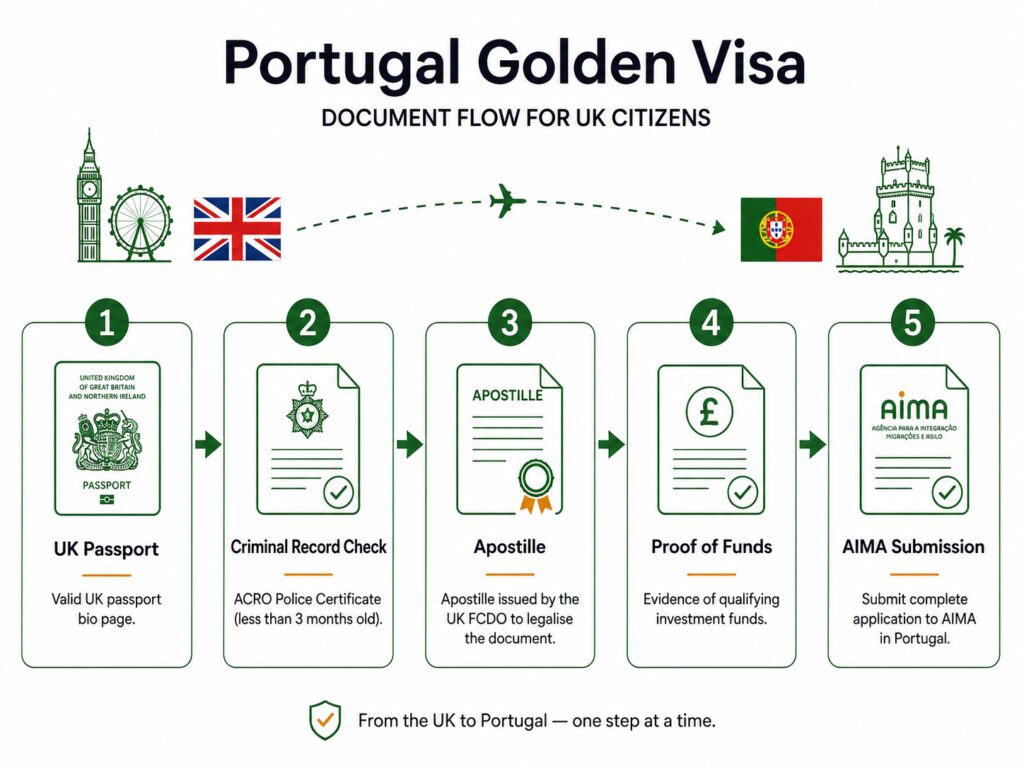
UK applicants need to provide a criminal record certificate as part of the ARI file. This is usually issued from the UK and must be properly legalised.
In practice, the file may require:
- A valid UK passport
- Criminal record certificate
- Apostille on UK public documents
- Certified translation where required
- Proof of address
- Passport-style photographs
- Portuguese tax number, known as NIF
- Portuguese bank account documentation
- Health insurance or equivalent cover
- Proof of qualifying investment
Apostille requirements matter. A document can be accurate but still rejected or delayed if it is not legalised correctly for use in Portugal.
Proof of Funds from UK Sources
UK applicants must show that their investment funds are lawful and traceable. This is where many applications become more detailed than expected.
Proof of funds may include:
- UK bank statements
- Sale agreement for a business or property
- Investment portfolio statements
- Dividend records
- Employment income records
- Inheritance documents
- Tax records or accountant letters
- HMRC-related documentation where relevant
The purpose is not only to show that the applicant has money. The purpose is to show where the money came from, how it moved, and that it can legally be used for the qualifying investment.
For a full document-level review, applicants should compare their file against a full eligibility checklist before submission.
Tax Considerations for UK Citizens
The Golden Visa is an immigration route. It does not automatically make a UK citizen tax resident in Portugal.
Tax residence usually depends on physical presence, home availability, personal ties, and local tax rules. A British investor who spends only the minimum required time in Portugal may have a different tax position from a British retiree who moves to Portugal full time.
The Portugal NHR Tax Regime
Many UK applicants still ask about NHR Portugal because older Golden Visa content heavily promoted the Non-Habitual Resident regime. The issue is that NHR has changed substantially and should not be treated as a guaranteed benefit for new applicants in 2026.
The safest approach is to separate two questions:
- Can you obtain Portugal residency through the Golden Visa?
- What tax regime applies if you become Portuguese tax resident?
Those are not the same question.
A UK citizen can obtain Golden Visa residency and still remain UK tax resident if their life, home, income, and time pattern remain UK-based. Another UK citizen may become Portuguese tax resident if they relocate, spend substantial time in Portugal, or establish stronger tax ties there.
If tax planning is part of the decision, review the current NHR tax benefits explained carefully and take personalised tax advice before changing residence.
UK-Portugal Double Taxation Treaty
The UK and Portugal have a double taxation treaty designed to reduce the risk of the same income being taxed twice. The UK Government confirms in its UK Government Living Abroad Guidance that the UK has a double taxation agreement with Portugal.
This matters for British applicants with:
- UK pension income
- Rental income from UK property
- Dividends from UK companies
- Capital gains
- Investment income
- Business income
- Employment or consulting income
The treaty does not mean tax disappears. It means the taxing rights between the UK and Portugal must be analysed under the treaty, domestic law, and the applicant’s actual residence position.
HMRC Obligations When Living Abroad
A UK citizen who becomes resident in Portugal may still have HMRC obligations. This is especially relevant for UK-source income, property, pensions, or capital gains.
Common HMRC-related issues include:
- Statutory residence test analysis
- UK self-assessment filing
- UK rental income reporting
- Pension taxation
- Capital gains tax on UK assets
- Double taxation relief claims
- National Insurance considerations
Do not assume that leaving the UK removes UK tax reporting duties. For British applicants, tax planning should happen before the move, not after the first Portuguese tax return is due.
Can UK Retirees Use the Golden Visa?
Yes, UK retirees can use the Portugal Golden Visa if they meet the investment, documentation, and eligibility requirements. Retirement status does not prevent an applicant from qualifying.
The Golden Visa can be attractive for retirees because it does not require full-time residence in Portugal. A retiree may use it as a flexible residency option while keeping family, property, or financial ties in the UK.
However, retirees should pay special attention to:
- UK pension income
- Private pension withdrawals
- State Pension treatment
- Healthcare arrangements
- Tax residence position
- Family inclusion planning
- Estate and succession issues
- Currency exposure between GBP and EUR
For British retirees who plan to spend more time in Portugal over several years, the question is not only whether the Golden Visa works. The better question is whether the residency, tax, healthcare, and pension structure work together.
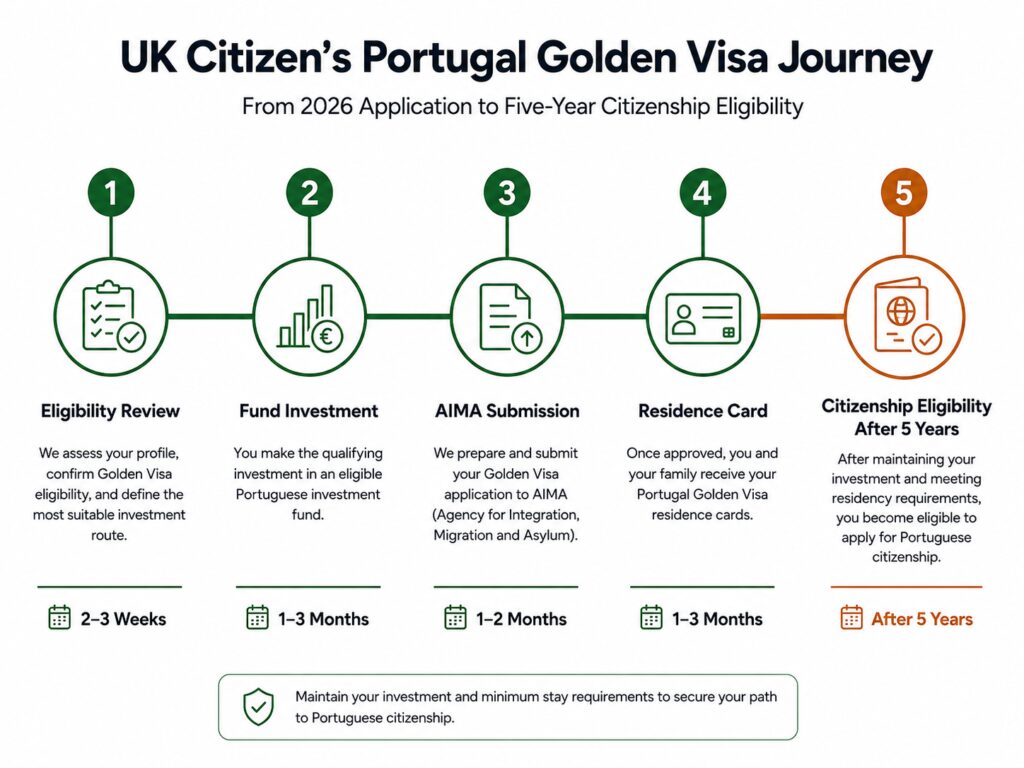
Step-by-Step Application Guide for UK Residents
A UK-based applicant should approach the Golden Visa as a staged process. Rushing the investment before the file is checked can create avoidable problems.
| Step | What Happens | UK-Specific Point |
| 1 | Initial eligibility review | Confirm non-EU status, family structure, and investment capacity |
| 2 | NIF and bank account setup | Required before investment and application submission |
| 3 | Fund selection and legal due diligence | Review CMVM supervision, fund terms, and risk documents |
| 4 | UK document preparation | Criminal record check, apostille, translations where required |
| 5 | Investment execution | Transfer funds from verified UK sources |
| 6 | ARI application submission | File submitted through the AIMA process |
| 7 | Biometric appointment | Applicant attends appointment when scheduled |
| 8 | Residence permit issuance | Permit is issued if application is approved |
| 9 | Renewals and compliance | Maintain investment and meet stay requirements |
A typical sequence looks like this:
- Confirm eligibility and family members.
- Obtain NIF and open a Portuguese bank account.
- Select a qualifying investment route.
- Complete legal due diligence.
- Prepare UK documents and apostilles.
- Transfer investment funds.
- Submit the ARI application.
- Attend biometrics when scheduled.
- Receive the residence card after approval.
- Maintain compliance for renewals and citizenship planning.
The Golden Visa requires a minimum stay of 7 days per year in Portugal. This is one reason it differs from relocation routes. Applicants who plan to move permanently may also compare it with other options for relocating to Portugal.
FAQs: Portugal Golden Visa for UK Citizens
Can UK citizens apply for the Portugal Golden Visa after Brexit?
Yes. UK citizens can apply for the Portugal Golden Visa after Brexit because they are generally treated as non-EU nationals for immigration purposes. Applicants who already hold protected residence rights under the Withdrawal Agreement may have a different status, but new UK applicants usually need a formal visa or residence route for long-term stays.
Does Brexit make the Golden Visa more attractive for British investors?
Yes, for many British investors. Brexit removed automatic EU free movement rights, so the Golden Visa now offers a structured way to obtain Portugal residency, maintain Schengen access, and potentially apply for citizenship after five years of legal residency. It is especially useful for applicants who want flexibility rather than immediate full relocation.
What are the tax implications for UK citizens?
Tax depends on whether the applicant becomes Portuguese tax resident, remains UK tax resident, or has obligations in both countries. UK pension income, rental income, dividends, and capital gains may all need treaty analysis. British applicants should take UK and Portuguese tax advice before relocating or changing their residence pattern.
Can a UK citizen retire in Portugal using the Golden Visa?
Yes. A UK citizen can retire in Portugal using the Golden Visa if they meet the investment and eligibility requirements. The route may suit retirees who want Portugal residency without needing to live there full time immediately. Pension income, healthcare, tax residence, and family planning should be reviewed before choosing the route.
Is the Portugal Golden Visa Right for UK Citizens?
The Portugal Golden Visa is strongest for UK citizens who want long-term optionality. It is not simply a visa for people moving immediately. It is a residency strategy for British investors who want EU access, family flexibility, and a possible citizenship path after five years.
The key post-Brexit point is that UK citizens now need to plan like other non-EU nationals. That means checking eligibility, preparing UK documents correctly, proving lawful funds, and understanding how residency interacts with tax, pensions, and long-term family plans.
Ready to take the next step?
Book a free initial assessment. We’ll assess your eligibility, walk through the current qualifying routes, and answer your questions, no cost, no commitment.












