

Portugal Real Estate Market in 2026: Key Trends
Portugal’s housing market is still supported by structural demand, limited supply, and strong interest from both domestic and international buyers. But the market is more expensive and more regulated than it was five years ago, which means investors need to look beyond headline price growth.
The most useful way to read the market is to separate three questions:
| Investor Question | Why It Matters |
| Are prices still rising? | Helps assess capital appreciation potential |
| Is rental demand strong? | Supports rental yield analysis |
| Does property qualify for residency? | Critical for Golden Visa planning |
Price Growth Over the Last 5 Years
Portugal has seen significant residential price growth since 2020, especially in Lisbon real estate, Porto real estate, the Algarve, and high-demand coastal areas. According to the INE Portugal Property Price Index, Portugal’s official statistics institute, the House Price Index increased by 17.6% in 2025.
That does not mean every property increased by the same amount. Prime Lisbon apartments, restored Porto buildings, Algarve villas, and Silver Coast homes each follow different demand patterns.
For investors, the important point is not just that prices rose. It is that prices rose while supply remained constrained. Banco de Portugal has also noted that housing investment growth is expected to moderate in the 2026 to 2028 period, partly because of financing conditions, construction costs, and supply barriers. The result is a market with continued demand, but less room for careless buying.

Demand Drivers: Tourism Expats and Remote Workers
The demand side of the market is driven by several overlapping groups:
- Portuguese residents buying primary homes
- Foreign retirees and expats relocating to Portugal
- Remote workers seeking long-stay European bases
- Lifestyle buyers looking at the Algarve and coastal regions
- Investors targeting long-term rental demand
- Buyers planning a future move but not relocating immediately
The tourism sector also supports demand in areas with legal short-term rental potential. However, investors should not assume that every property can be used for short-term rental. Local licensing rules, building regulations, condominium restrictions, and municipal policies can change the economics of a property quickly.
For cautious investors, this means one thing: the purchase decision must be based on legal use, tax cost, rental potential, and exit value, not just location.
Best Regions for Property Investment
Portugal is a small country, but its real estate market is highly regional. A price that looks normal in Lisbon may look expensive in Porto, and a yield that looks attractive in the Silver Coast may not be realistic in a prime Algarve location.
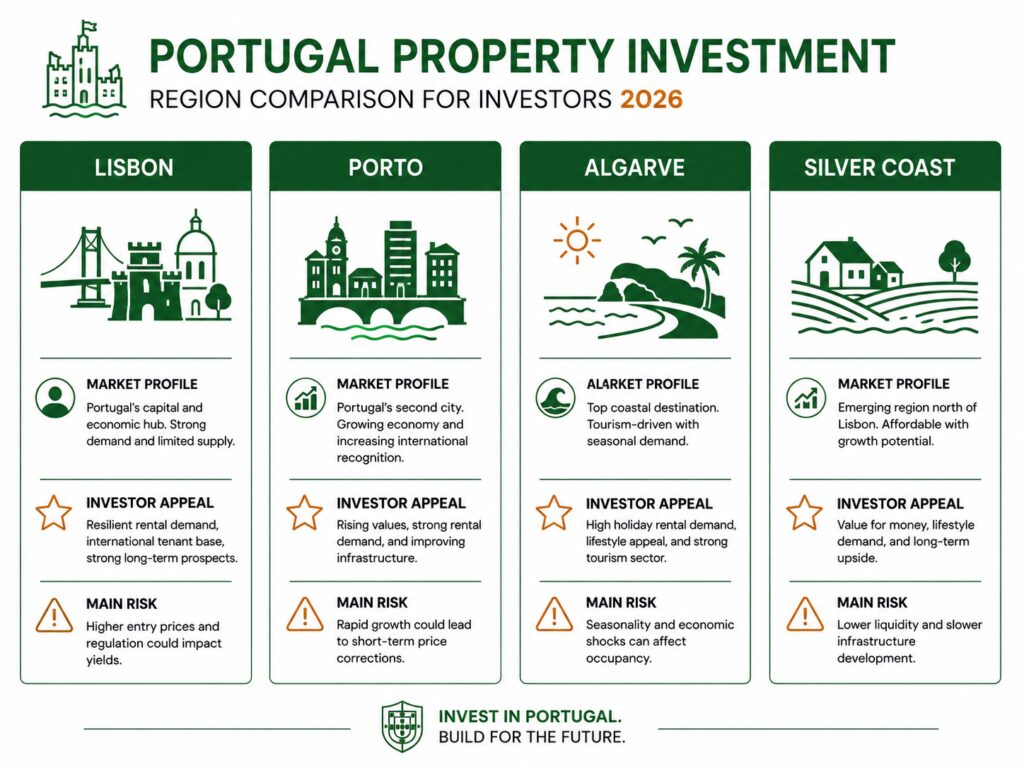
The table below gives a practical investor view.
| Region | Market Profile | Investor Appeal | Main Risk |
| Lisbon | Premium, liquid, expensive | Long-term demand and capital preservation | High entry price |
| Porto | Strong growth, lower than Lisbon | Urban regeneration and rental demand | Rising competition |
| Algarve | Tourism and lifestyle-driven | Seasonal yield and luxury demand | Short-term rental regulation |
| Silver Coast | Emerging value market | Lower entry cost and lifestyle demand | Lower liquidity than major cities |
Lisbon: Premium Prices High Demand
Lisbon remains Portugal’s most expensive and liquid residential market. It attracts professionals, international buyers, students, entrepreneurs, and relocating families. This depth of demand supports capital appreciation, but it also compresses rental yield because purchase prices are high.
Investors looking at Lisbon should pay close attention to:
- Building condition
- Condominium rules
- Energy certificate quality
- Noise and tourist pressure
- Long-term rental demand by neighbourhood
- Future resale appeal
Lisbon real estate is usually strongest for investors who want liquidity and long-term capital preservation. It is less attractive for buyers who are focused only on high rental yield.
Porto: Strong Growth More Affordable
Porto has moved from secondary option to serious investment market. It offers a lower entry point than Lisbon in many neighbourhoods, strong cultural appeal, a growing business base, and consistent tourism demand.
Porto real estate can work well for investors who want a balance between price growth and rental demand. The city has also benefited from urban renewal, infrastructure improvement, and international visibility.
The risk is that the easiest opportunities are no longer hidden. Prime Porto is now well understood by domestic and foreign buyers, so due diligence matters more than timing.
Algarve: Tourism Yield and Luxury
Algarve property remains attractive for lifestyle buyers, retirees, and investors looking at holiday rental demand. Prime coastal zones, golf communities, and luxury villas continue to attract high-budget buyers.
The Algarve can support strong seasonal income, but investors should avoid calculating returns from peak summer months only. A sensible rental model should include:
- Seasonal occupancy changes
- Property management fees
- Maintenance and pool costs
- Insurance
- Local licensing rules
- Vacancy periods
The Algarve can be a strong market, but it is not a passive investment unless professional property management is in place.
Silver Coast: Value and Emerging Demand
The Silver Coast attracts investors who want lower prices than Lisbon or the Algarve while still staying connected to coastal lifestyle demand. Areas such as Óbidos, Nazaré, Caldas da Rainha, and Peniche have become more visible to foreign buyers.
The appeal is value. The trade-off is liquidity. Properties may take longer to sell, and rental demand can be more location-specific.
For long-term investors, the Silver Coast may offer better entry pricing and room for capital appreciation, especially where infrastructure, tourism, and lifestyle demand continue to improve.
Can Foreigners Buy Property in Portugal?
Yes. Foreigners can buy property in Portugal, including EU and non-EU buyers. The practical requirements are usually administrative rather than nationality-based.
Most foreign buyers need:
- A Portuguese tax identification number, known as a NIF
- A Portuguese bank account or suitable payment structure
- Legal representation for due diligence
- Proof of funds and source of funds documentation
- A promissory purchase agreement, where applicable
- Completion through deed signing and registration
The official gov.pt guide to buying and selling real estate in Portugal explains that buyers must review legal documents, taxes, insurance, and registration steps before completing a purchase.
Foreign buyer rules are generally open, but openness does not remove risk. Investors should still verify title, planning permission, licensing history, condominium debts, habitation license status, and any restrictions on rental use.
A mortgage for foreigners may also be available through Portuguese banks, subject to income, residence status, loan-to-value limits, and bank risk assessment. Financing terms vary, so a property that looks attractive in cash terms may produce weaker returns after borrowing costs.
Property Taxes in Portugal
Property taxes are central to the investment calculation. They affect acquisition cost, annual holding cost, and net rental return.
A buyer should model taxes before signing a promissory contract, not after.
IMT Property Transfer Tax
IMT transfer tax is paid when buying property in Portugal. The rate depends on the property value, use, location, and whether the property is a primary residence or second home.
The gov.pt property purchase guide states that IMT is calculated based on the higher of the deed value or the taxable value of the property. It also confirms that stamp duty of 0.8% applies to the higher of those values.
For investors, IMT can materially affect total acquisition cost. A €500,000 property is not a €500,000 purchase once IMT, stamp duty, legal fees, notary fees, registration, and possible financing costs are included.
IMI Annual Property Tax
IMI annual property tax is paid by property owners in Portugal. The Portal das Finanças official IMI guidance explains that IMI applies to the taxable value of urban and rural properties and is set annually by municipalities within government limits.
For urban properties, the standard municipal range is generally 0.3% to 0.45%, with exceptional cases allowed up to 0.5%. Rural property rates can differ.
IMI is often lower than property taxes in some other countries, but it still matters for long-term holding costs.
AIMI Additional IMI for High-Value Properties
AIMI is an additional property tax that can apply to higher-value residential property holdings. It is calculated on the taxable property value, not necessarily the market purchase price.
For individual owners, Portal das Finanças states that a €600,000 deduction generally applies, with higher thresholds for married couples or civil partners who opt for joint taxation. Rates can then apply by bands.
This matters for investors buying larger portfolios or high-value homes. A single apartment may not trigger AIMI, but several properties held under one ownership structure can change the tax position.
Rental Yields: What to Expect in 2026
Rental yield in Portugal depends heavily on location, property type, purchase price, management cost, and whether the property is rented long-term or short-term.
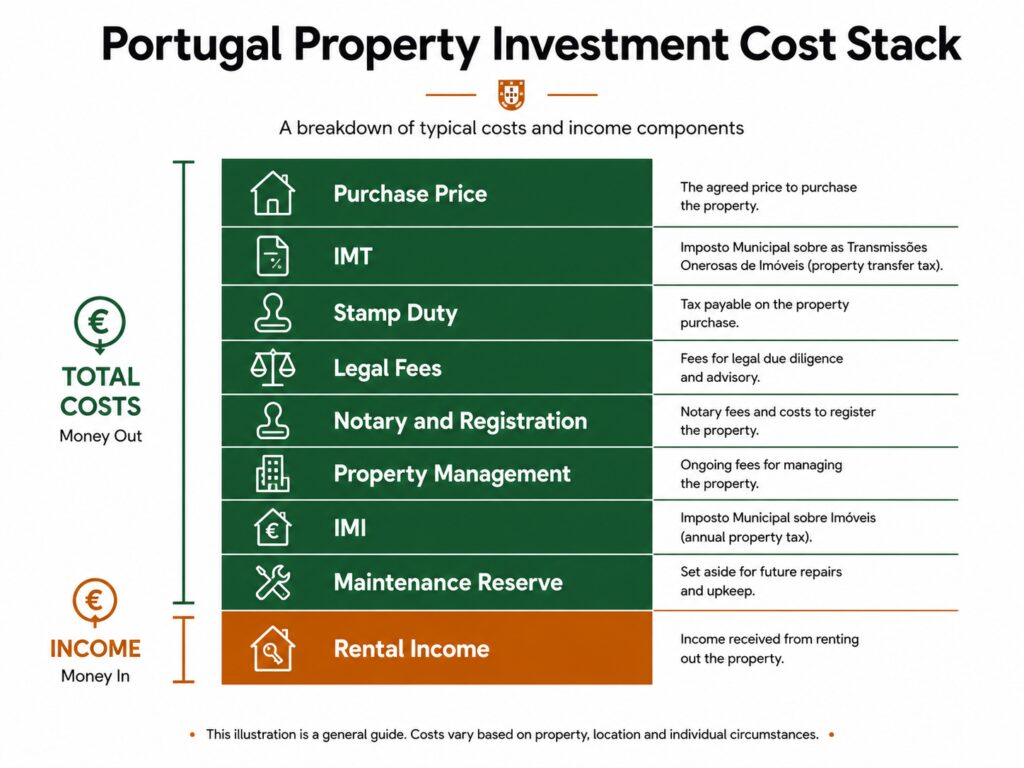
A realistic yield calculation should include:
- Purchase price
- IMT and stamp duty
- Legal and notary fees
- Renovation or furnishing cost
- Property management fees
- Maintenance reserve
- IMI and possible AIMI
- Insurance
- Vacancy periods
- Income tax on rental income
Investors often overestimate yield because they calculate rent against the purchase price only. That is not enough. The correct calculation should use the full acquisition and holding cost.
Short-term rental can produce higher gross income in tourist areas, but it also involves higher management intensity, licensing risk, seasonality, cleaning costs, and platform fees. Long-term rental may produce lower headline income, but it can offer more predictable cash flow.
In 2026, investors should treat rental yield as a property-specific question, not a national average. A central Lisbon apartment, a Porto student rental, an Algarve villa, and a Silver Coast townhouse are different assets.
Wondering if you qualify?
Book a free initial assessment with our team. We’ll confirm your eligibility, outline the current qualifying routes, and answer your questions, no commitment required.
Book a Consultation
Golden Visa Real Estate vs Investment Fund Route
This is the point many investors still get wrong.
Buying property in Portugal can be a real estate investment, but it is no longer a qualifying investment for the Golden Visa. Portugal removed real estate from the list of eligible Golden Visa routes in the 2023 reform.
That means an investor can still buy property for lifestyle, rental income, or long-term capital appreciation. But property purchase alone does not create Golden Visa eligibility.
For residency planning, investors should review the current golden visa fund investment options instead. The current qualifying route is generally based on a €500,000 investment into eligible CMVM-regulated funds, subject to the fund meeting programme requirements.
The ARI, Autorização de Residência para Investimento, remains the formal Golden Visa residence permit. AIMA, the Agency for Integration, Migration and Asylum, now processes residency applications after replacing SEF, Serviço de Estrangeiros e Fronteiras, in 2023.
Property still has a role. It can support relocation, lifestyle planning, rental income, or a future base in Portugal. It just needs to be separated from residency qualification.
Investors comparing both paths should understand the difference clearly:
| Question | Real Estate Purchase | Golden Visa Fund Route |
| Can it provide ownership of a Portuguese asset? | Yes | No direct property ownership |
| Can it generate rental income? | Potentially | Depends on fund structure |
| Does it qualify for the Golden Visa? | No | Potentially, subject to eligibility |
| Is it regulated as a fund investment? | No | Yes, if CMVM-regulated |
| Is it useful for relocation planning? | Yes | Indirectly |
For a full explanation of the current property rules, see our guide to real estate rules under the Golden Visa. Investors who want residency rather than property ownership should start with the current portugal golden visa route before committing to a purchase.
Is Portugal Real Estate a Good Investment in 2026?
Portugal real estate can still be a good investment in 2026, but only when the purchase is made with the correct objective. A property bought for lifestyle use, rental income, and long-term holding should be assessed differently from a property bought for short-term resale.
The strongest arguments for buying property in Portugal are:
- Long-term demand in Lisbon, Porto, Algarve, and selected coastal regions
- Limited supply in prime areas
- International buyer interest
- Strong tourism infrastructure
- Potential capital appreciation in well-selected locations
- Usability for future relocation or retirement
The main risks are just as important:
- High entry prices in Lisbon and prime Algarve areas
- Lower net yields after taxes and management costs
- Short-term rental restrictions
- Renovation risk in older buildings
- Possible liquidity differences outside major markets
- Confusion around Golden Visa eligibility
The safest conclusion is not that investors should avoid Portuguese property. It is that they should not buy based on outdated Golden Visa assumptions.
Property can be a strong part of a Portugal strategy. It should not be mistaken for the Golden Visa route.
FAQs: Portugal Real Estate Investment in 2026
Is Portugal real estate a good investment in 2026?
Yes, Portugal real estate can be a good investment in 2026 if the asset is selected carefully and the buyer understands taxes, rental rules, and market liquidity. Lisbon, Porto, the Algarve, and the Silver Coast each offer different risk and return profiles. Investors should focus on net return, not just price growth.
What are average property prices in Lisbon and Porto?
Lisbon remains significantly more expensive than Porto. INE data for 2025 showed national median prices above €2,000 per square metre, with Greater Lisbon and Porto Metropolitan Area above the national level. In practical buyer terms, central Lisbon often requires a much higher budget per square metre than Porto, although prime Porto neighbourhoods have also risen sharply.
Can foreigners buy property in Portugal?
Yes. Foreigners can buy property in Portugal, including non-EU citizens. Buyers usually need a NIF, suitable payment arrangements, legal due diligence, and completion through deed signing and registration. Foreign ownership is generally permitted, but the buyer still needs to verify title, tax status, property documents, and any rental restrictions.
What taxes apply when buying property in Portugal?
The main purchase taxes are IMT transfer tax and stamp duty. Owners also pay IMI annual property tax, and higher-value residential holdings may trigger AIMI. Investors should also budget for legal fees, notary fees, registration, insurance, property management, and tax advice.
Is Portugal Real Estate Right for Your Investment Plan?
Portugal’s property market still offers strong long-term appeal, but 2026 buyers need a more disciplined approach than buyers needed a decade ago. Prices have risen, taxes matter, and regional differences are significant.
For Golden Visa investors, the most important point is simple: real estate is no longer a qualifying route. If your goal is residency, evaluate the fund route first. If your goal is ownership, rental income, or future relocation, property can still make sense as a separate investment decision.
Ready to take the next step?
Book a free initial assessment. We’ll assess your eligibility, walk through the current qualifying routes, and answer your questions, no cost, no commitment.












