
Portugal golden visa

Portugal Golden Visa vs Malta Residency: Which Is the Better EU Bet?

Portugal Golden Visa vs Malta is not a simple question of which country sounds more attractive. It is a comparison between two different residency models: Portugal’s investment-based temporary residence route and Malta’s permanent residence programme with fixed contribution, property, and administrative requirements.

Both can provide Schengen access. Both can support long-term European planning. But they do not work the same way, cost the same way, or lead to citizenship on the same assumptions.

This guide compares the two programmes by structure, cost, residency rights, tax, travel access, and long-term citizenship planning.

Portugal Golden Visa vs Malta Residency: Overview

Portugal and Malta both appeal to non-EU investors who want a European base without necessarily relocating full-time. The difference is that Portugal is usually stronger for flexible residency and long-term integration planning, while Malta is more direct for permanent residence from the start.

Factor Portugal Golden Visa Malta Residency
Main programme Portugal ARI Malta Permanent Residence Programme
Common abbreviation ARI MPRP
Status granted Temporary residence permit Permanent residence certificate/card
Main investment route Regulated investment fund route Property rental or purchase plus fees and contribution
Real estate eligibility Residential real estate no longer qualifies Property requirement remains part of MPRP
Schengen access Yes Yes
Citizenship route Naturalisation subject to Portuguese nationality law Naturalisation subject to Maltese citizenship law
Best for Flexible EU residency planning Permanent residence with a Malta base

The better option depends on the investor’s goal. If the aim is a flexible, fund-based route through an investment program in Portugal, Portugal may be the cleaner fit. If the priority is a permanent residence structure tied to Malta, property, and fixed state payments, Malta may be more direct.

Portugal Golden Visa vs Malta residency comparison for EU investors

Program Type and Legal Framework

Portugal and Malta use different legal structures. This matters because investors often compare them as if both were “Golden Visa” programmes, when in practice the mechanics are different.

Portugal uses ARI, which stands for Autorização de Residência para Investimento, the formal residence permit for investment activity. Malta uses the Malta Permanent Residence Programme, commonly known as MPRP, which grants permanent residence subject to property, contribution, donation, and administrative fee requirements.

Portugal ARI (Residency by Investment)

Portugal ARI is a residency-by-investment route for non-EU investors. Applications are processed by AIMA official portal, the Agency for Integration, Migration and Asylum, which replaced SEF, the former immigration authority.

For private investors, the practical focus is now the regulated fund route. Real estate no longer qualifies for Portugal Golden Visa eligibility following the 2023 reform, so investors comparing Portugal with Malta should not assume that buying residential property in Lisbon, Porto, or the Algarve will secure ARI status.

The core appeal of Portugal is flexibility:

  • The minimum stay requirement is limited.
  • The investor can include eligible family members.
  • The programme supports long-term residence planning.
  • Fund investment can be structured through regulated investment vehicles.
  • Portugal remains a full EU and Schengen country.

Portugal ARI is not automatic approval. The applicant must satisfy eligibility, source-of-funds, investment, documentation, and background check requirements.

Malta Permanent Residence Programme

The Malta Permanent Residence Programme, or MPRP, is a permanent residence route for third-country nationals. According to the official Malta Permanent Residence Programme legal framework, the programme is built around four components: property, government contribution, donation to an approved NGO, and an administrative fee.

Malta’s model is more fixed than Portugal’s. It requires a qualifying property arrangement, either by purchase or rental, plus non-refundable state payments.

The MPRP generally involves:

  • A qualifying property purchase or rental.
  • A non-refundable administration fee.
  • A government contribution.
  • A donation to an approved organisation.
  • Health insurance.
  • Due diligence checks.
  • Use of a licensed agent.

The strength of Malta is that it offers permanent residence from the programme structure itself. The trade-off is that a larger part of the cost is non-refundable, especially when compared with Portugal’s investment fund model.
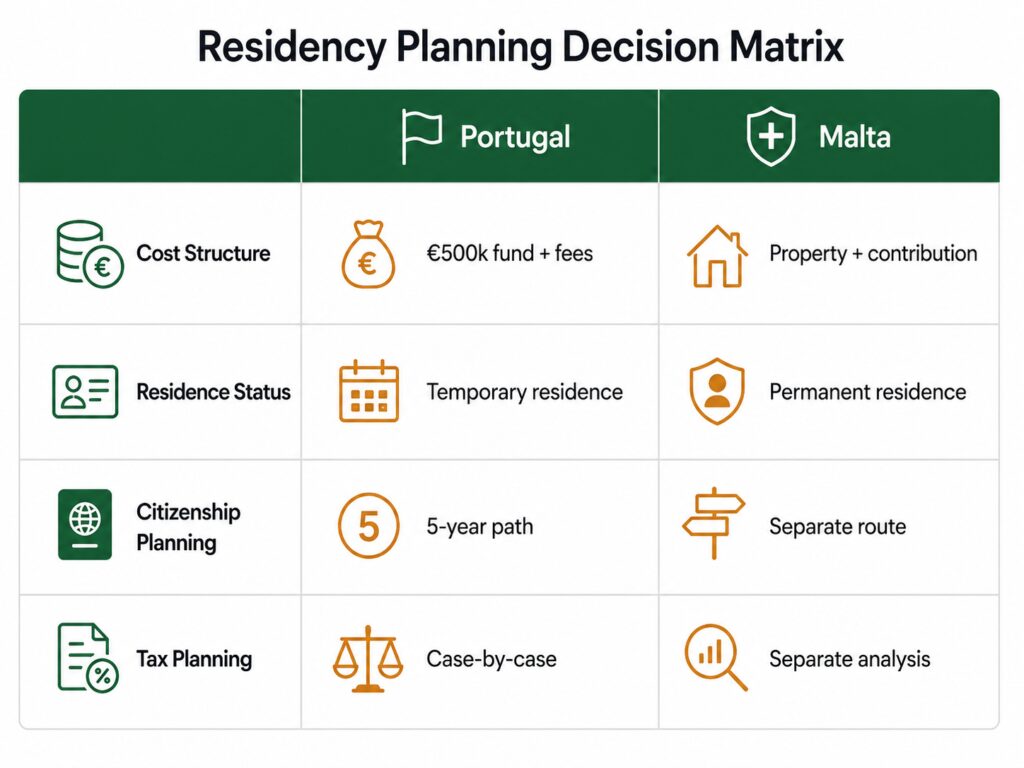
Portugal ARI and Malta MPRP legal framework comparison

Investment and Cost Comparison

The cost comparison is where many investors misunderstand the choice. Portugal usually requires a higher qualifying investment amount, but that investment is not the same as a donation. Malta may have a lower direct investment entry point if renting property, but several payments are non-refundable.

Cost Area Portugal Golden Visa Malta MPRP
Main qualifying amount Usually €500,000 fund investment Property purchase or rental requirement
Property purchase Not a qualifying ARI route Minimum €375,000 qualifying owned property
Property rental Not relevant for ARI qualification Minimum €14,000 per year qualifying rented property
State contribution Government fees apply €37,000 contribution
Admin fee Government application and permit fees apply €60,000 non-refundable administration fee
Donation Not part of main fund route €2,000 approved NGO donation
Family costs Additional government and professional fees Additional fees may apply for certain dependants
Capital return potential Depends on fund exit and performance Non-refundable payments are not recovered

Portugal’s fund route usually starts with a €500,000 qualifying investment. The investor should also budget for legal fees, fund subscription costs, bank account setup, documentation, translations, government fees, and renewals.

Malta’s MPRP includes a clear property rental requirement or purchase threshold. The rules specify a qualifying owned property of at least €375,000 or a qualifying rented property of at least €14,000 per year. On top of that, the main applicant pays a €60,000 non-refundable administration fee, a €37,000 contribution, and a €2,000 donation.

The key difference is not just the headline number. It is the recoverability of capital.

Portugal’s main investment may remain an investment, subject to fund risk and exit conditions. Malta’s contribution and administration fee are payments to access the programme and should be treated as sunk costs.

What You Get: Residency vs Citizenship

Neither Portugal nor Malta should be treated as an instant EU citizenship route. Both start with residence rights. Citizenship, if pursued later, depends on naturalisation rules, residence conditions, language or integration requirements, and government discretion.

This is where careful legal planning matters more than marketing language.

Portugal Path to Citizenship

Portugal’s Golden Visa can support a long-term route to Portuguese nationality, but applicants should not rely on outdated five-year citizenship language without checking the current law.

Portugal changed its nationality law in 2026. The official Portuguese government announcement on new nationality rules states that the new provisions apply to applications submitted after the law entered into force. For many new applicants, this means the naturalisation timeline may be longer than older Golden Visa guides suggest.

That does not remove Portugal’s value. It changes the planning horizon.

Portugal can still be attractive because it offers:

  • EU residence in Portugal.
  • Schengen access.
  • Family inclusion.
  • A regulated investment framework.
  • A long-term pathway toward permanent residence and potential nationality.
  • A clear European base without requiring full-time relocation.

For investors whose main goal is citizenship through Portugal residency, the citizenship strategy should be reviewed before starting the process, especially for nationality, language, timeline, and residence-counting assumptions.

Malta Path to Citizenship

Malta’s MPRP does not automatically grant Maltese citizenship. It grants permanent residence. Citizenship by naturalization is a separate process.

Official Maltese guidance on acquisition of citizenship explains that citizenship by naturalization based on residence requires residence in Malta throughout the 12 months immediately before application and an aggregate minimum period of four years during the six years before that 12-month period. The applicant must also satisfy good character, language knowledge, and suitability requirements.

That means Malta can be strong for permanent residence, but investors should not assume the MPRP itself creates a fast EU passport route.

The practical distinction is this:

  • Malta may provide permanent residence faster through MPRP.
  • Portugal may offer a broader lifestyle and integration pathway for investors who want Portugal as their main European base.
  • Neither programme guarantees EU citizenship.
  • Both require a separate naturalisation assessment.

Portugal Golden Visa

Start Your Portugal Golden Visa Journey

Receive personalized legal guidance from experienced immigration lawyers and discover the most effective pathway to securing your Portugal Golden Visa.

Book Your Free Consultation →
✓ No Obligation   •   ✓ Licensed Lawyers   •   ✓ Confidential Consultation

Schengen Access and Travel Rights

Both Portugal and Malta are part of the Schengen Area. The European Commission explains that the Schengen area includes 29 countries and allows travel without internal border checks between participating states.

For investors, this means both options can support short-term travel across Schengen, subject to residence card rules, passport validity, and border procedures.

Schengen access is often the immediate practical benefit. It may help with:

  • Business travel across Europe.
  • Family visits.
  • University planning for children.
  • Medical or lifestyle travel.
  • A European backup residence structure.

However, Schengen access is not the same as EU citizenship. A residence card can improve mobility, but it does not create the full rights of an EU passport, such as unrestricted settlement across all EU member states.

Investors who compare passport index rankings should separate marketing scores from legal rights. A residence permit, permanent residence card, and passport are three different tools.

Tax and Lifestyle Comparison

Tax should never be treated as a side note in a residency decision. The better programme is not only the one with the lower headline cost. It is the one that fits the applicant’s tax position, travel pattern, family structure, and long-term reporting obligations.

Portugal and Malta both require proper tax advice before applying.

NHR Portugal

NHR Portugal is still mentioned in many older residency comparisons, but investors need current advice. The original broad Non-Habitual Resident regime is no longer the simple planning tool that many older articles describe.

For Golden Visa investors, the key point is that residence status and tax residence are not identical. A Portugal Golden Visa holder may have residence rights without automatically becoming tax resident, depending on time spent in Portugal and personal circumstances.

Portugal can still be attractive for investors who want:

  • A larger mainland European base.
  • Access to Portuguese schools, healthcare, and lifestyle infrastructure.
  • A route that does not require full-time relocation.
  • Long-term residence planning through a regulated investment structure.

Tax advice should be taken before the application, not after the first renewal.

Malta Tax Regime for Residents

Malta has long been used by internationally mobile individuals for residence planning. Its tax system can be attractive in specific circumstances, but the result depends on domicile, remittance, source of income, and whether the person becomes tax resident.

The MPRP itself should not be treated as a tax plan. It is a residence programme. Tax treatment requires separate professional advice.

Malta may suit investors who want:

  • English-speaking administration.
  • Permanent residence status.
  • A compact island jurisdiction.
  • A property-linked residency structure.
  • A European base with a relatively defined application framework.

Portugal may suit investors who want a larger EU country, a fund-based investment route, and broader family relocation optionality. For readers comparing several options, this full European program comparison can help place Portugal, Greece, Malta, and other routes in context.
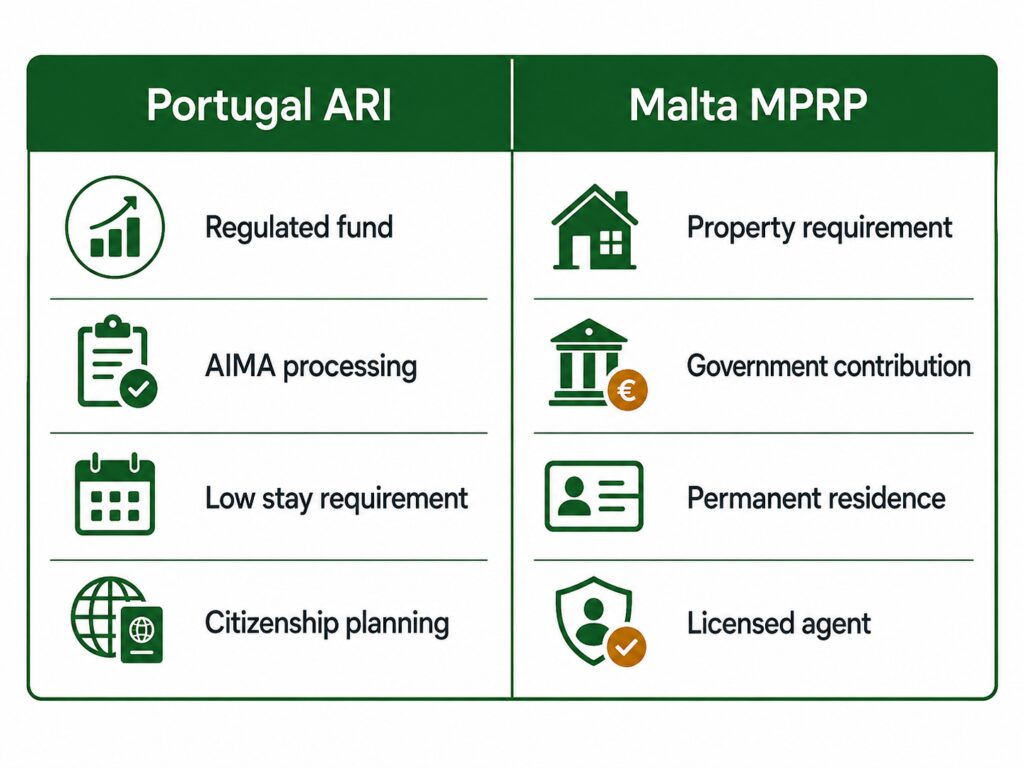
Portugal and Malta investment residency decision matrix

Which Program Is Better for Your Goals?

The better choice depends on what you are actually trying to achieve.

Choose Portugal if your priority is flexible EU residency through a regulated investment structure. Portugal is often better for investors who want Schengen access, a long-term European base, family inclusion, and optional relocation without committing to a property rental or purchase in a small island market.

Choose Malta if your priority is permanent residence from the programme structure itself. Malta may appeal to investors who want a defined MPRP framework, an English-speaking jurisdiction, and a residency route based on property, contribution, donation, and administrative fees.

Here is the practical decision table:

Investor Goal Better Fit Why
Flexible residence with limited stay Portugal Lower physical presence expectation
Permanent residence status from programme Malta MPRP is structured around permanent residence
Fund-based investment Portugal Portugal ARI focuses on regulated investment routes
Property-linked residence Malta MPRP requires qualifying property rental or purchase
Long-term EU citizenship planning Case-specific Both depend on naturalisation law
Family backup plan Both Structure and cost differ by family size
Lower sunk cost preference Portugal Main investment may be recoverable, subject to fund terms
English-speaking island jurisdiction Malta Malta operates in English and Maltese

Portugal Golden Visa vs Malta is not about which programme is universally superior. It is about matching the legal structure to the investor’s real objective.

If the goal is permanent residence in Malta, MPRP deserves serious consideration. If the goal is flexible residency in a larger EU country with fund-based investment and long-term optionality, Portugal is often the stronger bet.

FAQs: Portugal vs Malta

Is Malta or Portugal better for investment residency?

Portugal is usually better for investors who want flexible residency, a regulated fund route, and a larger EU base. Malta is usually better for applicants who want a permanent residence structure tied to property, contribution, and fixed state payments.

The right choice depends on cost tolerance, family structure, tax position, and whether the applicant wants Portugal or Malta as the main European base.

Does Malta offer citizenship faster than Portugal?

Malta does not grant citizenship through the MPRP itself. The MPRP grants permanent residence, while citizenship by naturalization is a separate legal process with residence, language, character, and suitability requirements.

Portugal also does not grant automatic citizenship through the Golden Visa. Portuguese nationality law changed in 2026, so investors should verify their expected naturalisation timeline before relying on older five-year guidance.

How does the cost compare?

Portugal usually requires a higher qualifying investment amount through the fund route, often €500,000, plus government, legal, and fund-related costs. Malta may require lower capital if using property rental instead of purchase, but it includes non-refundable payments such as the administration fee, government contribution, and NGO donation.

The better cost profile depends on whether the investor values capital recoverability or permanent residence status more.

Can I get an EU passport through Malta faster than through Portugal?

Not automatically. Malta’s MPRP is a residence programme, not an EU passport programme. Maltese citizenship by naturalization requires a separate application and satisfaction of legal conditions.

Portugal also requires a separate citizenship process. Since Portugal updated its nationality law in 2026, investors should treat citizenship planning as a legal strategy, not a guaranteed timeline.

Ready to take the next step?
Book a free initial assessment. We’ll assess your eligibility, walk through the current qualifying routes, and answer your questions, no cost, no commitment.


Portugal Golden Visa vs Malta Residency: Which Is the Better EU Bet?

Portugal Golden Visa vs Malta is not a simple question of which country sounds more attractive. It is a comparison between two different residency models: Portugal’s investment-based temporary residence route and Malta’s permanent residence programme with fixed contribution, property, and administrative requirements.

Both can provide Schengen access. Both can support long-term European planning. But they do not work the same way, cost the same way, or lead to citizenship on the same assumptions.

This guide compares the two programmes by structure, cost, residency rights, tax, travel access, and long-term citizenship planning.

Portugal Golden Visa vs Malta Residency: Overview

Portugal and Malta both appeal to non-EU investors who want a European base without necessarily relocating full-time. The difference is that Portugal is usually stronger for flexible residency and long-term integration planning, while Malta is more direct for permanent residence from the start.

Factor Portugal Golden Visa Malta Residency
Main programme Portugal ARI Malta Permanent Residence Programme
Common abbreviation ARI MPRP
Status granted Temporary residence permit Permanent residence certificate/card
Main investment route Regulated investment fund route Property rental or purchase plus fees and contribution
Real estate eligibility Residential real estate no longer qualifies Property requirement remains part of MPRP
Schengen access Yes Yes
Citizenship route Naturalisation subject to Portuguese nationality law Naturalisation subject to Maltese citizenship law
Best for Flexible EU residency planning Permanent residence with a Malta base

The better option depends on the investor’s goal. If the aim is a flexible, fund-based route through an investment program in Portugal, Portugal may be the cleaner fit. If the priority is a permanent residence structure tied to Malta, property, and fixed state payments, Malta may be more direct.

Portugal Golden Visa vs Malta residency comparison for EU investors

Program Type and Legal Framework

Portugal and Malta use different legal structures. This matters because investors often compare them as if both were “Golden Visa” programmes, when in practice the mechanics are different.

Portugal uses ARI, which stands for Autorização de Residência para Investimento, the formal residence permit for investment activity. Malta uses the Malta Permanent Residence Programme, commonly known as MPRP, which grants permanent residence subject to property, contribution, donation, and administrative fee requirements.

Portugal ARI (Residency by Investment)

Portugal ARI is a residency-by-investment route for non-EU investors. Applications are processed by AIMA official portal, the Agency for Integration, Migration and Asylum, which replaced SEF, the former immigration authority.

For private investors, the practical focus is now the regulated fund route. Real estate no longer qualifies for Portugal Golden Visa eligibility following the 2023 reform, so investors comparing Portugal with Malta should not assume that buying residential property in Lisbon, Porto, or the Algarve will secure ARI status.

The core appeal of Portugal is flexibility:

  • The minimum stay requirement is limited.
  • The investor can include eligible family members.
  • The programme supports long-term residence planning.
  • Fund investment can be structured through regulated investment vehicles.
  • Portugal remains a full EU and Schengen country.

Portugal ARI is not automatic approval. The applicant must satisfy eligibility, source-of-funds, investment, documentation, and background check requirements.

Malta Permanent Residence Programme

The Malta Permanent Residence Programme, or MPRP, is a permanent residence route for third-country nationals. According to the official Malta Permanent Residence Programme legal framework, the programme is built around four components: property, government contribution, donation to an approved NGO, and an administrative fee.

Malta’s model is more fixed than Portugal’s. It requires a qualifying property arrangement, either by purchase or rental, plus non-refundable state payments.

The MPRP generally involves:

  • A qualifying property purchase or rental.
  • A non-refundable administration fee.
  • A government contribution.
  • A donation to an approved organisation.
  • Health insurance.
  • Due diligence checks.
  • Use of a licensed agent.

The strength of Malta is that it offers permanent residence from the programme structure itself. The trade-off is that a larger part of the cost is non-refundable, especially when compared with Portugal’s investment fund model.

Portugal ARI and Malta MPRP legal framework comparison

Investment and Cost Comparison

The cost comparison is where many investors misunderstand the choice. Portugal usually requires a higher qualifying investment amount, but that investment is not the same as a donation. Malta may have a lower direct investment entry point if renting property, but several payments are non-refundable.

Cost Area Portugal Golden Visa Malta MPRP
Main qualifying amount Usually €500,000 fund investment Property purchase or rental requirement
Property purchase Not a qualifying ARI route Minimum €375,000 qualifying owned property
Property rental Not relevant for ARI qualification Minimum €14,000 per year qualifying rented property
State contribution Government fees apply €37,000 contribution
Admin fee Government application and permit fees apply €60,000 non-refundable administration fee
Donation Not part of main fund route €2,000 approved NGO donation
Family costs Additional government and professional fees Additional fees may apply for certain dependants
Capital return potential Depends on fund exit and performance Non-refundable payments are not recovered

Portugal’s fund route usually starts with a €500,000 qualifying investment. The investor should also budget for legal fees, fund subscription costs, bank account setup, documentation, translations, government fees, and renewals.

Malta’s MPRP includes a clear property rental requirement or purchase threshold. The rules specify a qualifying owned property of at least €375,000 or a qualifying rented property of at least €14,000 per year. On top of that, the main applicant pays a €60,000 non-refundable administration fee, a €37,000 contribution, and a €2,000 donation.

The key difference is not just the headline number. It is the recoverability of capital.

Portugal’s main investment may remain an investment, subject to fund risk and exit conditions. Malta’s contribution and administration fee are payments to access the programme and should be treated as sunk costs.

What You Get: Residency vs Citizenship

Neither Portugal nor Malta should be treated as an instant EU citizenship route. Both start with residence rights. Citizenship, if pursued later, depends on naturalisation rules, residence conditions, language or integration requirements, and government discretion.

This is where careful legal planning matters more than marketing language.

Portugal Path to Citizenship

Portugal’s Golden Visa can support a long-term route to Portuguese nationality, but applicants should not rely on outdated five-year citizenship language without checking the current law.

Portugal changed its nationality law in 2026. The official Portuguese government announcement on new nationality rules states that the new provisions apply to applications submitted after the law entered into force. For many new applicants, this means the naturalisation timeline may be longer than older Golden Visa guides suggest.

That does not remove Portugal’s value. It changes the planning horizon.

Portugal can still be attractive because it offers:

  • EU residence in Portugal.
  • Schengen access.
  • Family inclusion.
  • A regulated investment framework.
  • A long-term pathway toward permanent residence and potential nationality.
  • A clear European base without requiring full-time relocation.

For investors whose main goal is citizenship through Portugal residency, the citizenship strategy should be reviewed before starting the process, especially for nationality, language, timeline, and residence-counting assumptions.

Malta Path to Citizenship

Malta’s MPRP does not automatically grant Maltese citizenship. It grants permanent residence. Citizenship by naturalization is a separate process.

Official Maltese guidance on acquisition of citizenship explains that citizenship by naturalization based on residence requires residence in Malta throughout the 12 months immediately before application and an aggregate minimum period of four years during the six years before that 12-month period. The applicant must also satisfy good character, language knowledge, and suitability requirements.

That means Malta can be strong for permanent residence, but investors should not assume the MPRP itself creates a fast EU passport route.

The practical distinction is this:

  • Malta may provide permanent residence faster through MPRP.
  • Portugal may offer a broader lifestyle and integration pathway for investors who want Portugal as their main European base.
  • Neither programme guarantees EU citizenship.
  • Both require a separate naturalisation assessment.

Portugal Golden Visa

Start Your Portugal Golden Visa Journey

Receive personalized legal guidance from experienced immigration lawyers and discover the most effective pathway to securing your Portugal Golden Visa.

Book Your Free Consultation →
✓ No Obligation   •   ✓ Licensed Lawyers   •   ✓ Confidential Consultation

Schengen Access and Travel Rights

Both Portugal and Malta are part of the Schengen Area. The European Commission explains that the Schengen area includes 29 countries and allows travel without internal border checks between participating states.

For investors, this means both options can support short-term travel across Schengen, subject to residence card rules, passport validity, and border procedures.

Schengen access is often the immediate practical benefit. It may help with:

  • Business travel across Europe.
  • Family visits.
  • University planning for children.
  • Medical or lifestyle travel.
  • A European backup residence structure.

However, Schengen access is not the same as EU citizenship. A residence card can improve mobility, but it does not create the full rights of an EU passport, such as unrestricted settlement across all EU member states.

Investors who compare passport index rankings should separate marketing scores from legal rights. A residence permit, permanent residence card, and passport are three different tools.

Tax and Lifestyle Comparison

Tax should never be treated as a side note in a residency decision. The better programme is not only the one with the lower headline cost. It is the one that fits the applicant’s tax position, travel pattern, family structure, and long-term reporting obligations.

Portugal and Malta both require proper tax advice before applying.

NHR Portugal

NHR Portugal is still mentioned in many older residency comparisons, but investors need current advice. The original broad Non-Habitual Resident regime is no longer the simple planning tool that many older articles describe.

For Golden Visa investors, the key point is that residence status and tax residence are not identical. A Portugal Golden Visa holder may have residence rights without automatically becoming tax resident, depending on time spent in Portugal and personal circumstances.

Portugal can still be attractive for investors who want:

  • A larger mainland European base.
  • Access to Portuguese schools, healthcare, and lifestyle infrastructure.
  • A route that does not require full-time relocation.
  • Long-term residence planning through a regulated investment structure.

Tax advice should be taken before the application, not after the first renewal.

Malta Tax Regime for Residents

Malta has long been used by internationally mobile individuals for residence planning. Its tax system can be attractive in specific circumstances, but the result depends on domicile, remittance, source of income, and whether the person becomes tax resident.

The MPRP itself should not be treated as a tax plan. It is a residence programme. Tax treatment requires separate professional advice.

Malta may suit investors who want:

  • English-speaking administration.
  • Permanent residence status.
  • A compact island jurisdiction.
  • A property-linked residency structure.
  • A European base with a relatively defined application framework.

Portugal may suit investors who want a larger EU country, a fund-based investment route, and broader family relocation optionality. For readers comparing several options, this full European program comparison can help place Portugal, Greece, Malta, and other routes in context.

Portugal and Malta investment residency decision matrix

Which Program Is Better for Your Goals?

The better choice depends on what you are actually trying to achieve.

Choose Portugal if your priority is flexible EU residency through a regulated investment structure. Portugal is often better for investors who want Schengen access, a long-term European base, family inclusion, and optional relocation without committing to a property rental or purchase in a small island market.

Choose Malta if your priority is permanent residence from the programme structure itself. Malta may appeal to investors who want a defined MPRP framework, an English-speaking jurisdiction, and a residency route based on property, contribution, donation, and administrative fees.

Here is the practical decision table:

Investor Goal Better Fit Why
Flexible residence with limited stay Portugal Lower physical presence expectation
Permanent residence status from programme Malta MPRP is structured around permanent residence
Fund-based investment Portugal Portugal ARI focuses on regulated investment routes
Property-linked residence Malta MPRP requires qualifying property rental or purchase
Long-term EU citizenship planning Case-specific Both depend on naturalisation law
Family backup plan Both Structure and cost differ by family size
Lower sunk cost preference Portugal Main investment may be recoverable, subject to fund terms
English-speaking island jurisdiction Malta Malta operates in English and Maltese

Portugal Golden Visa vs Malta is not about which programme is universally superior. It is about matching the legal structure to the investor’s real objective.

If the goal is permanent residence in Malta, MPRP deserves serious consideration. If the goal is flexible residency in a larger EU country with fund-based investment and long-term optionality, Portugal is often the stronger bet.

FAQs: Portugal vs Malta

Is Malta or Portugal better for investment residency?

Portugal is usually better for investors who want flexible residency, a regulated fund route, and a larger EU base. Malta is usually better for applicants who want a permanent residence structure tied to property, contribution, and fixed state payments.

The right choice depends on cost tolerance, family structure, tax position, and whether the applicant wants Portugal or Malta as the main European base.

Does Malta offer citizenship faster than Portugal?

Malta does not grant citizenship through the MPRP itself. The MPRP grants permanent residence, while citizenship by naturalization is a separate legal process with residence, language, character, and suitability requirements.

Portugal also does not grant automatic citizenship through the Golden Visa. Portuguese nationality law changed in 2026, so investors should verify their expected naturalisation timeline before relying on older five-year guidance.

How does the cost compare?

Portugal usually requires a higher qualifying investment amount through the fund route, often €500,000, plus government, legal, and fund-related costs. Malta may require lower capital if using property rental instead of purchase, but it includes non-refundable payments such as the administration fee, government contribution, and NGO donation.

The better cost profile depends on whether the investor values capital recoverability or permanent residence status more.

Can I get an EU passport through Malta faster than through Portugal?

Not automatically. Malta’s MPRP is a residence programme, not an EU passport programme. Maltese citizenship by naturalization requires a separate application and satisfaction of legal conditions.

Portugal also requires a separate citizenship process. Since Portugal updated its nationality law in 2026, investors should treat citizenship planning as a legal strategy, not a guaranteed timeline.

Ready to take the next step?
Book a free initial assessment. We’ll assess your eligibility, walk through the current qualifying routes, and answer your questions, no cost, no commitment.

Portugal Golden Visa vs Malta Residency: Which Is the Better EU Bet?

Portugal-Golden-Visa-vs-Malta-Residency-Which-Is-the-Better-EU-Bet
Portugal Golden Visa vs Malta is not a simple question of which country sounds more attractive. It is a comparison between two different residency models: Portugal’s investment-based temporary residence route and Malta’s permanent residence programme with fixed contribution, property, and administrative requirements.

Both can provide Schengen access. Both can support long-term European planning. But they do not work the same way, cost the same way, or lead to citizenship on the same assumptions.

This guide compares the two programmes by structure, cost, residency rights, tax, travel access, and long-term citizenship planning.

Portugal Golden Visa vs Malta Residency: Overview

Portugal and Malta both appeal to non-EU investors who want a European base without necessarily relocating full-time. The difference is that Portugal is usually stronger for flexible residency and long-term integration planning, while Malta is more direct for permanent residence from the start.

Factor Portugal Golden Visa Malta Residency
Main programme Portugal ARI Malta Permanent Residence Programme
Common abbreviation ARI MPRP
Status granted Temporary residence permit Permanent residence certificate/card
Main investment route Regulated investment fund route Property rental or purchase plus fees and contribution
Real estate eligibility Residential real estate no longer qualifies Property requirement remains part of MPRP
Schengen access Yes Yes
Citizenship route Naturalisation subject to Portuguese nationality law Naturalisation subject to Maltese citizenship law
Best for Flexible EU residency planning Permanent residence with a Malta base

The better option depends on the investor’s goal. If the aim is a flexible, fund-based route through an investment program in Portugal, Portugal may be the cleaner fit. If the priority is a permanent residence structure tied to Malta, property, and fixed state payments, Malta may be more direct.

Portugal Golden Visa vs Malta residency comparison for EU investors

Program Type and Legal Framework

Portugal and Malta use different legal structures. This matters because investors often compare them as if both were “Golden Visa” programmes, when in practice the mechanics are different.

Portugal uses ARI, which stands for Autorização de Residência para Investimento, the formal residence permit for investment activity. Malta uses the Malta Permanent Residence Programme, commonly known as MPRP, which grants permanent residence subject to property, contribution, donation, and administrative fee requirements.

Portugal ARI (Residency by Investment)

Portugal ARI is a residency-by-investment route for non-EU investors. Applications are processed by AIMA official portal, the Agency for Integration, Migration and Asylum, which replaced SEF, the former immigration authority.

For private investors, the practical focus is now the regulated fund route. Real estate no longer qualifies for Portugal Golden Visa eligibility following the 2023 reform, so investors comparing Portugal with Malta should not assume that buying residential property in Lisbon, Porto, or the Algarve will secure ARI status.

The core appeal of Portugal is flexibility:

  • The minimum stay requirement is limited.
  • The investor can include eligible family members.
  • The programme supports long-term residence planning.
  • Fund investment can be structured through regulated investment vehicles.
  • Portugal remains a full EU and Schengen country.

Portugal ARI is not automatic approval. The applicant must satisfy eligibility, source-of-funds, investment, documentation, and background check requirements.

Malta Permanent Residence Programme

The Malta Permanent Residence Programme, or MPRP, is a permanent residence route for third-country nationals. According to the official Malta Permanent Residence Programme legal framework, the programme is built around four components: property, government contribution, donation to an approved NGO, and an administrative fee.

Malta’s model is more fixed than Portugal’s. It requires a qualifying property arrangement, either by purchase or rental, plus non-refundable state payments.

The MPRP generally involves:

  • A qualifying property purchase or rental.
  • A non-refundable administration fee.
  • A government contribution.
  • A donation to an approved organisation.
  • Health insurance.
  • Due diligence checks.
  • Use of a licensed agent.

The strength of Malta is that it offers permanent residence from the programme structure itself. The trade-off is that a larger part of the cost is non-refundable, especially when compared with Portugal’s investment fund model.

Portugal ARI and Malta MPRP legal framework comparison

Investment and Cost Comparison

The cost comparison is where many investors misunderstand the choice. Portugal usually requires a higher qualifying investment amount, but that investment is not the same as a donation. Malta may have a lower direct investment entry point if renting property, but several payments are non-refundable.

Cost Area Portugal Golden Visa Malta MPRP
Main qualifying amount Usually €500,000 fund investment Property purchase or rental requirement
Property purchase Not a qualifying ARI route Minimum €375,000 qualifying owned property
Property rental Not relevant for ARI qualification Minimum €14,000 per year qualifying rented property
State contribution Government fees apply €37,000 contribution
Admin fee Government application and permit fees apply €60,000 non-refundable administration fee
Donation Not part of main fund route €2,000 approved NGO donation
Family costs Additional government and professional fees Additional fees may apply for certain dependants
Capital return potential Depends on fund exit and performance Non-refundable payments are not recovered

Portugal’s fund route usually starts with a €500,000 qualifying investment. The investor should also budget for legal fees, fund subscription costs, bank account setup, documentation, translations, government fees, and renewals.

Malta’s MPRP includes a clear property rental requirement or purchase threshold. The rules specify a qualifying owned property of at least €375,000 or a qualifying rented property of at least €14,000 per year. On top of that, the main applicant pays a €60,000 non-refundable administration fee, a €37,000 contribution, and a €2,000 donation.

The key difference is not just the headline number. It is the recoverability of capital.

Portugal’s main investment may remain an investment, subject to fund risk and exit conditions. Malta’s contribution and administration fee are payments to access the programme and should be treated as sunk costs.

What You Get: Residency vs Citizenship

Neither Portugal nor Malta should be treated as an instant EU citizenship route. Both start with residence rights. Citizenship, if pursued later, depends on naturalisation rules, residence conditions, language or integration requirements, and government discretion.

This is where careful legal planning matters more than marketing language.

Portugal Path to Citizenship

Portugal’s Golden Visa can support a long-term route to Portuguese nationality, but applicants should not rely on outdated five-year citizenship language without checking the current law.

Portugal changed its nationality law in 2026. The official Portuguese government announcement on new nationality rules states that the new provisions apply to applications submitted after the law entered into force. For many new applicants, this means the naturalisation timeline may be longer than older Golden Visa guides suggest.

That does not remove Portugal’s value. It changes the planning horizon.

Portugal can still be attractive because it offers:

  • EU residence in Portugal.
  • Schengen access.
  • Family inclusion.
  • A regulated investment framework.
  • A long-term pathway toward permanent residence and potential nationality.
  • A clear European base without requiring full-time relocation.

For investors whose main goal is citizenship through Portugal residency, the citizenship strategy should be reviewed before starting the process, especially for nationality, language, timeline, and residence-counting assumptions.

Malta Path to Citizenship

Malta’s MPRP does not automatically grant Maltese citizenship. It grants permanent residence. Citizenship by naturalization is a separate process.

Official Maltese guidance on acquisition of citizenship explains that citizenship by naturalization based on residence requires residence in Malta throughout the 12 months immediately before application and an aggregate minimum period of four years during the six years before that 12-month period. The applicant must also satisfy good character, language knowledge, and suitability requirements.

That means Malta can be strong for permanent residence, but investors should not assume the MPRP itself creates a fast EU passport route.

The practical distinction is this:

  • Malta may provide permanent residence faster through MPRP.
  • Portugal may offer a broader lifestyle and integration pathway for investors who want Portugal as their main European base.
  • Neither programme guarantees EU citizenship.
  • Both require a separate naturalisation assessment.

Portugal Golden Visa

Start Your Portugal Golden Visa Journey

Receive personalized legal guidance from experienced immigration lawyers and discover the most effective pathway to securing your Portugal Golden Visa.

Book Your Free Consultation →
✓ No Obligation   •   ✓ Licensed Lawyers   •   ✓ Confidential Consultation

Schengen Access and Travel Rights

Both Portugal and Malta are part of the Schengen Area. The European Commission explains that the Schengen area includes 29 countries and allows travel without internal border checks between participating states.

For investors, this means both options can support short-term travel across Schengen, subject to residence card rules, passport validity, and border procedures.

Schengen access is often the immediate practical benefit. It may help with:

  • Business travel across Europe.
  • Family visits.
  • University planning for children.
  • Medical or lifestyle travel.
  • A European backup residence structure.

However, Schengen access is not the same as EU citizenship. A residence card can improve mobility, but it does not create the full rights of an EU passport, such as unrestricted settlement across all EU member states.

Investors who compare passport index rankings should separate marketing scores from legal rights. A residence permit, permanent residence card, and passport are three different tools.

Tax and Lifestyle Comparison

Tax should never be treated as a side note in a residency decision. The better programme is not only the one with the lower headline cost. It is the one that fits the applicant’s tax position, travel pattern, family structure, and long-term reporting obligations.

Portugal and Malta both require proper tax advice before applying.

NHR Portugal

NHR Portugal is still mentioned in many older residency comparisons, but investors need current advice. The original broad Non-Habitual Resident regime is no longer the simple planning tool that many older articles describe.

For Golden Visa investors, the key point is that residence status and tax residence are not identical. A Portugal Golden Visa holder may have residence rights without automatically becoming tax resident, depending on time spent in Portugal and personal circumstances.

Portugal can still be attractive for investors who want:

  • A larger mainland European base.
  • Access to Portuguese schools, healthcare, and lifestyle infrastructure.
  • A route that does not require full-time relocation.
  • Long-term residence planning through a regulated investment structure.

Tax advice should be taken before the application, not after the first renewal.

Malta Tax Regime for Residents

Malta has long been used by internationally mobile individuals for residence planning. Its tax system can be attractive in specific circumstances, but the result depends on domicile, remittance, source of income, and whether the person becomes tax resident.

The MPRP itself should not be treated as a tax plan. It is a residence programme. Tax treatment requires separate professional advice.

Malta may suit investors who want:

  • English-speaking administration.
  • Permanent residence status.
  • A compact island jurisdiction.
  • A property-linked residency structure.
  • A European base with a relatively defined application framework.

Portugal may suit investors who want a larger EU country, a fund-based investment route, and broader family relocation optionality. For readers comparing several options, this full European program comparison can help place Portugal, Greece, Malta, and other routes in context.

Portugal and Malta investment residency decision matrix

Which Program Is Better for Your Goals?

The better choice depends on what you are actually trying to achieve.

Choose Portugal if your priority is flexible EU residency through a regulated investment structure. Portugal is often better for investors who want Schengen access, a long-term European base, family inclusion, and optional relocation without committing to a property rental or purchase in a small island market.

Choose Malta if your priority is permanent residence from the programme structure itself. Malta may appeal to investors who want a defined MPRP framework, an English-speaking jurisdiction, and a residency route based on property, contribution, donation, and administrative fees.

Here is the practical decision table:

Investor Goal Better Fit Why
Flexible residence with limited stay Portugal Lower physical presence expectation
Permanent residence status from programme Malta MPRP is structured around permanent residence
Fund-based investment Portugal Portugal ARI focuses on regulated investment routes
Property-linked residence Malta MPRP requires qualifying property rental or purchase
Long-term EU citizenship planning Case-specific Both depend on naturalisation law
Family backup plan Both Structure and cost differ by family size
Lower sunk cost preference Portugal Main investment may be recoverable, subject to fund terms
English-speaking island jurisdiction Malta Malta operates in English and Maltese

Portugal Golden Visa vs Malta is not about which programme is universally superior. It is about matching the legal structure to the investor’s real objective.

If the goal is permanent residence in Malta, MPRP deserves serious consideration. If the goal is flexible residency in a larger EU country with fund-based investment and long-term optionality, Portugal is often the stronger bet.

FAQs: Portugal vs Malta

Is Malta or Portugal better for investment residency?

Portugal is usually better for investors who want flexible residency, a regulated fund route, and a larger EU base. Malta is usually better for applicants who want a permanent residence structure tied to property, contribution, and fixed state payments.

The right choice depends on cost tolerance, family structure, tax position, and whether the applicant wants Portugal or Malta as the main European base.

Does Malta offer citizenship faster than Portugal?

Malta does not grant citizenship through the MPRP itself. The MPRP grants permanent residence, while citizenship by naturalization is a separate legal process with residence, language, character, and suitability requirements.

Portugal also does not grant automatic citizenship through the Golden Visa. Portuguese nationality law changed in 2026, so investors should verify their expected naturalisation timeline before relying on older five-year guidance.

How does the cost compare?

Portugal usually requires a higher qualifying investment amount through the fund route, often €500,000, plus government, legal, and fund-related costs. Malta may require lower capital if using property rental instead of purchase, but it includes non-refundable payments such as the administration fee, government contribution, and NGO donation.

The better cost profile depends on whether the investor values capital recoverability or permanent residence status more.

Can I get an EU passport through Malta faster than through Portugal?

Not automatically. Malta’s MPRP is a residence programme, not an EU passport programme. Maltese citizenship by naturalization requires a separate application and satisfaction of legal conditions.

Portugal also requires a separate citizenship process. Since Portugal updated its nationality law in 2026, investors should treat citizenship planning as a legal strategy, not a guaranteed timeline.

Ready to take the next step?
Book a free initial assessment. We’ll assess your eligibility, walk through the current qualifying routes, and answer your questions, no cost, no commitment.

What do you think?
Blog

More Related Articles

top








