

Portugal golden visa

Portugal vs Spain Golden Visa: Key Differences Every Investor Should Know

Portugal vs Spain Golden Visa is no longer a simple comparison between two active property-based residency routes. Spain closed its investor visa programme in April 2025, while Portugal continues to offer the Portugal ARI, formally Autorização de Residência para Investimento, through qualifying non-real-estate investment routes.

That makes the decision clearer for new applicants. Spain may still appeal to people relocating through work, entrepreneurship, or non-lucrative residency, but it no longer offers the same investment-residency path that many investors used to compare with Portugal. This guide explains the key differences that matter in 2026: status, investment route, tax residency, minimum stay, citizenship timeline, and long-term planning.

Portugal vs Spain Golden Visa: At a Glance

The most important difference is programme status. Portugal still has a Golden Visa-style investor residency route. Spain does not accept new Golden Visa applications after the abolition of investor visas.

Factor Portugal Spain
Programme status in 2026 Active through Portugal ARI Closed to new investor visa applications
Main investment route Fund route Portugal, usually through qualifying investment funds Historic real estate route Spain, no longer available for new applicants
Real estate eligibility Real estate no longer qualifies for ARI Real estate investor visa route abolished
Minimum investment threshold Commonly €500,000 for qualifying fund investment Previously €500,000 real estate, no longer available
Processing authority AIMA, Agency for Integration, Migration and Asylum Spanish consular and immigration authorities before closure
Schengen residency Yes, through Portuguese residence permit Only for existing eligible holders, not new Golden Visa applicants
Minimum stay Low physical stay requirement under ARI rules Golden Visa route closed for new applicants
Citizenship timeline 7 or 10 years under the 2026 nationality rules, depending on nationality Usually 10 years for most applicants, with exceptions
Best for Investors seeking an active EU residency by investment route People considering non-investor Spanish residence options

For investors comparing spain vs portugal golden visa options in 2026, Portugal is the only one of the two that still offers a direct investor residency route.

Portugal vs Spain Golden Visa comparison for non-EU investors

Program Status in 2026

Programme status should be the first filter. Cost, tax, and lifestyle only matter after confirming whether an investor route is actually open.

Is Spain Golden Visa Still Active?

No. Spain Golden Visa is not active for new applicants in 2026.

Spain abolished investor visas from 3 April 2025. The change affected the investor visa framework that previously allowed non-EU nationals to qualify through significant investments, including real estate purchases of at least €500,000. The Spanish Ministry of Foreign Affairs states on its official investor visa page that investor visas were abolished from 3 April 2025, while Spain’s official BOE publication confirms the legal reform affecting the investor visa articles of Law 14/2013.

This means a new applicant cannot rely on the old real estate route Spain structure as a current residency-by-investment option. Existing investors or people who applied before the cut-off date may need separate legal advice, but that is not the same as a new 2026 application.

Portugal ARI Program Status

Portugal ARI remains active in 2026. ARI means Autorização de Residência para Investimento, Portugal’s formal residence permit for investment activity.

Portugal’s official immigration authority, AIMA, Agency for Integration, Migration and Asylum, describes ARI as a residence permit route for third-country nationals who make a qualifying investment. The route provides residence rights in Portugal, Schengen mobility, and family reunification, subject to eligibility and documentation requirements.

The key change is that Portugal no longer accepts standard real estate purchases as a qualifying Golden Visa investment. For most private investors comparing the portugal golden visa program, the practical focus is now the fund route Portugal, not property.

Minimum Investment Comparison

The old golden visa Spain vs Portugal comparison used to be straightforward: Spain had a €500,000 real estate route, while Portugal had multiple routes including real estate and funds. That comparison is outdated.

Today, the relevant comparison looks different.

Investment factor Portugal Spain
Active investor route Yes No new Golden Visa applications
Common qualifying amount €500,000 fund investment Not applicable for new Golden Visa applicants
Real estate option Removed from ARI eligibility Abolished for investor visa purposes
Regulatory focus Fund regulation and immigration compliance No active Golden Visa comparison for new investors
Main risk to check Fund eligibility, CMVM regulation, holding period, fees Whether another visa category fits the applicant

Portugal’s fund route requires careful legal and financial due diligence. CMVM, Portugal’s Securities Market Commission, supervises the investment fund environment, but a fund being regulated does not automatically mean it is suitable for every investor. The fund must fit the ARI rules, the applicant’s risk profile, and the required holding period.

Investors comparing cost breakdown should also consider legal fees, fund subscription costs, government fees, banking charges, tax advice, and family member costs. The minimum investment threshold is only one part of the total budget.
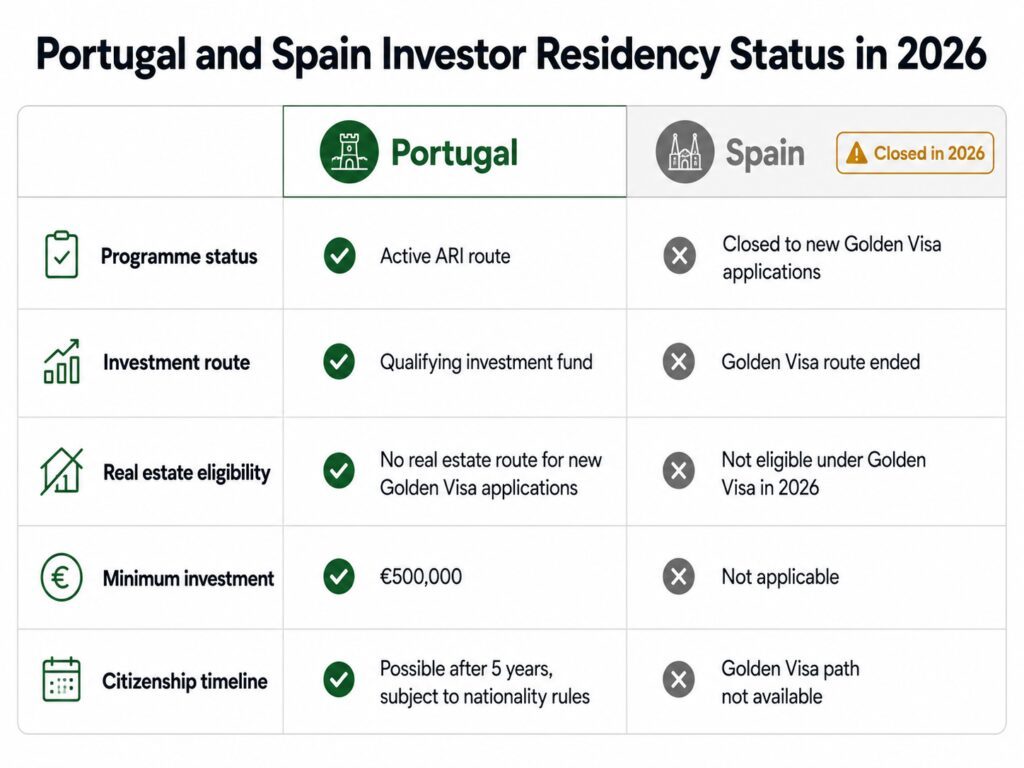
ortugal and Spain Golden Visa investment comparison table

Citizenship Timeline: Portugal vs Spain

Citizenship planning is one of the biggest reasons investors compare Portugal and Spain. The answer changed in 2026 because Portugal updated its nationality law.

Under Portugal’s current nationality law, naturalisation generally requires legal residence for at least seven years for nationals of Portuguese-speaking countries and EU citizens, or 10 years for nationals of other countries. Applicants must also meet language, integration, security, and other legal requirements. Investors should review the latest Portuguese citizenship requirements before treating any timeline as fixed.

Spain’s general nationality by residence timeline is also 10 years for most applicants. However, Spain has shorter periods for specific groups, including nationals of Latin American countries, Andorra, the Philippines, Equatorial Guinea, Portugal, and people of Sephardic origin. The official Spanish government portal lists these reduced periods alongside the general 10-year rule.

The practical difference is no longer simply “Portugal is faster.” For many non-EU investors in 2026, both countries may now point toward a 10-year general citizenship timeline. Portugal can still be more attractive because it offers an active investment residency route, while Spain does not.

Minimum Stay Requirements

Portugal remains attractive for investors who want EU residency without full relocation.

AIMA’s ARI guidance states that beneficiaries must remain in Portugal for at least seven days in the first year and at least 14 days in subsequent periods. This makes Portugal suitable for investors who want Schengen residency and long-term optionality without moving their life immediately.

Spain’s Golden Visa used to be known for flexibility too, but that point no longer helps new applicants because the route is closed. Anyone considering Spain in 2026 needs to compare other residency routes, such as work, entrepreneur, digital nomad, or non-lucrative residence options. Those routes may involve different stay, income, tax, and renewal requirements.

For a non-EU national who wants residency mainly through investment, Portugal is now the more direct comparison point.

Tax Regime Comparison

Golden Visa residence is not the same as tax residency. This distinction matters.

A person can hold a residence permit without automatically becoming tax resident, depending on physical presence, home availability, income structure, and domestic tax rules. Investors should obtain personal tax advice before choosing Portugal Golden Visa or Spain based on assumptions about tax savings.

Portugal NHR Regime

NHR Portugal used to be a major attraction for foreign residents. The old broad Non-Habitual Resident regime has changed, and new applicants should not rely on outdated online claims about automatic NHR access.

Portugal now has a more targeted tax incentive environment, often discussed in relation to scientific research, innovation, and specific professional categories. This may be relevant for some applicants, but it is not a universal Golden Visa benefit.

For Portugal Golden Visa investors, the right question is not only “Can I get NHR?” It is:

  • Will I become tax resident in Portugal?
  • What income sources do I have?
  • Are my dividends, capital gains, pensions, salary, or business profits exposed?
  • Does my fund investment create any reporting obligations?
  • How does my home country tax worldwide income?

A Golden Visa strategy without tax planning is incomplete.

Spain Non-Dom Tax Regime

Spain has a special tax regime for inbound workers, often called the Beckham Law or Spanish non-dom tax regime. The official Spanish Tax Agency explains that qualifying individuals who become tax resident in Spain may elect to be taxed under Non-Resident Income Tax rules for the year of arrival and the following five tax periods, subject to conditions.

This regime is not the same as Spain Golden Visa. It is usually tied to relocation for employment, remote work, directorship, entrepreneurial activity, or qualifying professional activity.

That makes Spain more relevant for people actually moving to Spain for work or business. It is less relevant for investors who want residence through passive capital investment.

Quality of Life and Cost of Living

Portugal and Spain both offer strong quality of life, established healthcare systems, international schools, good infrastructure, and Schengen access. The difference is not whether one country is objectively “better.” The difference is which country fits the investor’s intended use.

Portugal may suit investors who want:

  • A currently active investment residency structure
  • Lower physical stay requirements
  • A quieter base in Lisbon, Porto, Cascais, or the Algarve
  • A route designed around long-term optionality
  • A less relocation-heavy residency plan

Spain may suit people who want:

  • A larger domestic market
  • Major cities such as Madrid, Barcelona, Valencia, or Malaga
  • A work-based or entrepreneur-based relocation route
  • A more active lifestyle relocation
  • Spanish language and business integration

Cost of living depends heavily on the city. Lisbon and Madrid are not the same market. Porto and Barcelona are not the same market. A fair comparison should include housing, school fees, healthcare, tax exposure, travel needs, and family plans.

For investors still comparing EU options beyond Iberia, this Portugal vs Greece comparison may also help clarify how Portugal fits into the wider European residency market.

FREE LEGAL CONSULTATION

Have a Quick Question?

Our legal team is available Monday–Friday to answer your Portugal Golden Visa questions and help you understand your next steps.

Book Your Free Consultation Message Us on WhatsApp

Which Passport Is Stronger?

Portugal and Spain both issue EU passports. In practical mobility terms, both are strong passports with broad visa-free or visa-on-arrival access across many destinations. Passport ranking positions can move slightly depending on the index used, the date of publication, and the methodology.

For investors, the more practical question is not whether Portugal or Spain ranks one or two places higher in a passport ranking. The better question is:

  • Which country gives you a realistic residence route now?
  • Which citizenship timeline applies to your nationality?
  • Will you need to renounce your existing citizenship?
  • Can you meet the language and integration requirements?
  • Does the route fit your family and tax residency plan?

For U.S.-specific travel and entry information, government sources such as the U.S. Department of State travel portal are useful for checking official country entry guidance. For citizenship planning, however, the nationality laws of Portugal and Spain matter more than generic ranking tables.
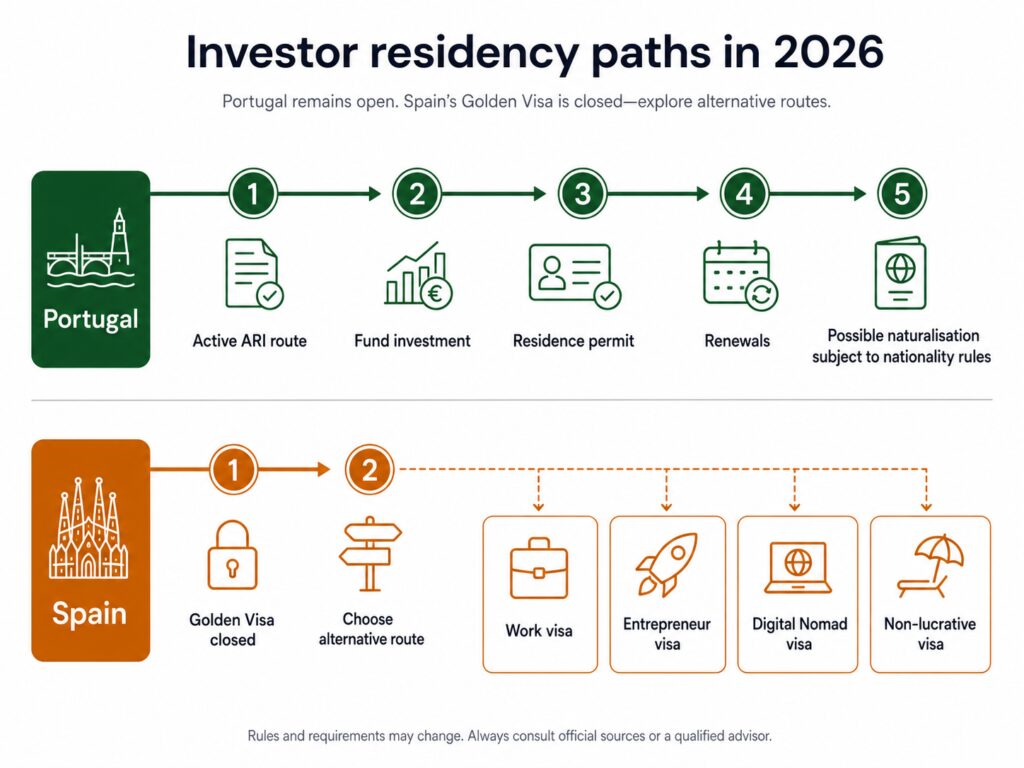
Portugal and Spain residency investment decision timeline for 2026

Who Should Choose Portugal Over Spain and Vice Versa?

Portugal is the stronger choice for investors who want a current residency-by-investment route. The programme remains active, the fund route Portugal gives a clear investment framework, and the minimum stay requirement remains relatively light compared with full relocation routes.

Spain may still be the better lifestyle choice for people who want to live, work, or build a business there. But that is a different decision. It is not a Spain Golden Visa vs Portugal comparison anymore for new applicants, because Spain has closed the investor visa route.

Choose Portugal if:

  • You want an active investment residency route
  • You do not want to relocate full-time immediately
  • You are comfortable with a regulated fund investment structure
  • You want Schengen residency with family inclusion
  • You want a structured long-term EU residency plan

Consider Spain if:

  • You are relocating for employment, business, or entrepreneurship
  • You qualify for a non-investor Spanish visa
  • Your family, language, or commercial life is already Spain-focused
  • You are not relying on passive investment as the basis for residence

The correct answer depends on the goal. For passive residency by investment, Portugal leads. For actual relocation to Spain through another legal category, Spain may still make sense.

FAQs: Portugal vs Spain Golden Visa

Which is better for investors, Portugal or Spain Golden Visa?

For new investors in 2026, Portugal is the better option if the goal is residency by investment. Spain abolished its Golden Visa route from 3 April 2025, so new applicants can no longer use the old investor visa structure. Portugal ARI remains active, subject to eligibility and investment requirements.

Does Spain still have a Golden Visa in 2026?

No. Spain does not have an active Golden Visa route for new applicants in 2026. The investor visa framework was abolished from 3 April 2025. People who applied before the legal cut-off date or already hold a status should get case-specific legal advice.

How does the minimum investment compare?

Portugal’s common Golden Visa investment route in 2026 is the €500,000 qualifying fund route. Spain previously allowed real estate investment from €500,000, but that Golden Visa route is no longer available for new applicants. So the current comparison is not €500,000 Portugal vs €500,000 Spain. It is active Portugal investment residency vs closed Spain investor visa.

Which country has a faster path to citizenship?

Under the 2026 rules, Portugal generally requires seven years of legal residence for nationals of Portuguese-speaking countries and EU citizens, or 10 years for nationals of other countries. Spain generally requires 10 years for most applicants, with shorter periods for certain nationalities and special categories. Investors should confirm the citizenship timeline based on nationality, residence history, language ability, and current law.

For most new non-EU investors, the bigger difference is not speed alone. Portugal still offers an active investment residence route, while Spain does not.

Ready to take the next step?
Book a free initial assessment. We’ll assess your eligibility, walk through the current qualifying routes, and answer your questions, no cost, no commitment.


Portugal vs Spain Golden Visa: Key Differences Every Investor Should Know

Portugal vs Spain Golden Visa is no longer a simple comparison between two active property-based residency routes. Spain closed its investor visa programme in April 2025, while Portugal continues to offer the Portugal ARI, formally Autorização de Residência para Investimento, through qualifying non-real-estate investment routes.

That makes the decision clearer for new applicants. Spain may still appeal to people relocating through work, entrepreneurship, or non-lucrative residency, but it no longer offers the same investment-residency path that many investors used to compare with Portugal. This guide explains the key differences that matter in 2026: status, investment route, tax residency, minimum stay, citizenship timeline, and long-term planning.

Portugal vs Spain Golden Visa: At a Glance

The most important difference is programme status. Portugal still has a Golden Visa-style investor residency route. Spain does not accept new Golden Visa applications after the abolition of investor visas.

Factor Portugal Spain
Programme status in 2026 Active through Portugal ARI Closed to new investor visa applications
Main investment route Fund route Portugal, usually through qualifying investment funds Historic real estate route Spain, no longer available for new applicants
Real estate eligibility Real estate no longer qualifies for ARI Real estate investor visa route abolished
Minimum investment threshold Commonly €500,000 for qualifying fund investment Previously €500,000 real estate, no longer available
Processing authority AIMA, Agency for Integration, Migration and Asylum Spanish consular and immigration authorities before closure
Schengen residency Yes, through Portuguese residence permit Only for existing eligible holders, not new Golden Visa applicants
Minimum stay Low physical stay requirement under ARI rules Golden Visa route closed for new applicants
Citizenship timeline 7 or 10 years under the 2026 nationality rules, depending on nationality Usually 10 years for most applicants, with exceptions
Best for Investors seeking an active EU residency by investment route People considering non-investor Spanish residence options

For investors comparing spain vs portugal golden visa options in 2026, Portugal is the only one of the two that still offers a direct investor residency route.

Portugal vs Spain Golden Visa comparison for non-EU investors

Program Status in 2026

Programme status should be the first filter. Cost, tax, and lifestyle only matter after confirming whether an investor route is actually open.

Is Spain Golden Visa Still Active?

No. Spain Golden Visa is not active for new applicants in 2026.

Spain abolished investor visas from 3 April 2025. The change affected the investor visa framework that previously allowed non-EU nationals to qualify through significant investments, including real estate purchases of at least €500,000. The Spanish Ministry of Foreign Affairs states on its official investor visa page that investor visas were abolished from 3 April 2025, while Spain’s official BOE publication confirms the legal reform affecting the investor visa articles of Law 14/2013.

This means a new applicant cannot rely on the old real estate route Spain structure as a current residency-by-investment option. Existing investors or people who applied before the cut-off date may need separate legal advice, but that is not the same as a new 2026 application.

Portugal ARI Program Status

Portugal ARI remains active in 2026. ARI means Autorização de Residência para Investimento, Portugal’s formal residence permit for investment activity.

Portugal’s official immigration authority, AIMA, Agency for Integration, Migration and Asylum, describes ARI as a residence permit route for third-country nationals who make a qualifying investment. The route provides residence rights in Portugal, Schengen mobility, and family reunification, subject to eligibility and documentation requirements.

The key change is that Portugal no longer accepts standard real estate purchases as a qualifying Golden Visa investment. For most private investors comparing the portugal golden visa program, the practical focus is now the fund route Portugal, not property.

Minimum Investment Comparison

The old golden visa Spain vs Portugal comparison used to be straightforward: Spain had a €500,000 real estate route, while Portugal had multiple routes including real estate and funds. That comparison is outdated.

Today, the relevant comparison looks different.

Investment factor Portugal Spain
Active investor route Yes No new Golden Visa applications
Common qualifying amount €500,000 fund investment Not applicable for new Golden Visa applicants
Real estate option Removed from ARI eligibility Abolished for investor visa purposes
Regulatory focus Fund regulation and immigration compliance No active Golden Visa comparison for new investors
Main risk to check Fund eligibility, CMVM regulation, holding period, fees Whether another visa category fits the applicant

Portugal’s fund route requires careful legal and financial due diligence. CMVM, Portugal’s Securities Market Commission, supervises the investment fund environment, but a fund being regulated does not automatically mean it is suitable for every investor. The fund must fit the ARI rules, the applicant’s risk profile, and the required holding period.

Investors comparing cost breakdown should also consider legal fees, fund subscription costs, government fees, banking charges, tax advice, and family member costs. The minimum investment threshold is only one part of the total budget.

ortugal and Spain Golden Visa investment comparison table

Citizenship Timeline: Portugal vs Spain

Citizenship planning is one of the biggest reasons investors compare Portugal and Spain. The answer changed in 2026 because Portugal updated its nationality law.

Under Portugal’s current nationality law, naturalisation generally requires legal residence for at least seven years for nationals of Portuguese-speaking countries and EU citizens, or 10 years for nationals of other countries. Applicants must also meet language, integration, security, and other legal requirements. Investors should review the latest Portuguese citizenship requirements before treating any timeline as fixed.

Spain’s general nationality by residence timeline is also 10 years for most applicants. However, Spain has shorter periods for specific groups, including nationals of Latin American countries, Andorra, the Philippines, Equatorial Guinea, Portugal, and people of Sephardic origin. The official Spanish government portal lists these reduced periods alongside the general 10-year rule.

The practical difference is no longer simply “Portugal is faster.” For many non-EU investors in 2026, both countries may now point toward a 10-year general citizenship timeline. Portugal can still be more attractive because it offers an active investment residency route, while Spain does not.

Minimum Stay Requirements

Portugal remains attractive for investors who want EU residency without full relocation.

AIMA’s ARI guidance states that beneficiaries must remain in Portugal for at least seven days in the first year and at least 14 days in subsequent periods. This makes Portugal suitable for investors who want Schengen residency and long-term optionality without moving their life immediately.

Spain’s Golden Visa used to be known for flexibility too, but that point no longer helps new applicants because the route is closed. Anyone considering Spain in 2026 needs to compare other residency routes, such as work, entrepreneur, digital nomad, or non-lucrative residence options. Those routes may involve different stay, income, tax, and renewal requirements.

For a non-EU national who wants residency mainly through investment, Portugal is now the more direct comparison point.

Tax Regime Comparison

Golden Visa residence is not the same as tax residency. This distinction matters.

A person can hold a residence permit without automatically becoming tax resident, depending on physical presence, home availability, income structure, and domestic tax rules. Investors should obtain personal tax advice before choosing Portugal Golden Visa or Spain based on assumptions about tax savings.

Portugal NHR Regime

NHR Portugal used to be a major attraction for foreign residents. The old broad Non-Habitual Resident regime has changed, and new applicants should not rely on outdated online claims about automatic NHR access.

Portugal now has a more targeted tax incentive environment, often discussed in relation to scientific research, innovation, and specific professional categories. This may be relevant for some applicants, but it is not a universal Golden Visa benefit.

For Portugal Golden Visa investors, the right question is not only “Can I get NHR?” It is:

  • Will I become tax resident in Portugal?
  • What income sources do I have?
  • Are my dividends, capital gains, pensions, salary, or business profits exposed?
  • Does my fund investment create any reporting obligations?
  • How does my home country tax worldwide income?

A Golden Visa strategy without tax planning is incomplete.

Spain Non-Dom Tax Regime

Spain has a special tax regime for inbound workers, often called the Beckham Law or Spanish non-dom tax regime. The official Spanish Tax Agency explains that qualifying individuals who become tax resident in Spain may elect to be taxed under Non-Resident Income Tax rules for the year of arrival and the following five tax periods, subject to conditions.

This regime is not the same as Spain Golden Visa. It is usually tied to relocation for employment, remote work, directorship, entrepreneurial activity, or qualifying professional activity.

That makes Spain more relevant for people actually moving to Spain for work or business. It is less relevant for investors who want residence through passive capital investment.

Quality of Life and Cost of Living

Portugal and Spain both offer strong quality of life, established healthcare systems, international schools, good infrastructure, and Schengen access. The difference is not whether one country is objectively “better.” The difference is which country fits the investor’s intended use.

Portugal may suit investors who want:

  • A currently active investment residency structure
  • Lower physical stay requirements
  • A quieter base in Lisbon, Porto, Cascais, or the Algarve
  • A route designed around long-term optionality
  • A less relocation-heavy residency plan

Spain may suit people who want:

  • A larger domestic market
  • Major cities such as Madrid, Barcelona, Valencia, or Malaga
  • A work-based or entrepreneur-based relocation route
  • A more active lifestyle relocation
  • Spanish language and business integration

Cost of living depends heavily on the city. Lisbon and Madrid are not the same market. Porto and Barcelona are not the same market. A fair comparison should include housing, school fees, healthcare, tax exposure, travel needs, and family plans.

For investors still comparing EU options beyond Iberia, this Portugal vs Greece comparison may also help clarify how Portugal fits into the wider European residency market.

FREE LEGAL CONSULTATION

Have a Quick Question?

Our legal team is available Monday–Friday to answer your Portugal Golden Visa questions and help you understand your next steps.

Book Your Free Consultation Message Us on WhatsApp

Which Passport Is Stronger?

Portugal and Spain both issue EU passports. In practical mobility terms, both are strong passports with broad visa-free or visa-on-arrival access across many destinations. Passport ranking positions can move slightly depending on the index used, the date of publication, and the methodology.

For investors, the more practical question is not whether Portugal or Spain ranks one or two places higher in a passport ranking. The better question is:

  • Which country gives you a realistic residence route now?
  • Which citizenship timeline applies to your nationality?
  • Will you need to renounce your existing citizenship?
  • Can you meet the language and integration requirements?
  • Does the route fit your family and tax residency plan?

For U.S.-specific travel and entry information, government sources such as the U.S. Department of State travel portal are useful for checking official country entry guidance. For citizenship planning, however, the nationality laws of Portugal and Spain matter more than generic ranking tables.

Portugal and Spain residency investment decision timeline for 2026

Who Should Choose Portugal Over Spain and Vice Versa?

Portugal is the stronger choice for investors who want a current residency-by-investment route. The programme remains active, the fund route Portugal gives a clear investment framework, and the minimum stay requirement remains relatively light compared with full relocation routes.

Spain may still be the better lifestyle choice for people who want to live, work, or build a business there. But that is a different decision. It is not a Spain Golden Visa vs Portugal comparison anymore for new applicants, because Spain has closed the investor visa route.

Choose Portugal if:

  • You want an active investment residency route
  • You do not want to relocate full-time immediately
  • You are comfortable with a regulated fund investment structure
  • You want Schengen residency with family inclusion
  • You want a structured long-term EU residency plan

Consider Spain if:

  • You are relocating for employment, business, or entrepreneurship
  • You qualify for a non-investor Spanish visa
  • Your family, language, or commercial life is already Spain-focused
  • You are not relying on passive investment as the basis for residence

The correct answer depends on the goal. For passive residency by investment, Portugal leads. For actual relocation to Spain through another legal category, Spain may still make sense.

FAQs: Portugal vs Spain Golden Visa

Which is better for investors, Portugal or Spain Golden Visa?

For new investors in 2026, Portugal is the better option if the goal is residency by investment. Spain abolished its Golden Visa route from 3 April 2025, so new applicants can no longer use the old investor visa structure. Portugal ARI remains active, subject to eligibility and investment requirements.

Does Spain still have a Golden Visa in 2026?

No. Spain does not have an active Golden Visa route for new applicants in 2026. The investor visa framework was abolished from 3 April 2025. People who applied before the legal cut-off date or already hold a status should get case-specific legal advice.

How does the minimum investment compare?

Portugal’s common Golden Visa investment route in 2026 is the €500,000 qualifying fund route. Spain previously allowed real estate investment from €500,000, but that Golden Visa route is no longer available for new applicants. So the current comparison is not €500,000 Portugal vs €500,000 Spain. It is active Portugal investment residency vs closed Spain investor visa.

Which country has a faster path to citizenship?

Under the 2026 rules, Portugal generally requires seven years of legal residence for nationals of Portuguese-speaking countries and EU citizens, or 10 years for nationals of other countries. Spain generally requires 10 years for most applicants, with shorter periods for certain nationalities and special categories. Investors should confirm the citizenship timeline based on nationality, residence history, language ability, and current law.

For most new non-EU investors, the bigger difference is not speed alone. Portugal still offers an active investment residence route, while Spain does not.

Ready to take the next step?
Book a free initial assessment. We’ll assess your eligibility, walk through the current qualifying routes, and answer your questions, no cost, no commitment.

Portugal vs Spain Golden Visa: Key Differences Every Investor Should Know

Portugal-vs-Spain-Golden-Visa-Key-Differences-Every-Investor-Should-Know
Portugal vs Spain Golden Visa is no longer a simple comparison between two active property-based residency routes. Spain closed its investor visa programme in April 2025, while Portugal continues to offer the Portugal ARI, formally Autorização de Residência para Investimento, through qualifying non-real-estate investment routes.

That makes the decision clearer for new applicants. Spain may still appeal to people relocating through work, entrepreneurship, or non-lucrative residency, but it no longer offers the same investment-residency path that many investors used to compare with Portugal. This guide explains the key differences that matter in 2026: status, investment route, tax residency, minimum stay, citizenship timeline, and long-term planning.

Portugal vs Spain Golden Visa: At a Glance

The most important difference is programme status. Portugal still has a Golden Visa-style investor residency route. Spain does not accept new Golden Visa applications after the abolition of investor visas.

Factor Portugal Spain
Programme status in 2026 Active through Portugal ARI Closed to new investor visa applications
Main investment route Fund route Portugal, usually through qualifying investment funds Historic real estate route Spain, no longer available for new applicants
Real estate eligibility Real estate no longer qualifies for ARI Real estate investor visa route abolished
Minimum investment threshold Commonly €500,000 for qualifying fund investment Previously €500,000 real estate, no longer available
Processing authority AIMA, Agency for Integration, Migration and Asylum Spanish consular and immigration authorities before closure
Schengen residency Yes, through Portuguese residence permit Only for existing eligible holders, not new Golden Visa applicants
Minimum stay Low physical stay requirement under ARI rules Golden Visa route closed for new applicants
Citizenship timeline 7 or 10 years under the 2026 nationality rules, depending on nationality Usually 10 years for most applicants, with exceptions
Best for Investors seeking an active EU residency by investment route People considering non-investor Spanish residence options

For investors comparing spain vs portugal golden visa options in 2026, Portugal is the only one of the two that still offers a direct investor residency route.

Portugal vs Spain Golden Visa comparison for non-EU investors

Program Status in 2026

Programme status should be the first filter. Cost, tax, and lifestyle only matter after confirming whether an investor route is actually open.

Is Spain Golden Visa Still Active?

No. Spain Golden Visa is not active for new applicants in 2026.

Spain abolished investor visas from 3 April 2025. The change affected the investor visa framework that previously allowed non-EU nationals to qualify through significant investments, including real estate purchases of at least €500,000. The Spanish Ministry of Foreign Affairs states on its official investor visa page that investor visas were abolished from 3 April 2025, while Spain’s official BOE publication confirms the legal reform affecting the investor visa articles of Law 14/2013.

This means a new applicant cannot rely on the old real estate route Spain structure as a current residency-by-investment option. Existing investors or people who applied before the cut-off date may need separate legal advice, but that is not the same as a new 2026 application.

Portugal ARI Program Status

Portugal ARI remains active in 2026. ARI means Autorização de Residência para Investimento, Portugal’s formal residence permit for investment activity.

Portugal’s official immigration authority, AIMA, Agency for Integration, Migration and Asylum, describes ARI as a residence permit route for third-country nationals who make a qualifying investment. The route provides residence rights in Portugal, Schengen mobility, and family reunification, subject to eligibility and documentation requirements.

The key change is that Portugal no longer accepts standard real estate purchases as a qualifying Golden Visa investment. For most private investors comparing the portugal golden visa program, the practical focus is now the fund route Portugal, not property.

Minimum Investment Comparison

The old golden visa Spain vs Portugal comparison used to be straightforward: Spain had a €500,000 real estate route, while Portugal had multiple routes including real estate and funds. That comparison is outdated.

Today, the relevant comparison looks different.

Investment factor Portugal Spain
Active investor route Yes No new Golden Visa applications
Common qualifying amount €500,000 fund investment Not applicable for new Golden Visa applicants
Real estate option Removed from ARI eligibility Abolished for investor visa purposes
Regulatory focus Fund regulation and immigration compliance No active Golden Visa comparison for new investors
Main risk to check Fund eligibility, CMVM regulation, holding period, fees Whether another visa category fits the applicant

Portugal’s fund route requires careful legal and financial due diligence. CMVM, Portugal’s Securities Market Commission, supervises the investment fund environment, but a fund being regulated does not automatically mean it is suitable for every investor. The fund must fit the ARI rules, the applicant’s risk profile, and the required holding period.

Investors comparing cost breakdown should also consider legal fees, fund subscription costs, government fees, banking charges, tax advice, and family member costs. The minimum investment threshold is only one part of the total budget.

ortugal and Spain Golden Visa investment comparison table

Citizenship Timeline: Portugal vs Spain

Citizenship planning is one of the biggest reasons investors compare Portugal and Spain. The answer changed in 2026 because Portugal updated its nationality law.

Under Portugal’s current nationality law, naturalisation generally requires legal residence for at least seven years for nationals of Portuguese-speaking countries and EU citizens, or 10 years for nationals of other countries. Applicants must also meet language, integration, security, and other legal requirements. Investors should review the latest Portuguese citizenship requirements before treating any timeline as fixed.

Spain’s general nationality by residence timeline is also 10 years for most applicants. However, Spain has shorter periods for specific groups, including nationals of Latin American countries, Andorra, the Philippines, Equatorial Guinea, Portugal, and people of Sephardic origin. The official Spanish government portal lists these reduced periods alongside the general 10-year rule.

The practical difference is no longer simply “Portugal is faster.” For many non-EU investors in 2026, both countries may now point toward a 10-year general citizenship timeline. Portugal can still be more attractive because it offers an active investment residency route, while Spain does not.

Minimum Stay Requirements

Portugal remains attractive for investors who want EU residency without full relocation.

AIMA’s ARI guidance states that beneficiaries must remain in Portugal for at least seven days in the first year and at least 14 days in subsequent periods. This makes Portugal suitable for investors who want Schengen residency and long-term optionality without moving their life immediately.

Spain’s Golden Visa used to be known for flexibility too, but that point no longer helps new applicants because the route is closed. Anyone considering Spain in 2026 needs to compare other residency routes, such as work, entrepreneur, digital nomad, or non-lucrative residence options. Those routes may involve different stay, income, tax, and renewal requirements.

For a non-EU national who wants residency mainly through investment, Portugal is now the more direct comparison point.

Tax Regime Comparison

Golden Visa residence is not the same as tax residency. This distinction matters.

A person can hold a residence permit without automatically becoming tax resident, depending on physical presence, home availability, income structure, and domestic tax rules. Investors should obtain personal tax advice before choosing Portugal Golden Visa or Spain based on assumptions about tax savings.

Portugal NHR Regime

NHR Portugal used to be a major attraction for foreign residents. The old broad Non-Habitual Resident regime has changed, and new applicants should not rely on outdated online claims about automatic NHR access.

Portugal now has a more targeted tax incentive environment, often discussed in relation to scientific research, innovation, and specific professional categories. This may be relevant for some applicants, but it is not a universal Golden Visa benefit.

For Portugal Golden Visa investors, the right question is not only “Can I get NHR?” It is:

  • Will I become tax resident in Portugal?
  • What income sources do I have?
  • Are my dividends, capital gains, pensions, salary, or business profits exposed?
  • Does my fund investment create any reporting obligations?
  • How does my home country tax worldwide income?

A Golden Visa strategy without tax planning is incomplete.

Spain Non-Dom Tax Regime

Spain has a special tax regime for inbound workers, often called the Beckham Law or Spanish non-dom tax regime. The official Spanish Tax Agency explains that qualifying individuals who become tax resident in Spain may elect to be taxed under Non-Resident Income Tax rules for the year of arrival and the following five tax periods, subject to conditions.

This regime is not the same as Spain Golden Visa. It is usually tied to relocation for employment, remote work, directorship, entrepreneurial activity, or qualifying professional activity.

That makes Spain more relevant for people actually moving to Spain for work or business. It is less relevant for investors who want residence through passive capital investment.

Quality of Life and Cost of Living

Portugal and Spain both offer strong quality of life, established healthcare systems, international schools, good infrastructure, and Schengen access. The difference is not whether one country is objectively “better.” The difference is which country fits the investor’s intended use.

Portugal may suit investors who want:

  • A currently active investment residency structure
  • Lower physical stay requirements
  • A quieter base in Lisbon, Porto, Cascais, or the Algarve
  • A route designed around long-term optionality
  • A less relocation-heavy residency plan

Spain may suit people who want:

  • A larger domestic market
  • Major cities such as Madrid, Barcelona, Valencia, or Malaga
  • A work-based or entrepreneur-based relocation route
  • A more active lifestyle relocation
  • Spanish language and business integration

Cost of living depends heavily on the city. Lisbon and Madrid are not the same market. Porto and Barcelona are not the same market. A fair comparison should include housing, school fees, healthcare, tax exposure, travel needs, and family plans.

For investors still comparing EU options beyond Iberia, this Portugal vs Greece comparison may also help clarify how Portugal fits into the wider European residency market.

FREE LEGAL CONSULTATION

Have a Quick Question?

Our legal team is available Monday–Friday to answer your Portugal Golden Visa questions and help you understand your next steps.

Book Your Free Consultation Message Us on WhatsApp

Which Passport Is Stronger?

Portugal and Spain both issue EU passports. In practical mobility terms, both are strong passports with broad visa-free or visa-on-arrival access across many destinations. Passport ranking positions can move slightly depending on the index used, the date of publication, and the methodology.

For investors, the more practical question is not whether Portugal or Spain ranks one or two places higher in a passport ranking. The better question is:

  • Which country gives you a realistic residence route now?
  • Which citizenship timeline applies to your nationality?
  • Will you need to renounce your existing citizenship?
  • Can you meet the language and integration requirements?
  • Does the route fit your family and tax residency plan?

For U.S.-specific travel and entry information, government sources such as the U.S. Department of State travel portal are useful for checking official country entry guidance. For citizenship planning, however, the nationality laws of Portugal and Spain matter more than generic ranking tables.

Portugal and Spain residency investment decision timeline for 2026

Who Should Choose Portugal Over Spain and Vice Versa?

Portugal is the stronger choice for investors who want a current residency-by-investment route. The programme remains active, the fund route Portugal gives a clear investment framework, and the minimum stay requirement remains relatively light compared with full relocation routes.

Spain may still be the better lifestyle choice for people who want to live, work, or build a business there. But that is a different decision. It is not a Spain Golden Visa vs Portugal comparison anymore for new applicants, because Spain has closed the investor visa route.

Choose Portugal if:

  • You want an active investment residency route
  • You do not want to relocate full-time immediately
  • You are comfortable with a regulated fund investment structure
  • You want Schengen residency with family inclusion
  • You want a structured long-term EU residency plan

Consider Spain if:

  • You are relocating for employment, business, or entrepreneurship
  • You qualify for a non-investor Spanish visa
  • Your family, language, or commercial life is already Spain-focused
  • You are not relying on passive investment as the basis for residence

The correct answer depends on the goal. For passive residency by investment, Portugal leads. For actual relocation to Spain through another legal category, Spain may still make sense.

FAQs: Portugal vs Spain Golden Visa

Which is better for investors, Portugal or Spain Golden Visa?

For new investors in 2026, Portugal is the better option if the goal is residency by investment. Spain abolished its Golden Visa route from 3 April 2025, so new applicants can no longer use the old investor visa structure. Portugal ARI remains active, subject to eligibility and investment requirements.

Does Spain still have a Golden Visa in 2026?

No. Spain does not have an active Golden Visa route for new applicants in 2026. The investor visa framework was abolished from 3 April 2025. People who applied before the legal cut-off date or already hold a status should get case-specific legal advice.

How does the minimum investment compare?

Portugal’s common Golden Visa investment route in 2026 is the €500,000 qualifying fund route. Spain previously allowed real estate investment from €500,000, but that Golden Visa route is no longer available for new applicants. So the current comparison is not €500,000 Portugal vs €500,000 Spain. It is active Portugal investment residency vs closed Spain investor visa.

Which country has a faster path to citizenship?

Under the 2026 rules, Portugal generally requires seven years of legal residence for nationals of Portuguese-speaking countries and EU citizens, or 10 years for nationals of other countries. Spain generally requires 10 years for most applicants, with shorter periods for certain nationalities and special categories. Investors should confirm the citizenship timeline based on nationality, residence history, language ability, and current law.

For most new non-EU investors, the bigger difference is not speed alone. Portugal still offers an active investment residence route, while Spain does not.

Ready to take the next step?
Book a free initial assessment. We’ll assess your eligibility, walk through the current qualifying routes, and answer your questions, no cost, no commitment.

What do you think?
Blog

More Related Articles

top








