

Portugal golden visa

Portugal Golden Visa Physical Presence for Citizenship: What You Really Need

The portugal golden visa physical presence requirement is often misunderstood because investors confuse two separate rules: the minimum stay needed to keep the residence permit valid, and the broader naturalization requirements for Portuguese citizenship. The Golden Visa does not require full-time relocation, but citizenship is no longer just a simple five-year waiting exercise for most applicants after the 2026 nationality law reform.

This guide explains what physical presence really means, what changed in 2026, what evidence applicants should keep, and how the A2 Portuguese language requirement fits into the citizenship process.

Physical Presence for Portugal Golden Visa Citizenship: The Key Distinction

The first mistake is assuming that the Golden Visa stay rule and the citizenship rule are the same thing. They are connected, but they answer different questions.

The Golden Visa stay rule asks: did you spend enough time in Portugal to maintain the residence permit? Citizenship asks: do you meet the legal residence, language, civic, criminal-record, and naturalization requirements in force when you apply?

Minimum Stay for the Visa vs Citizenship Naturalization

For the ARI, or Autorização de Residência para Investimento, the minimum stay requirement is relatively light. According to the AIMA official ARI page, investors must remain in Portugal for at least 7 days in the first year and at least 14 days in subsequent two-year periods.

That rule helps you maintain the residence permit. It does not automatically prove you qualify for citizenship.

Here is the practical distinction:

Requirement What It Applies To What It Means
ARI minimum stay Golden Visa renewal 7 days in year one, then 14 days in later two-year periods
Legal residence period Citizenship eligibility 7 or 10 years under the 2026 law for most applicants, depending on nationality
Physical presence for naturalization Citizenship file assessment No simple “X days per year” rule, but evidence of lawful residence and connection matters
183-day rule for tax Tax residency A separate tax concept, not the Golden Visa stay rule

The 183-day rule for tax is especially easy to confuse with immigration status. Spending 183 days or more in Portugal may affect tax residency, but it is not the same as the Golden Visa minimum stay requirement.

What the Law Currently Requires

Portugal’s 2026 nationality reform changed the citizenship timeline. Under Lei Orgânica n.º 1/2026, naturalization generally requires legal residence for:

  • 7 years for nationals of Portuguese-speaking countries and EU Member States
  • 10 years for nationals of other countries

The law also requires applicants to satisfy additional conditions, including sufficient knowledge of Portuguese language and culture, understanding of fundamental rights and duties, a qualifying criminal record position, and capacity to support themselves.

This is why physical presence must be planned as part of a wider citizenship strategy. A Golden Visa holder who only focuses on renewal days may keep the permit valid, but still be unprepared for the citizenship application.

For investors comparing residency routes, the Portugal Golden Visa programme remains attractive because it offers legal residence with a low stay requirement, but citizenship planning now needs more careful timing.
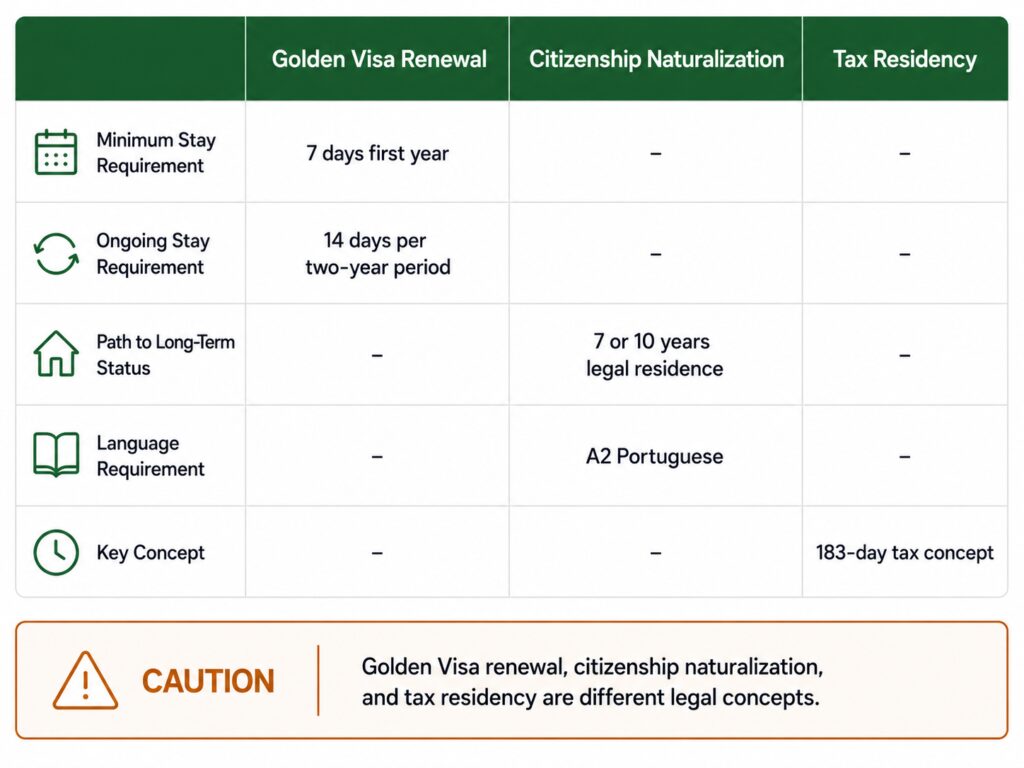
Golden Visa renewal versus citizenship physical presence requirements

The 5-Year Residency Pathway to Citizenship

For years, Portugal’s Golden Visa was commonly explained as a five-year route to citizenship. That statement now needs careful qualification.

The former five-year residency period still matters historically, and it may matter for specific pending nationality procedures, but it is no longer the general rule for most new citizenship applications after the 2026 reform.

How the Citizenship Clock Starts

The citizenship clock is based on legal residence in Portugal, not tourist visits. A Golden Visa investor begins building legal residence through a valid residence status issued under the Portuguese immigration framework.

For Golden Visa applicants, the practical citizenship file should include:

  1. Residence permit records
  2. Renewal records
  3. AIMA correspondence
  4. Proof of completed biometric appointments
  5. Evidence of lawful entries and stays in Portugal
  6. Documents showing the investment and residence status were maintained

The key point is simple: physical visits help support the file, but citizenship eligibility depends on legal residence continuity and the naturalization rules in force.

FREE LEGAL CONSULTATION

Have a Quick Question?

Our legal team is available Monday–Friday to answer your Portugal Golden Visa questions and help you understand your next steps.

Book Your Free Consultation Message Us on WhatsApp

Continuous vs Interrupted Residency

Portuguese nationality law does not treat every gap in exactly the same way. The current consolidated Nationality Law allows the sum of legal residence periods, followed or interrupted, within defined time windows depending on the applicant’s category.

For most Golden Visa investors, this matters because delays, renewals, administrative backlogs, and travel patterns can complicate the record. A clean file should show that the applicant maintained lawful residence status and did not allow avoidable gaps to weaken the citizenship application.

A strong citizenship timeline normally includes:

  • Valid ARI residence cards
  • Timely renewal submissions
  • Proof that the qualifying investment was maintained
  • Entry and exit evidence
  • No unresolved criminal record issues
  • Portuguese language preparation before the final year
  • Clear legal review before filing with the civil registry

This is also where strategic route selection matters. Investors using fund-based routes should make sure their investment remains compliant during the residence period. You can review current Portugal Golden Visa investment fund options before committing to a structure.

Physical Presence Evidence for Citizenship Application

There is no single magic document that proves physical presence for citizenship. A serious file uses a bundle of evidence, because immigration and civil registry authorities may look at the applicant’s residence history as a whole.

The objective is not to overwhelm the file with travel paperwork. The objective is to make your residence history easy to verify.

What Documents the Civil Registry Accepts

Portuguese citizenship applications are handled through the civil registry framework, involving IRN, the Instituto dos Registos e do Notariado. The consolidated Nationality Law states that nationality records and related declarations are managed within the civil registry system.

In practice, applicants should expect to prepare documents such as:

  • Valid passport copies
  • Portuguese residence permit copies
  • Birth certificate and legalized civil documents
  • Criminal record certificates from relevant countries
  • Portuguese criminal record authorization or certificate
  • Evidence of legal residence
  • Proof of Portuguese language and civic knowledge
  • Application forms and registry fee evidence
  • Supporting travel and residence records when relevant

The exact file depends on nationality, residence history, family situation, and the law in force at the application date.

Travel Records and Supporting Proof

Golden Visa investors often travel frequently, so travel records should be organized from the beginning rather than reconstructed years later. Border systems are not a personal filing cabinet. Keep your own record.

Useful supporting evidence may include:

  • Passport stamps
  • Boarding passes
  • Flight confirmations
  • Hotel invoices
  • Rental agreements
  • Utility bills during stays
  • Medical appointment records
  • School or family records, if relevant
  • Calendar of Portugal visits
  • Copies of AIMA appointment confirmations
  • Schengen travel records where available

For a high-net-worth investor, the best system is boring but reliable: keep a dated folder for each year of residence. Bureaucracy rewards boring files. It always has.

The A2 Portuguese Language Requirement

Physical presence is only one part of the citizenship picture. Language is another.

Portuguese nationality law requires applicants to prove sufficient knowledge of the Portuguese language and, after the 2026 reform, also refers to knowledge of Portuguese culture, history, national symbols, rights, duties, and the political organization of the Portuguese state.

How to Prepare for the Language Test

The most common route is the CIPLE exam, which corresponds to A2 level under the Common European Framework of Reference for Languages. The official CAPLE CIPLE page describes CIPLE as the A2-level exam for Portuguese as a foreign language.

A2 is basic, but it is not nothing. Applicants should be able to handle everyday communication, understand simple texts, and respond to basic spoken Portuguese.

A practical preparation plan looks like this:

  1. Start 12 to 18 months before the expected citizenship filing date.
  2. Study European Portuguese, not Brazilian Portuguese, unless advised otherwise.
  3. Practice listening, reading, writing, and speaking.
  4. Take mock CIPLE papers before registering.
  5. Book the exam early because seats can fill quickly.
  6. Keep the original certificate and certified copies.

Applicants from Portuguese-speaking countries may benefit from presumptions or different treatment under the law, but they should still confirm their documentary requirements before filing.

Approved Testing Centers Internationally

CAPLE exams are offered through authorized LAPE centers. The official CAPLE exam seasons page states that candidates must find an authorized exam center and notes that there are around 100 centers in 35 countries.

This matters for Golden Visa investors who do not live in Portugal full-time. You may be able to sit the exam outside Portugal, depending on availability, country, and exam level.

Before choosing a center, check:

  • Whether that LAPE offers CIPLE A2
  • Whether seats are available for the relevant session
  • Whether registration deadlines fit your citizenship timeline
  • Whether the certificate format is accepted for your case
  • Whether you need additional cultural or civic knowledge preparation under the updated law

Do not leave the A2 requirement until the month before filing. The exam is manageable, but scheduling can be the harder part.
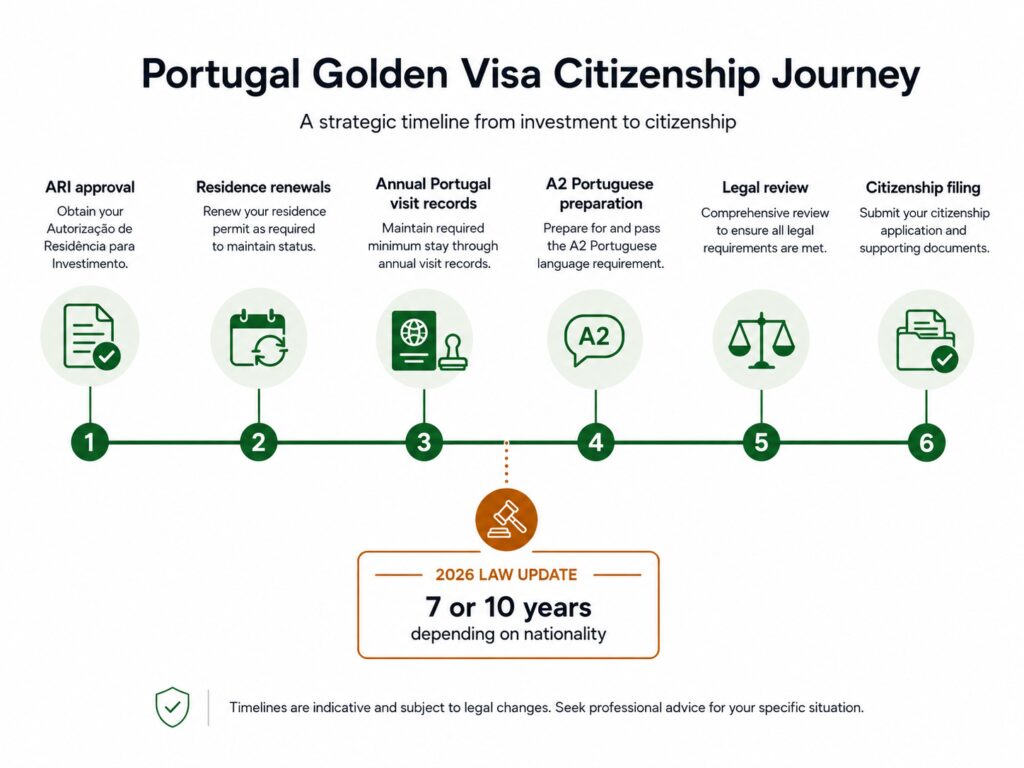
Portugal Golden Visa citizenship timeline and A2 language preparation

Recent Changes to Citizenship Timeline: 2025-2026 Updates

The citizenship timeline is the part of the Portugal Golden Visa discussion that changed most significantly. Older articles may still say that Golden Visa holders can apply after five years. That was the standard position before the 2026 law reform, but it is no longer the general rule for most new applicants.

Anyone planning citizenship should now treat timing as a legal question, not just an SEO headline.

Parliament Vote on Extending to 7-10 Years

Portugal’s Parliament approved changes to the Nationality Law in 2026, and the reform was published as Lei Orgânica n.º 1/2026 on 18 May 2026. It entered into force the following day.

The new rule changed the naturalization timeline to:

Applicant Category Legal Residence Requirement After 2026 Reform
Nationals of Portuguese-speaking countries 7 years
EU Member State nationals 7 years
Most other foreign nationals 10 years

For many Golden Visa investors from the United States, Canada, South Africa, China, the Middle East, and other non-EU, non-CPLP jurisdictions, the practical citizenship timeline is now generally 10 years, not 5.

This does not mean the Golden Visa has lost its purpose. It still gives qualifying investors legal residence, Schengen mobility, family inclusion, and a structured route toward long-term status. It does mean the citizenship expectation must be updated.

For some investors, another residency route may make more sense depending on relocation plans, income profile, and tax position. This is why it is useful to compare how the Golden Visa compares to the D7 before choosing a route.

What Grandfathered Applicants Should Know

Grandfathering is not the same as “I already have a Golden Visa, so the old rule applies to me.” That assumption is risky.

Lei Orgânica n.º 1/2026 states that administrative procedures pending at the date the law entered into force are governed by the previous version of the Nationality Law. In practical terms, this is most relevant to nationality applications already pending before 19 May 2026.

Golden Visa holders who had not yet filed a citizenship application by that date should not assume they are protected by the former five-year rule. Their position depends on the exact legal status of their file, the timing of any application, and the interpretation applied by the relevant authorities.

A careful review should answer four questions:

  1. Did you have a nationality application pending before 19 May 2026?
  2. Did you already meet the previous naturalization requirements before filing?
  3. Do you have uninterrupted or acceptable legal residence records?
  4. Does your nationality place you under the 7-year or 10-year category?

This is not an area for guesswork. A timing mistake can affect several years of planning.

FAQs About Citizenship Physical Presence via Golden Visa

How much time must I physically spend in Portugal to qualify for citizenship?

There is no simple rule saying that a Golden Visa holder must spend a fixed number of days per year in Portugal for citizenship. The ARI permit has its own minimum stay rule, but citizenship depends on legal residence, language and civic requirements, criminal record conditions, and the naturalization law in force when you apply. You should still keep clear evidence of your Portugal visits and residence history.

Is the physical presence for citizenship different from the visa minimum stay?

Yes. The Golden Visa minimum stay rule is mainly about maintaining and renewing the ARI residence permit. Citizenship is assessed under Portuguese nationality law, which now requires 7 or 10 years of legal residence for most applicants after the 2026 reform, depending on nationality. Physical presence evidence may support the file, but it does not replace the legal residence requirement.

Has Portugal changed the physical presence requirements in 2026?

Portugal changed the citizenship timeline and naturalization requirements in 2026, not the basic Golden Visa stay rule in the same way. The major change is that the former five-year citizenship expectation no longer applies generally to most new applicants. Under the 2026 law, many applicants now need 10 years of legal residence, while EU and Portuguese-speaking country nationals generally need 7 years.

What language test do I need for Portuguese citizenship?

Most applicants prove Portuguese language ability through an A2-level certificate, commonly the CIPLE exam administered through CAPLE-authorized centers. The 2026 law also refers to knowledge of Portuguese culture, history, national symbols, rights, duties, and the political organization of the Portuguese state. Applicants should prepare early and confirm the accepted certificate route before filing.

Is Portugal Golden Visa Citizenship Still Realistic?

The Portugal Golden Visa can still be a serious route to long-term Portuguese residence and, eventually, citizenship. What changed is the timeline. For many investors, the question is no longer “Can I apply after five years?” but “Which timeline applies to me, and how should I prepare my file from the beginning?”

The practical strategy is to separate the process into three tracks: maintain the ARI permit, preserve clean legal residence continuity, and prepare for citizenship requirements early. That means keeping travel records, renewing on time, preparing for A2 Portuguese, and reviewing the file before the final filing window.

If citizenship is the goal, the Golden Visa should be managed as a long-term legal residence file, not simply as an investment transaction.

Ready to take the next step?
Book a free initial assessment. We’ll assess your eligibility, walk through the current qualifying routes, and answer your questions, no cost, no commitment.


Portugal Golden Visa Physical Presence for Citizenship: What You Really Need

The portugal golden visa physical presence requirement is often misunderstood because investors confuse two separate rules: the minimum stay needed to keep the residence permit valid, and the broader naturalization requirements for Portuguese citizenship. The Golden Visa does not require full-time relocation, but citizenship is no longer just a simple five-year waiting exercise for most applicants after the 2026 nationality law reform.

This guide explains what physical presence really means, what changed in 2026, what evidence applicants should keep, and how the A2 Portuguese language requirement fits into the citizenship process.

Physical Presence for Portugal Golden Visa Citizenship: The Key Distinction

The first mistake is assuming that the Golden Visa stay rule and the citizenship rule are the same thing. They are connected, but they answer different questions.

The Golden Visa stay rule asks: did you spend enough time in Portugal to maintain the residence permit? Citizenship asks: do you meet the legal residence, language, civic, criminal-record, and naturalization requirements in force when you apply?

Minimum Stay for the Visa vs Citizenship Naturalization

For the ARI, or Autorização de Residência para Investimento, the minimum stay requirement is relatively light. According to the AIMA official ARI page, investors must remain in Portugal for at least 7 days in the first year and at least 14 days in subsequent two-year periods.

That rule helps you maintain the residence permit. It does not automatically prove you qualify for citizenship.

Here is the practical distinction:

Requirement What It Applies To What It Means
ARI minimum stay Golden Visa renewal 7 days in year one, then 14 days in later two-year periods
Legal residence period Citizenship eligibility 7 or 10 years under the 2026 law for most applicants, depending on nationality
Physical presence for naturalization Citizenship file assessment No simple “X days per year” rule, but evidence of lawful residence and connection matters
183-day rule for tax Tax residency A separate tax concept, not the Golden Visa stay rule

The 183-day rule for tax is especially easy to confuse with immigration status. Spending 183 days or more in Portugal may affect tax residency, but it is not the same as the Golden Visa minimum stay requirement.

What the Law Currently Requires

Portugal’s 2026 nationality reform changed the citizenship timeline. Under Lei Orgânica n.º 1/2026, naturalization generally requires legal residence for:

  • 7 years for nationals of Portuguese-speaking countries and EU Member States
  • 10 years for nationals of other countries

The law also requires applicants to satisfy additional conditions, including sufficient knowledge of Portuguese language and culture, understanding of fundamental rights and duties, a qualifying criminal record position, and capacity to support themselves.

This is why physical presence must be planned as part of a wider citizenship strategy. A Golden Visa holder who only focuses on renewal days may keep the permit valid, but still be unprepared for the citizenship application.

For investors comparing residency routes, the Portugal Golden Visa programme remains attractive because it offers legal residence with a low stay requirement, but citizenship planning now needs more careful timing.

Golden Visa renewal versus citizenship physical presence requirements

The 5-Year Residency Pathway to Citizenship

For years, Portugal’s Golden Visa was commonly explained as a five-year route to citizenship. That statement now needs careful qualification.

The former five-year residency period still matters historically, and it may matter for specific pending nationality procedures, but it is no longer the general rule for most new citizenship applications after the 2026 reform.

How the Citizenship Clock Starts

The citizenship clock is based on legal residence in Portugal, not tourist visits. A Golden Visa investor begins building legal residence through a valid residence status issued under the Portuguese immigration framework.

For Golden Visa applicants, the practical citizenship file should include:

  1. Residence permit records
  2. Renewal records
  3. AIMA correspondence
  4. Proof of completed biometric appointments
  5. Evidence of lawful entries and stays in Portugal
  6. Documents showing the investment and residence status were maintained

The key point is simple: physical visits help support the file, but citizenship eligibility depends on legal residence continuity and the naturalization rules in force.

FREE LEGAL CONSULTATION

Have a Quick Question?

Our legal team is available Monday–Friday to answer your Portugal Golden Visa questions and help you understand your next steps.

Book Your Free Consultation Message Us on WhatsApp

Continuous vs Interrupted Residency

Portuguese nationality law does not treat every gap in exactly the same way. The current consolidated Nationality Law allows the sum of legal residence periods, followed or interrupted, within defined time windows depending on the applicant’s category.

For most Golden Visa investors, this matters because delays, renewals, administrative backlogs, and travel patterns can complicate the record. A clean file should show that the applicant maintained lawful residence status and did not allow avoidable gaps to weaken the citizenship application.

A strong citizenship timeline normally includes:

  • Valid ARI residence cards
  • Timely renewal submissions
  • Proof that the qualifying investment was maintained
  • Entry and exit evidence
  • No unresolved criminal record issues
  • Portuguese language preparation before the final year
  • Clear legal review before filing with the civil registry

This is also where strategic route selection matters. Investors using fund-based routes should make sure their investment remains compliant during the residence period. You can review current Portugal Golden Visa investment fund options before committing to a structure.

Physical Presence Evidence for Citizenship Application

There is no single magic document that proves physical presence for citizenship. A serious file uses a bundle of evidence, because immigration and civil registry authorities may look at the applicant’s residence history as a whole.

The objective is not to overwhelm the file with travel paperwork. The objective is to make your residence history easy to verify.

What Documents the Civil Registry Accepts

Portuguese citizenship applications are handled through the civil registry framework, involving IRN, the Instituto dos Registos e do Notariado. The consolidated Nationality Law states that nationality records and related declarations are managed within the civil registry system.

In practice, applicants should expect to prepare documents such as:

  • Valid passport copies
  • Portuguese residence permit copies
  • Birth certificate and legalized civil documents
  • Criminal record certificates from relevant countries
  • Portuguese criminal record authorization or certificate
  • Evidence of legal residence
  • Proof of Portuguese language and civic knowledge
  • Application forms and registry fee evidence
  • Supporting travel and residence records when relevant

The exact file depends on nationality, residence history, family situation, and the law in force at the application date.

Travel Records and Supporting Proof

Golden Visa investors often travel frequently, so travel records should be organized from the beginning rather than reconstructed years later. Border systems are not a personal filing cabinet. Keep your own record.

Useful supporting evidence may include:

  • Passport stamps
  • Boarding passes
  • Flight confirmations
  • Hotel invoices
  • Rental agreements
  • Utility bills during stays
  • Medical appointment records
  • School or family records, if relevant
  • Calendar of Portugal visits
  • Copies of AIMA appointment confirmations
  • Schengen travel records where available

For a high-net-worth investor, the best system is boring but reliable: keep a dated folder for each year of residence. Bureaucracy rewards boring files. It always has.

The A2 Portuguese Language Requirement

Physical presence is only one part of the citizenship picture. Language is another.

Portuguese nationality law requires applicants to prove sufficient knowledge of the Portuguese language and, after the 2026 reform, also refers to knowledge of Portuguese culture, history, national symbols, rights, duties, and the political organization of the Portuguese state.

How to Prepare for the Language Test

The most common route is the CIPLE exam, which corresponds to A2 level under the Common European Framework of Reference for Languages. The official CAPLE CIPLE page describes CIPLE as the A2-level exam for Portuguese as a foreign language.

A2 is basic, but it is not nothing. Applicants should be able to handle everyday communication, understand simple texts, and respond to basic spoken Portuguese.

A practical preparation plan looks like this:

  1. Start 12 to 18 months before the expected citizenship filing date.
  2. Study European Portuguese, not Brazilian Portuguese, unless advised otherwise.
  3. Practice listening, reading, writing, and speaking.
  4. Take mock CIPLE papers before registering.
  5. Book the exam early because seats can fill quickly.
  6. Keep the original certificate and certified copies.

Applicants from Portuguese-speaking countries may benefit from presumptions or different treatment under the law, but they should still confirm their documentary requirements before filing.

Approved Testing Centers Internationally

CAPLE exams are offered through authorized LAPE centers. The official CAPLE exam seasons page states that candidates must find an authorized exam center and notes that there are around 100 centers in 35 countries.

This matters for Golden Visa investors who do not live in Portugal full-time. You may be able to sit the exam outside Portugal, depending on availability, country, and exam level.

Before choosing a center, check:

  • Whether that LAPE offers CIPLE A2
  • Whether seats are available for the relevant session
  • Whether registration deadlines fit your citizenship timeline
  • Whether the certificate format is accepted for your case
  • Whether you need additional cultural or civic knowledge preparation under the updated law

Do not leave the A2 requirement until the month before filing. The exam is manageable, but scheduling can be the harder part.

Portugal Golden Visa citizenship timeline and A2 language preparation

Recent Changes to Citizenship Timeline: 2025-2026 Updates

The citizenship timeline is the part of the Portugal Golden Visa discussion that changed most significantly. Older articles may still say that Golden Visa holders can apply after five years. That was the standard position before the 2026 law reform, but it is no longer the general rule for most new applicants.

Anyone planning citizenship should now treat timing as a legal question, not just an SEO headline.

Parliament Vote on Extending to 7-10 Years

Portugal’s Parliament approved changes to the Nationality Law in 2026, and the reform was published as Lei Orgânica n.º 1/2026 on 18 May 2026. It entered into force the following day.

The new rule changed the naturalization timeline to:

Applicant Category Legal Residence Requirement After 2026 Reform
Nationals of Portuguese-speaking countries 7 years
EU Member State nationals 7 years
Most other foreign nationals 10 years

For many Golden Visa investors from the United States, Canada, South Africa, China, the Middle East, and other non-EU, non-CPLP jurisdictions, the practical citizenship timeline is now generally 10 years, not 5.

This does not mean the Golden Visa has lost its purpose. It still gives qualifying investors legal residence, Schengen mobility, family inclusion, and a structured route toward long-term status. It does mean the citizenship expectation must be updated.

For some investors, another residency route may make more sense depending on relocation plans, income profile, and tax position. This is why it is useful to compare how the Golden Visa compares to the D7 before choosing a route.

What Grandfathered Applicants Should Know

Grandfathering is not the same as “I already have a Golden Visa, so the old rule applies to me.” That assumption is risky.

Lei Orgânica n.º 1/2026 states that administrative procedures pending at the date the law entered into force are governed by the previous version of the Nationality Law. In practical terms, this is most relevant to nationality applications already pending before 19 May 2026.

Golden Visa holders who had not yet filed a citizenship application by that date should not assume they are protected by the former five-year rule. Their position depends on the exact legal status of their file, the timing of any application, and the interpretation applied by the relevant authorities.

A careful review should answer four questions:

  1. Did you have a nationality application pending before 19 May 2026?
  2. Did you already meet the previous naturalization requirements before filing?
  3. Do you have uninterrupted or acceptable legal residence records?
  4. Does your nationality place you under the 7-year or 10-year category?

This is not an area for guesswork. A timing mistake can affect several years of planning.

FAQs About Citizenship Physical Presence via Golden Visa

How much time must I physically spend in Portugal to qualify for citizenship?

There is no simple rule saying that a Golden Visa holder must spend a fixed number of days per year in Portugal for citizenship. The ARI permit has its own minimum stay rule, but citizenship depends on legal residence, language and civic requirements, criminal record conditions, and the naturalization law in force when you apply. You should still keep clear evidence of your Portugal visits and residence history.

Is the physical presence for citizenship different from the visa minimum stay?

Yes. The Golden Visa minimum stay rule is mainly about maintaining and renewing the ARI residence permit. Citizenship is assessed under Portuguese nationality law, which now requires 7 or 10 years of legal residence for most applicants after the 2026 reform, depending on nationality. Physical presence evidence may support the file, but it does not replace the legal residence requirement.

Has Portugal changed the physical presence requirements in 2026?

Portugal changed the citizenship timeline and naturalization requirements in 2026, not the basic Golden Visa stay rule in the same way. The major change is that the former five-year citizenship expectation no longer applies generally to most new applicants. Under the 2026 law, many applicants now need 10 years of legal residence, while EU and Portuguese-speaking country nationals generally need 7 years.

What language test do I need for Portuguese citizenship?

Most applicants prove Portuguese language ability through an A2-level certificate, commonly the CIPLE exam administered through CAPLE-authorized centers. The 2026 law also refers to knowledge of Portuguese culture, history, national symbols, rights, duties, and the political organization of the Portuguese state. Applicants should prepare early and confirm the accepted certificate route before filing.

Is Portugal Golden Visa Citizenship Still Realistic?

The Portugal Golden Visa can still be a serious route to long-term Portuguese residence and, eventually, citizenship. What changed is the timeline. For many investors, the question is no longer “Can I apply after five years?” but “Which timeline applies to me, and how should I prepare my file from the beginning?”

The practical strategy is to separate the process into three tracks: maintain the ARI permit, preserve clean legal residence continuity, and prepare for citizenship requirements early. That means keeping travel records, renewing on time, preparing for A2 Portuguese, and reviewing the file before the final filing window.

If citizenship is the goal, the Golden Visa should be managed as a long-term legal residence file, not simply as an investment transaction.

Ready to take the next step?
Book a free initial assessment. We’ll assess your eligibility, walk through the current qualifying routes, and answer your questions, no cost, no commitment.

Portugal Golden Visa Physical Presence for Citizenship: What You Really Need

Portugal-Golden-Visa-Physical-Presence-for-Citizenship-What-You-Really-Need
The portugal golden visa physical presence requirement is often misunderstood because investors confuse two separate rules: the minimum stay needed to keep the residence permit valid, and the broader naturalization requirements for Portuguese citizenship. The Golden Visa does not require full-time relocation, but citizenship is no longer just a simple five-year waiting exercise for most applicants after the 2026 nationality law reform.

This guide explains what physical presence really means, what changed in 2026, what evidence applicants should keep, and how the A2 Portuguese language requirement fits into the citizenship process.

Physical Presence for Portugal Golden Visa Citizenship: The Key Distinction

The first mistake is assuming that the Golden Visa stay rule and the citizenship rule are the same thing. They are connected, but they answer different questions.

The Golden Visa stay rule asks: did you spend enough time in Portugal to maintain the residence permit? Citizenship asks: do you meet the legal residence, language, civic, criminal-record, and naturalization requirements in force when you apply?

Minimum Stay for the Visa vs Citizenship Naturalization

For the ARI, or Autorização de Residência para Investimento, the minimum stay requirement is relatively light. According to the AIMA official ARI page, investors must remain in Portugal for at least 7 days in the first year and at least 14 days in subsequent two-year periods.

That rule helps you maintain the residence permit. It does not automatically prove you qualify for citizenship.

Here is the practical distinction:

Requirement What It Applies To What It Means
ARI minimum stay Golden Visa renewal 7 days in year one, then 14 days in later two-year periods
Legal residence period Citizenship eligibility 7 or 10 years under the 2026 law for most applicants, depending on nationality
Physical presence for naturalization Citizenship file assessment No simple “X days per year” rule, but evidence of lawful residence and connection matters
183-day rule for tax Tax residency A separate tax concept, not the Golden Visa stay rule

The 183-day rule for tax is especially easy to confuse with immigration status. Spending 183 days or more in Portugal may affect tax residency, but it is not the same as the Golden Visa minimum stay requirement.

What the Law Currently Requires

Portugal’s 2026 nationality reform changed the citizenship timeline. Under Lei Orgânica n.º 1/2026, naturalization generally requires legal residence for:

  • 7 years for nationals of Portuguese-speaking countries and EU Member States
  • 10 years for nationals of other countries

The law also requires applicants to satisfy additional conditions, including sufficient knowledge of Portuguese language and culture, understanding of fundamental rights and duties, a qualifying criminal record position, and capacity to support themselves.

This is why physical presence must be planned as part of a wider citizenship strategy. A Golden Visa holder who only focuses on renewal days may keep the permit valid, but still be unprepared for the citizenship application.

For investors comparing residency routes, the Portugal Golden Visa programme remains attractive because it offers legal residence with a low stay requirement, but citizenship planning now needs more careful timing.

Golden Visa renewal versus citizenship physical presence requirements

The 5-Year Residency Pathway to Citizenship

For years, Portugal’s Golden Visa was commonly explained as a five-year route to citizenship. That statement now needs careful qualification.

The former five-year residency period still matters historically, and it may matter for specific pending nationality procedures, but it is no longer the general rule for most new citizenship applications after the 2026 reform.

How the Citizenship Clock Starts

The citizenship clock is based on legal residence in Portugal, not tourist visits. A Golden Visa investor begins building legal residence through a valid residence status issued under the Portuguese immigration framework.

For Golden Visa applicants, the practical citizenship file should include:

  1. Residence permit records
  2. Renewal records
  3. AIMA correspondence
  4. Proof of completed biometric appointments
  5. Evidence of lawful entries and stays in Portugal
  6. Documents showing the investment and residence status were maintained

The key point is simple: physical visits help support the file, but citizenship eligibility depends on legal residence continuity and the naturalization rules in force.

FREE LEGAL CONSULTATION

Have a Quick Question?

Our legal team is available Monday–Friday to answer your Portugal Golden Visa questions and help you understand your next steps.

Book Your Free Consultation Message Us on WhatsApp

Continuous vs Interrupted Residency

Portuguese nationality law does not treat every gap in exactly the same way. The current consolidated Nationality Law allows the sum of legal residence periods, followed or interrupted, within defined time windows depending on the applicant’s category.

For most Golden Visa investors, this matters because delays, renewals, administrative backlogs, and travel patterns can complicate the record. A clean file should show that the applicant maintained lawful residence status and did not allow avoidable gaps to weaken the citizenship application.

A strong citizenship timeline normally includes:

  • Valid ARI residence cards
  • Timely renewal submissions
  • Proof that the qualifying investment was maintained
  • Entry and exit evidence
  • No unresolved criminal record issues
  • Portuguese language preparation before the final year
  • Clear legal review before filing with the civil registry

This is also where strategic route selection matters. Investors using fund-based routes should make sure their investment remains compliant during the residence period. You can review current Portugal Golden Visa investment fund options before committing to a structure.

Physical Presence Evidence for Citizenship Application

There is no single magic document that proves physical presence for citizenship. A serious file uses a bundle of evidence, because immigration and civil registry authorities may look at the applicant’s residence history as a whole.

The objective is not to overwhelm the file with travel paperwork. The objective is to make your residence history easy to verify.

What Documents the Civil Registry Accepts

Portuguese citizenship applications are handled through the civil registry framework, involving IRN, the Instituto dos Registos e do Notariado. The consolidated Nationality Law states that nationality records and related declarations are managed within the civil registry system.

In practice, applicants should expect to prepare documents such as:

  • Valid passport copies
  • Portuguese residence permit copies
  • Birth certificate and legalized civil documents
  • Criminal record certificates from relevant countries
  • Portuguese criminal record authorization or certificate
  • Evidence of legal residence
  • Proof of Portuguese language and civic knowledge
  • Application forms and registry fee evidence
  • Supporting travel and residence records when relevant

The exact file depends on nationality, residence history, family situation, and the law in force at the application date.

Travel Records and Supporting Proof

Golden Visa investors often travel frequently, so travel records should be organized from the beginning rather than reconstructed years later. Border systems are not a personal filing cabinet. Keep your own record.

Useful supporting evidence may include:

  • Passport stamps
  • Boarding passes
  • Flight confirmations
  • Hotel invoices
  • Rental agreements
  • Utility bills during stays
  • Medical appointment records
  • School or family records, if relevant
  • Calendar of Portugal visits
  • Copies of AIMA appointment confirmations
  • Schengen travel records where available

For a high-net-worth investor, the best system is boring but reliable: keep a dated folder for each year of residence. Bureaucracy rewards boring files. It always has.

The A2 Portuguese Language Requirement

Physical presence is only one part of the citizenship picture. Language is another.

Portuguese nationality law requires applicants to prove sufficient knowledge of the Portuguese language and, after the 2026 reform, also refers to knowledge of Portuguese culture, history, national symbols, rights, duties, and the political organization of the Portuguese state.

How to Prepare for the Language Test

The most common route is the CIPLE exam, which corresponds to A2 level under the Common European Framework of Reference for Languages. The official CAPLE CIPLE page describes CIPLE as the A2-level exam for Portuguese as a foreign language.

A2 is basic, but it is not nothing. Applicants should be able to handle everyday communication, understand simple texts, and respond to basic spoken Portuguese.

A practical preparation plan looks like this:

  1. Start 12 to 18 months before the expected citizenship filing date.
  2. Study European Portuguese, not Brazilian Portuguese, unless advised otherwise.
  3. Practice listening, reading, writing, and speaking.
  4. Take mock CIPLE papers before registering.
  5. Book the exam early because seats can fill quickly.
  6. Keep the original certificate and certified copies.

Applicants from Portuguese-speaking countries may benefit from presumptions or different treatment under the law, but they should still confirm their documentary requirements before filing.

Approved Testing Centers Internationally

CAPLE exams are offered through authorized LAPE centers. The official CAPLE exam seasons page states that candidates must find an authorized exam center and notes that there are around 100 centers in 35 countries.

This matters for Golden Visa investors who do not live in Portugal full-time. You may be able to sit the exam outside Portugal, depending on availability, country, and exam level.

Before choosing a center, check:

  • Whether that LAPE offers CIPLE A2
  • Whether seats are available for the relevant session
  • Whether registration deadlines fit your citizenship timeline
  • Whether the certificate format is accepted for your case
  • Whether you need additional cultural or civic knowledge preparation under the updated law

Do not leave the A2 requirement until the month before filing. The exam is manageable, but scheduling can be the harder part.

Portugal Golden Visa citizenship timeline and A2 language preparation

Recent Changes to Citizenship Timeline: 2025-2026 Updates

The citizenship timeline is the part of the Portugal Golden Visa discussion that changed most significantly. Older articles may still say that Golden Visa holders can apply after five years. That was the standard position before the 2026 law reform, but it is no longer the general rule for most new applicants.

Anyone planning citizenship should now treat timing as a legal question, not just an SEO headline.

Parliament Vote on Extending to 7-10 Years

Portugal’s Parliament approved changes to the Nationality Law in 2026, and the reform was published as Lei Orgânica n.º 1/2026 on 18 May 2026. It entered into force the following day.

The new rule changed the naturalization timeline to:

Applicant Category Legal Residence Requirement After 2026 Reform
Nationals of Portuguese-speaking countries 7 years
EU Member State nationals 7 years
Most other foreign nationals 10 years

For many Golden Visa investors from the United States, Canada, South Africa, China, the Middle East, and other non-EU, non-CPLP jurisdictions, the practical citizenship timeline is now generally 10 years, not 5.

This does not mean the Golden Visa has lost its purpose. It still gives qualifying investors legal residence, Schengen mobility, family inclusion, and a structured route toward long-term status. It does mean the citizenship expectation must be updated.

For some investors, another residency route may make more sense depending on relocation plans, income profile, and tax position. This is why it is useful to compare how the Golden Visa compares to the D7 before choosing a route.

What Grandfathered Applicants Should Know

Grandfathering is not the same as “I already have a Golden Visa, so the old rule applies to me.” That assumption is risky.

Lei Orgânica n.º 1/2026 states that administrative procedures pending at the date the law entered into force are governed by the previous version of the Nationality Law. In practical terms, this is most relevant to nationality applications already pending before 19 May 2026.

Golden Visa holders who had not yet filed a citizenship application by that date should not assume they are protected by the former five-year rule. Their position depends on the exact legal status of their file, the timing of any application, and the interpretation applied by the relevant authorities.

A careful review should answer four questions:

  1. Did you have a nationality application pending before 19 May 2026?
  2. Did you already meet the previous naturalization requirements before filing?
  3. Do you have uninterrupted or acceptable legal residence records?
  4. Does your nationality place you under the 7-year or 10-year category?

This is not an area for guesswork. A timing mistake can affect several years of planning.

FAQs About Citizenship Physical Presence via Golden Visa

How much time must I physically spend in Portugal to qualify for citizenship?

There is no simple rule saying that a Golden Visa holder must spend a fixed number of days per year in Portugal for citizenship. The ARI permit has its own minimum stay rule, but citizenship depends on legal residence, language and civic requirements, criminal record conditions, and the naturalization law in force when you apply. You should still keep clear evidence of your Portugal visits and residence history.

Is the physical presence for citizenship different from the visa minimum stay?

Yes. The Golden Visa minimum stay rule is mainly about maintaining and renewing the ARI residence permit. Citizenship is assessed under Portuguese nationality law, which now requires 7 or 10 years of legal residence for most applicants after the 2026 reform, depending on nationality. Physical presence evidence may support the file, but it does not replace the legal residence requirement.

Has Portugal changed the physical presence requirements in 2026?

Portugal changed the citizenship timeline and naturalization requirements in 2026, not the basic Golden Visa stay rule in the same way. The major change is that the former five-year citizenship expectation no longer applies generally to most new applicants. Under the 2026 law, many applicants now need 10 years of legal residence, while EU and Portuguese-speaking country nationals generally need 7 years.

What language test do I need for Portuguese citizenship?

Most applicants prove Portuguese language ability through an A2-level certificate, commonly the CIPLE exam administered through CAPLE-authorized centers. The 2026 law also refers to knowledge of Portuguese culture, history, national symbols, rights, duties, and the political organization of the Portuguese state. Applicants should prepare early and confirm the accepted certificate route before filing.

Is Portugal Golden Visa Citizenship Still Realistic?

The Portugal Golden Visa can still be a serious route to long-term Portuguese residence and, eventually, citizenship. What changed is the timeline. For many investors, the question is no longer “Can I apply after five years?” but “Which timeline applies to me, and how should I prepare my file from the beginning?”

The practical strategy is to separate the process into three tracks: maintain the ARI permit, preserve clean legal residence continuity, and prepare for citizenship requirements early. That means keeping travel records, renewing on time, preparing for A2 Portuguese, and reviewing the file before the final filing window.

If citizenship is the goal, the Golden Visa should be managed as a long-term legal residence file, not simply as an investment transaction.

Ready to take the next step?
Book a free initial assessment. We’ll assess your eligibility, walk through the current qualifying routes, and answer your questions, no cost, no commitment.

What do you think?
Blog

More Related Articles

top








