
The correct fund can support your residency strategy, match your risk profile, and give you a defined exit framework. The wrong fund can expose you to weak governance, poor liquidity, unclear fees, or a manager whose sales material is stronger than their track record.
This guide explains how to evaluate qualifying funds through performance, risk, documentation, fees, and due diligence before committing capital.
Why Choosing the Right Portugal Golden Visa Investment Fund Matters
Portugal removed real estate from the Golden Visa qualifying routes in 2023. For many applicants, the main route is now a qualifying investment into a regulated fund structure.
That change makes fund selection one of the most important parts of the process. You are not only applying for residence under the ARI, Autorização de Residência para Investimento, but also placing capital into a financial product that must be assessed on its own merits.
Residency applications are handled by AIMA, the Agency for Integration, Migration and Asylum, while qualifying investment funds operate under the supervision of CMVM, Portugal’s Securities Market Commission. These two institutions play different roles. AIMA reviews immigration eligibility and ARI processing. CMVM supervises the financial market framework.
That distinction matters because approval for residency does not mean the investment is low risk. A fund can be regulated and still have weak performance, high fees, long exit terms, or a portfolio that does not suit your personal risk profile.
For a full overview of the residency route itself, see the Portugal Golden Visa programme. For investors comparing fund structures, our guide to Portugal Golden Visa investment fund options explains how different fund categories may fit different objectives.

Key Metrics to Evaluate Any Qualifying Fund
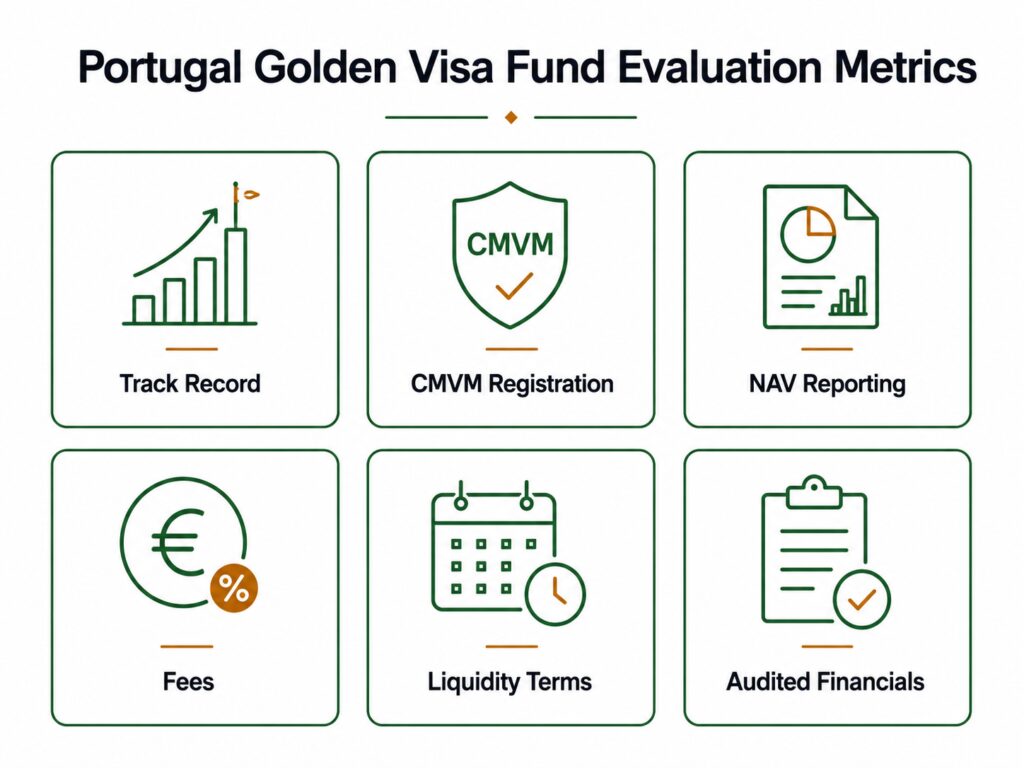
A fund should not be judged by one headline figure. You need to compare the fund manager, investment strategy, fees, reporting quality, portfolio composition, and exit assumptions together.
The table below gives a practical starting point.
| Evaluation Area | What to Review | Why It Matters |
| Track record | Past exits, realised performance, comparable funds | Shows whether the manager has executed before |
| NAV | Net asset value methodology and reporting frequency | Helps you understand how the fund values assets |
| IRR | Internal rate of return assumptions | Shows how performance is being presented over time |
| Liquidity | Exit timeline and redemption terms | Determines when and how you may recover capital |
| Fees | Management fee, carried interest, entry fees | Affects net investor return |
| Documentation | Fund prospectus and audited financials | Shows governance, risks, and obligations |
Track Record and Historical Performance
A fund track record should be specific, not decorative. Look for evidence of realised exits, historical performance across market cycles, and experience managing similar assets.
Do not rely only on target returns. A presentation may show attractive projections, but the more useful question is what the manager has already done with comparable capital.
Ask for:
- Historical fund performance, net of fees.
- Realised exits, not only paper valuations.
- Comparison between target IRR and achieved IRR.
- NAV, net asset value, reporting history.
- Performance during weaker market conditions.
For Portugal Golden Visa fund performance, the most important issue is not whether the return target looks high. It is whether the assumptions behind the target are credible, documented, and supported by manager experience.
Fund Manager Experience and Regulatory Status
The fund manager should have a clear regulatory profile, relevant experience, and an investment team capable of executing the stated strategy.
A strong fund manager should be able to explain:
- Who manages the fund.
- Who controls investment decisions.
- Whether the fund is registered and supervised.
- Who acts as depositary or custodian.
- How conflicts of interest are handled.
- How investors receive reporting.
For EU alternative investment structures, the AIFM Directive on alternative investment fund managers provides a wider regulatory framework around authorisation, operation, and transparency for managers of alternative investment funds.
This does not remove investment risk. It simply means the fund must be evaluated through both immigration suitability and financial governance.
Exit Timeline and Liquidity Terms
Most qualifying funds are structured as closed-ended funds. That means investors usually commit capital for a defined period and cannot redeem freely whenever they want.
The exit timeline should be compared with your Golden Visa objective. The programme requires a minimum investment holding period of five years. A fund with a seven, eight, or ten-year life may still be acceptable from an investment perspective, but it may not suit an investor who wants flexibility shortly after citizenship eligibility.
Review these terms carefully:
- Fund maturity date.
- Extension rights.
- Early redemption rules.
- Secondary market possibilities.
- Lock-up period.
- Distribution policy.
- Exit strategy for underlying assets.
A clear liquidity structure is better than an optimistic one. “Expected exit in year six” is not the same as a legally defined redemption right.
Fee Structure: Management Performance and Entry Fees
Fees can materially affect your net return. A fund with a lower headline return and transparent fees may be stronger than a fund with aggressive return targets and unclear costs.
Common fees include:
- Management fee: Usually charged annually for fund operations and investment management.
- Entry fee or subscription fee: Charged when the investor subscribes.
- Performance fee or carried interest: Paid to the manager if the fund exceeds a defined hurdle.
- Administration and custody costs: Related to fund operations, reporting, and safekeeping.
- Exit fees: Sometimes applied on redemption or transfer.
Ask for a complete fee table. Also ask whether the quoted Portugal Golden Visa investment fund returns are gross or net of all fund-level fees.
Understanding the Fund Prospectus
The fund prospectus is not a formality. It is the document that tells you what the fund can do, what it cannot do, how it charges fees, and what risks you are accepting.
A serious investor should read the prospectus before subscribing, then have it reviewed by an independent lawyer, financial adviser, or tax professional where appropriate.
What to Look For in the Key Investor Information Document
The key investor information document should make the main terms understandable. It does not replace the full fund prospectus, but it helps you identify whether the fund deserves deeper review.
Focus on:
- Investment strategy: What assets does the fund actually buy?
- Investor suitability: Who is the fund designed for?
- Risk rating: What level of volatility or capital risk should investors expect?
- Fund duration: When does the fund expect to exit?
- Capital call schedule: Is the full investment paid upfront or called in stages?
- Reporting frequency: How often does the manager report NAV and performance?
- Fee structure: Which fees apply at entry, during holding, and at exit?
- Governance: Who supervises valuation, custody, and audit?
The goal is not to find a risk-free fund. That does not exist. The goal is to understand the risk clearly before the investment becomes part of your residency plan.
Red Flags to Watch For
Some warning signs are obvious. Others only become visible when you compare the fund documents with the sales pitch.
Watch carefully for:
- Return projections without clear assumptions.
- No audited financials or limited historical reporting.
- Unclear exit timeline.
- Vague portfolio composition.
- Weak explanation of liquidity terms.
- Overreliance on one asset, one borrower, or one development.
- Conflicts of interest that are disclosed poorly.
- Manager with limited experience in the fund’s stated asset class.
- Fees that are scattered across multiple documents.
Also be cautious if the conversation focuses almost entirely on immigration approval and barely addresses investment risk. The fund exists for both purposes. A serious adviser should be willing to discuss both.
For investors still deciding how to choose Portugal Golden Visa fund options, our page on qualifying fund investment options explains the investment route in more detail.
Due Diligence Checklist for Investors
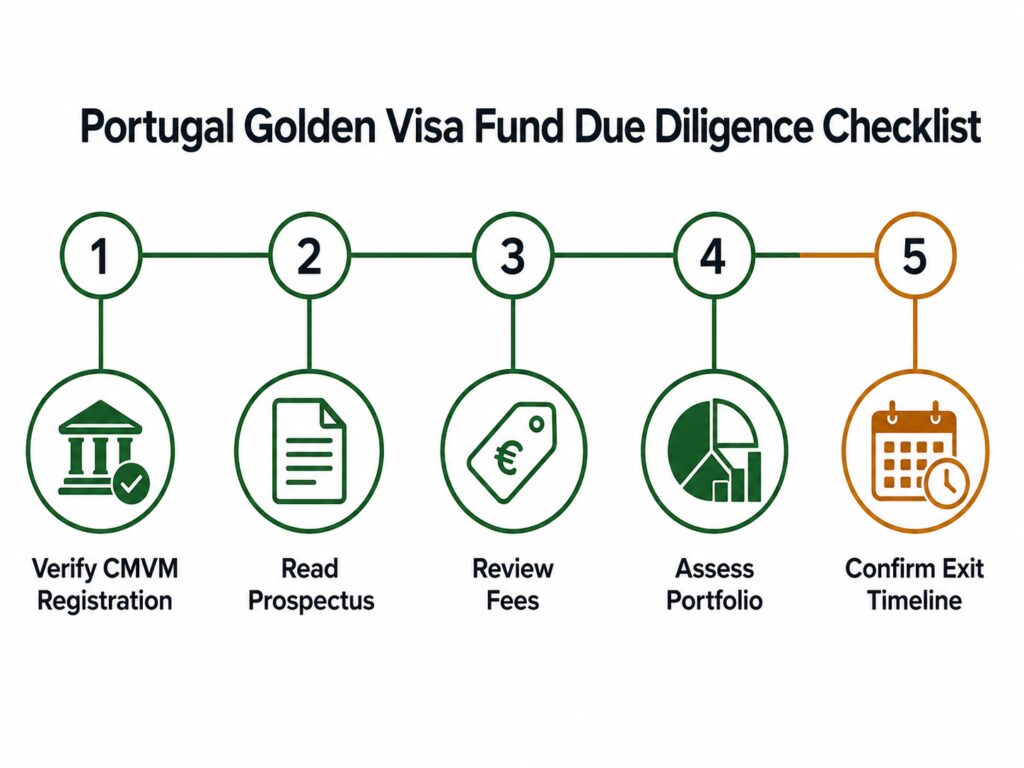
Due diligence should happen before subscription, not after the investor has transferred funds. The process should verify the fund, the manager, the documents, the strategy, and the practical fit with your Golden Visa plan.
Use the checklist below as a starting point.
| Due Diligence Question | What a Strong Answer Looks Like |
| Is the fund CMVM-regulated? | Clear registration and supervisory information |
| Who is the fund manager? | Named manager with relevant experience |
| Are audited financials available? | Recent audits or a clear explanation for new funds |
| What is the portfolio strategy? | Specific asset class, allocation, and risk logic |
| What is the exit plan? | Defined timeline with realistic assumptions |
| What are total fees? | Full cost table, including management fee and carried interest |
| How often is NAV reported? | Regular reporting with a transparent valuation method |
| Does the fund fit investor suitability rules? | Clear target investor profile and risk disclosure |
Verify CMVM Registration
CMVM registration is a starting point, not the whole due diligence process. It confirms the fund or manager sits within Portugal’s supervised financial market framework, but it does not guarantee performance.
Investors should ask the fund manager or adviser to show:
- Fund registration details.
- Management company details.
- Depositary or custodian information.
- Prospectus approval status where relevant.
- Current regulatory standing.
Any hesitation around basic regulatory verification should be treated seriously.
Review Audited Financial Statements
Audited financials help you see how the fund reports assets, liabilities, costs, and performance. For a newer fund, full historical audits may not exist yet. In that case, ask for audits of prior funds managed by the same team.
Review:
- Net asset value calculations.
- Fund expenses.
- Asset valuation methods.
- Related-party transactions.
- Notes from the auditor.
- Realised and unrealised gains.
This is where many investors discover the difference between a strong presentation and a strong fund.
Assess Portfolio Composition
Portfolio composition tells you where the money actually goes. A fund may invest in private equity, venture capital, credit, operating companies, hospitality, infrastructure, or other eligible strategies.
Assess:
- Number of underlying investments.
- Sector concentration.
- Geographic exposure.
- Use of leverage.
- Stage of each investment.
- Exit route for each major asset.
- Dependence on one buyer, one market, or one refinancing event.
A concentrated fund is not automatically bad. It may even be intentional. But concentration should be priced, disclosed, and understood.
Realistic Return Expectations
Portugal Golden Visa investment fund returns vary by strategy, manager, asset class, fees, and market conditions. No adviser should promise a fixed outcome unless the product legally supports that structure and the risks are fully disclosed.
A realistic review separates three things:
- Target return: What the fund hopes to achieve.
- Projected return: What the fund model suggests under certain assumptions.
- Realised return: What investors actually receive after fees, timing, and exit.
IRR, internal rate of return, is useful, but it can be misunderstood. A strong IRR does not always mean a high total cash return if the investment period is short, distributions are delayed, or fees reduce the net result.
NAV, net asset value, also needs context. A rising NAV may indicate value creation, but it may also reflect valuation assumptions for assets that have not yet been sold.
For most investors, the best question is not “Which fund has the highest return target?” It is “Which fund has a credible strategy, transparent risks, suitable liquidity terms, and a manager I can evaluate properly?”
That is the difference between marketing and due diligence.
Questions to Ask a Fund Manager Before Investing
A good fund manager should welcome detailed questions. If the answers are vague, delayed, or overly defensive, that tells you something.
Before investing, ask:
- Is the fund eligible for the Portugal Golden Visa under current rules?
- Is the fund registered with CMVM?
- What is the fund’s investment strategy?
- Is the fund open or closed-ended?
- What is the target holding period?
- What is the expected exit timeline?
- What happens if the fund extends beyond the original term?
- How often is NAV reported?
- Are financial statements audited?
- What are the management fees?
- Is there carried interest?
- Are entry, subscription, administration, or exit fees charged?
- What is the capital call schedule?
- How diversified is the portfolio?
- What are the main risks?
- What happens if the fund underperforms?
- What investor reporting will I receive?
- Does the fund match my investor suitability profile?
- How does the fund coordinate with immigration counsel?
- What documents will support my ARI application?
If you are comparing the Golden Visa with another residency option, review how the Golden Visa compares to the D7. The right route depends on whether your priority is investment flexibility, income-based residence, family planning, or long-term citizenship eligibility.
FAQs: Portugal Golden Visa Fund Due Diligence
How do I evaluate which Portugal Golden Visa fund to invest in?
Start by confirming that the fund is eligible, CMVM-supervised, and supported by proper documentation. Then review the fund prospectus, audited financials, NAV reporting, fee structure, portfolio composition, and exit timeline. You should also assess whether the fund matches your investor suitability profile and personal risk tolerance.
What returns should I realistically expect?
Returns vary by fund strategy, asset class, fees, and market conditions. Investors should be cautious with aggressive return projections and should ask whether figures are gross or net of management fees, carried interest, and other costs. A realistic evaluation focuses on the credibility of assumptions, not only the headline IRR.
What are the risks of investing in a Golden Visa fund?
The main risks include capital loss, delayed exits, weak liquidity, poor portfolio performance, valuation uncertainty, fee drag, and regulatory or programme changes. A fund may be regulated and still carry investment risk. That is why the prospectus, audited financials, and fund manager track record matter.
What questions should I ask a fund manager?
Ask about CMVM registration, fund eligibility, investment strategy, portfolio composition, NAV reporting, audited financials, fee structure, capital call schedule, exit timeline, and investor reporting. You should also ask what happens if the fund underperforms or extends beyond its original term. Clear answers are part of the due diligence process.
Is a Portugal Golden Visa Investment Fund Right for You?
A fund-based Golden Visa can work well for investors who want Portuguese residency, Schengen access, family inclusion, and a potential citizenship pathway after five years of legal residency. But the investment decision should never be treated as an administrative box to tick.
The fund must be reviewed as a financial product first. That means understanding risk, fees, liquidity, manager quality, and documentation before subscribing.
If you want professional guidance on fund selection and residency planning, our team can help you compare Portugal investment residency solutions and identify which route fits your goals, timeline, and risk profile.
Ready to take the next step?
Book a free initial assessment. We’ll assess your eligibility, walk through the current qualifying routes, and answer your questions, no cost, no commitment.












