Portugal golden visa

Portugal Golden Visa for Retirees: Is It the Right Residency Option?

The Portugal Golden Visa for retirees is not a traditional retirement visa. It is a residency by investment route for non-EU nationals who want Portugal access, Schengen mobility, and long-term optionality without necessarily relocating full time.

That distinction matters. Retirees usually compare the Golden Visa with the D7 Passive Income Visa, but the two routes serve different lifestyles. This guide explains when the Golden Visa makes sense for retirement planning, when the D7 may be better, and what retirees should know about tax, healthcare, minimum stay flexibility, and citizenship.

Is the Portugal Golden Visa Right for Retirees?

For retirees, the Golden Visa is most useful when Portugal is part of a broader mobility, family security, or long-term residency plan. It is less suitable for retirees who simply want the lowest-cost route to live in Portugal full time.

The formal permit is the ARI, or Autorização de Residência para Investimento. Applications are processed by AIMA Residency for Retirees, the Agency for Integration, Migration and Asylum, which replaced SEF, Serviço de Estrangeiros e Fronteiras, in 2023.

What Makes It Attractive for Those Over 55

The Golden Visa appeals to retirees because it separates residency rights from full-time relocation. You can maintain residence status while spending limited time in Portugal, which is valuable if you still split your year between the United States, Canada, Brazil, the UK, the Gulf, or another home country.

Key advantages include:

  • Minimum stay flexibility, usually the strongest advantage for retirees who do not want to relocate immediately
  • Schengen travel access for easier movement across Europe
  • Family inclusion for a spouse, dependent children, and eligible dependent parents
  • Long-term residence planning without requiring immediate tax residency
  • A pathway toward permanent residence or nationality, subject to current eligibility rules
  • Access to Portugal as a retirement base without fully cutting ties elsewhere

The programme is especially relevant if you want a European residency option but are not ready to move your entire financial, medical, and family life to Portugal in year one.

Portugal Golden Visa news 2026 update for investors reviewing ARI changes

When the D7 Visa Might Be Better

The D7 Passive Income Visa may be better if your main goal is to live in Portugal full time and you can prove stable passive income. Pension income, rental income, dividends, and other recurring income sources may support a D7 application.

The trade-off is lifestyle commitment. The D7 generally suits retirees who intend to relocate and spend substantial time in Portugal. The Golden Visa suits retirees who want optionality and a lighter physical presence obligation.

Factor Golden Visa D7 Passive Income Visa
Best for Retirees seeking flexibility Retirees relocating full time
Core basis Qualifying investment Passive income
Capital requirement Higher Lower
Stay expectation Minimal stay flexibility Residence-focused
Tax planning impact Can avoid immediate tax residency if managed properly Often linked to actual relocation
Best reader profile Global retiree with assets Retiree ready to live in Portugal

For a deeper comparison, review our Golden Visa vs D7 comparison.

Investment Requirements for Retiree Applicants

Retirees must meet the same investment rules as other Golden Visa applicants. Retirement status does not reduce the qualifying investment threshold, and pension income does not replace the investment requirement.

For most private investors, the core route is a qualifying investment in a regulated fund structure. You can review available Portugal Golden Visa investment fund options before comparing suitability, risk, liquidity, and exit timelines.

Can Pension Funds or Retirement Accounts Be Used?

Pension income can support your wider financial profile, but it is not the same as qualifying investment capital. A Golden Visa applicant must still make the required investment through an eligible route.

Retirees should separate three questions:

  1. Do you have enough liquid capital for the qualifying investment?
  2. Can the funds be legally moved from your home country to Portugal or an eligible investment vehicle?
  3. Will using retirement capital create tax consequences in your home country?

For example, withdrawing from a retirement account may trigger tax, penalties, or reporting obligations depending on your country of residence and the structure of the account. A pension statement may help show financial stability, but it does not replace legal due diligence on the source and movement of funds.

Portugal Golden Visa

Start Your Portugal Golden Visa Journey

Receive personalized legal guidance from experienced immigration lawyers and discover the most effective pathway to securing your Portugal Golden Visa.

Book Your Free Consultation →
✓ No Obligation   •   ✓ Licensed Lawyers   •   ✓ Confidential Consultation

Using IRA or Superannuation as Investment Capital

Some retirees ask whether they can use an IRA, 401(k), pension fund, or Australian superannuation to fund the Golden Visa. The answer depends on the account structure, withdrawal rules, tax treatment, and whether the capital can be transferred into an eligible investment.

For US retirees, IRA or 401(k) withdrawals may create taxable events. For Australian applicants, superannuation access depends on preservation rules and personal eligibility. For UK applicants, pension access may involve different rules again.

Before committing funds, retirees should speak with:

  • An immigration lawyer
  • A tax advisor in the home country
  • A Portuguese tax advisor
  • A regulated financial advisor
  • The fund manager or investment provider

The Golden Visa is a residency decision, but it is also a retirement planning decision. Treat the investment source with the same care as the immigration file.
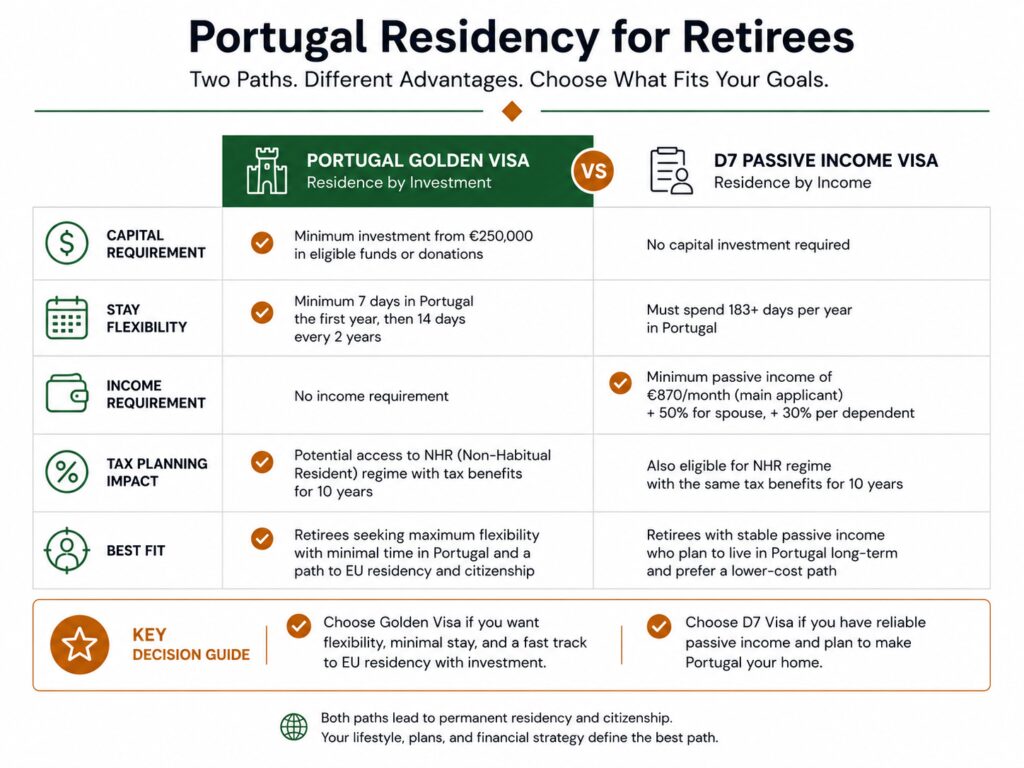
Golden Visa and D7 comparison for Portugal retirement planning

Tax Benefits for Retirees

Tax is often the most misunderstood part of retiring to Portugal. The Golden Visa does not automatically make you a Portuguese tax resident, and it does not automatically grant a special tax regime.

Your tax position depends on where you actually live, how many days you spend in Portugal, where your income comes from, and whether you register as a Portuguese tax resident.

NHR and IFICI: Pension Income Treatment

The former NHR regime, Non-Habitual Resident regime, was historically important for retirees because it offered favorable treatment for some foreign income. However, Portugal has changed its tax framework. The Portuguese Tax and Customs Authority states in its Non-Habitual Resident tax guidance that the NHR regime was repealed from 1 January 2024 and replaced by the Tax Incentive for Scientific Research and Innovation, commonly known as IFICI.

That matters for retirees. IFICI is not simply “NHR for retirees.” It is more targeted and should not be assumed to give pension income the same treatment older articles may describe.

Retirees should review:

  • Pension income from public and private sources
  • Social Security income
  • Investment income
  • Rental income
  • Capital gains
  • Tax treaty relief
  • Whether becoming a Portuguese tax resident is necessary or desirable

For a detailed tax-focused overview, see our guide to tax benefits including pension rules.

Social Security Totalization Agreements

A Social Security treaty can affect whether retirees or self-employed individuals pay contributions in one country, another country, or both. For US retirees and workers, the U.S. Social Security Administration Portugal agreement explains how the US-Portugal agreement coordinates certain old-age, survivors, and disability insurance coverage.

This is especially important for retirees who still consult, own businesses, receive mixed income, or continue part-time professional work after moving.

Do not assume that a Golden Visa solves pension taxation. It solves residence status. Tax residency and pension taxation require separate advice.

Healthcare in Portugal for Golden Visa Holders

Healthcare access is a major factor for retirees. Portugal has a public health system, known as SNS, Serviço Nacional de Saúde, and a well-developed private healthcare market.

Golden Visa holders should plan healthcare in two stages: what is required for the application and what is practical for retirement living.

Access to the SNS Public Health System

In practice, access to the SNS Portuguese health system can depend on residency status, registration steps, local health center procedures, and your tax and social security position. A residence permit does not mean you should arrive without coverage and assume everything is immediately available.

Retirees should prepare for:

  • Private health insurance during the application stage
  • Coverage for any pre-existing conditions
  • Local registration after receiving a residence permit
  • Medical records translated where useful
  • Prescription continuity for ongoing treatment
  • Emergency and travel coverage during transition periods

For retirees, healthcare planning should happen before the move, not after arrival. That is especially true if you take regular medication or need specialist care.

Private Health Insurance Options

Many retirees use private health insurance even when they may later access public healthcare. Private coverage can help with faster appointments, English-speaking doctors, and specialist consultations.

When comparing policies, look carefully at:

  • Age limits
  • Waiting periods
  • Exclusions for pre-existing conditions
  • Hospital network
  • Prescription coverage
  • International emergency coverage
  • Whether the policy satisfies residence application requirements

Private insurance is not just a paperwork item. For retirees, it is part of the risk management plan.

Cost of Living in Portugal for Retirees

Portugal is often viewed as a retirement-friendly country because of its lifestyle, healthcare access, climate, and relative affordability compared with major cities in the United States, Canada, and Northern Europe. However, cost of living varies sharply by location.

Lisbon, Cascais, and parts of the Algarve are not low-cost markets by local standards. Smaller cities and interior regions can be more affordable, but they may offer fewer international services.

Eurostat’s EU Retirement Migration Statistics show the wider demographic reality: Portugal has one of Europe’s older population profiles, which helps explain why healthcare, pensions, and ageing policy are central to long-term planning.

A retiree budget should include:

Cost Category What to Consider
Housing Rent, utilities, condominium costs, maintenance
Healthcare Private insurance, specialists, prescriptions
Tax advice Home country and Portuguese filings
Travel Flights, family visits, Schengen trips
Legal support Immigration renewals, document updates
Lifestyle Dining, transport, clubs, domestic help
Currency risk Exchange rate movement if income is foreign

Retirees should not compare Portugal only with their current city. They should compare the total cost of relocation, healthcare, tax, family travel, and long-term residency maintenance.

Minimum Stay Flexibility: Why Retirees Love the Golden Visa

The Golden Visa’s biggest retirement advantage is minimum stay flexibility. Retirees can keep Portugal as a European base without needing to become full-time residents immediately.

That flexibility helps retirees who:

  • Want to test Portugal before relocating
  • Have adult children or grandchildren abroad
  • Own property or businesses in another country
  • Need to maintain medical care in their home country
  • Prefer to spend winters or summers in Portugal
  • Want Schengen travel access without year-round relocation

Golden Visa holders also benefit from Schengen mobility. The Schengen Borders Code is set out in EUR-Lex Regulation 2016/399, which governs movement across the Schengen external borders.

Most people spend more than seven days a year managing paperwork. Spending that time in Portugal is usually the easier part.

Path to Citizenship as a Retiree

Retirees often ask whether the Golden Visa can lead to Portuguese citizenship. The answer is yes in principle, but the timeline and eligibility rules must be checked under current nationality law.

Nationality applications are handled through the Portuguese civil registry framework. The Portuguese nationality service currently states that legal residence requirements differ by nationality category, including a 10-year requirement for people with nationalities outside Portuguese-speaking countries and the EU.

That is a major planning point for retirees. Older content often refers to a 5-year citizenship route. Current applicants should not rely on outdated timelines without legal review.

Retirees should plan for:

  • Legal residence continuity
  • A valid residence permit history
  • Portuguese language requirements
  • Criminal record requirements
  • IRN, Instituto dos Registos e do Notariado, procedures
  • Possible rule changes during the holding period
  • Whether permanent residence is a better first objective than citizenship

The Golden Visa can still be valuable even where citizenship takes longer than expected. For some retirees, the main benefit is not a passport. It is having a stable European residence option while keeping control over where and how they spend their retirement years.
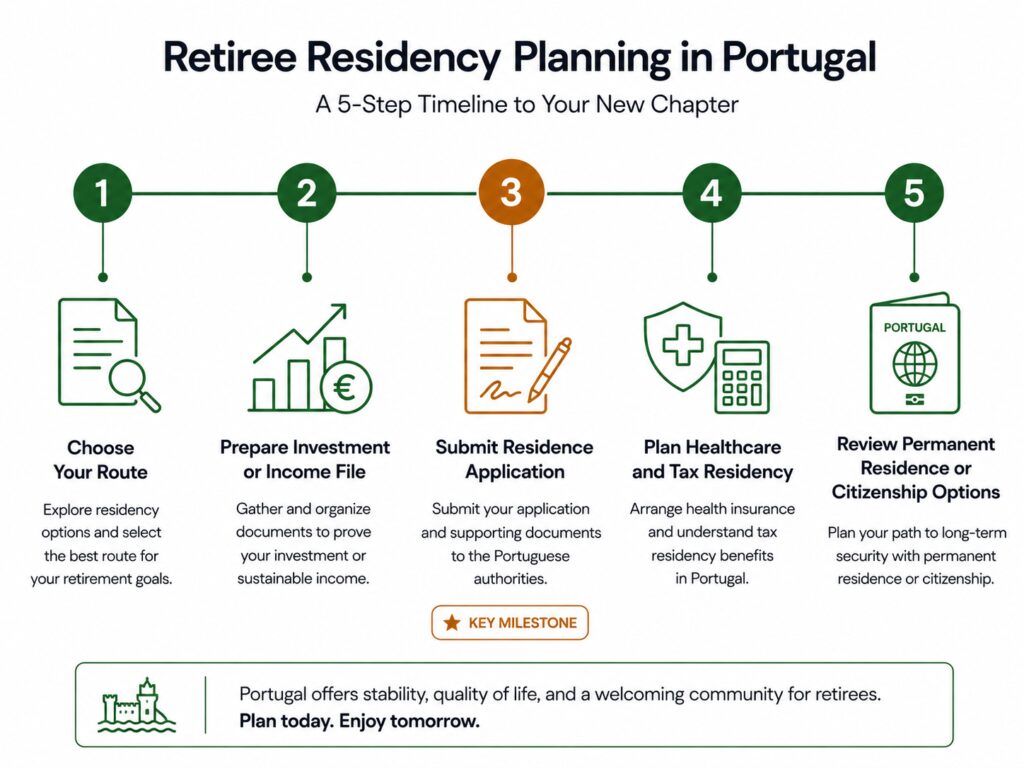
Portugal retirement residency timeline for Golden Visa applicants

FAQs: Portugal Golden Visa for Retirees

Is the Portugal Golden Visa a good option for retirees?

Yes, the Portugal Golden Visa can be a good option for retirees who want EU residency flexibility without relocating full time. It is most suitable for retirees with sufficient investment capital who want Portugal as a long-term base, Schengen access, and future residence optionality. It is less suitable if your main goal is the lowest-cost way to live in Portugal full time.

How does the Golden Visa compare to the D7 Passive Income Visa?

The Golden Visa is investment-based and offers greater minimum stay flexibility. The D7 Passive Income Visa is income-based and generally better suited to retirees who plan to live in Portugal full time. If you have strong pension income and want to relocate, the D7 may be more efficient. If you want Portugal residency without immediate relocation, the Golden Visa may be more appropriate.

Can retirees use pension income to qualify?

Pension income can support your overall financial profile, but it does not replace the qualifying investment requirement for the Golden Visa. Retirees must still complete an eligible investment route. Pension income is more directly relevant to the D7 Passive Income Visa, where recurring income is central to eligibility.

What healthcare access do Golden Visa retirees have in Portugal?

Golden Visa retirees should usually maintain private health insurance during the application and transition period. Access to Portugal’s SNS public health system may depend on residence status, registration, and local procedures. Many retirees keep private insurance for faster specialist access and broader coverage, especially if they have pre-existing conditions.

Is the Portugal Golden Visa for Retirees Right for You?

The portugal golden visa for retirees is best understood as a flexibility tool. It gives eligible retirees a way to secure Portuguese residence while keeping control over where they live, how often they visit, and when they may choose to relocate more fully.

The D7 Passive Income Visa may be better if Portugal is your immediate retirement destination and your pension income is strong enough to support the application. The Golden Visa may be better if you want a higher-control, investment-based route with lighter physical presence.

Retirement planning is personal, but the wrong visa route can create unnecessary tax, healthcare, and lifestyle problems. Review both options before committing to a structure, especially if your pension, investments, and family ties span more than one country.

Ready to take the next step?
Book a free initial assessment. We’ll assess your eligibility, walk through the current qualifying routes, and answer your questions, no cost, no commitment.


Portugal Golden Visa for Retirees: Is It the Right Residency Option?

The Portugal Golden Visa for retirees is not a traditional retirement visa. It is a residency by investment route for non-EU nationals who want Portugal access, Schengen mobility, and long-term optionality without necessarily relocating full time.

That distinction matters. Retirees usually compare the Golden Visa with the D7 Passive Income Visa, but the two routes serve different lifestyles. This guide explains when the Golden Visa makes sense for retirement planning, when the D7 may be better, and what retirees should know about tax, healthcare, minimum stay flexibility, and citizenship.

Is the Portugal Golden Visa Right for Retirees?

For retirees, the Golden Visa is most useful when Portugal is part of a broader mobility, family security, or long-term residency plan. It is less suitable for retirees who simply want the lowest-cost route to live in Portugal full time.

The formal permit is the ARI, or Autorização de Residência para Investimento. Applications are processed by AIMA Residency for Retirees, the Agency for Integration, Migration and Asylum, which replaced SEF, Serviço de Estrangeiros e Fronteiras, in 2023.

What Makes It Attractive for Those Over 55

The Golden Visa appeals to retirees because it separates residency rights from full-time relocation. You can maintain residence status while spending limited time in Portugal, which is valuable if you still split your year between the United States, Canada, Brazil, the UK, the Gulf, or another home country.

Key advantages include:

  • Minimum stay flexibility, usually the strongest advantage for retirees who do not want to relocate immediately
  • Schengen travel access for easier movement across Europe
  • Family inclusion for a spouse, dependent children, and eligible dependent parents
  • Long-term residence planning without requiring immediate tax residency
  • A pathway toward permanent residence or nationality, subject to current eligibility rules
  • Access to Portugal as a retirement base without fully cutting ties elsewhere

The programme is especially relevant if you want a European residency option but are not ready to move your entire financial, medical, and family life to Portugal in year one.

Portugal Golden Visa news 2026 update for investors reviewing ARI changes

When the D7 Visa Might Be Better

The D7 Passive Income Visa may be better if your main goal is to live in Portugal full time and you can prove stable passive income. Pension income, rental income, dividends, and other recurring income sources may support a D7 application.

The trade-off is lifestyle commitment. The D7 generally suits retirees who intend to relocate and spend substantial time in Portugal. The Golden Visa suits retirees who want optionality and a lighter physical presence obligation.

Factor Golden Visa D7 Passive Income Visa
Best for Retirees seeking flexibility Retirees relocating full time
Core basis Qualifying investment Passive income
Capital requirement Higher Lower
Stay expectation Minimal stay flexibility Residence-focused
Tax planning impact Can avoid immediate tax residency if managed properly Often linked to actual relocation
Best reader profile Global retiree with assets Retiree ready to live in Portugal

For a deeper comparison, review our Golden Visa vs D7 comparison.

Investment Requirements for Retiree Applicants

Retirees must meet the same investment rules as other Golden Visa applicants. Retirement status does not reduce the qualifying investment threshold, and pension income does not replace the investment requirement.

For most private investors, the core route is a qualifying investment in a regulated fund structure. You can review available Portugal Golden Visa investment fund options before comparing suitability, risk, liquidity, and exit timelines.

Can Pension Funds or Retirement Accounts Be Used?

Pension income can support your wider financial profile, but it is not the same as qualifying investment capital. A Golden Visa applicant must still make the required investment through an eligible route.

Retirees should separate three questions:

  1. Do you have enough liquid capital for the qualifying investment?
  2. Can the funds be legally moved from your home country to Portugal or an eligible investment vehicle?
  3. Will using retirement capital create tax consequences in your home country?

For example, withdrawing from a retirement account may trigger tax, penalties, or reporting obligations depending on your country of residence and the structure of the account. A pension statement may help show financial stability, but it does not replace legal due diligence on the source and movement of funds.

Portugal Golden Visa

Start Your Portugal Golden Visa Journey

Receive personalized legal guidance from experienced immigration lawyers and discover the most effective pathway to securing your Portugal Golden Visa.

Book Your Free Consultation →
✓ No Obligation   •   ✓ Licensed Lawyers   •   ✓ Confidential Consultation

Using IRA or Superannuation as Investment Capital

Some retirees ask whether they can use an IRA, 401(k), pension fund, or Australian superannuation to fund the Golden Visa. The answer depends on the account structure, withdrawal rules, tax treatment, and whether the capital can be transferred into an eligible investment.

For US retirees, IRA or 401(k) withdrawals may create taxable events. For Australian applicants, superannuation access depends on preservation rules and personal eligibility. For UK applicants, pension access may involve different rules again.

Before committing funds, retirees should speak with:

  • An immigration lawyer
  • A tax advisor in the home country
  • A Portuguese tax advisor
  • A regulated financial advisor
  • The fund manager or investment provider

The Golden Visa is a residency decision, but it is also a retirement planning decision. Treat the investment source with the same care as the immigration file.

Golden Visa and D7 comparison for Portugal retirement planning

Tax Benefits for Retirees

Tax is often the most misunderstood part of retiring to Portugal. The Golden Visa does not automatically make you a Portuguese tax resident, and it does not automatically grant a special tax regime.

Your tax position depends on where you actually live, how many days you spend in Portugal, where your income comes from, and whether you register as a Portuguese tax resident.

NHR and IFICI: Pension Income Treatment

The former NHR regime, Non-Habitual Resident regime, was historically important for retirees because it offered favorable treatment for some foreign income. However, Portugal has changed its tax framework. The Portuguese Tax and Customs Authority states in its Non-Habitual Resident tax guidance that the NHR regime was repealed from 1 January 2024 and replaced by the Tax Incentive for Scientific Research and Innovation, commonly known as IFICI.

That matters for retirees. IFICI is not simply “NHR for retirees.” It is more targeted and should not be assumed to give pension income the same treatment older articles may describe.

Retirees should review:

  • Pension income from public and private sources
  • Social Security income
  • Investment income
  • Rental income
  • Capital gains
  • Tax treaty relief
  • Whether becoming a Portuguese tax resident is necessary or desirable

For a detailed tax-focused overview, see our guide to tax benefits including pension rules.

Social Security Totalization Agreements

A Social Security treaty can affect whether retirees or self-employed individuals pay contributions in one country, another country, or both. For US retirees and workers, the U.S. Social Security Administration Portugal agreement explains how the US-Portugal agreement coordinates certain old-age, survivors, and disability insurance coverage.

This is especially important for retirees who still consult, own businesses, receive mixed income, or continue part-time professional work after moving.

Do not assume that a Golden Visa solves pension taxation. It solves residence status. Tax residency and pension taxation require separate advice.

Healthcare in Portugal for Golden Visa Holders

Healthcare access is a major factor for retirees. Portugal has a public health system, known as SNS, Serviço Nacional de Saúde, and a well-developed private healthcare market.

Golden Visa holders should plan healthcare in two stages: what is required for the application and what is practical for retirement living.

Access to the SNS Public Health System

In practice, access to the SNS Portuguese health system can depend on residency status, registration steps, local health center procedures, and your tax and social security position. A residence permit does not mean you should arrive without coverage and assume everything is immediately available.

Retirees should prepare for:

  • Private health insurance during the application stage
  • Coverage for any pre-existing conditions
  • Local registration after receiving a residence permit
  • Medical records translated where useful
  • Prescription continuity for ongoing treatment
  • Emergency and travel coverage during transition periods

For retirees, healthcare planning should happen before the move, not after arrival. That is especially true if you take regular medication or need specialist care.

Private Health Insurance Options

Many retirees use private health insurance even when they may later access public healthcare. Private coverage can help with faster appointments, English-speaking doctors, and specialist consultations.

When comparing policies, look carefully at:

  • Age limits
  • Waiting periods
  • Exclusions for pre-existing conditions
  • Hospital network
  • Prescription coverage
  • International emergency coverage
  • Whether the policy satisfies residence application requirements

Private insurance is not just a paperwork item. For retirees, it is part of the risk management plan.

Cost of Living in Portugal for Retirees

Portugal is often viewed as a retirement-friendly country because of its lifestyle, healthcare access, climate, and relative affordability compared with major cities in the United States, Canada, and Northern Europe. However, cost of living varies sharply by location.

Lisbon, Cascais, and parts of the Algarve are not low-cost markets by local standards. Smaller cities and interior regions can be more affordable, but they may offer fewer international services.

Eurostat’s EU Retirement Migration Statistics show the wider demographic reality: Portugal has one of Europe’s older population profiles, which helps explain why healthcare, pensions, and ageing policy are central to long-term planning.

A retiree budget should include:

Cost Category What to Consider
Housing Rent, utilities, condominium costs, maintenance
Healthcare Private insurance, specialists, prescriptions
Tax advice Home country and Portuguese filings
Travel Flights, family visits, Schengen trips
Legal support Immigration renewals, document updates
Lifestyle Dining, transport, clubs, domestic help
Currency risk Exchange rate movement if income is foreign

Retirees should not compare Portugal only with their current city. They should compare the total cost of relocation, healthcare, tax, family travel, and long-term residency maintenance.

Minimum Stay Flexibility: Why Retirees Love the Golden Visa

The Golden Visa’s biggest retirement advantage is minimum stay flexibility. Retirees can keep Portugal as a European base without needing to become full-time residents immediately.

That flexibility helps retirees who:

  • Want to test Portugal before relocating
  • Have adult children or grandchildren abroad
  • Own property or businesses in another country
  • Need to maintain medical care in their home country
  • Prefer to spend winters or summers in Portugal
  • Want Schengen travel access without year-round relocation

Golden Visa holders also benefit from Schengen mobility. The Schengen Borders Code is set out in EUR-Lex Regulation 2016/399, which governs movement across the Schengen external borders.

Most people spend more than seven days a year managing paperwork. Spending that time in Portugal is usually the easier part.

Path to Citizenship as a Retiree

Retirees often ask whether the Golden Visa can lead to Portuguese citizenship. The answer is yes in principle, but the timeline and eligibility rules must be checked under current nationality law.

Nationality applications are handled through the Portuguese civil registry framework. The Portuguese nationality service currently states that legal residence requirements differ by nationality category, including a 10-year requirement for people with nationalities outside Portuguese-speaking countries and the EU.

That is a major planning point for retirees. Older content often refers to a 5-year citizenship route. Current applicants should not rely on outdated timelines without legal review.

Retirees should plan for:

  • Legal residence continuity
  • A valid residence permit history
  • Portuguese language requirements
  • Criminal record requirements
  • IRN, Instituto dos Registos e do Notariado, procedures
  • Possible rule changes during the holding period
  • Whether permanent residence is a better first objective than citizenship

The Golden Visa can still be valuable even where citizenship takes longer than expected. For some retirees, the main benefit is not a passport. It is having a stable European residence option while keeping control over where and how they spend their retirement years.

Portugal retirement residency timeline for Golden Visa applicants

FAQs: Portugal Golden Visa for Retirees

Is the Portugal Golden Visa a good option for retirees?

Yes, the Portugal Golden Visa can be a good option for retirees who want EU residency flexibility without relocating full time. It is most suitable for retirees with sufficient investment capital who want Portugal as a long-term base, Schengen access, and future residence optionality. It is less suitable if your main goal is the lowest-cost way to live in Portugal full time.

How does the Golden Visa compare to the D7 Passive Income Visa?

The Golden Visa is investment-based and offers greater minimum stay flexibility. The D7 Passive Income Visa is income-based and generally better suited to retirees who plan to live in Portugal full time. If you have strong pension income and want to relocate, the D7 may be more efficient. If you want Portugal residency without immediate relocation, the Golden Visa may be more appropriate.

Can retirees use pension income to qualify?

Pension income can support your overall financial profile, but it does not replace the qualifying investment requirement for the Golden Visa. Retirees must still complete an eligible investment route. Pension income is more directly relevant to the D7 Passive Income Visa, where recurring income is central to eligibility.

What healthcare access do Golden Visa retirees have in Portugal?

Golden Visa retirees should usually maintain private health insurance during the application and transition period. Access to Portugal’s SNS public health system may depend on residence status, registration, and local procedures. Many retirees keep private insurance for faster specialist access and broader coverage, especially if they have pre-existing conditions.

Is the Portugal Golden Visa for Retirees Right for You?

The portugal golden visa for retirees is best understood as a flexibility tool. It gives eligible retirees a way to secure Portuguese residence while keeping control over where they live, how often they visit, and when they may choose to relocate more fully.

The D7 Passive Income Visa may be better if Portugal is your immediate retirement destination and your pension income is strong enough to support the application. The Golden Visa may be better if you want a higher-control, investment-based route with lighter physical presence.

Retirement planning is personal, but the wrong visa route can create unnecessary tax, healthcare, and lifestyle problems. Review both options before committing to a structure, especially if your pension, investments, and family ties span more than one country.

Ready to take the next step?
Book a free initial assessment. We’ll assess your eligibility, walk through the current qualifying routes, and answer your questions, no cost, no commitment.

Portugal Golden Visa for Retirees: Is It the Right Residency Option?

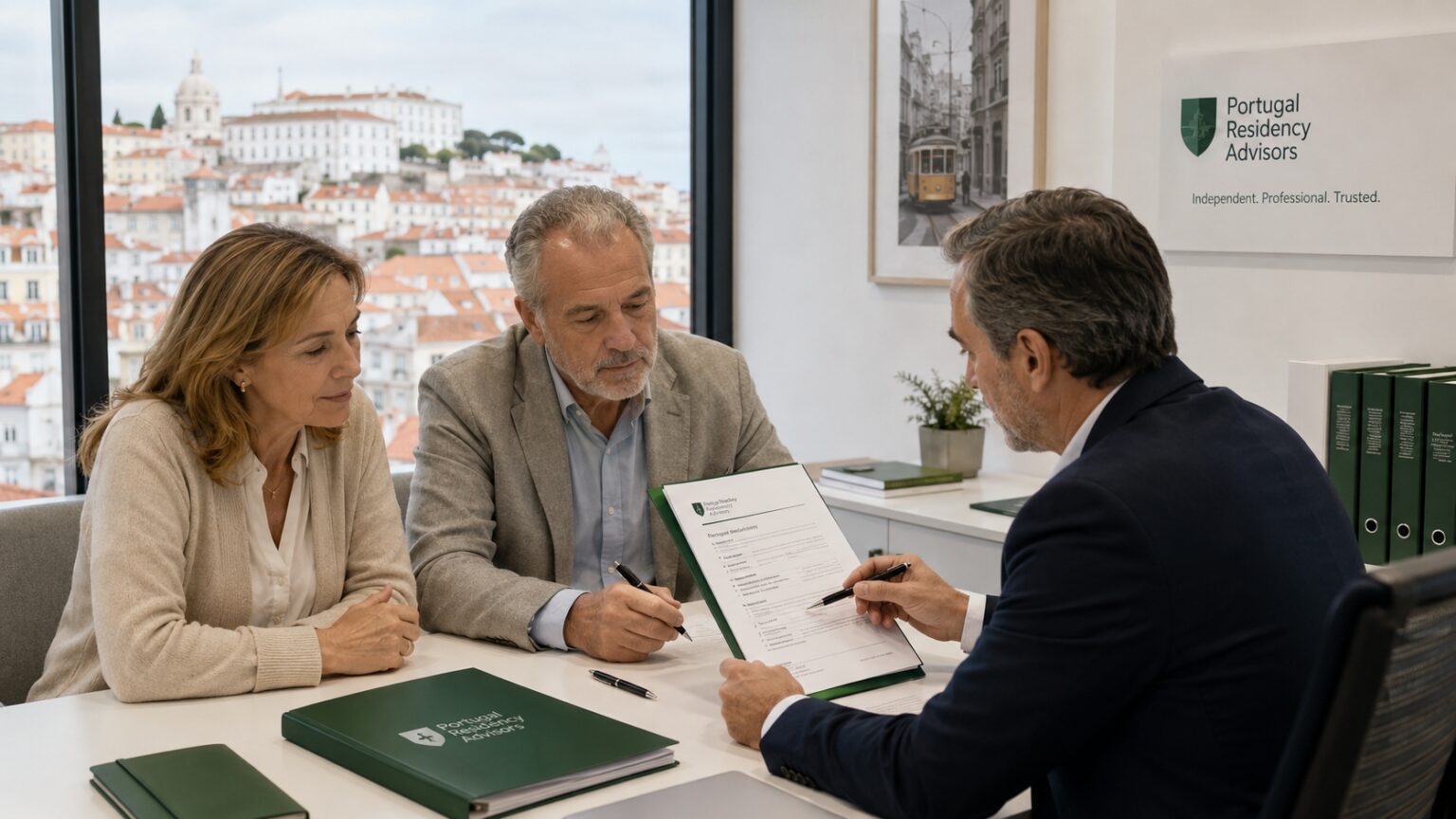
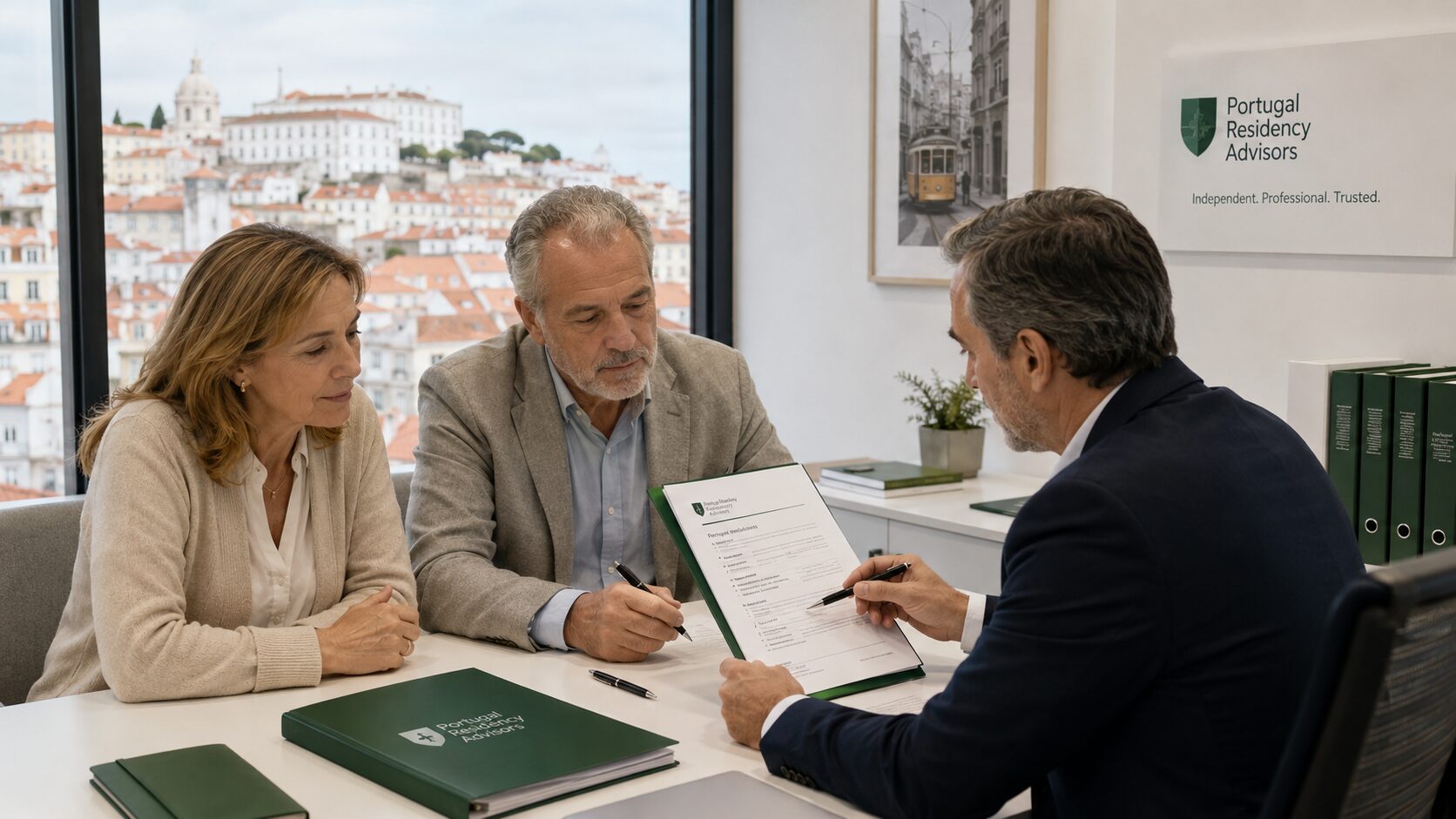
Portugal Golden Visa for retirees planning residency with a Lisbon advisor
The Portugal Golden Visa for retirees is not a traditional retirement visa. It is a residency by investment route for non-EU nationals who want Portugal access, Schengen mobility, and long-term optionality without necessarily relocating full time.

That distinction matters. Retirees usually compare the Golden Visa with the D7 Passive Income Visa, but the two routes serve different lifestyles. This guide explains when the Golden Visa makes sense for retirement planning, when the D7 may be better, and what retirees should know about tax, healthcare, minimum stay flexibility, and citizenship.

Is the Portugal Golden Visa Right for Retirees?

For retirees, the Golden Visa is most useful when Portugal is part of a broader mobility, family security, or long-term residency plan. It is less suitable for retirees who simply want the lowest-cost route to live in Portugal full time.

The formal permit is the ARI, or Autorização de Residência para Investimento. Applications are processed by AIMA Residency for Retirees, the Agency for Integration, Migration and Asylum, which replaced SEF, Serviço de Estrangeiros e Fronteiras, in 2023.

What Makes It Attractive for Those Over 55

The Golden Visa appeals to retirees because it separates residency rights from full-time relocation. You can maintain residence status while spending limited time in Portugal, which is valuable if you still split your year between the United States, Canada, Brazil, the UK, the Gulf, or another home country.

Key advantages include:

  • Minimum stay flexibility, usually the strongest advantage for retirees who do not want to relocate immediately
  • Schengen travel access for easier movement across Europe
  • Family inclusion for a spouse, dependent children, and eligible dependent parents
  • Long-term residence planning without requiring immediate tax residency
  • A pathway toward permanent residence or nationality, subject to current eligibility rules
  • Access to Portugal as a retirement base without fully cutting ties elsewhere

The programme is especially relevant if you want a European residency option but are not ready to move your entire financial, medical, and family life to Portugal in year one.

Portugal Golden Visa news 2026 update for investors reviewing ARI changes

When the D7 Visa Might Be Better

The D7 Passive Income Visa may be better if your main goal is to live in Portugal full time and you can prove stable passive income. Pension income, rental income, dividends, and other recurring income sources may support a D7 application.

The trade-off is lifestyle commitment. The D7 generally suits retirees who intend to relocate and spend substantial time in Portugal. The Golden Visa suits retirees who want optionality and a lighter physical presence obligation.

Factor Golden Visa D7 Passive Income Visa
Best for Retirees seeking flexibility Retirees relocating full time
Core basis Qualifying investment Passive income
Capital requirement Higher Lower
Stay expectation Minimal stay flexibility Residence-focused
Tax planning impact Can avoid immediate tax residency if managed properly Often linked to actual relocation
Best reader profile Global retiree with assets Retiree ready to live in Portugal

For a deeper comparison, review our Golden Visa vs D7 comparison.

Investment Requirements for Retiree Applicants

Retirees must meet the same investment rules as other Golden Visa applicants. Retirement status does not reduce the qualifying investment threshold, and pension income does not replace the investment requirement.

For most private investors, the core route is a qualifying investment in a regulated fund structure. You can review available Portugal Golden Visa investment fund options before comparing suitability, risk, liquidity, and exit timelines.

Can Pension Funds or Retirement Accounts Be Used?

Pension income can support your wider financial profile, but it is not the same as qualifying investment capital. A Golden Visa applicant must still make the required investment through an eligible route.

Retirees should separate three questions:

  1. Do you have enough liquid capital for the qualifying investment?
  2. Can the funds be legally moved from your home country to Portugal or an eligible investment vehicle?
  3. Will using retirement capital create tax consequences in your home country?

For example, withdrawing from a retirement account may trigger tax, penalties, or reporting obligations depending on your country of residence and the structure of the account. A pension statement may help show financial stability, but it does not replace legal due diligence on the source and movement of funds.

Portugal Golden Visa

Start Your Portugal Golden Visa Journey

Receive personalized legal guidance from experienced immigration lawyers and discover the most effective pathway to securing your Portugal Golden Visa.

Book Your Free Consultation →
✓ No Obligation   •   ✓ Licensed Lawyers   •   ✓ Confidential Consultation

Using IRA or Superannuation as Investment Capital

Some retirees ask whether they can use an IRA, 401(k), pension fund, or Australian superannuation to fund the Golden Visa. The answer depends on the account structure, withdrawal rules, tax treatment, and whether the capital can be transferred into an eligible investment.

For US retirees, IRA or 401(k) withdrawals may create taxable events. For Australian applicants, superannuation access depends on preservation rules and personal eligibility. For UK applicants, pension access may involve different rules again.

Before committing funds, retirees should speak with:

  • An immigration lawyer
  • A tax advisor in the home country
  • A Portuguese tax advisor
  • A regulated financial advisor
  • The fund manager or investment provider

The Golden Visa is a residency decision, but it is also a retirement planning decision. Treat the investment source with the same care as the immigration file.

Golden Visa and D7 comparison for Portugal retirement planning

Tax Benefits for Retirees

Tax is often the most misunderstood part of retiring to Portugal. The Golden Visa does not automatically make you a Portuguese tax resident, and it does not automatically grant a special tax regime.

Your tax position depends on where you actually live, how many days you spend in Portugal, where your income comes from, and whether you register as a Portuguese tax resident.

NHR and IFICI: Pension Income Treatment

The former NHR regime, Non-Habitual Resident regime, was historically important for retirees because it offered favorable treatment for some foreign income. However, Portugal has changed its tax framework. The Portuguese Tax and Customs Authority states in its Non-Habitual Resident tax guidance that the NHR regime was repealed from 1 January 2024 and replaced by the Tax Incentive for Scientific Research and Innovation, commonly known as IFICI.

That matters for retirees. IFICI is not simply “NHR for retirees.” It is more targeted and should not be assumed to give pension income the same treatment older articles may describe.

Retirees should review:

  • Pension income from public and private sources
  • Social Security income
  • Investment income
  • Rental income
  • Capital gains
  • Tax treaty relief
  • Whether becoming a Portuguese tax resident is necessary or desirable

For a detailed tax-focused overview, see our guide to tax benefits including pension rules.

Social Security Totalization Agreements

A Social Security treaty can affect whether retirees or self-employed individuals pay contributions in one country, another country, or both. For US retirees and workers, the U.S. Social Security Administration Portugal agreement explains how the US-Portugal agreement coordinates certain old-age, survivors, and disability insurance coverage.

This is especially important for retirees who still consult, own businesses, receive mixed income, or continue part-time professional work after moving.

Do not assume that a Golden Visa solves pension taxation. It solves residence status. Tax residency and pension taxation require separate advice.

Healthcare in Portugal for Golden Visa Holders

Healthcare access is a major factor for retirees. Portugal has a public health system, known as SNS, Serviço Nacional de Saúde, and a well-developed private healthcare market.

Golden Visa holders should plan healthcare in two stages: what is required for the application and what is practical for retirement living.

Access to the SNS Public Health System

In practice, access to the SNS Portuguese health system can depend on residency status, registration steps, local health center procedures, and your tax and social security position. A residence permit does not mean you should arrive without coverage and assume everything is immediately available.

Retirees should prepare for:

  • Private health insurance during the application stage
  • Coverage for any pre-existing conditions
  • Local registration after receiving a residence permit
  • Medical records translated where useful
  • Prescription continuity for ongoing treatment
  • Emergency and travel coverage during transition periods

For retirees, healthcare planning should happen before the move, not after arrival. That is especially true if you take regular medication or need specialist care.

Private Health Insurance Options

Many retirees use private health insurance even when they may later access public healthcare. Private coverage can help with faster appointments, English-speaking doctors, and specialist consultations.

When comparing policies, look carefully at:

  • Age limits
  • Waiting periods
  • Exclusions for pre-existing conditions
  • Hospital network
  • Prescription coverage
  • International emergency coverage
  • Whether the policy satisfies residence application requirements

Private insurance is not just a paperwork item. For retirees, it is part of the risk management plan.

Cost of Living in Portugal for Retirees

Portugal is often viewed as a retirement-friendly country because of its lifestyle, healthcare access, climate, and relative affordability compared with major cities in the United States, Canada, and Northern Europe. However, cost of living varies sharply by location.

Lisbon, Cascais, and parts of the Algarve are not low-cost markets by local standards. Smaller cities and interior regions can be more affordable, but they may offer fewer international services.

Eurostat’s EU Retirement Migration Statistics show the wider demographic reality: Portugal has one of Europe’s older population profiles, which helps explain why healthcare, pensions, and ageing policy are central to long-term planning.

A retiree budget should include:

Cost Category What to Consider
Housing Rent, utilities, condominium costs, maintenance
Healthcare Private insurance, specialists, prescriptions
Tax advice Home country and Portuguese filings
Travel Flights, family visits, Schengen trips
Legal support Immigration renewals, document updates
Lifestyle Dining, transport, clubs, domestic help
Currency risk Exchange rate movement if income is foreign

Retirees should not compare Portugal only with their current city. They should compare the total cost of relocation, healthcare, tax, family travel, and long-term residency maintenance.

Minimum Stay Flexibility: Why Retirees Love the Golden Visa

The Golden Visa’s biggest retirement advantage is minimum stay flexibility. Retirees can keep Portugal as a European base without needing to become full-time residents immediately.

That flexibility helps retirees who:

  • Want to test Portugal before relocating
  • Have adult children or grandchildren abroad
  • Own property or businesses in another country
  • Need to maintain medical care in their home country
  • Prefer to spend winters or summers in Portugal
  • Want Schengen travel access without year-round relocation

Golden Visa holders also benefit from Schengen mobility. The Schengen Borders Code is set out in EUR-Lex Regulation 2016/399, which governs movement across the Schengen external borders.

Most people spend more than seven days a year managing paperwork. Spending that time in Portugal is usually the easier part.

Path to Citizenship as a Retiree

Retirees often ask whether the Golden Visa can lead to Portuguese citizenship. The answer is yes in principle, but the timeline and eligibility rules must be checked under current nationality law.

Nationality applications are handled through the Portuguese civil registry framework. The Portuguese nationality service currently states that legal residence requirements differ by nationality category, including a 10-year requirement for people with nationalities outside Portuguese-speaking countries and the EU.

That is a major planning point for retirees. Older content often refers to a 5-year citizenship route. Current applicants should not rely on outdated timelines without legal review.

Retirees should plan for:

  • Legal residence continuity
  • A valid residence permit history
  • Portuguese language requirements
  • Criminal record requirements
  • IRN, Instituto dos Registos e do Notariado, procedures
  • Possible rule changes during the holding period
  • Whether permanent residence is a better first objective than citizenship

The Golden Visa can still be valuable even where citizenship takes longer than expected. For some retirees, the main benefit is not a passport. It is having a stable European residence option while keeping control over where and how they spend their retirement years.

Portugal retirement residency timeline for Golden Visa applicants

FAQs: Portugal Golden Visa for Retirees

Is the Portugal Golden Visa a good option for retirees?

Yes, the Portugal Golden Visa can be a good option for retirees who want EU residency flexibility without relocating full time. It is most suitable for retirees with sufficient investment capital who want Portugal as a long-term base, Schengen access, and future residence optionality. It is less suitable if your main goal is the lowest-cost way to live in Portugal full time.

How does the Golden Visa compare to the D7 Passive Income Visa?

The Golden Visa is investment-based and offers greater minimum stay flexibility. The D7 Passive Income Visa is income-based and generally better suited to retirees who plan to live in Portugal full time. If you have strong pension income and want to relocate, the D7 may be more efficient. If you want Portugal residency without immediate relocation, the Golden Visa may be more appropriate.

Can retirees use pension income to qualify?

Pension income can support your overall financial profile, but it does not replace the qualifying investment requirement for the Golden Visa. Retirees must still complete an eligible investment route. Pension income is more directly relevant to the D7 Passive Income Visa, where recurring income is central to eligibility.

What healthcare access do Golden Visa retirees have in Portugal?

Golden Visa retirees should usually maintain private health insurance during the application and transition period. Access to Portugal’s SNS public health system may depend on residence status, registration, and local procedures. Many retirees keep private insurance for faster specialist access and broader coverage, especially if they have pre-existing conditions.

Is the Portugal Golden Visa for Retirees Right for You?

The portugal golden visa for retirees is best understood as a flexibility tool. It gives eligible retirees a way to secure Portuguese residence while keeping control over where they live, how often they visit, and when they may choose to relocate more fully.

The D7 Passive Income Visa may be better if Portugal is your immediate retirement destination and your pension income is strong enough to support the application. The Golden Visa may be better if you want a higher-control, investment-based route with lighter physical presence.

Retirement planning is personal, but the wrong visa route can create unnecessary tax, healthcare, and lifestyle problems. Review both options before committing to a structure, especially if your pension, investments, and family ties span more than one country.

Ready to take the next step?
Book a free initial assessment. We’ll assess your eligibility, walk through the current qualifying routes, and answer your questions, no cost, no commitment.

What do you think?
Blog

More Related Articles

top