

For investors, the key issue is not only whether the application qualifies. It is whether the file moves through AIMA, the Agency for Integration, Migration and Asylum, without avoidable delay. This guide explains how AIMA affects Golden Visa applicants in 2026, how biometric appointment booking works, what the backlog means, and how auto-renewal protection should be understood.
What Is AIMA and How Does It Affect Your Golden Visa Application?
AIMA, the Agency for Integration, Migration and Asylum, is the Portuguese authority now responsible for the administrative handling of immigration and residence matters. For Golden Visa investors, this means AIMA manages key parts of the ARI process, including online submissions, appointment scheduling, renewals, and residence card follow-up.
The ARI, or Autorização de Residência para Investimento, is the formal name of the Golden Visa residence permit. The public-facing name may be familiar, but the legal and administrative file still moves through the ARI framework.
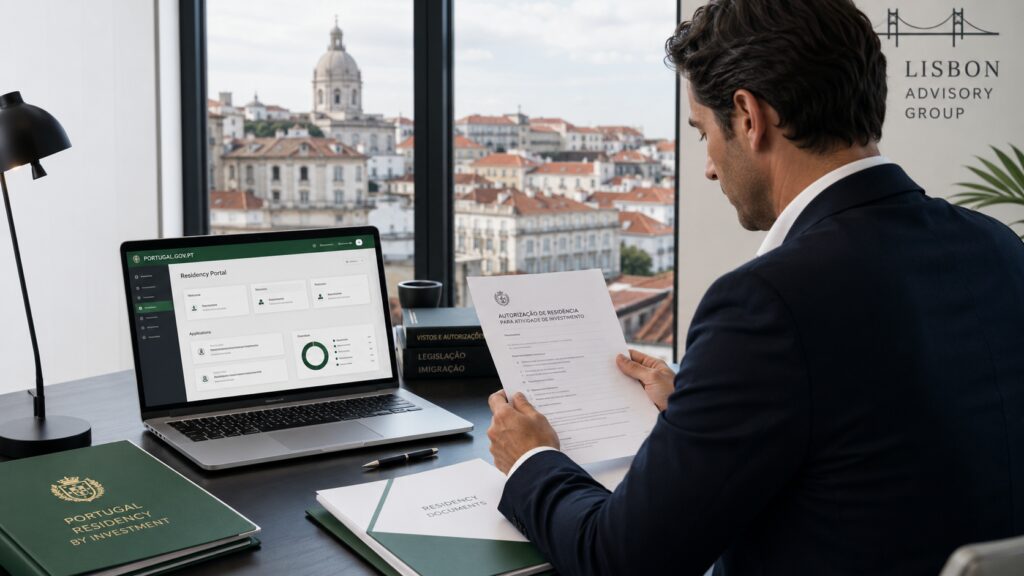
AIMA vs the Old SEF: What Changed
SEF, the Serviço de Estrangeiros e Fronteiras, was Portugal’s former immigration and borders authority. It handled immigration administration and also had border and police-related responsibilities.
That changed when Portugal abolished SEF and transferred the administrative side of immigration to AIMA. The Portuguese Government explains that AIMA became responsible for migrant reception, integration, asylum, and administrative immigration functions after SEF was abolished and the border control system was restructured.
For Golden Visa applicants, the practical change is simple:
| Before | Now |
| SEF handled Golden Visa administrative appointments and residence processing | AIMA handles the administrative immigration process |
| Older files may still be referred to as SEF legacy cases | Pending files are now handled under AIMA systems |
| Applicants used older SEF-era processes and portals | Investors now rely on AIMA and the ARI portal |
| Delays were often tied to SEF transition issues | Delays are now tied to AIMA capacity, backlog management, and digital processing |
This is why older articles about SEF can be misleading. The programme still exists, but the operating authority has changed.
How AIMA Manages the ARI Program Today
The ARI programme allows eligible non-EU investors to apply for residence in Portugal through qualifying investment activity. AIMA’s official ARI page confirms that the regime allows third-country nationals to obtain temporary residence for investment activity, with rights including residence in Portugal, Schengen circulation, family reunification, and potential access to permanent residence or nationality subject to legal requirements.
Today, AIMA manages the ARI process through digital and appointment-based systems. According to the AIMA Official Portal, the Portal ARI allows investors and family members to register applications, upload documents, generate the Documento Único de Cobrança, pay relevant fees, and access appointment scheduling.
For applicants comparing different residency routes, this is one reason the portugal golden visa process needs to be managed as both an investment file and an immigration file. A qualifying investment is only one part of the timeline. AIMA processing is the part that converts the file into a residence card.
AIMA Biometric Appointment: What You Need to Know
The biometric appointment is the point at which the digital Golden Visa file becomes a physical attendance requirement. Applicants usually need to appear in person so AIMA can verify identity, collect biometric data, and move the file toward approval and residence card issuance.
A missed, incomplete, or poorly prepared appointment can create avoidable delay. The goal is to arrive with the right documents, the right expectations, and a clear understanding of how the ARI portal works.
How to Book Through the ARI Portal
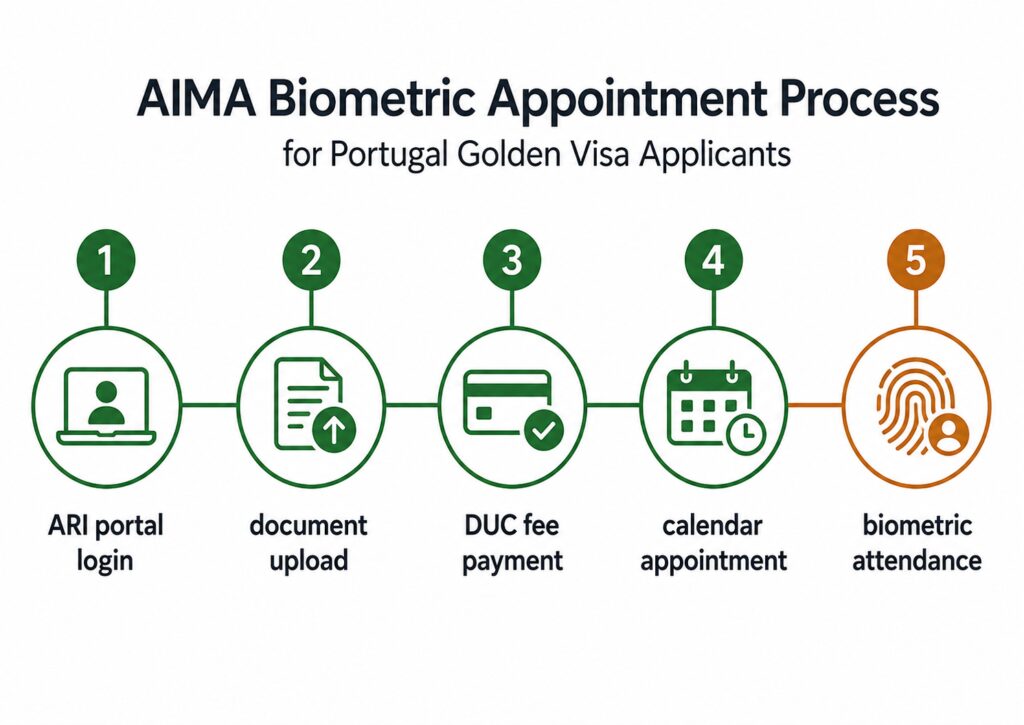
AIMA’s Portal ARI explains that applicants can submit the ARI application, upload required documents, generate payment documents, and access appointment scheduling through the portal. The portal also states that appointment booking is made through a calendar function after the application is accepted for scheduling.
The usual sequence is:
- Log in to the ARI portal.
- Complete the investor or family member application.
- Upload the required documents in the correct format.
- Generate and pay the DUC, the official payment document for applicable fees.
- Wait for AIMA to confirm whether the application has been accepted for scheduling or needs correction.
- Open the Calendar area once scheduling becomes available.
- Select the available AIMA office, year, month, day, and hour.
- Confirm the selected appointment slot.
This is where many applicants misunderstand the process. You do not simply choose any date at any time. Appointment availability depends on the portal, office capacity, and the specific status of the file.
For a step-by-step view of the wider submission route, investors should also review the full application guide before entering the appointment stage.
Current Wait Times in 2026
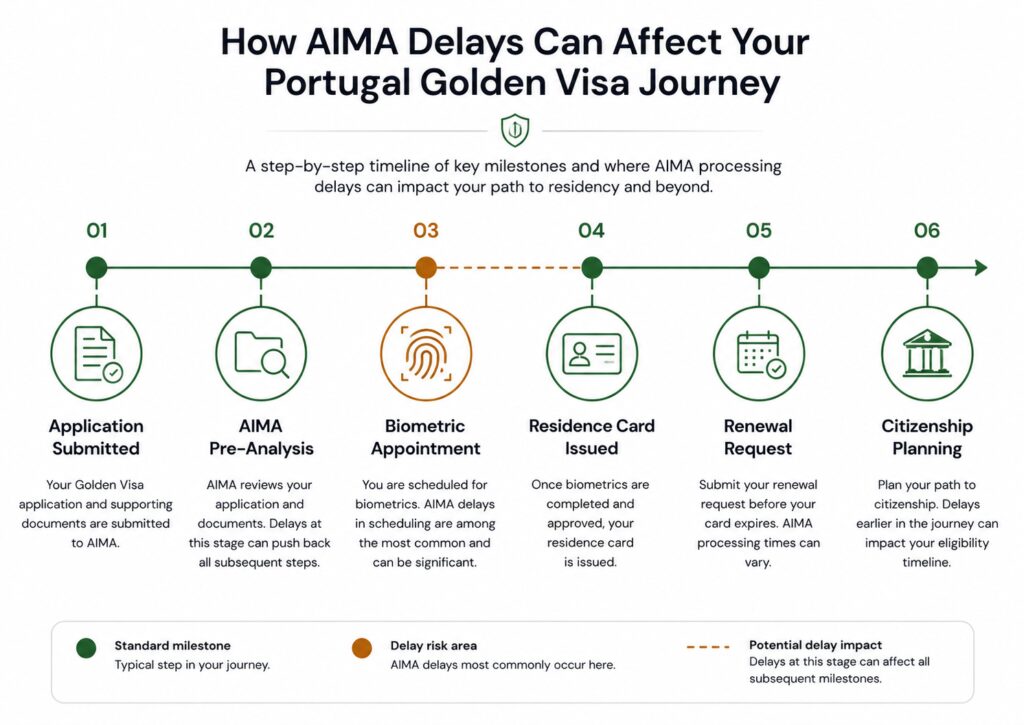
There is no single official AIMA wait-time number that applies to every Golden Visa applicant in 2026. The waiting period can vary depending on when the application was submitted, whether it is a legacy SEF case, whether documents require correction, and which AIMA offices have available appointment capacity.
A practical way to think about the wait is by stage:
| Stage | What may cause delay |
| Pre-analysis | Missing documents, unclear investment evidence, payment issues |
| Appointment release | Limited calendar availability and office capacity |
| Biometric attendance | Applicant availability, family member coordination, travel planning |
| Post-appointment review | Final verification and residence card issuance |
| Residence card delivery | Printing, dispatch, returned cards, address issues |
The safest advice is to plan for administrative delay rather than assume a fixed processing time. If your file is time-sensitive because of renewal, citizenship planning, or dependent family members, build in extra time.
For a wider breakdown of expected timing, see the firm’s guide to current processing timelines.
What to Bring to Your Appointment
AIMA can request specific documents depending on the type of ARI file and the applicant’s personal situation. Applicants should always follow the appointment notice and lawyer guidance, but the common preparation list includes:
- Valid passport
- Appointment confirmation
- ARI portal submission proof
- Proof of payment of applicable fees
- Updated criminal record certificates, if requested
- Valid health insurance, if applicable
- Proof of qualifying investment
- Proof of family relationship for dependents
- Power of attorney or legal representation documents, where relevant
- Any correction documents requested by AIMA
Do not treat the appointment as a formality. A biometric appointment is usually short, but the document history behind it is not. If AIMA asks for a document and the applicant cannot produce it, the file may move back into correction or additional review.
The AIMA Backlog: Causes and Current Status
The AIMA backlog is not one single queue. It includes different types of immigration files, old SEF-era cases, residence renewals, family applications, and new submissions. Golden Visa applications sit within that wider administrative environment.
For investors, the backlog matters because it can delay appointment booking, residence card issuance, and family member processing. It can also create uncertainty for applicants trying to plan travel, tax residence, school admissions, or future citizenship eligibility.
Why So Many Applications Are Delayed
Several factors created the current pressure on AIMA:
- SEF was abolished and its administrative functions moved into a new agency structure.
- AIMA inherited a large volume of pending applications.
- Digital systems had to be updated while files were already in progress.
- Residence renewals, new applications, and legacy cases were all competing for capacity.
- Some applicants submitted incomplete or outdated documents, creating correction cycles.
- Appointment capacity depends on AIMA offices, staffing, and available calendar slots.
The European Commission reported that Portugal’s Mission Structure had assisted 763,509 immigrants and issued 311,316 residence cards by January 2026. That figure covers wider immigration processing, not only Golden Visa files, but it shows the scale of the administrative workload behind the system. The broader context can also be reviewed through EU Residency Application Data.
A backlog does not mean every file is stuck. It means applicants need realistic expectations, well-prepared documents, and close monitoring of portal updates.
How Legacy SEF Cases Are Being Handled
A SEF legacy case is an application or renewal that began under the former SEF framework but is now handled by AIMA. These files may have older references, older submission histories, or appointment expectations based on the former system.
In practice, legacy cases require careful checking because the file may have moved through several administrative stages before AIMA took over. Applicants should confirm:
- Whether the file is visible in the correct portal
- Whether the registered email is still active
- Whether a representative has access to the file
- Whether old documents have expired
- Whether any AIMA notification was missed
- Whether the case requires correction or re-upload
This is especially important for grandfathered applications. A grandfathered Golden Visa application may be protected under earlier rules, but it still needs to move through AIMA’s current administrative process.
Auto-Renewal Protection: What It Means for You
Auto-renewal and residence validity extensions are often misunderstood. They do not usually mean that every step of the Golden Visa process happens automatically. They mean that, in certain situations, Portuguese law or AIMA guidance may protect residence status while the renewal process is pending.
The distinction matters. Status protection helps prevent an applicant from falling into irregular status because of administrative delay. It does not remove the need to submit renewal requests, pay fees, attend appointments where required, or keep documents updated.
How the Auto-Renewal Decree Works
AIMA has clarified that a foreign citizen’s right of residence may remain valid for a defined period after the expiry date of the residence card, in line with the applicable regulatory framework. For some categories, AIMA has also referred to specific transitional dates for expired residence cards and renewal procedures.
For a Golden Visa holder, the important point is this: do not assume your residence card is renewed simply because a general extension exists. You still need to confirm whether your ARI renewal is covered, whether a renewal request must be submitted, and whether AIMA requires biometric attendance.
AIMA announced that ARI renewals would be available through its Renewal Portal from 16 February 2026. This is an important operational update because Golden Visa renewals increasingly depend on digital submission, payment of applicable fees, and follow-up instructions from AIMA.
For investors who want a structured overview of the available residency paths, investment program in Portugal information should be reviewed alongside AIMA updates. The legal eligibility and the administrative timeline are connected, but they are not the same thing.
Does Auto-Renewal Affect Your Citizenship Timeline?
Auto-renewal protection may help maintain lawful residence status during administrative delay, but applicants should not assume it automatically resolves every citizenship-timeline issue. Citizenship eligibility depends on meeting the requirements under Portuguese nationality law, including legal residence duration and other conditions.
The key issue is evidence. If you plan to apply for citizenship after five years of legal residence, you should keep clear records of:
- ARI application submission
- Residence card issuance
- Renewal requests
- Payment confirmations
- AIMA appointment notices
- Expired cards, where relevant
- Receipts proving renewal requests
- Travel and physical presence evidence
Administrative delay should be documented, not ignored. If the citizenship timeline is part of your planning, treat AIMA correspondence as part of your long-term file.
Tips for Navigating AIMA Efficiently
AIMA delays are not always within the applicant’s control. Preparation is. The applicants who move most efficiently are usually the ones who treat the ARI file as a regulated process, not a set of disconnected forms.
Use this checklist before and after submission:
| AIMA task | Why it matters |
| Keep portal login access secure | Missed portal access can delay appointment booking |
| Monitor the registered email address | AIMA notices often arrive by email |
| Check spam and junk folders | Appointment and correction notices can be missed |
| Keep documents updated | Criminal records and certificates can expire |
| Track every payment receipt | DUC proof may be needed later |
| Keep copies of appointment confirmations | Useful for renewals and citizenship records |
| Coordinate family members early | Dependents can create scheduling complexity |
| Use legal support for corrections | A small document error can create months of delay |
Applicants should also avoid three common mistakes.
First, do not assume that a submitted application is the same as an accepted application. AIMA may still request corrections.
Second, do not wait until a residence card is close to expiry before asking about renewal. Renewal preparation should begin early, especially while digital systems are changing.
Third, do not rely on forum timelines. Other applicants can provide useful signals, but your file depends on its own submission date, document quality, office availability, and case category.
For investors deciding whether the Golden Visa remains the right route compared with residence alternatives, it may also help to review how the Golden Visa compares to the D7. The AIMA process matters in both routes, but the investment profile and residency planning are different.
FAQs About AIMA and Portugal Golden Visa Processing
What is AIMA and how does it replace SEF?
AIMA, the Agency for Integration, Migration and Asylum, is Portugal’s current immigration administration authority for many residence processes. It took over administrative functions after SEF, the former Serviço de Estrangeiros e Fronteiras, was abolished and Portugal restructured immigration and border responsibilities. For Golden Visa applicants, this means ARI files are now handled under AIMA systems rather than the old SEF framework.
How do I book a biometric appointment with AIMA?
For Golden Visa applicants, biometric appointment booking is generally managed through the ARI portal once the application is accepted for scheduling. The applicant or legal representative logs in, accesses the Calendar area, selects an available AIMA office, and chooses an available date and time. Appointment access depends on the status of the application and current availability.
What is the AIMA auto-renewal rule?
The AIMA auto-renewal rule refers to residence validity and renewal protections that may apply when residence permits expire while renewal systems or administrative processing are still pending. It does not mean every Golden Visa renewal is completed automatically without action. Applicants should still check whether they must submit a renewal request, pay fees, provide updated documents, or attend biometrics.
How long is the current biometric appointment wait time in 2026?
There is no official single wait time that applies to every Portugal Golden Visa biometric appointment in 2026. Wait times vary based on file status, office availability, document corrections, legacy SEF processing, and AIMA capacity. Applicants should plan for possible administrative delay and monitor the ARI portal and registered email closely.
Is Portugal Golden Visa AIMA Processing Manageable in 2026?
The AIMA process is manageable if you approach it with realistic expectations. The biggest risk is not usually the existence of the backlog itself. The bigger risk is assuming that a digital submission, an expired card, or a general extension means no further action is required.
For Golden Visa investors, the safest strategy is to keep the file clean, keep every proof of submission and payment, respond quickly to AIMA notices, and prepare for biometric appointments before the calendar opens. AIMA delays may be frustrating, but strong file management can reduce avoidable problems.
Portugal’s Golden Visa remains a structured route for eligible non-EU investors who want residence rights, Schengen access, family inclusion, and a potential citizenship pathway. The administrative process now runs through AIMA, so understanding AIMA is no longer optional. It is part of the investment decision.
Ready to take the next step?
Book a free initial assessment. We’ll assess your eligibility, walk through the current qualifying routes, and answer your questions, no cost, no commitment.












