

Portugal golden visa

Portugal Golden Visa for Australians: How to Apply and What to Expect

The portugal golden visa for australians is a practical route for Australian investors who want European residency, Schengen Area access, and a five-year pathway toward Portuguese citizenship without relocating full time. The key point is simple: Australians qualify as non-EU nationals, but the application has Australia-specific document, banking, police clearance, and tax considerations.

This guide explains what Australian applicants should expect before they start. It covers eligibility, AFP police checks, financial proof from Australian accounts, investment routes, superannuation issues, and tax points that should be reviewed before funds move offshore.

Can Australians Apply for the Portugal Golden Visa?

Yes. Australian citizens can apply for the Portugal Golden Visa because Australia is outside the European Union, the European Economic Area, and Switzerland. In Portugal, the formal name of the permit is ARI, Autorização de Residência para Investimento, which means residence permit for investment.

The ARI programme is processed by AIMA, the Agency for Integration, Migration and Asylum, the Portuguese immigration authority that replaced SEF in 2023. AIMA confirms that ARI applicants must be third-country nationals and must meet one of the qualifying investment routes.

For Australians, the programme is usually attractive because it does not require full-time relocation. It can support:

  • A European residency backup plan
  • Visa-free travel across the Schengen Area
  • Family inclusion under one investment structure
  • A long-term route to citizenship, subject to eligibility
  • Optional relocation rather than immediate migration

An Australian passport is strong for global travel, but it does not give its holder the right to live in the European Union. That is the gap the Portugal Golden Visa addresses.

Requirements for Australian Applicants

Australian applicants must meet the same core Golden Visa requirements as other non-EU investors, but some documents must be prepared specifically through Australian institutions.

At a high level, an applicant should expect to provide:

Requirement What Australian Applicants Usually Need
Identity proof Valid Australian passport
Criminal record evidence Australian Federal Police National Police Check
Document legalisation Apostille where required
Tax setup Portuguese NIF number
Banking Portuguese bank account
Investment proof Evidence of qualifying investment
Financial proof Bank statements and source of funds documentation
Health cover Valid health insurance for Portugal
Immigration submission ARI application through AIMA process

A Portuguese NIF number is usually one of the first practical steps. The NIF is the Portuguese tax identification number, and it is required before opening a Portuguese bank account, signing investment documents, or completing most financial steps in Portugal.

Portugal Golden Visa for Australians application planning with passport and documents

AFP National Police Check and Apostille

Australian applicants normally need an Australian Federal Police, or AFP, National Police Check. The Australian Federal Police describes the National Police Certificate as a summary of a person’s offender history in Australia.

For immigration use, applicants should make sure the certificate type, purpose, and name details match the requirements of the Portuguese process. Small inconsistencies can create delays, especially when middle names, previous names, or passport details do not match across documents.

After issue, the police certificate may need an apostille. An apostille is a formal certification that confirms a public document is valid for use overseas. In Australia, DFAT handles apostilles and authentications for Australian public documents.

The safe approach is to prepare the AFP check only when the application timing is clear. Police certificates can become stale for immigration purposes, so ordering too early can create unnecessary repeat work.

Portugal Golden Visa

Start Your Portugal Golden Visa Journey

Receive personalized legal guidance from experienced immigration lawyers and discover the most effective pathway to securing your Portugal Golden Visa.

Book Your Free Consultation →
✓ No Obligation   •   ✓ Licensed Lawyers   •   ✓ Confidential Consultation

Financial Proof from Australian Accounts

Australian applicants must show that their investment funds are legitimate, traceable, and available for the qualifying route. This is not just a bank balance exercise. Portugal Golden Visa applications usually require a clear source of funds file.

Common documents include:

  • Australian bank statements
  • Investment account statements
  • Sale agreements for property or business assets
  • Dividend or distribution records
  • Employment income evidence
  • Tax returns or accountant letters
  • Evidence of funds transferred to Portugal
  • Portuguese bank account confirmation

Applicants moving money from Australia should also consider exchange rate timing, bank transfer limits, and compliance checks from both Australian and Portuguese banks. A clean paper trail matters because Portuguese banks and fund managers must follow anti-money laundering procedures.

This is also where legal due diligence becomes important. Before sending funds, the investor should understand the fund, subscription documents, redemption terms, fees, custody structure, and whether the investment is suitable for Golden Visa purposes.

Health Insurance

Australian applicants who do not yet live in Portugal normally need private health insurance that is valid for Portugal. The policy should cover the applicant and any family members included in the application.

For families, this should be arranged early enough to avoid last-minute document gaps before submission. Health insurance is usually not the most complex requirement, but it is one of those small items that can delay a file when left until the end.

Investment Options Available to Australians

The available investment route matters more than nationality. Australians do not receive a separate investment category. They must choose from the routes allowed under Portuguese law and then prepare the Australian-specific documents around that route.

Most Australian applicants focus on the investment fund route because it is structured, documentable, and easier to align with professional due diligence than a less common route.

Investment Fund Route

The investment fund route requires a qualifying investment into eligible Portuguese investment funds. The minimum threshold is generally €500,000, and the fund must meet the legal conditions for the ARI programme.

For Australian investors, this route has several practical advantages:

  • It avoids direct property management in Portugal
  • It can be documented through subscription records and bank transfers
  • It is supervised within Portugal’s financial regulatory framework
  • It can suit investors who want residency optionality without moving immediately
  • It may be easier to coordinate with Australian tax and wealth advisers than a personally managed Portuguese asset

Qualifying funds are supervised by CMVM, Portugal’s Securities Market Commission, which is the regulator responsible for Portugal’s securities market and investment fund supervision. Applicants should still complete independent legal and financial review. Regulation does not remove investment risk.

Australian investors comparing options can review the firm’s qualifying fund investment options to understand how this route usually works in practice.
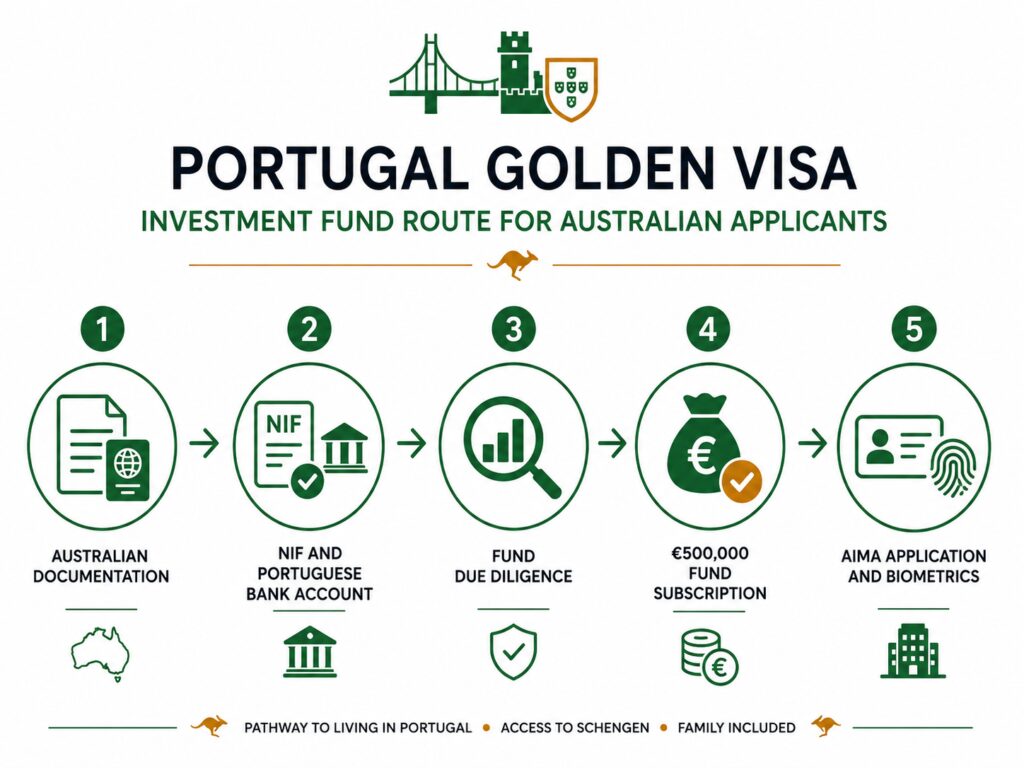
Portugal Golden Visa Australia fund route steps for investors

Cultural Donation Route

AIMA lists a cultural support route involving a capital transfer for artistic production or the recovery and maintenance of national cultural heritage. This route is generally less common than the fund route because it can involve more specific eligibility checks, public interest requirements, and documentation around the receiving entity.

For Australian applicants, the key question is not whether the route sounds simpler. It is whether the receiving project qualifies, whether the documentation is strong enough for ARI purposes, and whether the investor accepts the financial nature of the contribution.

In many cases, Australians who want a clearer investment file prefer the fund route. The cultural route may still be relevant for applicants with a strong philanthropic objective or a specific Portuguese cultural project, but it should be assessed carefully before commitment.

Can Australians Use Superannuation for the Investment?

This is one of the most important questions for Australian applicants. Superannuation is not ordinary cash sitting in a bank account. It is a regulated retirement structure with strict rules, tax consequences, trustee obligations, and access restrictions.

Most Australians cannot simply withdraw superannuation early to fund a Portugal Golden Visa investment. Whether superannuation can be used depends on the type of fund, the member’s age, preservation status, conditions of release, and the legal structure of the investment.

Before making any decision, the applicant should speak with an Australian tax adviser, licensed financial adviser, and where relevant, an SMSF specialist.

Self-Managed Super Fund SMSF Considerations

A self-managed super fund, or SMSF, adds another layer of complexity. The Australian Tax Office explains SMSF residency requirements, including rules that matter when members or trustees go overseas.

An SMSF may lose its complying status if residency rules are not managed correctly. That can create serious tax consequences. This is why an SMSF-funded Golden Visa strategy should never be treated as a simple transfer of funds.

Australian applicants should review:

  1. Whether the SMSF can legally make the investment.
  2. Whether the investment satisfies the SMSF investment strategy.
  3. Whether the fund remains an Australian super fund.
  4. Whether central management and control remains in Australia.
  5. Whether the applicant’s move to Portugal changes tax residency or trustee control.
  6. Whether the investment creates conflicts with sole purpose test obligations.

For many applicants, personal investment funds outside superannuation are simpler. For those who want to explore SMSF options, the review should happen before any Portuguese bank account or fund subscription step.
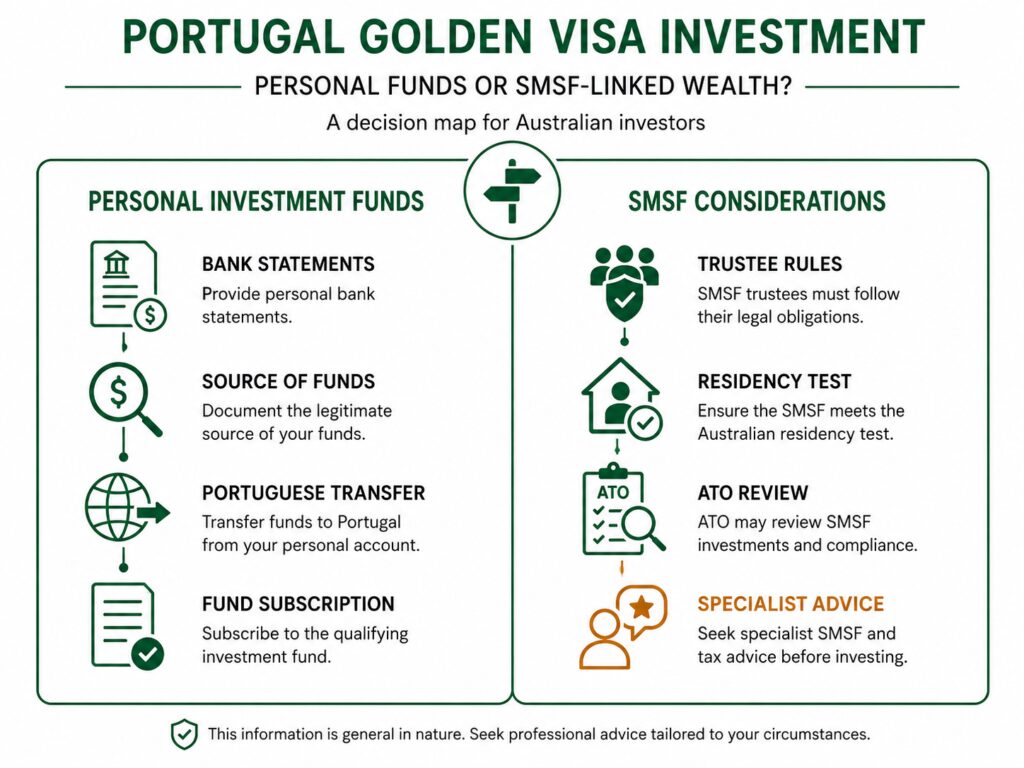
Australian superannuation considerations for Portugal Golden Visa investment planning

Tax Implications for Australians

The Portugal Golden Visa does not automatically make an Australian applicant a Portuguese tax resident. Tax residency depends on where the person lives, how long they stay, where their home and economic interests are located, and how Australian and Portuguese tax rules apply.

This matters because many Australians use the Golden Visa as a Plan B rather than an immediate relocation visa. If the applicant spends only short periods in Portugal, the tax result may be very different from someone who moves permanently.

Australia-Portugal Double Tax Treaty

Australia and Portugal signed a double tax treaty in 2023. The Australian Treasury states that the treaty is intended to reduce double taxation and provide more certainty for Australians and Australian businesses earning income in both countries.

For Golden Visa applicants, the treaty is relevant if they have income, investments, pensions, employment, or business interests connected to both Australia and Portugal. It does not remove the need for advice. It provides a framework for allocating taxing rights between the two countries.

Australian applicants should review treaty issues before relocation if they have:

  • Australian rental income
  • Dividends or interest from Australian investments
  • Capital gains exposure
  • Business income
  • Superannuation income
  • Trust structures
  • Company ownership
  • Planned Portuguese tax residency

Tax planning should be done before a move, not after the first Portuguese tax filing deadline appears.

NHR Regime Eligibility

NHR Portugal is still widely discussed online, but applicants need current advice. Portugal’s Tax and Customs Authority has stated that the former Non-Habitual Resident regime was repealed from 1 January 2024 and replaced by the Tax Incentive for Scientific Research and Innovation, with transitional rules for certain taxpayers.

That means Australian applicants should not assume that older NHR benefits are available simply because they read about them on an old Golden Visa article. The correct question is whether the applicant qualifies under the transitional rules or any current replacement regime.

For many Australians, the Golden Visa decision is primarily about residency and future optionality. The tax result depends on whether they actually move to Portugal, when they become tax resident, what income they receive, and whether they qualify for any special tax regime at the time.

ATO Reporting When Moving Abroad

The Australian Tax Office explains that Australians living overseas may still need to lodge an Australian tax return if they remain Australian tax residents.

This is especially important for Golden Visa holders who keep strong ties to Australia. Owning a home, keeping family in Australia, maintaining Australian investments, continuing directorships, or spending substantial time in Australia can all affect the analysis.

Before moving to Portugal, Australians should ask their adviser to review:

  • Australian tax residency
  • Portuguese tax residency
  • Foreign income reporting
  • Capital gains tax exposure
  • Superannuation treatment
  • Trust and company structures
  • Exit planning for Australian assets
  • Timing of residency registration in Portugal

The Golden Visa creates an immigration pathway. It does not replace tax planning.

Practical Step-by-Step Guide for Australian Applicants

The process is easier to manage when the Australian and Portuguese steps are planned together. A document delay in Australia can slow a Portuguese submission. A banking issue in Portugal can delay the investment.

Here is a practical sequence:

  1. Confirm eligibility as a non-EU national
    Australian citizens generally qualify by nationality, but they still need to meet personal, criminal record, financial, and investment requirements.
  2. Choose the investment route
    Most Australians review the investment fund route first. The fund must satisfy ARI requirements and should be reviewed by legal and financial advisers.
  3. Get a Portuguese NIF number
    The NIF is required for banking, tax, and investment steps in Portugal.
  4. Open a Portuguese bank account
    The bank will usually request identity documents, proof of address, tax information, and source of funds details.
  5. Prepare Australian documents
    This normally includes the Australian passport, AFP National Police Check, apostille where required, proof of address, family documents, and financial proof.
  6. Complete legal due diligence
    Review the fund, subscription agreement, fees, custody arrangements, exit terms, and Golden Visa eligibility.
  7. Transfer funds and complete the investment
    Keep a clean record of every transfer from Australia to Portugal.
  8. Submit the ARI application
    The application is submitted through the Portuguese immigration process managed by AIMA.
  9. Attend the biometric appointment
    The applicant and included family members attend biometrics when scheduled.
  10. Receive the residence permit
    Once approved and issued, the permit gives residency rights subject to renewal and ongoing compliance.
  11. Maintain the investment and renewal file
    Keep investment documents, insurance, passport validity, and criminal record updates ready for renewal stages.

Australian applicants who want a structured comparison of residency options can also review Portugal investment residency solutions before choosing the best route.

For applicants comparing relocation-based visas with investment residency, how the Golden Visa compares to the D7 can help clarify whether the Golden Visa is the right fit.

FAQs: Portugal Golden Visa for Australians

Can Australians apply for the Portugal Golden Visa?

Yes. Australians can apply because they are non-EU nationals. They must meet the required investment, documentation, criminal record, health insurance, and source of funds requirements. An Australian passport alone is not enough, but it satisfies the nationality condition for the programme.

What police clearance do Australian applicants need?

Australian applicants normally need an AFP National Police Check. The document may also need an apostille before it is accepted for Portuguese immigration use. Applicants should confirm the correct certificate type and timing before ordering it, because police certificates can become outdated for application purposes.

Can I use Australian superannuation funds?

Possibly, but it depends on the superannuation structure and the applicant’s circumstances. Most applicants cannot simply access super early for a Golden Visa investment. SMSF strategies require specialist advice because ATO rules, residency requirements, trustee control, and compliance obligations can create serious tax consequences.

What are the tax implications for Australians?

The tax implications depend on whether the applicant becomes tax resident in Portugal, remains tax resident in Australia, or has income in both countries. Australians should review the Australia-Portugal double tax treaty, ATO reporting obligations, Portuguese tax residency rules, and any current Portuguese tax incentive regime before relocating or restructuring assets.

Is the Portugal Golden Visa Right for Australians?

The Portugal Golden Visa can make sense for Australians who want European residency without an immediate full-time move. It is especially relevant for investors who want a five-year pathway to Portuguese citizenship, family inclusion, and Schengen mobility while keeping their main life and business interests in Australia.

The main challenge is coordination. Australian applicants need to align Portuguese immigration requirements with AFP police checks, apostilles, banking compliance, ATO reporting, superannuation rules, and cross-border tax planning. None of these points should be left until after the investment is made.

If you are comparing investment routes, review the Portugal Golden Visa programme with a qualified adviser before moving funds offshore. A clear plan at the start can prevent document delays, tax surprises, and avoidable compliance problems later.

Ready to take the next step?
Book a free initial assessment. We’ll assess your eligibility, walk through the current qualifying routes, and answer your questions, no cost, no commitment.


Portugal Golden Visa for Australians: How to Apply and What to Expect

The portugal golden visa for australians is a practical route for Australian investors who want European residency, Schengen Area access, and a five-year pathway toward Portuguese citizenship without relocating full time. The key point is simple: Australians qualify as non-EU nationals, but the application has Australia-specific document, banking, police clearance, and tax considerations.

This guide explains what Australian applicants should expect before they start. It covers eligibility, AFP police checks, financial proof from Australian accounts, investment routes, superannuation issues, and tax points that should be reviewed before funds move offshore.

Can Australians Apply for the Portugal Golden Visa?

Yes. Australian citizens can apply for the Portugal Golden Visa because Australia is outside the European Union, the European Economic Area, and Switzerland. In Portugal, the formal name of the permit is ARI, Autorização de Residência para Investimento, which means residence permit for investment.

The ARI programme is processed by AIMA, the Agency for Integration, Migration and Asylum, the Portuguese immigration authority that replaced SEF in 2023. AIMA confirms that ARI applicants must be third-country nationals and must meet one of the qualifying investment routes.

For Australians, the programme is usually attractive because it does not require full-time relocation. It can support:

  • A European residency backup plan
  • Visa-free travel across the Schengen Area
  • Family inclusion under one investment structure
  • A long-term route to citizenship, subject to eligibility
  • Optional relocation rather than immediate migration

An Australian passport is strong for global travel, but it does not give its holder the right to live in the European Union. That is the gap the Portugal Golden Visa addresses.

Requirements for Australian Applicants

Australian applicants must meet the same core Golden Visa requirements as other non-EU investors, but some documents must be prepared specifically through Australian institutions.

At a high level, an applicant should expect to provide:

Requirement What Australian Applicants Usually Need
Identity proof Valid Australian passport
Criminal record evidence Australian Federal Police National Police Check
Document legalisation Apostille where required
Tax setup Portuguese NIF number
Banking Portuguese bank account
Investment proof Evidence of qualifying investment
Financial proof Bank statements and source of funds documentation
Health cover Valid health insurance for Portugal
Immigration submission ARI application through AIMA process

A Portuguese NIF number is usually one of the first practical steps. The NIF is the Portuguese tax identification number, and it is required before opening a Portuguese bank account, signing investment documents, or completing most financial steps in Portugal.

Portugal Golden Visa for Australians application planning with passport and documents

AFP National Police Check and Apostille

Australian applicants normally need an Australian Federal Police, or AFP, National Police Check. The Australian Federal Police describes the National Police Certificate as a summary of a person’s offender history in Australia.

For immigration use, applicants should make sure the certificate type, purpose, and name details match the requirements of the Portuguese process. Small inconsistencies can create delays, especially when middle names, previous names, or passport details do not match across documents.

After issue, the police certificate may need an apostille. An apostille is a formal certification that confirms a public document is valid for use overseas. In Australia, DFAT handles apostilles and authentications for Australian public documents.

The safe approach is to prepare the AFP check only when the application timing is clear. Police certificates can become stale for immigration purposes, so ordering too early can create unnecessary repeat work.

Portugal Golden Visa

Start Your Portugal Golden Visa Journey

Receive personalized legal guidance from experienced immigration lawyers and discover the most effective pathway to securing your Portugal Golden Visa.

Book Your Free Consultation →
✓ No Obligation   •   ✓ Licensed Lawyers   •   ✓ Confidential Consultation

Financial Proof from Australian Accounts

Australian applicants must show that their investment funds are legitimate, traceable, and available for the qualifying route. This is not just a bank balance exercise. Portugal Golden Visa applications usually require a clear source of funds file.

Common documents include:

  • Australian bank statements
  • Investment account statements
  • Sale agreements for property or business assets
  • Dividend or distribution records
  • Employment income evidence
  • Tax returns or accountant letters
  • Evidence of funds transferred to Portugal
  • Portuguese bank account confirmation

Applicants moving money from Australia should also consider exchange rate timing, bank transfer limits, and compliance checks from both Australian and Portuguese banks. A clean paper trail matters because Portuguese banks and fund managers must follow anti-money laundering procedures.

This is also where legal due diligence becomes important. Before sending funds, the investor should understand the fund, subscription documents, redemption terms, fees, custody structure, and whether the investment is suitable for Golden Visa purposes.

Health Insurance

Australian applicants who do not yet live in Portugal normally need private health insurance that is valid for Portugal. The policy should cover the applicant and any family members included in the application.

For families, this should be arranged early enough to avoid last-minute document gaps before submission. Health insurance is usually not the most complex requirement, but it is one of those small items that can delay a file when left until the end.

Investment Options Available to Australians

The available investment route matters more than nationality. Australians do not receive a separate investment category. They must choose from the routes allowed under Portuguese law and then prepare the Australian-specific documents around that route.

Most Australian applicants focus on the investment fund route because it is structured, documentable, and easier to align with professional due diligence than a less common route.

Investment Fund Route

The investment fund route requires a qualifying investment into eligible Portuguese investment funds. The minimum threshold is generally €500,000, and the fund must meet the legal conditions for the ARI programme.

For Australian investors, this route has several practical advantages:

  • It avoids direct property management in Portugal
  • It can be documented through subscription records and bank transfers
  • It is supervised within Portugal’s financial regulatory framework
  • It can suit investors who want residency optionality without moving immediately
  • It may be easier to coordinate with Australian tax and wealth advisers than a personally managed Portuguese asset

Qualifying funds are supervised by CMVM, Portugal’s Securities Market Commission, which is the regulator responsible for Portugal’s securities market and investment fund supervision. Applicants should still complete independent legal and financial review. Regulation does not remove investment risk.

Australian investors comparing options can review the firm’s qualifying fund investment options to understand how this route usually works in practice.

Portugal Golden Visa Australia fund route steps for investors

Cultural Donation Route

AIMA lists a cultural support route involving a capital transfer for artistic production or the recovery and maintenance of national cultural heritage. This route is generally less common than the fund route because it can involve more specific eligibility checks, public interest requirements, and documentation around the receiving entity.

For Australian applicants, the key question is not whether the route sounds simpler. It is whether the receiving project qualifies, whether the documentation is strong enough for ARI purposes, and whether the investor accepts the financial nature of the contribution.

In many cases, Australians who want a clearer investment file prefer the fund route. The cultural route may still be relevant for applicants with a strong philanthropic objective or a specific Portuguese cultural project, but it should be assessed carefully before commitment.

Can Australians Use Superannuation for the Investment?

This is one of the most important questions for Australian applicants. Superannuation is not ordinary cash sitting in a bank account. It is a regulated retirement structure with strict rules, tax consequences, trustee obligations, and access restrictions.

Most Australians cannot simply withdraw superannuation early to fund a Portugal Golden Visa investment. Whether superannuation can be used depends on the type of fund, the member’s age, preservation status, conditions of release, and the legal structure of the investment.

Before making any decision, the applicant should speak with an Australian tax adviser, licensed financial adviser, and where relevant, an SMSF specialist.

Self-Managed Super Fund SMSF Considerations

A self-managed super fund, or SMSF, adds another layer of complexity. The Australian Tax Office explains SMSF residency requirements, including rules that matter when members or trustees go overseas.

An SMSF may lose its complying status if residency rules are not managed correctly. That can create serious tax consequences. This is why an SMSF-funded Golden Visa strategy should never be treated as a simple transfer of funds.

Australian applicants should review:

  1. Whether the SMSF can legally make the investment.
  2. Whether the investment satisfies the SMSF investment strategy.
  3. Whether the fund remains an Australian super fund.
  4. Whether central management and control remains in Australia.
  5. Whether the applicant’s move to Portugal changes tax residency or trustee control.
  6. Whether the investment creates conflicts with sole purpose test obligations.

For many applicants, personal investment funds outside superannuation are simpler. For those who want to explore SMSF options, the review should happen before any Portuguese bank account or fund subscription step.

Australian superannuation considerations for Portugal Golden Visa investment planning

Tax Implications for Australians

The Portugal Golden Visa does not automatically make an Australian applicant a Portuguese tax resident. Tax residency depends on where the person lives, how long they stay, where their home and economic interests are located, and how Australian and Portuguese tax rules apply.

This matters because many Australians use the Golden Visa as a Plan B rather than an immediate relocation visa. If the applicant spends only short periods in Portugal, the tax result may be very different from someone who moves permanently.

Australia-Portugal Double Tax Treaty

Australia and Portugal signed a double tax treaty in 2023. The Australian Treasury states that the treaty is intended to reduce double taxation and provide more certainty for Australians and Australian businesses earning income in both countries.

For Golden Visa applicants, the treaty is relevant if they have income, investments, pensions, employment, or business interests connected to both Australia and Portugal. It does not remove the need for advice. It provides a framework for allocating taxing rights between the two countries.

Australian applicants should review treaty issues before relocation if they have:

  • Australian rental income
  • Dividends or interest from Australian investments
  • Capital gains exposure
  • Business income
  • Superannuation income
  • Trust structures
  • Company ownership
  • Planned Portuguese tax residency

Tax planning should be done before a move, not after the first Portuguese tax filing deadline appears.

NHR Regime Eligibility

NHR Portugal is still widely discussed online, but applicants need current advice. Portugal’s Tax and Customs Authority has stated that the former Non-Habitual Resident regime was repealed from 1 January 2024 and replaced by the Tax Incentive for Scientific Research and Innovation, with transitional rules for certain taxpayers.

That means Australian applicants should not assume that older NHR benefits are available simply because they read about them on an old Golden Visa article. The correct question is whether the applicant qualifies under the transitional rules or any current replacement regime.

For many Australians, the Golden Visa decision is primarily about residency and future optionality. The tax result depends on whether they actually move to Portugal, when they become tax resident, what income they receive, and whether they qualify for any special tax regime at the time.

ATO Reporting When Moving Abroad

The Australian Tax Office explains that Australians living overseas may still need to lodge an Australian tax return if they remain Australian tax residents.

This is especially important for Golden Visa holders who keep strong ties to Australia. Owning a home, keeping family in Australia, maintaining Australian investments, continuing directorships, or spending substantial time in Australia can all affect the analysis.

Before moving to Portugal, Australians should ask their adviser to review:

  • Australian tax residency
  • Portuguese tax residency
  • Foreign income reporting
  • Capital gains tax exposure
  • Superannuation treatment
  • Trust and company structures
  • Exit planning for Australian assets
  • Timing of residency registration in Portugal

The Golden Visa creates an immigration pathway. It does not replace tax planning.

Practical Step-by-Step Guide for Australian Applicants

The process is easier to manage when the Australian and Portuguese steps are planned together. A document delay in Australia can slow a Portuguese submission. A banking issue in Portugal can delay the investment.

Here is a practical sequence:

  1. Confirm eligibility as a non-EU national
    Australian citizens generally qualify by nationality, but they still need to meet personal, criminal record, financial, and investment requirements.
  2. Choose the investment route
    Most Australians review the investment fund route first. The fund must satisfy ARI requirements and should be reviewed by legal and financial advisers.
  3. Get a Portuguese NIF number
    The NIF is required for banking, tax, and investment steps in Portugal.
  4. Open a Portuguese bank account
    The bank will usually request identity documents, proof of address, tax information, and source of funds details.
  5. Prepare Australian documents
    This normally includes the Australian passport, AFP National Police Check, apostille where required, proof of address, family documents, and financial proof.
  6. Complete legal due diligence
    Review the fund, subscription agreement, fees, custody arrangements, exit terms, and Golden Visa eligibility.
  7. Transfer funds and complete the investment
    Keep a clean record of every transfer from Australia to Portugal.
  8. Submit the ARI application
    The application is submitted through the Portuguese immigration process managed by AIMA.
  9. Attend the biometric appointment
    The applicant and included family members attend biometrics when scheduled.
  10. Receive the residence permit
    Once approved and issued, the permit gives residency rights subject to renewal and ongoing compliance.
  11. Maintain the investment and renewal file
    Keep investment documents, insurance, passport validity, and criminal record updates ready for renewal stages.

Australian applicants who want a structured comparison of residency options can also review Portugal investment residency solutions before choosing the best route.

For applicants comparing relocation-based visas with investment residency, how the Golden Visa compares to the D7 can help clarify whether the Golden Visa is the right fit.

FAQs: Portugal Golden Visa for Australians

Can Australians apply for the Portugal Golden Visa?

Yes. Australians can apply because they are non-EU nationals. They must meet the required investment, documentation, criminal record, health insurance, and source of funds requirements. An Australian passport alone is not enough, but it satisfies the nationality condition for the programme.

What police clearance do Australian applicants need?

Australian applicants normally need an AFP National Police Check. The document may also need an apostille before it is accepted for Portuguese immigration use. Applicants should confirm the correct certificate type and timing before ordering it, because police certificates can become outdated for application purposes.

Can I use Australian superannuation funds?

Possibly, but it depends on the superannuation structure and the applicant’s circumstances. Most applicants cannot simply access super early for a Golden Visa investment. SMSF strategies require specialist advice because ATO rules, residency requirements, trustee control, and compliance obligations can create serious tax consequences.

What are the tax implications for Australians?

The tax implications depend on whether the applicant becomes tax resident in Portugal, remains tax resident in Australia, or has income in both countries. Australians should review the Australia-Portugal double tax treaty, ATO reporting obligations, Portuguese tax residency rules, and any current Portuguese tax incentive regime before relocating or restructuring assets.

Is the Portugal Golden Visa Right for Australians?

The Portugal Golden Visa can make sense for Australians who want European residency without an immediate full-time move. It is especially relevant for investors who want a five-year pathway to Portuguese citizenship, family inclusion, and Schengen mobility while keeping their main life and business interests in Australia.

The main challenge is coordination. Australian applicants need to align Portuguese immigration requirements with AFP police checks, apostilles, banking compliance, ATO reporting, superannuation rules, and cross-border tax planning. None of these points should be left until after the investment is made.

If you are comparing investment routes, review the Portugal Golden Visa programme with a qualified adviser before moving funds offshore. A clear plan at the start can prevent document delays, tax surprises, and avoidable compliance problems later.

Ready to take the next step?
Book a free initial assessment. We’ll assess your eligibility, walk through the current qualifying routes, and answer your questions, no cost, no commitment.

Portugal Golden Visa for Australians: How to Apply and What to Expect

Portugal-Golden-Visa-for-Australians-How-to-Apply-and-What-to-Expect
The portugal golden visa for australians is a practical route for Australian investors who want European residency, Schengen Area access, and a five-year pathway toward Portuguese citizenship without relocating full time. The key point is simple: Australians qualify as non-EU nationals, but the application has Australia-specific document, banking, police clearance, and tax considerations.

This guide explains what Australian applicants should expect before they start. It covers eligibility, AFP police checks, financial proof from Australian accounts, investment routes, superannuation issues, and tax points that should be reviewed before funds move offshore.

Can Australians Apply for the Portugal Golden Visa?

Yes. Australian citizens can apply for the Portugal Golden Visa because Australia is outside the European Union, the European Economic Area, and Switzerland. In Portugal, the formal name of the permit is ARI, Autorização de Residência para Investimento, which means residence permit for investment.

The ARI programme is processed by AIMA, the Agency for Integration, Migration and Asylum, the Portuguese immigration authority that replaced SEF in 2023. AIMA confirms that ARI applicants must be third-country nationals and must meet one of the qualifying investment routes.

For Australians, the programme is usually attractive because it does not require full-time relocation. It can support:

  • A European residency backup plan
  • Visa-free travel across the Schengen Area
  • Family inclusion under one investment structure
  • A long-term route to citizenship, subject to eligibility
  • Optional relocation rather than immediate migration

An Australian passport is strong for global travel, but it does not give its holder the right to live in the European Union. That is the gap the Portugal Golden Visa addresses.

Requirements for Australian Applicants

Australian applicants must meet the same core Golden Visa requirements as other non-EU investors, but some documents must be prepared specifically through Australian institutions.

At a high level, an applicant should expect to provide:

Requirement What Australian Applicants Usually Need
Identity proof Valid Australian passport
Criminal record evidence Australian Federal Police National Police Check
Document legalisation Apostille where required
Tax setup Portuguese NIF number
Banking Portuguese bank account
Investment proof Evidence of qualifying investment
Financial proof Bank statements and source of funds documentation
Health cover Valid health insurance for Portugal
Immigration submission ARI application through AIMA process

A Portuguese NIF number is usually one of the first practical steps. The NIF is the Portuguese tax identification number, and it is required before opening a Portuguese bank account, signing investment documents, or completing most financial steps in Portugal.

Portugal Golden Visa for Australians application planning with passport and documents

AFP National Police Check and Apostille

Australian applicants normally need an Australian Federal Police, or AFP, National Police Check. The Australian Federal Police describes the National Police Certificate as a summary of a person’s offender history in Australia.

For immigration use, applicants should make sure the certificate type, purpose, and name details match the requirements of the Portuguese process. Small inconsistencies can create delays, especially when middle names, previous names, or passport details do not match across documents.

After issue, the police certificate may need an apostille. An apostille is a formal certification that confirms a public document is valid for use overseas. In Australia, DFAT handles apostilles and authentications for Australian public documents.

The safe approach is to prepare the AFP check only when the application timing is clear. Police certificates can become stale for immigration purposes, so ordering too early can create unnecessary repeat work.

Portugal Golden Visa

Start Your Portugal Golden Visa Journey

Receive personalized legal guidance from experienced immigration lawyers and discover the most effective pathway to securing your Portugal Golden Visa.

Book Your Free Consultation →
✓ No Obligation   •   ✓ Licensed Lawyers   •   ✓ Confidential Consultation

Financial Proof from Australian Accounts

Australian applicants must show that their investment funds are legitimate, traceable, and available for the qualifying route. This is not just a bank balance exercise. Portugal Golden Visa applications usually require a clear source of funds file.

Common documents include:

  • Australian bank statements
  • Investment account statements
  • Sale agreements for property or business assets
  • Dividend or distribution records
  • Employment income evidence
  • Tax returns or accountant letters
  • Evidence of funds transferred to Portugal
  • Portuguese bank account confirmation

Applicants moving money from Australia should also consider exchange rate timing, bank transfer limits, and compliance checks from both Australian and Portuguese banks. A clean paper trail matters because Portuguese banks and fund managers must follow anti-money laundering procedures.

This is also where legal due diligence becomes important. Before sending funds, the investor should understand the fund, subscription documents, redemption terms, fees, custody structure, and whether the investment is suitable for Golden Visa purposes.

Health Insurance

Australian applicants who do not yet live in Portugal normally need private health insurance that is valid for Portugal. The policy should cover the applicant and any family members included in the application.

For families, this should be arranged early enough to avoid last-minute document gaps before submission. Health insurance is usually not the most complex requirement, but it is one of those small items that can delay a file when left until the end.

Investment Options Available to Australians

The available investment route matters more than nationality. Australians do not receive a separate investment category. They must choose from the routes allowed under Portuguese law and then prepare the Australian-specific documents around that route.

Most Australian applicants focus on the investment fund route because it is structured, documentable, and easier to align with professional due diligence than a less common route.

Investment Fund Route

The investment fund route requires a qualifying investment into eligible Portuguese investment funds. The minimum threshold is generally €500,000, and the fund must meet the legal conditions for the ARI programme.

For Australian investors, this route has several practical advantages:

  • It avoids direct property management in Portugal
  • It can be documented through subscription records and bank transfers
  • It is supervised within Portugal’s financial regulatory framework
  • It can suit investors who want residency optionality without moving immediately
  • It may be easier to coordinate with Australian tax and wealth advisers than a personally managed Portuguese asset

Qualifying funds are supervised by CMVM, Portugal’s Securities Market Commission, which is the regulator responsible for Portugal’s securities market and investment fund supervision. Applicants should still complete independent legal and financial review. Regulation does not remove investment risk.

Australian investors comparing options can review the firm’s qualifying fund investment options to understand how this route usually works in practice.

Portugal Golden Visa Australia fund route steps for investors

Cultural Donation Route

AIMA lists a cultural support route involving a capital transfer for artistic production or the recovery and maintenance of national cultural heritage. This route is generally less common than the fund route because it can involve more specific eligibility checks, public interest requirements, and documentation around the receiving entity.

For Australian applicants, the key question is not whether the route sounds simpler. It is whether the receiving project qualifies, whether the documentation is strong enough for ARI purposes, and whether the investor accepts the financial nature of the contribution.

In many cases, Australians who want a clearer investment file prefer the fund route. The cultural route may still be relevant for applicants with a strong philanthropic objective or a specific Portuguese cultural project, but it should be assessed carefully before commitment.

Can Australians Use Superannuation for the Investment?

This is one of the most important questions for Australian applicants. Superannuation is not ordinary cash sitting in a bank account. It is a regulated retirement structure with strict rules, tax consequences, trustee obligations, and access restrictions.

Most Australians cannot simply withdraw superannuation early to fund a Portugal Golden Visa investment. Whether superannuation can be used depends on the type of fund, the member’s age, preservation status, conditions of release, and the legal structure of the investment.

Before making any decision, the applicant should speak with an Australian tax adviser, licensed financial adviser, and where relevant, an SMSF specialist.

Self-Managed Super Fund SMSF Considerations

A self-managed super fund, or SMSF, adds another layer of complexity. The Australian Tax Office explains SMSF residency requirements, including rules that matter when members or trustees go overseas.

An SMSF may lose its complying status if residency rules are not managed correctly. That can create serious tax consequences. This is why an SMSF-funded Golden Visa strategy should never be treated as a simple transfer of funds.

Australian applicants should review:

  1. Whether the SMSF can legally make the investment.
  2. Whether the investment satisfies the SMSF investment strategy.
  3. Whether the fund remains an Australian super fund.
  4. Whether central management and control remains in Australia.
  5. Whether the applicant’s move to Portugal changes tax residency or trustee control.
  6. Whether the investment creates conflicts with sole purpose test obligations.

For many applicants, personal investment funds outside superannuation are simpler. For those who want to explore SMSF options, the review should happen before any Portuguese bank account or fund subscription step.

Australian superannuation considerations for Portugal Golden Visa investment planning

Tax Implications for Australians

The Portugal Golden Visa does not automatically make an Australian applicant a Portuguese tax resident. Tax residency depends on where the person lives, how long they stay, where their home and economic interests are located, and how Australian and Portuguese tax rules apply.

This matters because many Australians use the Golden Visa as a Plan B rather than an immediate relocation visa. If the applicant spends only short periods in Portugal, the tax result may be very different from someone who moves permanently.

Australia-Portugal Double Tax Treaty

Australia and Portugal signed a double tax treaty in 2023. The Australian Treasury states that the treaty is intended to reduce double taxation and provide more certainty for Australians and Australian businesses earning income in both countries.

For Golden Visa applicants, the treaty is relevant if they have income, investments, pensions, employment, or business interests connected to both Australia and Portugal. It does not remove the need for advice. It provides a framework for allocating taxing rights between the two countries.

Australian applicants should review treaty issues before relocation if they have:

  • Australian rental income
  • Dividends or interest from Australian investments
  • Capital gains exposure
  • Business income
  • Superannuation income
  • Trust structures
  • Company ownership
  • Planned Portuguese tax residency

Tax planning should be done before a move, not after the first Portuguese tax filing deadline appears.

NHR Regime Eligibility

NHR Portugal is still widely discussed online, but applicants need current advice. Portugal’s Tax and Customs Authority has stated that the former Non-Habitual Resident regime was repealed from 1 January 2024 and replaced by the Tax Incentive for Scientific Research and Innovation, with transitional rules for certain taxpayers.

That means Australian applicants should not assume that older NHR benefits are available simply because they read about them on an old Golden Visa article. The correct question is whether the applicant qualifies under the transitional rules or any current replacement regime.

For many Australians, the Golden Visa decision is primarily about residency and future optionality. The tax result depends on whether they actually move to Portugal, when they become tax resident, what income they receive, and whether they qualify for any special tax regime at the time.

ATO Reporting When Moving Abroad

The Australian Tax Office explains that Australians living overseas may still need to lodge an Australian tax return if they remain Australian tax residents.

This is especially important for Golden Visa holders who keep strong ties to Australia. Owning a home, keeping family in Australia, maintaining Australian investments, continuing directorships, or spending substantial time in Australia can all affect the analysis.

Before moving to Portugal, Australians should ask their adviser to review:

  • Australian tax residency
  • Portuguese tax residency
  • Foreign income reporting
  • Capital gains tax exposure
  • Superannuation treatment
  • Trust and company structures
  • Exit planning for Australian assets
  • Timing of residency registration in Portugal

The Golden Visa creates an immigration pathway. It does not replace tax planning.

Practical Step-by-Step Guide for Australian Applicants

The process is easier to manage when the Australian and Portuguese steps are planned together. A document delay in Australia can slow a Portuguese submission. A banking issue in Portugal can delay the investment.

Here is a practical sequence:

  1. Confirm eligibility as a non-EU national
    Australian citizens generally qualify by nationality, but they still need to meet personal, criminal record, financial, and investment requirements.
  2. Choose the investment route
    Most Australians review the investment fund route first. The fund must satisfy ARI requirements and should be reviewed by legal and financial advisers.
  3. Get a Portuguese NIF number
    The NIF is required for banking, tax, and investment steps in Portugal.
  4. Open a Portuguese bank account
    The bank will usually request identity documents, proof of address, tax information, and source of funds details.
  5. Prepare Australian documents
    This normally includes the Australian passport, AFP National Police Check, apostille where required, proof of address, family documents, and financial proof.
  6. Complete legal due diligence
    Review the fund, subscription agreement, fees, custody arrangements, exit terms, and Golden Visa eligibility.
  7. Transfer funds and complete the investment
    Keep a clean record of every transfer from Australia to Portugal.
  8. Submit the ARI application
    The application is submitted through the Portuguese immigration process managed by AIMA.
  9. Attend the biometric appointment
    The applicant and included family members attend biometrics when scheduled.
  10. Receive the residence permit
    Once approved and issued, the permit gives residency rights subject to renewal and ongoing compliance.
  11. Maintain the investment and renewal file
    Keep investment documents, insurance, passport validity, and criminal record updates ready for renewal stages.

Australian applicants who want a structured comparison of residency options can also review Portugal investment residency solutions before choosing the best route.

For applicants comparing relocation-based visas with investment residency, how the Golden Visa compares to the D7 can help clarify whether the Golden Visa is the right fit.

FAQs: Portugal Golden Visa for Australians

Can Australians apply for the Portugal Golden Visa?

Yes. Australians can apply because they are non-EU nationals. They must meet the required investment, documentation, criminal record, health insurance, and source of funds requirements. An Australian passport alone is not enough, but it satisfies the nationality condition for the programme.

What police clearance do Australian applicants need?

Australian applicants normally need an AFP National Police Check. The document may also need an apostille before it is accepted for Portuguese immigration use. Applicants should confirm the correct certificate type and timing before ordering it, because police certificates can become outdated for application purposes.

Can I use Australian superannuation funds?

Possibly, but it depends on the superannuation structure and the applicant’s circumstances. Most applicants cannot simply access super early for a Golden Visa investment. SMSF strategies require specialist advice because ATO rules, residency requirements, trustee control, and compliance obligations can create serious tax consequences.

What are the tax implications for Australians?

The tax implications depend on whether the applicant becomes tax resident in Portugal, remains tax resident in Australia, or has income in both countries. Australians should review the Australia-Portugal double tax treaty, ATO reporting obligations, Portuguese tax residency rules, and any current Portuguese tax incentive regime before relocating or restructuring assets.

Is the Portugal Golden Visa Right for Australians?

The Portugal Golden Visa can make sense for Australians who want European residency without an immediate full-time move. It is especially relevant for investors who want a five-year pathway to Portuguese citizenship, family inclusion, and Schengen mobility while keeping their main life and business interests in Australia.

The main challenge is coordination. Australian applicants need to align Portuguese immigration requirements with AFP police checks, apostilles, banking compliance, ATO reporting, superannuation rules, and cross-border tax planning. None of these points should be left until after the investment is made.

If you are comparing investment routes, review the Portugal Golden Visa programme with a qualified adviser before moving funds offshore. A clear plan at the start can prevent document delays, tax surprises, and avoidable compliance problems later.

Ready to take the next step?
Book a free initial assessment. We’ll assess your eligibility, walk through the current qualifying routes, and answer your questions, no cost, no commitment.

What do you think?
Blog

More Related Articles

top








