
Portugal golden visa

Portugal Golden Visa Job Creation Option: The 10-Job Route Explained

The portugal golden visa job creation route is one of the least passive ways to qualify for Portugal’s ARI residence permit. It can work for entrepreneurs and business owners who want to build real operations in Portugal, not simply place capital into a fund.

The rule sounds simple: create jobs. The reality is more demanding. Applicants must prove company activity, employment contracts, payroll compliance, Social Security registration, and continued eligibility at renewal.

This guide explains how the 10-job route works, who it suits, how it compares with fund investment and the D2 visa, and what evidence AIMA expects to see.

What Is the Portugal Golden Visa Job Creation Route?

The job creation route is a qualifying investment route under Portugal’s ARI, or Autorização de Residência para Investimento. ARI is Portugal’s residence permit for investment activity, processed by AIMA, the Agency for Integration, Migration and Asylum.

Under this route, an applicant qualifies by creating employment in Portugal through a genuine business activity. For a broader overview of the residence permit itself, see Portugal’s ARI residency program.

Portugal Golden Visa job creation route business documents in Lisbon

Minimum Requirement: 10 Permanent Jobs

The standard requirement is the creation of at least 10 jobs in Portugal.

This route does not work like a passive investment fund subscription. The applicant must show that the employment is real, documented, and connected to a qualifying business activity.

In practice, this means the file should be supported by:

  • A Portuguese company or qualifying business structure
  • Individual employment contracts
  • Payroll records
  • Social Security registration
  • Tax and contribution compliance
  • Evidence that the business is active, not dormant

AIMA Job Creation Route guidance confirms that job creation is one of the ARI investment activities. The official route focuses on employment creation, not on real estate acquisition.

That distinction matters. The job creation route is not a way to convert a property purchase into an employment structure. AIMA’s job creation documentation also states that the investment activity cannot directly or indirectly target real estate.

Low-Density Area Exception: 8 Jobs

The minimum job creation requirement may be reduced by 20% when the activity takes place in a low-density territory. In practical terms, this means 8 jobs instead of 10 jobs.

Low-density territories are generally assessed by population density or GDP per capita criteria. The reduction is useful for businesses that can operate outside Portugal’s most competitive urban centres.

However, the lower threshold does not make the route light-touch. The applicant still needs to prove:

  • Genuine business activity
  • Valid employment relationships
  • Continued job maintenance
  • Clean tax and Social Security standing
  • Clear connection between the company and the jobs created

The 8-job exception can be valuable, but it should be planned carefully before incorporation, hiring, or location selection.

How to Qualify: Business and Employment Requirements

The job creation route is best understood as a business compliance route, not just an immigration route. AIMA wants evidence that the applicant has created jobs through a legitimate Portuguese business structure.

This makes preparation more complex than a fund route, but potentially more suitable for applicants who already want to operate a company in Portugal.

Setting Up a Portuguese Company

Most applicants use Portuguese company incorporation to create the legal structure for hiring. This is usually done before the ARI application is submitted.

A typical setup includes:

  1. Obtaining a NIF, the Portuguese tax identification number
  2. Opening a Portuguese bank account
  3. Incorporating a Portuguese company
  4. Defining a qualifying business activity
  5. Hiring employees under valid contracts
  6. Registering workers with Social Security
  7. Preparing evidence for the ARI submission

The company should have a clear business purpose. A paper company with no operational logic is weak evidence.

Useful supporting documents may include a business plan, commercial contracts, invoices, office lease, service agreements, client records, accounting statements, and payroll records.

What Counts as a Qualifying Employment Contract

The safest approach is to use genuine employment contracts with clear duties, salary terms, working hours, and employer obligations.

For the job creation route, the contracts should show that the positions are not artificial. AIMA will be more interested in substance than labels.

A qualifying employment file should usually show:

Evidence Why It Matters
Signed employment contracts Shows the legal employment relationship
Payroll records Confirms salary payments
Social Security registration Shows official employee registration
Tax compliance records Supports business legitimacy
Job descriptions Explains the role of each employee
Company activity proof Links jobs to a real operating business

Short-term, seasonal, or informal arrangements are risky. The route is designed around employment creation, so the jobs should be credible and maintainable.

Social Security Registration Requirements

Social Security registration is one of the most important evidence points in this route. It shows that employees are formally registered within the Portuguese system.

Applicants should expect to provide evidence that the company’s contribution position is regular. This may include declarations showing no outstanding debt to Social Security or the Portuguese Tax Authority.

This is where timing matters. If payroll is not properly structured before submission, the immigration file can become harder to defend.

Before choosing this route, review the full eligibility requirements so the employment evidence fits the wider ARI conditions.
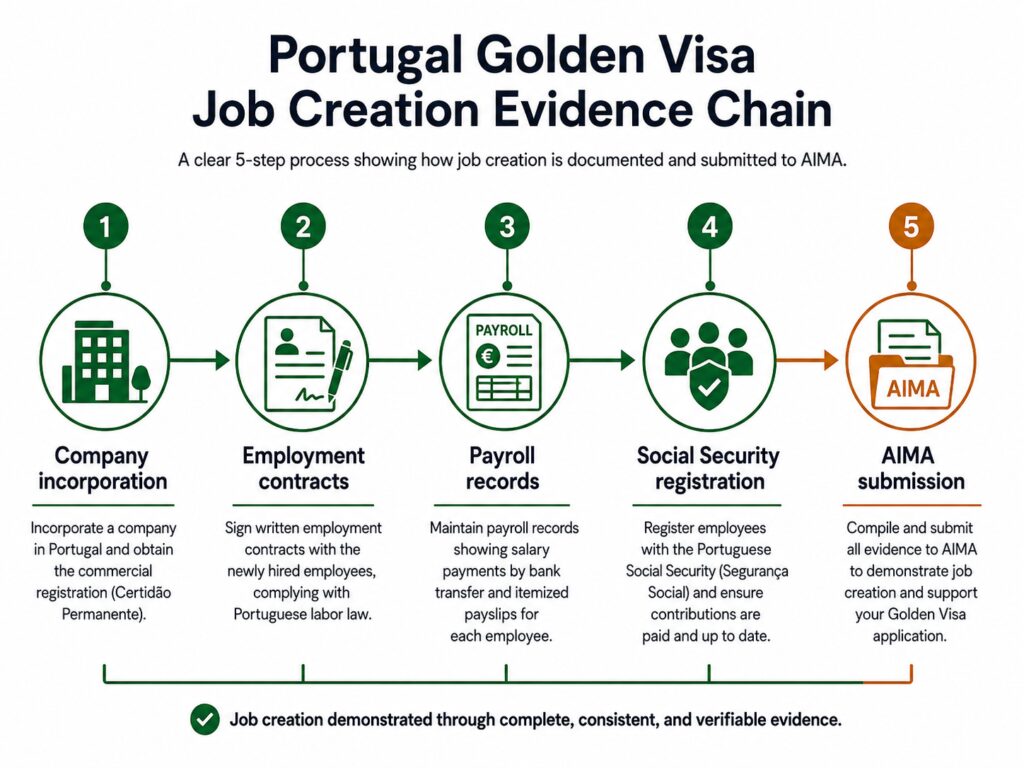
Portugal Golden Visa job creation evidence steps for AIMA submission

Documents Required for the Job Creation Route

The documentation burden is heavier than the fund route because the applicant must prove both immigration eligibility and business substance. A well-prepared file does not just show that a company exists. It shows that the jobs exist, the company operates, and the employment is legally documented.

Below are the main categories of documents applicants should prepare.

Business Registration Proof

If the investment is made through a Portuguese company, the applicant should prepare company registration records and ownership documentation.

Typical documents include:

  • Commercial registry certificate
  • Company incorporation documents
  • Proof of shareholder or owner status
  • Corporate tax registration
  • NIF documentation
  • Bank account confirmation
  • Business activity details
  • Company accounting records, where available

The company should have a purpose that explains why the employees were hired. AIMA is not simply checking a box for company formation. It is assessing whether the job creation claim is credible.

FREE LEGAL CONSULTATION

Have a Quick Question?

Our legal team is available Monday–Friday to answer your Portugal Golden Visa questions and help you understand your next steps.

Book Your Free Consultation Message Us on WhatsApp

Employment Contracts and Payroll Records

Employment contracts are central to the application. They show the legal basis for each job created.

A strong file should include:

  • Individual employment contracts
  • Employee identification details
  • Job titles and duties
  • Salary terms
  • Payroll reports
  • Salary payment evidence
  • Social Security registration proof
  • Tax and contribution compliance evidence

The applicant should also keep renewal evidence from the start. Waiting until renewal to organise payroll records is a bad strategy. Bureaucracy rarely rewards last-minute archaeology.

AIMA Application Submission

AIMA, formerly preceded by SEF, handles ARI residence applications. SEF, or Serviço de Estrangeiros e Fronteiras, was Portugal’s former immigration authority. AIMA now processes the residence permit route.

The application usually includes:

  1. General applicant documents
  2. Criminal record certificates
  3. Health insurance evidence
  4. Proof of legal entry or stay, where applicable
  5. Proof of investment activity
  6. Company documents
  7. Employment contracts
  8. Social Security and tax compliance evidence
  9. Payment receipts for government processing fees

The job creation route should be filed only when the evidence is complete enough to support the claim. Missing employment proof can delay the application or create avoidable questions.

Job Creation Route vs Investment Fund Route

The job creation route and the investment fund route serve very different investor profiles. Both can fall under Portugal’s Golden Visa framework, but they involve different levels of effort, risk, and control.

The fund route is generally more passive. The job creation route is active and operational.

Factor Job Creation Route Investment Fund Route
Core requirement Create 10 jobs, or 8 in low-density areas Subscribe to qualifying fund units
Investor role Active business owner or operator Passive investor
Operational burden High Lower
Evidence focus Jobs, payroll, company activity Fund subscription, CMVM regulation, investment proof
Best suited for Entrepreneurs and expanding businesses Investors seeking a more hands-off route
Main risk Maintaining employment and compliance Fund selection, liquidity, investment risk

Applicants who want to compare the broader residency options can use this visa comparison guide before deciding between an investment route, business route, or income-based route.

Which Investors the Job Route Suits Best

The job creation route may suit investors who already want to build or expand a business in Portugal.

It is usually more appropriate for applicants who:

  • Have operational business experience
  • Can support payroll for 8 to 10 employees
  • Understand Portuguese employment obligations
  • Want active involvement in the Portuguese market
  • Have a clear business plan
  • Can maintain compliance through renewals

It is usually not ideal for investors who want a simple residency route without day-to-day management. Creating jobs is not just an entry requirement. It creates continuing employer responsibilities.

Job Creation Golden Visa vs D2 Startup Visa

The job creation Golden Visa and the D2 visa both attract entrepreneurs, but they are not the same route. The Golden Visa is an ARI investment residence permit. The D2 visa is a residence visa for entrepreneurs, independent professionals, or business founders who intend to live and operate in Portugal more directly.

This is one of the most common points of confusion for business-minded applicants.

Key Differences in Requirements and Flexibility

The job creation Golden Visa is built around investment activity and job creation. The D2 visa is built around entrepreneurial relocation and business viability.

Category Job Creation Golden Visa D2 Startup or Entrepreneur Visa
Main basis ARI investment activity through job creation Entrepreneurial or independent activity
Job requirement 10 jobs, or 8 in low-density areas No fixed 10-job requirement
Residence style Designed for investors with lower physical presence needs Usually expects stronger residence intention
Business evidence Employment creation and company compliance Business plan, viability, income, activity
Best fit Established entrepreneur creating employment Founder or operator relocating to Portugal
Family planning ARI family inclusion may apply Family reunification may apply under general rules

The D2 visa alternative may be better for founders who plan to live in Portugal and operate the business themselves. The job creation Golden Visa may be better for investors who can create and sustain employment while preserving more flexibility.

The right answer depends on the applicant’s business model, family goals, residence plans, and ability to maintain jobs over time.

Maintaining Eligibility: Keeping Jobs Active During Renewals

The job creation route does not end once the first residence permit is issued. Applicants must maintain the qualifying investment activity during the required holding period and through renewals.

For this route, that means keeping employment evidence current.

Renewal preparation should include:

  • Updated company registration documents
  • Current employment contracts
  • Payroll records
  • Social Security contribution records
  • Tax compliance certificates
  • Evidence of ongoing commercial activity
  • Updated business accounts, where relevant

Employment retention is critical. If employees leave, the company should act quickly to replace roles and document continuity.

A practical renewal file should answer three questions clearly:

  1. Does the company still exist and operate?
  2. Are the required jobs still active or properly maintained?
  3. Is the employer compliant with tax and Social Security obligations?
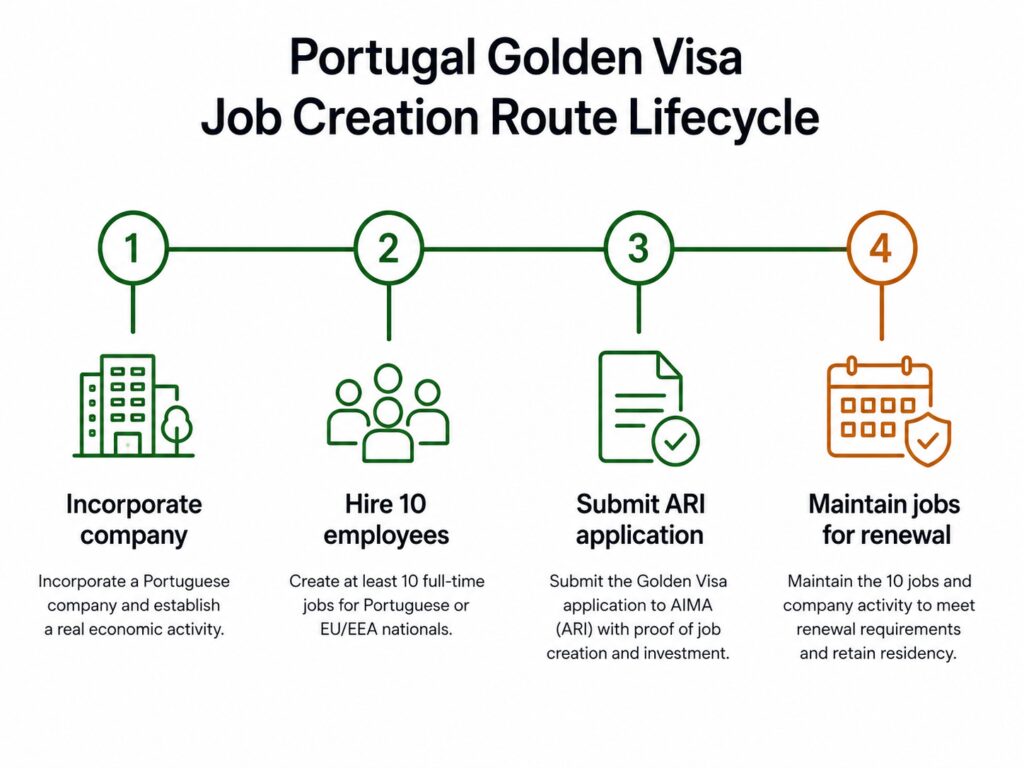
 

Portugal Golden Visa job creation renewal timeline with employment retention

The route should be managed like an ongoing compliance project. Payroll, accounting, and employment records should be organised continuously, not recreated after AIMA requests them.

Official EU business data can also help investors understand the wider labour and enterprise environment. Eurostat’s EU business demography statistics track business creation, survival, and employment dynamics across the European economy.

FAQs About Portugal Golden Visa Job Creation

How many jobs do I need to create for the Portugal Golden Visa?

The standard requirement is the creation of at least 10 jobs in Portugal. This may be reduced to 8 jobs when the activity takes place in a qualifying low-density territory. The jobs should be properly documented through employment contracts, payroll evidence, and Social Security registration.

Can I use an existing business to qualify?

It may be possible to use an existing Portuguese business structure if the required jobs are created or maintained in a way that satisfies the ARI rules. The key question is not only whether the company exists, but whether the employment evidence supports the application. Applicants should prepare company records, contracts, payroll evidence, and tax and Social Security compliance documents before submission.

What is the difference between the job creation route and the D2 startup visa?

The job creation Golden Visa is an ARI investment route based on creating employment in Portugal. The D2 visa is an entrepreneur or independent activity visa that usually focuses more on business viability and residence intention. The Golden Visa route may suit investors who need more flexibility, while the D2 route may suit founders planning to live and operate in Portugal.

Do the 10 jobs need to be maintained throughout the residency period?

Yes, the job creation activity should be maintained through the relevant residence and renewal period. AIMA can request updated evidence showing that the employment requirement is still being met. This is why payroll records, Social Security registration, contracts, and company compliance documents should be kept organised from the beginning.

Is the Portugal Golden Visa Job Creation Route Right for You?

The job creation route is a serious option for entrepreneurs who want to build a real Portuguese business. It can be attractive because it focuses on employment rather than a fixed passive investment threshold, but it is not administratively simple.

It suits applicants who can manage company incorporation, payroll, employment contracts, Social Security registration, and renewal evidence. It is less suitable for investors who want a mostly passive route.

If your priority is flexibility, business expansion, and long-term presence in Portugal’s market, the route may be worth assessing. If your priority is lower operational involvement, another Golden Visa route may be more practical.

Ready to take the next step?
Book a free initial assessment. We’ll assess your eligibility, walk through the current qualifying routes, and answer your questions, no cost, no commitment.


Portugal Golden Visa Job Creation Option: The 10-Job Route Explained

The portugal golden visa job creation route is one of the least passive ways to qualify for Portugal’s ARI residence permit. It can work for entrepreneurs and business owners who want to build real operations in Portugal, not simply place capital into a fund.

The rule sounds simple: create jobs. The reality is more demanding. Applicants must prove company activity, employment contracts, payroll compliance, Social Security registration, and continued eligibility at renewal.

This guide explains how the 10-job route works, who it suits, how it compares with fund investment and the D2 visa, and what evidence AIMA expects to see.

What Is the Portugal Golden Visa Job Creation Route?

The job creation route is a qualifying investment route under Portugal’s ARI, or Autorização de Residência para Investimento. ARI is Portugal’s residence permit for investment activity, processed by AIMA, the Agency for Integration, Migration and Asylum.

Under this route, an applicant qualifies by creating employment in Portugal through a genuine business activity. For a broader overview of the residence permit itself, see Portugal’s ARI residency program.

Portugal Golden Visa job creation route business documents in Lisbon

Minimum Requirement: 10 Permanent Jobs

The standard requirement is the creation of at least 10 jobs in Portugal.

This route does not work like a passive investment fund subscription. The applicant must show that the employment is real, documented, and connected to a qualifying business activity.

In practice, this means the file should be supported by:

  • A Portuguese company or qualifying business structure
  • Individual employment contracts
  • Payroll records
  • Social Security registration
  • Tax and contribution compliance
  • Evidence that the business is active, not dormant

AIMA Job Creation Route guidance confirms that job creation is one of the ARI investment activities. The official route focuses on employment creation, not on real estate acquisition.

That distinction matters. The job creation route is not a way to convert a property purchase into an employment structure. AIMA’s job creation documentation also states that the investment activity cannot directly or indirectly target real estate.

Low-Density Area Exception: 8 Jobs

The minimum job creation requirement may be reduced by 20% when the activity takes place in a low-density territory. In practical terms, this means 8 jobs instead of 10 jobs.

Low-density territories are generally assessed by population density or GDP per capita criteria. The reduction is useful for businesses that can operate outside Portugal’s most competitive urban centres.

However, the lower threshold does not make the route light-touch. The applicant still needs to prove:

  • Genuine business activity
  • Valid employment relationships
  • Continued job maintenance
  • Clean tax and Social Security standing
  • Clear connection between the company and the jobs created

The 8-job exception can be valuable, but it should be planned carefully before incorporation, hiring, or location selection.

How to Qualify: Business and Employment Requirements

The job creation route is best understood as a business compliance route, not just an immigration route. AIMA wants evidence that the applicant has created jobs through a legitimate Portuguese business structure.

This makes preparation more complex than a fund route, but potentially more suitable for applicants who already want to operate a company in Portugal.

Setting Up a Portuguese Company

Most applicants use Portuguese company incorporation to create the legal structure for hiring. This is usually done before the ARI application is submitted.

A typical setup includes:

  1. Obtaining a NIF, the Portuguese tax identification number
  2. Opening a Portuguese bank account
  3. Incorporating a Portuguese company
  4. Defining a qualifying business activity
  5. Hiring employees under valid contracts
  6. Registering workers with Social Security
  7. Preparing evidence for the ARI submission

The company should have a clear business purpose. A paper company with no operational logic is weak evidence.

Useful supporting documents may include a business plan, commercial contracts, invoices, office lease, service agreements, client records, accounting statements, and payroll records.

What Counts as a Qualifying Employment Contract

The safest approach is to use genuine employment contracts with clear duties, salary terms, working hours, and employer obligations.

For the job creation route, the contracts should show that the positions are not artificial. AIMA will be more interested in substance than labels.

A qualifying employment file should usually show:

Evidence Why It Matters
Signed employment contracts Shows the legal employment relationship
Payroll records Confirms salary payments
Social Security registration Shows official employee registration
Tax compliance records Supports business legitimacy
Job descriptions Explains the role of each employee
Company activity proof Links jobs to a real operating business

Short-term, seasonal, or informal arrangements are risky. The route is designed around employment creation, so the jobs should be credible and maintainable.

Social Security Registration Requirements

Social Security registration is one of the most important evidence points in this route. It shows that employees are formally registered within the Portuguese system.

Applicants should expect to provide evidence that the company’s contribution position is regular. This may include declarations showing no outstanding debt to Social Security or the Portuguese Tax Authority.

This is where timing matters. If payroll is not properly structured before submission, the immigration file can become harder to defend.

Before choosing this route, review the full eligibility requirements so the employment evidence fits the wider ARI conditions.

Portugal Golden Visa job creation evidence steps for AIMA submission

Documents Required for the Job Creation Route

The documentation burden is heavier than the fund route because the applicant must prove both immigration eligibility and business substance. A well-prepared file does not just show that a company exists. It shows that the jobs exist, the company operates, and the employment is legally documented.

Below are the main categories of documents applicants should prepare.

Business Registration Proof

If the investment is made through a Portuguese company, the applicant should prepare company registration records and ownership documentation.

Typical documents include:

  • Commercial registry certificate
  • Company incorporation documents
  • Proof of shareholder or owner status
  • Corporate tax registration
  • NIF documentation
  • Bank account confirmation
  • Business activity details
  • Company accounting records, where available

The company should have a purpose that explains why the employees were hired. AIMA is not simply checking a box for company formation. It is assessing whether the job creation claim is credible.

FREE LEGAL CONSULTATION

Have a Quick Question?

Our legal team is available Monday–Friday to answer your Portugal Golden Visa questions and help you understand your next steps.

Book Your Free Consultation Message Us on WhatsApp

Employment Contracts and Payroll Records

Employment contracts are central to the application. They show the legal basis for each job created.

A strong file should include:

  • Individual employment contracts
  • Employee identification details
  • Job titles and duties
  • Salary terms
  • Payroll reports
  • Salary payment evidence
  • Social Security registration proof
  • Tax and contribution compliance evidence

The applicant should also keep renewal evidence from the start. Waiting until renewal to organise payroll records is a bad strategy. Bureaucracy rarely rewards last-minute archaeology.

AIMA Application Submission

AIMA, formerly preceded by SEF, handles ARI residence applications. SEF, or Serviço de Estrangeiros e Fronteiras, was Portugal’s former immigration authority. AIMA now processes the residence permit route.

The application usually includes:

  1. General applicant documents
  2. Criminal record certificates
  3. Health insurance evidence
  4. Proof of legal entry or stay, where applicable
  5. Proof of investment activity
  6. Company documents
  7. Employment contracts
  8. Social Security and tax compliance evidence
  9. Payment receipts for government processing fees

The job creation route should be filed only when the evidence is complete enough to support the claim. Missing employment proof can delay the application or create avoidable questions.

Job Creation Route vs Investment Fund Route

The job creation route and the investment fund route serve very different investor profiles. Both can fall under Portugal’s Golden Visa framework, but they involve different levels of effort, risk, and control.

The fund route is generally more passive. The job creation route is active and operational.

Factor Job Creation Route Investment Fund Route
Core requirement Create 10 jobs, or 8 in low-density areas Subscribe to qualifying fund units
Investor role Active business owner or operator Passive investor
Operational burden High Lower
Evidence focus Jobs, payroll, company activity Fund subscription, CMVM regulation, investment proof
Best suited for Entrepreneurs and expanding businesses Investors seeking a more hands-off route
Main risk Maintaining employment and compliance Fund selection, liquidity, investment risk

Applicants who want to compare the broader residency options can use this visa comparison guide before deciding between an investment route, business route, or income-based route.

Which Investors the Job Route Suits Best

The job creation route may suit investors who already want to build or expand a business in Portugal.

It is usually more appropriate for applicants who:

  • Have operational business experience
  • Can support payroll for 8 to 10 employees
  • Understand Portuguese employment obligations
  • Want active involvement in the Portuguese market
  • Have a clear business plan
  • Can maintain compliance through renewals

It is usually not ideal for investors who want a simple residency route without day-to-day management. Creating jobs is not just an entry requirement. It creates continuing employer responsibilities.

Job Creation Golden Visa vs D2 Startup Visa

The job creation Golden Visa and the D2 visa both attract entrepreneurs, but they are not the same route. The Golden Visa is an ARI investment residence permit. The D2 visa is a residence visa for entrepreneurs, independent professionals, or business founders who intend to live and operate in Portugal more directly.

This is one of the most common points of confusion for business-minded applicants.

Key Differences in Requirements and Flexibility

The job creation Golden Visa is built around investment activity and job creation. The D2 visa is built around entrepreneurial relocation and business viability.

Category Job Creation Golden Visa D2 Startup or Entrepreneur Visa
Main basis ARI investment activity through job creation Entrepreneurial or independent activity
Job requirement 10 jobs, or 8 in low-density areas No fixed 10-job requirement
Residence style Designed for investors with lower physical presence needs Usually expects stronger residence intention
Business evidence Employment creation and company compliance Business plan, viability, income, activity
Best fit Established entrepreneur creating employment Founder or operator relocating to Portugal
Family planning ARI family inclusion may apply Family reunification may apply under general rules

The D2 visa alternative may be better for founders who plan to live in Portugal and operate the business themselves. The job creation Golden Visa may be better for investors who can create and sustain employment while preserving more flexibility.

The right answer depends on the applicant’s business model, family goals, residence plans, and ability to maintain jobs over time.

Maintaining Eligibility: Keeping Jobs Active During Renewals

The job creation route does not end once the first residence permit is issued. Applicants must maintain the qualifying investment activity during the required holding period and through renewals.

For this route, that means keeping employment evidence current.

Renewal preparation should include:

  • Updated company registration documents
  • Current employment contracts
  • Payroll records
  • Social Security contribution records
  • Tax compliance certificates
  • Evidence of ongoing commercial activity
  • Updated business accounts, where relevant

Employment retention is critical. If employees leave, the company should act quickly to replace roles and document continuity.

A practical renewal file should answer three questions clearly:

  1. Does the company still exist and operate?
  2. Are the required jobs still active or properly maintained?
  3. Is the employer compliant with tax and Social Security obligations?


Portugal Golden Visa job creation renewal timeline with employment retention

The route should be managed like an ongoing compliance project. Payroll, accounting, and employment records should be organised continuously, not recreated after AIMA requests them.

Official EU business data can also help investors understand the wider labour and enterprise environment. Eurostat’s EU business demography statistics track business creation, survival, and employment dynamics across the European economy.

FAQs About Portugal Golden Visa Job Creation

How many jobs do I need to create for the Portugal Golden Visa?

The standard requirement is the creation of at least 10 jobs in Portugal. This may be reduced to 8 jobs when the activity takes place in a qualifying low-density territory. The jobs should be properly documented through employment contracts, payroll evidence, and Social Security registration.

Can I use an existing business to qualify?

It may be possible to use an existing Portuguese business structure if the required jobs are created or maintained in a way that satisfies the ARI rules. The key question is not only whether the company exists, but whether the employment evidence supports the application. Applicants should prepare company records, contracts, payroll evidence, and tax and Social Security compliance documents before submission.

What is the difference between the job creation route and the D2 startup visa?

The job creation Golden Visa is an ARI investment route based on creating employment in Portugal. The D2 visa is an entrepreneur or independent activity visa that usually focuses more on business viability and residence intention. The Golden Visa route may suit investors who need more flexibility, while the D2 route may suit founders planning to live and operate in Portugal.

Do the 10 jobs need to be maintained throughout the residency period?

Yes, the job creation activity should be maintained through the relevant residence and renewal period. AIMA can request updated evidence showing that the employment requirement is still being met. This is why payroll records, Social Security registration, contracts, and company compliance documents should be kept organised from the beginning.

Is the Portugal Golden Visa Job Creation Route Right for You?

The job creation route is a serious option for entrepreneurs who want to build a real Portuguese business. It can be attractive because it focuses on employment rather than a fixed passive investment threshold, but it is not administratively simple.

It suits applicants who can manage company incorporation, payroll, employment contracts, Social Security registration, and renewal evidence. It is less suitable for investors who want a mostly passive route.

If your priority is flexibility, business expansion, and long-term presence in Portugal’s market, the route may be worth assessing. If your priority is lower operational involvement, another Golden Visa route may be more practical.

Ready to take the next step?
Book a free initial assessment. We’ll assess your eligibility, walk through the current qualifying routes, and answer your questions, no cost, no commitment.

Portugal Golden Visa Job Creation Option: The 10-Job Route Explained

Portugal-Golden-Visa-Job-Creation-Option-The-10-Job-Route-Explained
The portugal golden visa job creation route is one of the least passive ways to qualify for Portugal’s ARI residence permit. It can work for entrepreneurs and business owners who want to build real operations in Portugal, not simply place capital into a fund.

The rule sounds simple: create jobs. The reality is more demanding. Applicants must prove company activity, employment contracts, payroll compliance, Social Security registration, and continued eligibility at renewal.

This guide explains how the 10-job route works, who it suits, how it compares with fund investment and the D2 visa, and what evidence AIMA expects to see.

What Is the Portugal Golden Visa Job Creation Route?

The job creation route is a qualifying investment route under Portugal’s ARI, or Autorização de Residência para Investimento. ARI is Portugal’s residence permit for investment activity, processed by AIMA, the Agency for Integration, Migration and Asylum.

Under this route, an applicant qualifies by creating employment in Portugal through a genuine business activity. For a broader overview of the residence permit itself, see Portugal’s ARI residency program.

Portugal Golden Visa job creation route business documents in Lisbon

Minimum Requirement: 10 Permanent Jobs

The standard requirement is the creation of at least 10 jobs in Portugal.

This route does not work like a passive investment fund subscription. The applicant must show that the employment is real, documented, and connected to a qualifying business activity.

In practice, this means the file should be supported by:

  • A Portuguese company or qualifying business structure
  • Individual employment contracts
  • Payroll records
  • Social Security registration
  • Tax and contribution compliance
  • Evidence that the business is active, not dormant

AIMA Job Creation Route guidance confirms that job creation is one of the ARI investment activities. The official route focuses on employment creation, not on real estate acquisition.

That distinction matters. The job creation route is not a way to convert a property purchase into an employment structure. AIMA’s job creation documentation also states that the investment activity cannot directly or indirectly target real estate.

Low-Density Area Exception: 8 Jobs

The minimum job creation requirement may be reduced by 20% when the activity takes place in a low-density territory. In practical terms, this means 8 jobs instead of 10 jobs.

Low-density territories are generally assessed by population density or GDP per capita criteria. The reduction is useful for businesses that can operate outside Portugal’s most competitive urban centres.

However, the lower threshold does not make the route light-touch. The applicant still needs to prove:

  • Genuine business activity
  • Valid employment relationships
  • Continued job maintenance
  • Clean tax and Social Security standing
  • Clear connection between the company and the jobs created

The 8-job exception can be valuable, but it should be planned carefully before incorporation, hiring, or location selection.

How to Qualify: Business and Employment Requirements

The job creation route is best understood as a business compliance route, not just an immigration route. AIMA wants evidence that the applicant has created jobs through a legitimate Portuguese business structure.

This makes preparation more complex than a fund route, but potentially more suitable for applicants who already want to operate a company in Portugal.

Setting Up a Portuguese Company

Most applicants use Portuguese company incorporation to create the legal structure for hiring. This is usually done before the ARI application is submitted.

A typical setup includes:

  1. Obtaining a NIF, the Portuguese tax identification number
  2. Opening a Portuguese bank account
  3. Incorporating a Portuguese company
  4. Defining a qualifying business activity
  5. Hiring employees under valid contracts
  6. Registering workers with Social Security
  7. Preparing evidence for the ARI submission

The company should have a clear business purpose. A paper company with no operational logic is weak evidence.

Useful supporting documents may include a business plan, commercial contracts, invoices, office lease, service agreements, client records, accounting statements, and payroll records.

What Counts as a Qualifying Employment Contract

The safest approach is to use genuine employment contracts with clear duties, salary terms, working hours, and employer obligations.

For the job creation route, the contracts should show that the positions are not artificial. AIMA will be more interested in substance than labels.

A qualifying employment file should usually show:

Evidence Why It Matters
Signed employment contracts Shows the legal employment relationship
Payroll records Confirms salary payments
Social Security registration Shows official employee registration
Tax compliance records Supports business legitimacy
Job descriptions Explains the role of each employee
Company activity proof Links jobs to a real operating business

Short-term, seasonal, or informal arrangements are risky. The route is designed around employment creation, so the jobs should be credible and maintainable.

Social Security Registration Requirements

Social Security registration is one of the most important evidence points in this route. It shows that employees are formally registered within the Portuguese system.

Applicants should expect to provide evidence that the company’s contribution position is regular. This may include declarations showing no outstanding debt to Social Security or the Portuguese Tax Authority.

This is where timing matters. If payroll is not properly structured before submission, the immigration file can become harder to defend.

Before choosing this route, review the full eligibility requirements so the employment evidence fits the wider ARI conditions.

Portugal Golden Visa job creation evidence steps for AIMA submission

Documents Required for the Job Creation Route

The documentation burden is heavier than the fund route because the applicant must prove both immigration eligibility and business substance. A well-prepared file does not just show that a company exists. It shows that the jobs exist, the company operates, and the employment is legally documented.

Below are the main categories of documents applicants should prepare.

Business Registration Proof

If the investment is made through a Portuguese company, the applicant should prepare company registration records and ownership documentation.

Typical documents include:

  • Commercial registry certificate
  • Company incorporation documents
  • Proof of shareholder or owner status
  • Corporate tax registration
  • NIF documentation
  • Bank account confirmation
  • Business activity details
  • Company accounting records, where available

The company should have a purpose that explains why the employees were hired. AIMA is not simply checking a box for company formation. It is assessing whether the job creation claim is credible.

FREE LEGAL CONSULTATION

Have a Quick Question?

Our legal team is available Monday–Friday to answer your Portugal Golden Visa questions and help you understand your next steps.

Book Your Free Consultation Message Us on WhatsApp

Employment Contracts and Payroll Records

Employment contracts are central to the application. They show the legal basis for each job created.

A strong file should include:

  • Individual employment contracts
  • Employee identification details
  • Job titles and duties
  • Salary terms
  • Payroll reports
  • Salary payment evidence
  • Social Security registration proof
  • Tax and contribution compliance evidence

The applicant should also keep renewal evidence from the start. Waiting until renewal to organise payroll records is a bad strategy. Bureaucracy rarely rewards last-minute archaeology.

AIMA Application Submission

AIMA, formerly preceded by SEF, handles ARI residence applications. SEF, or Serviço de Estrangeiros e Fronteiras, was Portugal’s former immigration authority. AIMA now processes the residence permit route.

The application usually includes:

  1. General applicant documents
  2. Criminal record certificates
  3. Health insurance evidence
  4. Proof of legal entry or stay, where applicable
  5. Proof of investment activity
  6. Company documents
  7. Employment contracts
  8. Social Security and tax compliance evidence
  9. Payment receipts for government processing fees

The job creation route should be filed only when the evidence is complete enough to support the claim. Missing employment proof can delay the application or create avoidable questions.

Job Creation Route vs Investment Fund Route

The job creation route and the investment fund route serve very different investor profiles. Both can fall under Portugal’s Golden Visa framework, but they involve different levels of effort, risk, and control.

The fund route is generally more passive. The job creation route is active and operational.

Factor Job Creation Route Investment Fund Route
Core requirement Create 10 jobs, or 8 in low-density areas Subscribe to qualifying fund units
Investor role Active business owner or operator Passive investor
Operational burden High Lower
Evidence focus Jobs, payroll, company activity Fund subscription, CMVM regulation, investment proof
Best suited for Entrepreneurs and expanding businesses Investors seeking a more hands-off route
Main risk Maintaining employment and compliance Fund selection, liquidity, investment risk

Applicants who want to compare the broader residency options can use this visa comparison guide before deciding between an investment route, business route, or income-based route.

Which Investors the Job Route Suits Best

The job creation route may suit investors who already want to build or expand a business in Portugal.

It is usually more appropriate for applicants who:

  • Have operational business experience
  • Can support payroll for 8 to 10 employees
  • Understand Portuguese employment obligations
  • Want active involvement in the Portuguese market
  • Have a clear business plan
  • Can maintain compliance through renewals

It is usually not ideal for investors who want a simple residency route without day-to-day management. Creating jobs is not just an entry requirement. It creates continuing employer responsibilities.

Job Creation Golden Visa vs D2 Startup Visa

The job creation Golden Visa and the D2 visa both attract entrepreneurs, but they are not the same route. The Golden Visa is an ARI investment residence permit. The D2 visa is a residence visa for entrepreneurs, independent professionals, or business founders who intend to live and operate in Portugal more directly.

This is one of the most common points of confusion for business-minded applicants.

Key Differences in Requirements and Flexibility

The job creation Golden Visa is built around investment activity and job creation. The D2 visa is built around entrepreneurial relocation and business viability.

Category Job Creation Golden Visa D2 Startup or Entrepreneur Visa
Main basis ARI investment activity through job creation Entrepreneurial or independent activity
Job requirement 10 jobs, or 8 in low-density areas No fixed 10-job requirement
Residence style Designed for investors with lower physical presence needs Usually expects stronger residence intention
Business evidence Employment creation and company compliance Business plan, viability, income, activity
Best fit Established entrepreneur creating employment Founder or operator relocating to Portugal
Family planning ARI family inclusion may apply Family reunification may apply under general rules

The D2 visa alternative may be better for founders who plan to live in Portugal and operate the business themselves. The job creation Golden Visa may be better for investors who can create and sustain employment while preserving more flexibility.

The right answer depends on the applicant’s business model, family goals, residence plans, and ability to maintain jobs over time.

Maintaining Eligibility: Keeping Jobs Active During Renewals

The job creation route does not end once the first residence permit is issued. Applicants must maintain the qualifying investment activity during the required holding period and through renewals.

For this route, that means keeping employment evidence current.

Renewal preparation should include:

  • Updated company registration documents
  • Current employment contracts
  • Payroll records
  • Social Security contribution records
  • Tax compliance certificates
  • Evidence of ongoing commercial activity
  • Updated business accounts, where relevant

Employment retention is critical. If employees leave, the company should act quickly to replace roles and document continuity.

A practical renewal file should answer three questions clearly:

  1. Does the company still exist and operate?
  2. Are the required jobs still active or properly maintained?
  3. Is the employer compliant with tax and Social Security obligations?


Portugal Golden Visa job creation renewal timeline with employment retention

The route should be managed like an ongoing compliance project. Payroll, accounting, and employment records should be organised continuously, not recreated after AIMA requests them.

Official EU business data can also help investors understand the wider labour and enterprise environment. Eurostat’s EU business demography statistics track business creation, survival, and employment dynamics across the European economy.

FAQs About Portugal Golden Visa Job Creation

How many jobs do I need to create for the Portugal Golden Visa?

The standard requirement is the creation of at least 10 jobs in Portugal. This may be reduced to 8 jobs when the activity takes place in a qualifying low-density territory. The jobs should be properly documented through employment contracts, payroll evidence, and Social Security registration.

Can I use an existing business to qualify?

It may be possible to use an existing Portuguese business structure if the required jobs are created or maintained in a way that satisfies the ARI rules. The key question is not only whether the company exists, but whether the employment evidence supports the application. Applicants should prepare company records, contracts, payroll evidence, and tax and Social Security compliance documents before submission.

What is the difference between the job creation route and the D2 startup visa?

The job creation Golden Visa is an ARI investment route based on creating employment in Portugal. The D2 visa is an entrepreneur or independent activity visa that usually focuses more on business viability and residence intention. The Golden Visa route may suit investors who need more flexibility, while the D2 route may suit founders planning to live and operate in Portugal.

Do the 10 jobs need to be maintained throughout the residency period?

Yes, the job creation activity should be maintained through the relevant residence and renewal period. AIMA can request updated evidence showing that the employment requirement is still being met. This is why payroll records, Social Security registration, contracts, and company compliance documents should be kept organised from the beginning.

Is the Portugal Golden Visa Job Creation Route Right for You?

The job creation route is a serious option for entrepreneurs who want to build a real Portuguese business. It can be attractive because it focuses on employment rather than a fixed passive investment threshold, but it is not administratively simple.

It suits applicants who can manage company incorporation, payroll, employment contracts, Social Security registration, and renewal evidence. It is less suitable for investors who want a mostly passive route.

If your priority is flexibility, business expansion, and long-term presence in Portugal’s market, the route may be worth assessing. If your priority is lower operational involvement, another Golden Visa route may be more practical.

Ready to take the next step?
Book a free initial assessment. We’ll assess your eligibility, walk through the current qualifying routes, and answer your questions, no cost, no commitment.

What do you think?
Blog

More Related Articles

top








