

For many U.S. passport holders, the appeal is not panic. It is planning. A second residency can work like an insurance policy, useful precisely because it is arranged before it becomes urgent.
Portugal’s ARI, or Autorização de Residência para Investimento, gives non-EU investors a route to Portuguese residency through a qualifying investment, subject to eligibility and regulatory requirements. This guide explains why Americans are choosing it, what it gives them, and where tax planning needs extra care.
Why Americans Are Looking at Portugal Golden Visa as a Plan B
American interest in Portugal is driven by a mix of mobility, family planning, political uncertainty, and long-term financial flexibility. The portugal golden visa is attractive because it does not require full relocation from the United States.
For U.S. citizens who want access to Europe without immediately moving their household, business, children, or assets, the programme sits in a practical middle ground.

Geopolitical and Economic Uncertainty
Plan B residency has become part of serious wealth planning for many Americans. The motivation is not always about leaving the U.S. permanently. More often, it is about having a legal alternative if circumstances change.
Common drivers include:
- Political instability and election-cycle uncertainty
- Geopolitical risk affecting travel, business, or family security
- Concerns about healthcare abroad and medical access options
- Desire for dual residency rather than immediate emigration
- Long-term estate, education, and lifestyle planning
This is why many Americans describe the Golden Visa as an insurance policy. You hope you never need to use every feature, but you want it available if the situation changes.
EU Access Healthcare and Education
Portugal appeals to Americans because it offers practical access to the European Union without requiring a daily life reset. A legal Portuguese residence permit can support EU mobility, family planning, and long-term access to European education options.
For families, the strongest benefits are often:
| Planning Goal | Why Portugal Helps |
| EU mobility | Residence in Portugal plus Schengen travel access |
| Family security | Spouse, dependent children, and qualifying parents may be included |
| Education planning | Children may have access to Portuguese and wider European options |
| Healthcare abroad | Residency can support access to the Portuguese system, subject to registration rules |
| Long-term citizenship | Eligibility to apply after 5 years of legal residency, subject to requirements |
Portugal is not simply a low-cost lifestyle destination. For American families, it can become a structured residency base in Europe.
What the Portugal Golden Visa Actually Gives Americans
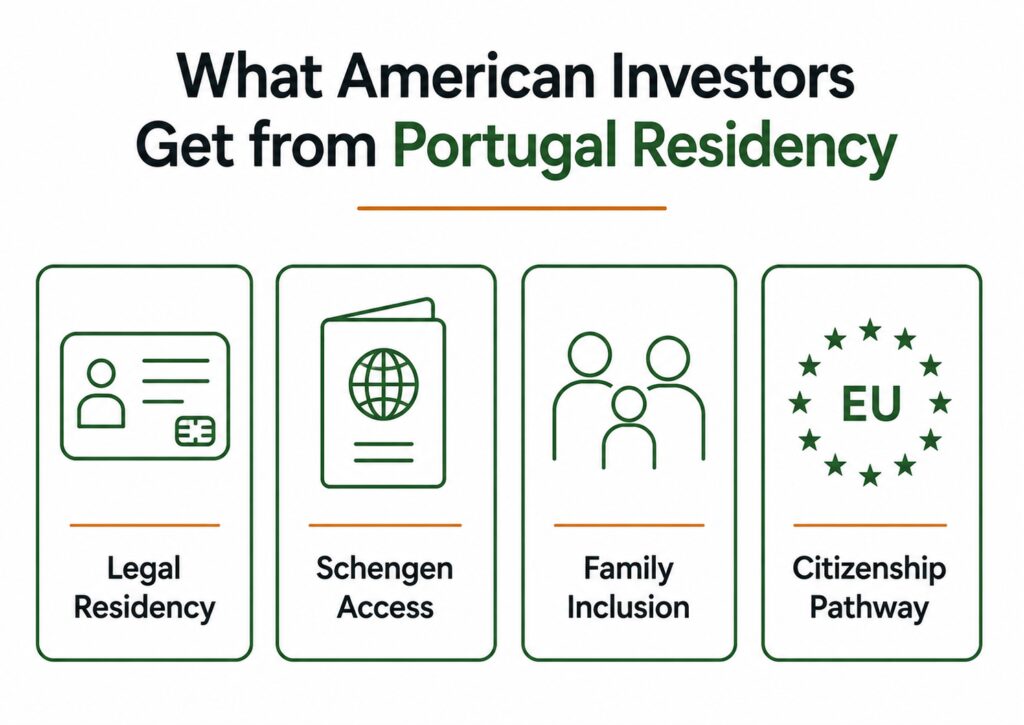
The Golden Visa does not give Americans instant citizenship, automatic tax advantages, or guaranteed investment returns. It gives legal residency through a regulated investment route, with the possibility of applying for citizenship after 5 years of legal residency.
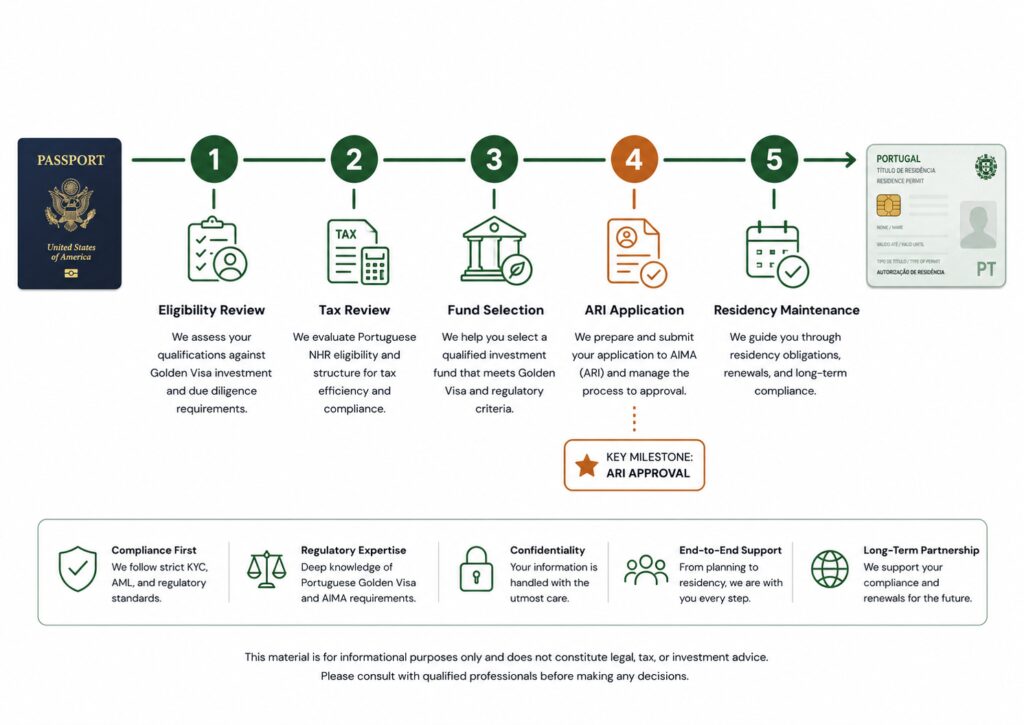
Applications are processed under Portugal’s ARI framework by AIMA, the Agency for Integration, Migration and Asylum, which replaced SEF, the former Serviço de Estrangeiros e Fronteiras, in 2023.
Legal Residency Without Full Relocation
The core advantage for Americans is flexibility. The Portugal Golden Visa allows a qualifying investor to hold Portuguese residency while spending most of the year outside Portugal.
This matters because many U.S. applicants are still running businesses, managing U.S. assets, caring for family, or maintaining children’s schooling in America.
The permit gives Americans a legal foothold in Portugal without forcing a full move on day one. That is the main difference between a Plan B residency strategy and a relocation visa.
For a detailed breakdown of eligibility, investment structure, and current rules, see Portugal’s ARI program.
Schengen Area Travel Freedom
A Portuguese residence permit gives the holder access to the Schengen Area for short stays across 29 countries. For Americans, this is useful because U.S. passport access to Europe remains travel-based, not residency-based.
A Golden Visa adds legal residence status in Portugal. That can be important for families who want to spend more time in Europe, manage business interests, or create a stable base for future relocation.
Schengen access is often one of the clearest practical benefits. It turns Europe from a repeated visitor destination into a region where the family has a legal anchor.
Path to an EU Passport
After 5 years of legal residency, a Golden Visa holder may apply for Portuguese citizenship, subject to eligibility. Requirements generally include a valid residency period, a clean criminal record, and basic Portuguese language ability.
For Americans, the long-term outcome can be significant: a Portuguese passport is an EU passport. It can open access to broader EU rights, including the ability to live, work, and study across EU member states.
Portugal also permits dual citizenship. That means U.S. citizens do not usually need to surrender their American passport solely because they naturalize as Portuguese citizens, although personal legal advice is still important.
The 7-Day Rule: Why It Works for Americans with Busy Lives
The Portugal Golden Visa minimum stay requirement is one of the main reasons Americans consider it. The programme requires only 7 days per year in Portugal.
For investors who cannot move immediately, that is a major advantage. They can maintain their U.S. residence, business commitments, school schedules, and tax planning while still preserving Portuguese residency status.
This is especially useful for:
- Founders and executives who cannot relocate full-time
- Families with children in U.S. schools or universities
- Retirees testing Portugal before committing
- Investors who want EU mobility without becoming Europe-based immediately
- Americans comparing Portugal as Plan B for Americans against full relocation routes
Seven days is not a lifestyle promise. It is a compliance requirement. Applicants still need to track visits carefully, maintain documents, attend biometric appointments when required, and follow renewal obligations.
Investment Options Popular with American Investors
American investors usually prefer routes that are regulated, documentable, and professionally managed. Since real estate no longer qualifies for Portugal Golden Visa purposes under the current post-2023 framework used by Portugal Golden Visa, fund-based investment has become the primary route for U.S. applicants.
Qualifying investments are typically supervised within Portugal’s financial regulatory system. CMVM, Portugal’s Securities Market Commission, is the authority responsible for supervising investment funds and market participants.
Fund Route No Property Management Required
The fund route appeals to Americans because it avoids the operational burden of owning and managing Portuguese property. There are no tenants, repairs, condominium disputes, or short-term rental compliance issues to manage.
The usual starting point is a €500,000 minimum qualifying investment in a CMVM-regulated investment fund. Applicants should still review fund structure, fees, exit strategy, liquidity terms, and risk disclosures before committing.
Key advantages for U.S. investors include:
| Feature | Why It Matters |
| No direct property management | Useful for Americans living far from Portugal |
| Professional fund oversight | Fund managers operate under a regulated framework |
| Clear investment documentation | Important for source-of-funds and compliance review |
| Easier family planning | One main investment can support qualifying dependents |
| Long-term structure | Aligns with the 5-year minimum holding period |
Fund selection is not a formality. The right fund must fit the investor’s risk profile, liquidity expectations, tax position, and residency goals.
You can review current Portugal Golden Visa investment fund options before comparing specific structures.
IRA and 401k Capital Use
Some American investors ask whether they can use IRA or 401k capital for the Golden Visa investment. The answer requires careful tax and retirement-plan advice.
In some cases, investors may explore self-directed retirement structures, rollovers, or post-tax capital strategies. However, this is not something to improvise. Retirement funds are governed by U.S. tax rules, custodian restrictions, prohibited transaction rules, and possible distribution consequences.
Before using retirement capital, Americans should confirm:
- Whether the account custodian allows the structure
- Whether the investment creates U.S. tax reporting obligations
- Whether a distribution or rollover triggers tax consequences
- Whether the fund is compatible with retirement-account rules
- Whether the structure affects FATCA or FBAR reporting
For a more focused explanation, see how U.S. investors may fund your investment with IRA or 401k.
US Tax Implications of Holding Portuguese Residency
A Golden Visa is an immigration status. It is not automatically a tax strategy. For Americans, this distinction matters more than almost anything else in the process.
U.S. citizens are generally taxed by the United States on worldwide income, even when living abroad. The IRS provides guidance for U.S. citizens and resident aliens abroad, including filing obligations and international tax topics.
FATCA FBAR and What You Must Report
FATCA, the Foreign Account Tax Compliance Act, can require certain U.S. taxpayers to report specified foreign financial assets. The IRS explains that FATCA reporting for U.S. taxpayers may apply in addition to FBAR obligations for foreign financial accounts.
FBAR refers to the Report of Foreign Bank and Financial Accounts, commonly filed through FinCEN Form 114. A Portuguese bank account, fund investment, or related foreign financial structure may create reporting obligations, depending on balances and ownership.
American applicants should speak with a cross-border tax advisor before they invest. The Golden Visa may be simple from a stay-requirement perspective, but U.S. reporting rules are not known for being sentimental.
Does Having a Golden Visa Make You a Tax Resident?
Holding a Portugal Golden Visa does not automatically make a U.S. citizen a Portuguese tax resident. Tax residency usually depends on factual presence, home availability, and other tests under Portuguese tax law.
The key question is not “Do I have a visa?” The better question is “Have I created tax residency through time spent, housing arrangements, or personal and economic ties?”
This is where Americans need coordinated advice. Immigration lawyers, tax advisors, and investment professionals should be aligned before the application is submitted.
The former NHR regime, or Non-Habitual Resident regime, was a major draw for foreign residents in Portugal, but applicants should not assume old NHR guidance still applies. Tax planning should be reviewed under the current rules at the time of application.
Portugal vs Other Plan B Destinations
Americans comparing Plan B destinations usually look at Portugal alongside countries such as Greece, Spain, Italy, Malta, Mexico, Costa Rica, and the UAE. Each option serves a different purpose.
Portugal’s advantage is the combination of EU residency, a citizenship pathway, low physical stay requirements, and a European legal framework. It is not always the cheapest option, and it is not the fastest if the only goal is immediate relocation. But for Americans seeking investment migration with long-term EU optionality, it is one of the more structured choices.
| Destination Type | Common Appeal | Main Trade-Off |
| Portugal Golden Visa | EU residency, low stay requirement, citizenship pathway | Requires qualifying investment and patience |
| Passive income visas | Lower investment burden | Often require more physical presence |
| Caribbean citizenship programmes | Faster passport planning | Not EU residency |
| Latin American residency | Lower cost of living comparison | Less direct EU mobility |
| UAE residency | Business and tax planning appeal | No EU access or EU passport pathway |
For Americans deciding between Portugal’s Golden Visa and passive-income options, this comparison of how the Golden Visa compares to the D7 can help clarify the difference.
Americans should also use the US State Department Living Abroad resources when planning a move, extended stay, or long-term family strategy outside the United States.
FAQs: Portugal Golden Visa as Plan B for Americans
Why are so many Americans getting the Portugal Golden Visa?
Americans are choosing the Portugal Golden Visa because it offers legal EU residency without requiring immediate full relocation. It gives U.S. citizens access to Portugal, Schengen mobility, family inclusion, and a possible citizenship pathway after 5 years of legal residency. For many, it is part of broader Plan B residency and family-security planning.
Does the Portugal Golden Visa work as a Plan B?
Yes, it can work as a Plan B because the stay requirement is low and the residency status can be maintained while the investor continues living mainly in the United States. It is not an emergency product, since applications take time and depend on eligibility. It works best when arranged before the family urgently needs it.
Can I hold a Portugal Golden Visa without moving there permanently?
Yes. The Portugal Golden Visa requires only 7 days per year in Portugal, which is why it works well for Americans with business, family, or tax obligations in the United States. You must still meet renewal requirements, maintain the qualifying investment, and follow AIMA procedures.
What rights do US citizens get with a Portugal Golden Visa?
U.S. citizens who obtain a Portugal Golden Visa receive legal residence in Portugal, the ability to include qualifying family members, Schengen Area travel access, and a pathway to apply for Portuguese citizenship after 5 years of legal residency. The permit does not automatically remove U.S. tax obligations or create Portuguese tax residency by itself.
Is the Portugal Golden Visa the Right Plan B for American Investors?
The Portugal Golden Visa is most useful for American investors who want EU residency without moving immediately. It offers flexibility, Schengen access, family inclusion, and a long-term route toward Portuguese citizenship.
It is not suitable for everyone. U.S. investors need to review fund risk, tax reporting, FATCA, FBAR, retirement-account rules, and the practical cost of maintaining a second residency.
For Americans who want a serious European Plan B, the value is not only in what the permit provides today. It is in having a legal option ready before life, politics, markets, or family needs force the decision.
Ready to take the next step?
Book a free initial assessment. We’ll assess your eligibility, walk through the current qualifying routes, and answer your questions, no cost, no commitment.












