

This guide explains the fund landscape in Portugal, including private equity, venture capital, real estate funds, key investment sectors, CMVM regulation, and how Golden Visa-qualifying funds should be reviewed before subscription.
Overview of Portugal Investment Fund Market
Portugal’s investment fund market has developed into a more structured environment for international investors. The market includes regulated collective investment vehicles, private equity funds, venture capital funds, real estate funds, and alternative investment structures serving both domestic and foreign capital.
For Golden Visa applicants, the important point is narrower: only certain non-real estate collective investment or venture capital funds may qualify, and eligibility must be confirmed before investing.
Size and Growth of the Sector
Portugal’s fund market has grown alongside the country’s broader capital markets, startup ecosystem, hospitality sector, renewable energy pipeline, and private investment activity. For foreign investors, the appeal is not simply that Portugal has funds. It is that the market now offers a wider range of strategies than it did a decade ago.
These strategies may include:
- Growth capital for Portuguese companies
- Private equity exposure to established businesses
- Venture capital for technology and innovation
- Sector-specific funds in healthcare, energy, or tourism
- Real estate funds for non-Golden Visa investment exposure
- Alternative investment structures with professional management
The European Central Bank tracks investment fund statistics across euro area countries through its investment fund statistics dataset, which distinguishes funds by investment policy and structure. For Portugal, this wider European context matters because fund reporting, regulation, and investor expectations increasingly sit inside a cross-border investment framework.
The market is still smaller than fund hubs such as Luxembourg or Ireland. That can be a limitation for investors looking for deep liquidity or very large fund universes. It can also create a more targeted opportunity set for investors who want exposure to Portuguese companies, Portuguese capital markets, and specific growth sectors.
How CMVM Regulates Investment Funds
CMVM, Portugal’s Securities Market Commission, supervises the country’s securities markets and regulated investment activity. For foreign investors, CMVM regulation is one of the first checks in any fund review.
A regulated fund does not mean a guaranteed return. It does mean the fund manager, structure, documentation, reporting obligations, and investor disclosures fall within a formal supervision framework.
Before subscribing to any fund, investors should check:
- Whether the fund or manager is registered or authorised
- Whether the fund has a regulated management company
- Whether there is an independent depositary
- Whether the fund is audited
- Whether the fund documents explain fees, risks, liquidity, and exit terms
- Whether the fund is eligible for the investor’s intended purpose
CMVM maintains official information on supervised entities through the CMVM Fund Regulator. This should be the starting point for confirming whether a fund manager is operating inside Portugal’s regulated investment framework.
For Golden Visa investors, regulation is necessary but not enough. A fund may be regulated and still not qualify for the ARI, Autorização de Residência para Investimento, which is the formal Portuguese Golden Visa residence permit. Legal eligibility must be reviewed separately.
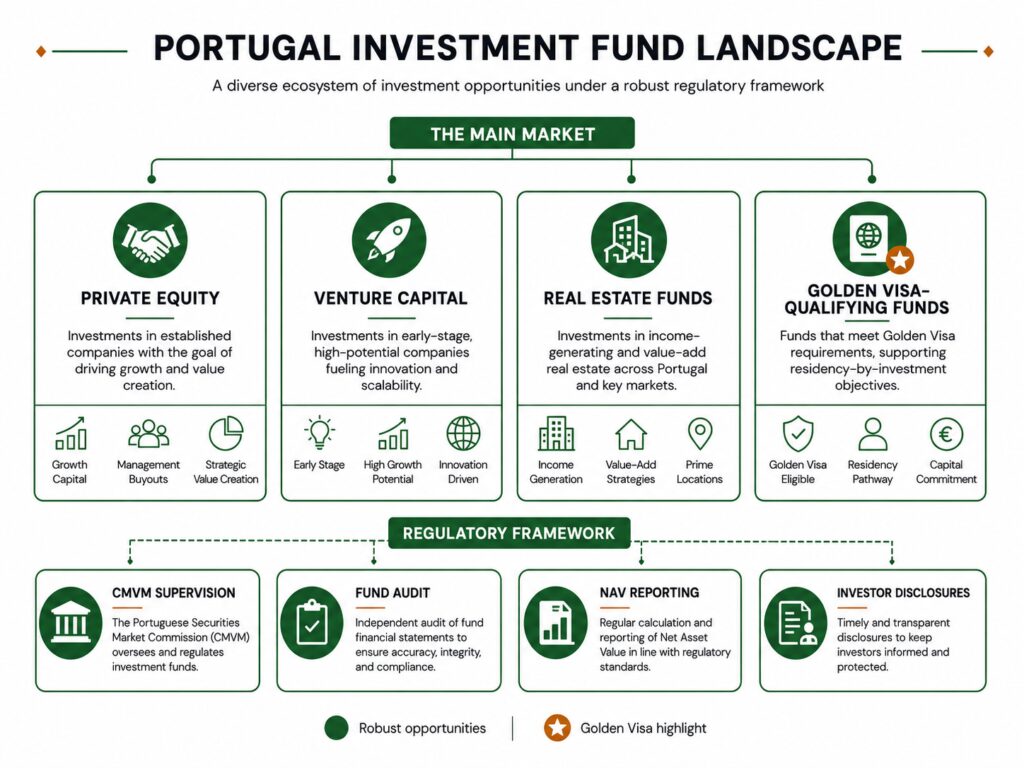
Foreign investors usually encounter several categories of Portuguese funds. Some are relevant for investment diversification. Some may be relevant for the Golden Visa. Others may be useful from a portfolio perspective but not for residency purposes.
The distinction matters because fund selection should start with the investor’s objective. A residency-focused investor needs a different review process from an investor seeking only Portuguese market exposure.
Private Equity Funds
Private equity funds usually invest in established companies rather than early-stage startups. They may take minority or majority positions, support expansion, restructure operations, or prepare companies for future sale.
In Portugal, private equity may focus on:
- Mid-market Portuguese companies
- Export-oriented businesses
- Hospitality and tourism operators
- Healthcare platforms
- Consumer services
- Energy and infrastructure-related companies
- Business services and technology-enabled firms
For foreign investors, private equity can offer exposure to the real economy rather than listed securities alone. The trade-off is liquidity. Most private equity funds are not designed for short-term redemption. Investors normally commit capital for a fixed term and rely on the manager’s exit strategy.
Key terms to review include:
| Review Area | What It Means for Investors |
| Fund term | How long capital may remain locked in |
| NAV | Net asset value used to estimate fund unit value |
| Management fee | Annual fee charged by the fund manager |
| Performance fee | Share of returns paid to the manager if targets are met |
| Exit strategy | How the fund expects to realise value |
| Audit | Independent review of financial statements |
NAV, or net asset value, is useful, but it is not the same as cash liquidity. A fund may report NAV periodically while still restricting redemption until exits occur.
Venture Capital Funds
Venture capital funds invest in earlier-stage companies with higher growth potential and higher risk. In Portugal, venture capital has been linked to technology, software, fintech, life sciences, climate innovation, and export-oriented startups.
The appeal is clear: investors can access emerging companies before they mature. The risk is equally clear: early-stage companies may fail, take longer to scale, or need additional capital.
A venture capital fund should be reviewed through several questions:
- What stage does it invest in: seed, early stage, growth, or mixed?
- How diversified is the portfolio?
- Does the manager have a track record in the sector?
- What are the follow-on funding rules?
- How are valuations calculated?
- What are the expected exit channels?
Venture capital can fit some Golden Visa strategies, but it should not be treated as a formality. The residency route and the investment risk are connected in the application file, but they remain separate decisions.
Real Estate Investment Funds
Real estate investment funds still exist in Portugal and may appeal to investors who want exposure to Portuguese property without buying and managing a single asset directly. These funds may invest in residential developments, commercial property, hospitality assets, logistics, or mixed-use portfolios.
However, investors must separate general real estate fund exposure from Golden Visa eligibility. Since the 2023 legislative reform, real estate purchases no longer qualify for the Portugal Golden Visa. Real estate-heavy funds may also raise eligibility concerns, depending on their structure and investment policy.
That does not mean real estate funds are irrelevant. They may still be useful for investors who want property exposure through a regulated vehicle. They simply need to be reviewed as investment products, not automatically as residency tools.
Investors comparing fund routes should review the portugal golden visa investment fund route separately before assuming that any fund subscription can support an immigration application.
Key Investment Sectors
Portugal’s fund market reflects the country’s economic priorities and areas of private capital demand. The most relevant sectors for foreign investors tend to include technology, hospitality, renewable energy, healthcare, and selected real estate-linked strategies.
Sector exposure should be assessed with the same discipline as the fund structure. A strong sector theme does not compensate for weak governance, unclear fees, or poor exit planning.
Technology and Innovation
Portugal’s technology sector has attracted international attention because of its startup ecosystem, engineering talent, and Lisbon’s position as a European innovation hub. Venture capital funds may invest in software, fintech, cybersecurity, artificial intelligence, data infrastructure, and digital platforms.
For foreign investors, technology funds can offer growth exposure. They can also carry valuation risk, especially where portfolio companies depend on future fundraising rounds.
A proper review should include:
- Portfolio concentration
- Stage of investment
- Founder and management quality
- Revenue model
- Follow-on funding capacity
- Valuation policy
- Exit assumptions
Technology can be attractive, but it should never be evaluated only through headline growth. The fund documents should show how the manager controls downside risk.
Tourism and Hospitality
Tourism and hospitality remain important to Portugal’s economy. Funds may target hotels, serviced accommodation, hospitality operators, food and beverage platforms, or tourism-linked operating companies.
For investors, the sector has two sides. Portugal has strong tourism demand, but hospitality assets can be sensitive to seasonality, labour costs, debt costs, and travel cycles.
A hospitality fund should explain:
- Whether it invests in operating companies or physical assets
- How revenue is generated
- Whether returns depend on asset sale, income, or both
- How leverage is used
- What happens during lower occupancy periods
Hospitality can be a credible sector, but it requires operational expertise. A fund manager with property knowledge but limited operating experience may not be enough.
Renewable Energy
Renewable energy has become a common theme across European private capital. In Portugal, funds may focus on solar, wind, storage, energy efficiency, infrastructure services, or companies serving the green transition.
Renewable energy funds can appeal to investors who want long-term exposure to infrastructure-like themes. The risks often sit in permitting, grid connection, regulation, construction, power prices, and project execution.
Investors should check whether the fund invests in:
- Operating assets
- Development-stage projects
- Technology companies
- Infrastructure services
- Mixed renewable portfolios
The risk profile changes significantly depending on this answer. An operating solar portfolio is not the same as an early-stage clean technology company.
Healthcare and Life Sciences
Healthcare investment in Portugal can include clinics, medical services, biotechnology, diagnostics, health technology, and life sciences businesses. The sector may appeal to investors looking for demographic resilience and less cyclical demand.
Still, healthcare is not risk-free. Regulatory approvals, reimbursement rules, staffing, clinical quality, and scientific uncertainty can affect outcomes.
A fund investing in healthcare should explain:
- The type of healthcare exposure
- Whether companies are revenue-generating or research-stage
- Clinical or regulatory risks
- Management experience
- Exit routes
- Audit and reporting standards
Healthcare can be defensive or speculative depending on the fund’s strategy. Investors need to read the documents, not just the sector label.
How to Access Golden Visa-Qualifying Funds
For Golden Visa applicants, the fund selection process is not just financial due diligence. It is also an immigration eligibility review.
AIMA, the Agency for Integration, Migration and Asylum, publishes documentation for the ARI investment fund route, including the requirement for a capital transfer of at least €500,000 for units in qualifying non-real-estate collective investment entities established under Portuguese law. The fund must generally have a maturity of at least five years and meet Portuguese investment allocation rules. The official route documentation is available through the AIMA official portal.
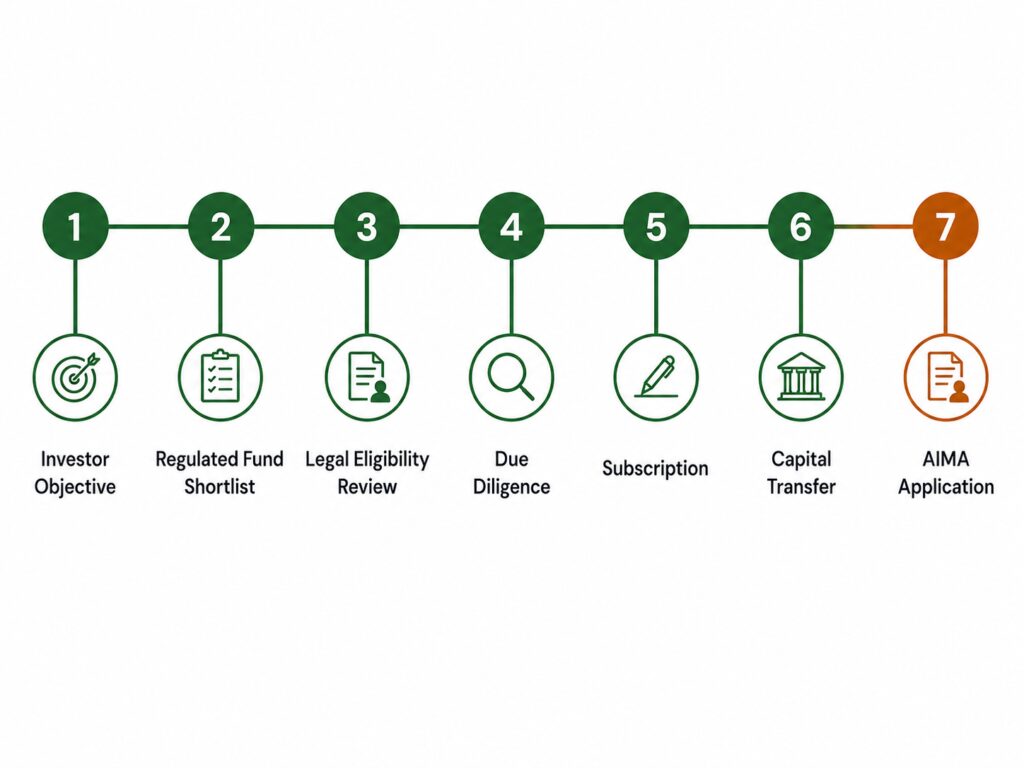
A typical access process looks like this:
- Define the investor’s objective
Confirm whether the priority is Golden Visa eligibility, capital preservation, growth exposure, income, sector access, or a combination. - Shortlist regulated funds
Review only funds with clear manager details, fund documents, depositary information, audit arrangements, and CMVM registration context. - Confirm Golden Visa eligibility
Portuguese legal counsel should review whether the fund structure, investment policy, maturity, and allocation rules support an ARI application. - Review investment risk
Assess sector exposure, fees, NAV policy, liquidity, exit terms, manager track record, and downside scenarios. - Complete KYC and subscription
The investor provides identity documents, proof of funds, source-of-wealth information, and subscription documents. - Transfer capital and obtain evidence
The bank, fund manager, or depositary provides confirmation documents required for the ARI application. - Submit the Golden Visa application
The application file is submitted to AIMA with the investment evidence, personal documents, criminal record certificates, and family documents where relevant.
Investors comparing fund routes with other residence options can use investment visa options in Portugal to understand how the Golden Visa fits beside other residency pathways.
Before selecting a fund, investors should also use a structured fund evaluation guide to compare documentation, sector risk, liquidity, manager experience, and legal eligibility.
Outlook for Portugal Fund Market in 2026
The outlook for Portugal’s fund market in 2026 is shaped by three forces: Golden Visa demand, private capital growth, and tighter investor scrutiny.
First, the Golden Visa fund route remains central because real estate no longer qualifies for new applications. That has moved more investor attention toward CMVM-regulated funds. It has also raised the standard for fund selection because more managers now market to international investors.
Second, Portugal’s private equity and venture capital ecosystem continues to mature. More funds are targeting technology, healthcare, renewable energy, hospitality, and growth companies. This gives foreign investors a broader opportunity set, but it also makes comparisons harder.
Third, investors are asking better questions. They want to know how the fund calculates NAV, who audits the fund, what rights LP investors have, how the exit works, what fees apply, and whether the fund documentation supports the immigration objective.
A practical 2026 fund review should include this checklist:
| Question | Why It Matters |
| Is the manager regulated or authorised? | Confirms the fund operates within a supervisory framework |
| Is the fund eligible for Golden Visa use? | Regulation alone does not guarantee ARI eligibility |
| What does the fund invest in? | Determines sector risk and return profile |
| What is the fund term? | Affects liquidity and exit planning |
| How is NAV calculated? | Helps investors understand reported value |
| Who audits the fund? | Supports financial transparency |
| What rights do LP investors have? | Clarifies voting, reporting, and investor protections |
| What are all fees? | Shows the true cost of participation |
| What is the exit strategy? | Explains how capital may be returned |
Portugal golden visa funds outlook 2026 is positive for investors who approach the market with discipline. The opportunity is real, but the best outcomes will likely come from careful fund selection, legal eligibility review, and realistic expectations about risk.
Investors who want a deeper review of reporting, NAV, sector risk, and exits should also read how to evaluate fund performance before committing capital.
FAQs: Portugal Investment Fund Landscape
What types of investment funds are available in Portugal?
Portugal offers several types of investment funds, including private equity funds, venture capital funds, real estate investment funds, and other alternative investment structures. Foreign investors usually focus on funds that provide exposure to Portuguese companies, sector-specific growth, or regulated investment strategies. For Golden Visa purposes, only certain non-real-estate collective investment or venture capital funds may qualify, so legal review is required before subscription.
What sectors do Portugal qualifying funds invest in?
Portugal qualifying funds may invest in sectors such as technology, healthcare, renewable energy, hospitality, business services, and Portuguese growth companies. The exact exposure depends on the fund’s investment policy and legal structure. Investors should not rely only on a sector label. They should review the fund documents, manager track record, NAV policy, audit process, fees, and exit strategy.
How is the Portugal investment fund market regulated?
The Portugal investment fund market is supervised by CMVM, Portugal’s Securities Market Commission. CMVM regulation covers fund managers, market conduct, disclosures, and supervised entities, but regulation does not guarantee returns or remove investment risk. For Golden Visa investors, there is a second layer of review because a regulated fund must also meet ARI eligibility requirements.
What is the outlook for the Golden Visa fund sector in 2026?
The outlook for the Golden Visa fund sector in 2026 remains active because fund investment is now one of the main practical routes after the removal of real estate purchases from the programme. Investor attention is likely to stay focused on CMVM-regulated funds with clear documentation, strong governance, credible sector strategies, and transparent exit planning. The market may offer attractive portugal investment fund opportunities, but each fund must be reviewed on its own merits.
Is Portugal’s Investment Fund Landscape Right for You?
Portugal’s investment fund market offers foreign investors a more sophisticated route into the country’s economy than direct property ownership alone. For Golden Visa applicants, it also provides one of the clearest remaining investment routes, provided the fund is properly structured, regulated, and legally eligible.
The strongest portugal investment fund opportunities are not defined by marketing materials. They are defined by fund governance, manager quality, sector exposure, audit discipline, NAV transparency, LP investor rights, and a credible exit plan.
A good fund review should answer two questions at the same time: does the investment make sense financially, and does it support the investor’s residency objective? If either answer is unclear, the fund needs deeper review before capital is transferred.
Ready to take the next step?
Book a free initial assessment. We’ll assess your eligibility, walk through the current qualifying routes, and answer your questions, no cost, no commitment.












