

Portugal golden visa

Portugal Golden Visa vs Italy: Which European Program Wins?

Portugal Golden Visa vs Italy is a serious comparison for investors who want European residency, Schengen access, and a credible long-term route to an EU passport. The two programmes look similar from a distance, but they are built for different types of non-EU investor.

Portugal is generally stronger for applicants who want a fund-based route with low physical presence. Italy is more attractive for investors who want a direct economic link to Italian companies, startups, government bonds, or public-interest projects. This guide compares investment requirements, processing time, minimum stay, tax regimes, and citizenship timelines in practical terms.

Portugal vs Italy: Investment Residency at a Glance

Portugal and Italy both offer residence by investment, but they do not solve the same problem. Portugal is usually the cleaner option for globally mobile investors who want EU residence without relocating full-time. Italy suits applicants who want a closer relationship with the Italian economy or who may actually live in Italy.

Category Portugal Golden Visa Italy Investor Visa
Formal programme Portugal ARI, Autorização de Residência para Investimento Italy Investor Visa, Visto Investitori
Main investor profile Non-EU investor seeking flexible EU residency Non-EU investor committing capital to Italian strategic assets
Common route €500,000 fund route Portugal €250,000 innovative startup or €500,000 Italian company
Real estate route No longer available for new ARI applicants Not a qualifying route
Schengen access Yes, through Portuguese residence Yes, through Italian residence
Minimum stay Low stay requirement No minimum stay to maintain the investor permit, but citizenship requires real residence
Citizenship timeline Changed in 2026, see section below Usually 10 years of legal residence for non-EU nationals
Best fit Investors prioritising flexibility and long-term optionality Investors seeking Italian residence, business exposure, or tax relocation planning

For investors comparing Europe more broadly, it may also help to see how Portugal compares to Greece and review the Portugal vs Spain comparison before choosing one programme.
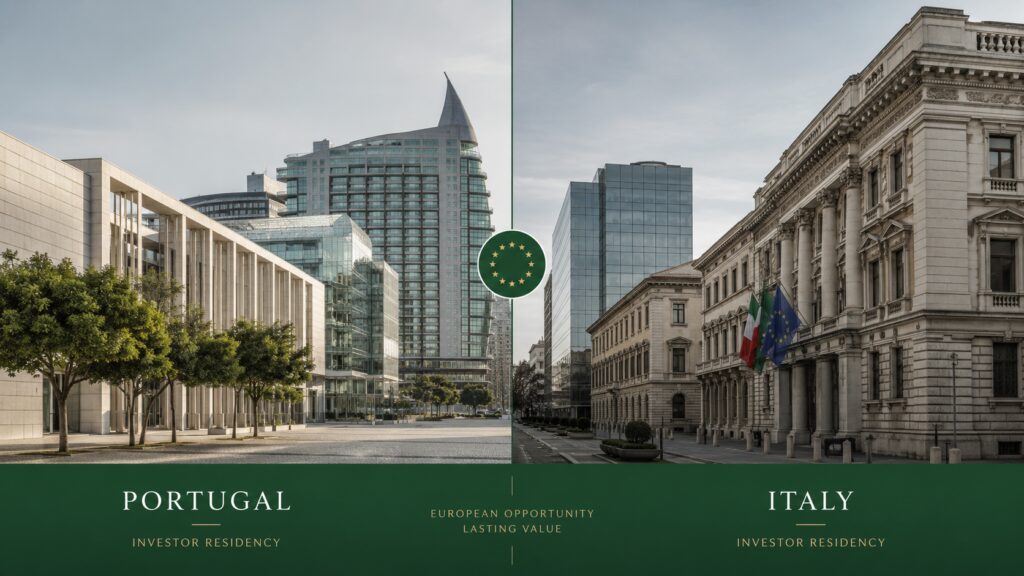
Portugal Golden Visa vs Italy: Which European Program Wins?

Program Overview

Both programmes are designed for non-EU nationals, but Portugal and Italy use different legal structures. Portugal grants a residence permit through the ARI programme. Italy grants an investor visa first, followed by a residence permit after arrival.

Portugal ARI (Golden Visa) in 2026

Portugal’s Golden Visa is formally called the ARI, or Autorização de Residência para Investimento. It allows eligible third-country nationals to obtain Portuguese residence through a qualifying investment.

Residency applications are handled by AIMA, the Agency for Integration, Migration and Asylum. AIMA replaced SEF, Serviço de Estrangeiros e Fronteiras, in 2023, which is why older articles may still refer to SEF.

For many international investors, the main practical route is the regulated investment fund route. A qualifying fund must be structured under Portuguese law and supervised by CMVM, Portugal’s Securities Market Commission. Investors reviewing the ARI program Portugal should pay close attention to whether the investment is genuinely eligible under current rules.

Portugal’s old real estate route is no longer the central Golden Visa pathway for new applicants. That matters because many outdated comparison articles still present Portuguese property purchases as if they were a current qualifying option. They are not.


Italy Investor Visa (Visto Investitori)

Italy’s programme is officially the Investor Visa for Italy. It is designed for non-EU citizens who invest in strategic assets for Italy’s economy and society.

The official Italian investor portal lists four main routes:

  • €2 million in Italian government bonds
  • €500,000 in an Italian limited company
  • €250,000 in an Italian innovative startup
  • €1 million in a philanthropic initiative

Italy’s structure is different from Portugal’s. It is not a Portugal-style regulated fund route. The lower €250,000 option is tied to innovative startups, which may suit some investors but carries a different risk profile from a regulated fund subscription.

Italy also has a pre-approval feature. The investor normally secures the Nulla Osta, or certificate of no impediment, before completing the qualifying investment. For cautious investors, that can reduce the psychological discomfort of transferring capital before the immigration file has been assessed.

Investment Requirements Compared

The headline number can be misleading. Italy starts lower at €250,000, but the lowest route is an innovative startup investment. Portugal’s common investor route starts at €500,000, but the structure may feel more familiar to investors who prefer fund-based exposure.

Route Portugal Italy
Fund route €500,000 through eligible investment funds No direct equivalent
Startup route Not the main Golden Visa structure €250,000 in an innovative Italian startup
Company investment Business and job-linked routes may exist under Portuguese law €500,000 in an Italian limited company
Government bonds Not the usual ARI route €2 million in Italian government bonds
Philanthropy or cultural route Portugal has cultural and heritage-related legal routes, subject to strict eligibility €1 million philanthropic initiative
Real estate No longer qualifies for new Golden Visa applicants Does not qualify

For investors asking “portugal or italy golden visa,” the better question is not only “which is cheaper?” It is “which type of risk do I want to take?”

Italy may be cheaper on paper if the applicant chooses the €250,000 innovative startup route. Portugal may be more suitable if the investor wants exposure through qualifying fund investment options rather than a startup or direct company investment.
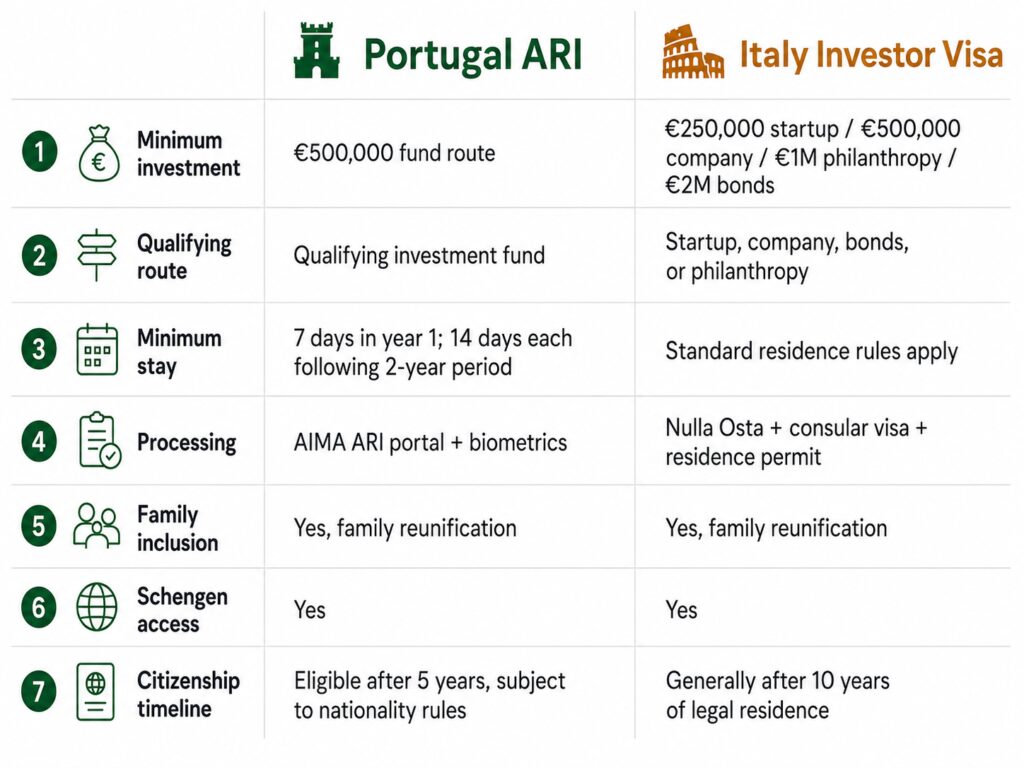
Portugal and Italy Golden Visa comparison table for investor residency

Processing Times and Application Complexity

Processing time is one of the clearest differences between the two programmes.

Portugal’s process usually involves document preparation, NIF registration, bank account opening, fund subscription, application filing, biometric appointment, AIMA review, and card issuance. The initial approval timeline often depends on appointment availability, document completeness, and AIMA capacity.

A typical Portugal ARI file involves:

  1. Eligibility assessment and route selection
  2. NIF, Portuguese bank account, and fund subscription
  3. Legal due diligence and source-of-funds review
  4. ARI application submission
  5. Biometric appointment
  6. Residence card approval and issuance

Italy’s investor visa process is usually more front-loaded around the Nulla Osta. The Italian Investor Visa Committee reviews the application before the consular visa stage. After entry into Italy, the investor applies for the residence permit and completes the investment within the required timeframe.

A typical Italy Investor Visa file involves:

  1. Selection of investment route
  2. Online Nulla Osta application
  3. Committee review
  4. Investor visa application at the Italian consulate
  5. Entry into Italy
  6. Residence permit application at the Questura
  7. Completion of the investment after arrival

Italy can feel more procedural but clearer in sequence. Portugal can feel more flexible but slower in practice, especially when biometric appointment availability becomes the bottleneck.

For a broader European golden visa comparison, Portugal remains attractive because the residence obligation is low and the programme is familiar to global investors. Italy may be stronger for applicants who value pre-approval before transferring investment capital.

Minimum Stay Requirements

This section is where Portugal often wins for globally mobile investors.

Portugal’s ARI residence obligation is low. The official AIMA framework refers to limited physical presence, commonly planned as seven days in the first year and fourteen days in subsequent two-year periods. For many investors, that means Portugal can support long-term EU optionality without forcing a full relocation.

Italy’s Investor Visa does not impose the same type of minimum stay requirement to maintain the investor permit. However, there is an important distinction: maintaining a residence permit is not the same as qualifying for citizenship.

If the investor wants Italian citizenship later, Italy generally expects real legal residence over a long period. A person who keeps an Italian permit but rarely lives in Italy should not assume that citizenship will follow automatically.

This is why the minimum stay question has two layers:

  • Residence maintenance: Italy can be very flexible, and Portugal is also low-stay.
  • Citizenship planning: Both countries require a much more careful analysis of actual residence, language, integration, and legal continuity.

Path to Citizenship

Investors often compare Golden Visa programmes by asking which one leads faster to an EU passport. That question became more complicated in 2026 because Portugal’s nationality law changed.

An EU passport can be a powerful long-term benefit, but it should not be treated as automatic. Residence by investment gives a pathway, not a guaranteed passport.

Portugal Golden Visa

Start Your Portugal Golden Visa Journey

Receive personalized legal guidance from experienced immigration lawyers and discover the most effective pathway to securing your Portugal Golden Visa.

Book Your Free Consultation →
✓ No Obligation   •   ✓ Licensed Lawyers   •   ✓ Confidential Consultation

Portugal Citizenship Timeline

Portugal was historically known for a five-year pathway to citizenship after legal residence. In 2026, Portugal amended its nationality law. The new framework introduced longer naturalisation residence periods for many applicants, including seven years for nationals of Portuguese-speaking countries and EU member states, and ten years for nationals of other countries.

That does not mean the portugal golden visa has lost its value. It still offers Portuguese residence, Schengen access, family inclusion, and a route to long-term residence. But investors should now separate three different goals:

  • Getting a Portuguese residence permit
  • Qualifying for permanent residence
  • Applying for Portuguese citizenship

The citizenship timeline now depends more heavily on nationality, filing date, transitional rules, and the applicant’s personal facts. Any investor whose strategy depends on a Portuguese passport should take legal advice before assuming the old five-year citizenship rule applies.

Italy Citizenship Timeline

Italy generally requires ten years of legal residence for non-EU nationals applying for citizenship by naturalisation. That makes Italy a longer-term citizenship strategy for most Investor Visa applicants.

Italy may still be attractive for investors who genuinely want to live in Italy. But for a non-EU investor who mainly wants a low-presence route to future citizenship, Italy is usually less direct than older summaries suggest.

The practical conclusion is simple: Italy can be a strong residence option, but it is not a shortcut to an EU passport.

Tax Benefits Compared

Tax should never be treated as an automatic benefit of a Golden Visa. Holding a residence permit does not necessarily make you tax resident. Tax residency usually depends on physical presence, home availability, centre of life, and domestic law.

Portugal NHR Regime

The old NHR Portugal regime was one of the reasons many investors originally considered Portuguese residence. In 2026, it should not be presented as a simple, universally available benefit for all new Golden Visa applicants.

Portugal has moved away from the old broad NHR model and toward more specific tax incentive frameworks. Whether a new resident qualifies for any preferential regime depends on the applicant’s profession, timing, prior residence history, and tax position.

This matters because many investors do not intend to relocate to Portugal. If you do not become tax resident, Portugal’s domestic tax regime may be less relevant to your immediate planning. If you do plan to relocate, tax advice should be taken before the immigration application is structured.

Italy Flat Tax for New Residents

Italy’s flat tax regime for new residents can be highly relevant for ultra-high-net-worth individuals who intend to move their tax residence to Italy. It is separate from the Investor Visa itself, but the two are often considered together.

The Italian flat tax may appeal to investors with substantial foreign-source income who want tax predictability. However, it is not automatically available just because someone receives an Investor Visa. The applicant must satisfy Italian tax residency and eligibility rules.

For official travel and country-entry checks, investors can cross-reference government resources such as EU Passport Strength Rankings, but tax decisions should be based on advice from qualified Italian and Portuguese tax professionals.

For broader EU data context, official European datasets such as EU Investor Residency Statistics may be useful, although programme-specific eligibility still depends on national law.

Which Program Suits Which Investor Profile?

There is no universal winner. The stronger programme depends on the investor’s objective.

Portugal is usually better for investors who want:

  • A flexible European residence route
  • A fund-based investment structure
  • Low physical presence
  • Family inclusion under one residency strategy
  • A long-term base in the Schengen Area
  • A programme with strong name recognition among global investors

Italy is usually better for investors who want:

  • A direct investment into Italy’s economy
  • Startup, company, bond, or philanthropic investment options
  • A pre-approval model before capital is committed
  • The possibility of living, working, or doing business in Italy
  • A tax relocation strategy involving the Italian flat tax
  • A long-term connection to Italy, not only Schengen mobility

Investors comparing “italy vs portugal golden visa” should also consider administrative style. Portugal’s process is well known but can be delayed by appointment and processing capacity. Italy’s process is more structured around the Nulla Osta and post-entry investment completion.

If your main goal is flexible EU residence without relocation, Portugal will often be the stronger fit. If your goal is to establish a real base in Italy and align your capital with Italian business or public-interest projects, Italy may be the more logical choice.
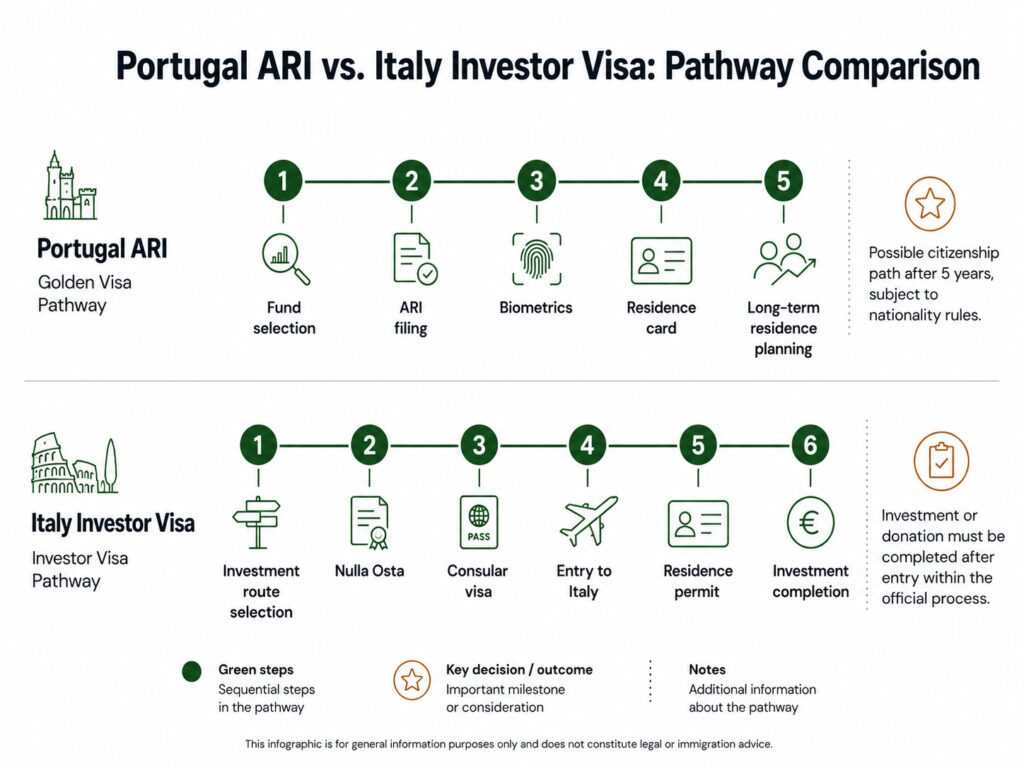
portugal-ari-italy-investor-visa-timeline

FAQs: Portugal Golden Visa vs Italy

How does the Portugal Golden Visa compare to Italy investor visa?

Portugal’s Golden Visa is usually better for investors who want a flexible, low-stay European residence route through a fund-based structure. Italy’s Investor Visa is better for applicants who want to invest directly in Italian startups, companies, government bonds, or philanthropic projects. Both can provide Schengen access, but the investment structure and long-term citizenship planning are very different.

Which is cheaper, Italy or Portugal?

Italy has the lower headline minimum because the innovative startup route starts at €250,000. Portugal’s common fund route starts at €500,000. However, cheaper does not always mean better. A startup investment has a different risk profile from a regulated fund route, so investors should compare structure, liquidity, risk, legal fees, and long-term goals.

Which country gives citizenship faster?

This depends on the applicant’s nationality, residence history, and current law. Portugal historically had a five-year naturalisation pathway, but the 2026 nationality law introduced longer timelines for many applicants. Italy generally requires ten years of legal residence for non-EU nationals. Investors should not treat either programme as an automatic passport route.

Does Italy have a Golden Visa similar to Portugal?

Yes, Italy has an investor residence route often called the Italy Golden Visa, but its formal name is the Investor Visa for Italy. It is not identical to Portugal’s ARI programme. Italy focuses on investment in Italian government bonds, companies, innovative startups, or philanthropic initiatives, while Portugal’s mainstream investor route is usually discussed around qualifying fund investment options.

Which European Program Wins?

Portugal wins for investors who want flexibility, low physical presence, and a fund-based residence route. It is often the stronger choice for globally mobile families who want Schengen access and long-term European optionality without immediately relocating.

Italy wins for investors who want a real Italian base, direct business exposure, or a tax relocation plan built around Italy. Its pre-approval structure can also appeal to applicants who do not want to commit capital before the visa file has been reviewed.

The most sensible answer is not “Portugal always wins” or “Italy always wins.” The right answer depends on whether you want flexible residence, tax relocation, business exposure, or a realistic citizenship strategy. Before choosing, compare the investment structure, residence obligations, tax impact, and family goals side by side. For investors still comparing European options, reviewing Portugal investment residency solutions can help clarify which route fits your situation.

Ready to take the next step?
Book a free initial assessment. We’ll assess your eligibility, walk through the current qualifying routes, and answer your questions, no cost, no commitment.


Portugal Golden Visa vs Italy: Which European Program Wins?

Portugal Golden Visa vs Italy is a serious comparison for investors who want European residency, Schengen access, and a credible long-term route to an EU passport. The two programmes look similar from a distance, but they are built for different types of non-EU investor.

Portugal is generally stronger for applicants who want a fund-based route with low physical presence. Italy is more attractive for investors who want a direct economic link to Italian companies, startups, government bonds, or public-interest projects. This guide compares investment requirements, processing time, minimum stay, tax regimes, and citizenship timelines in practical terms.

Portugal vs Italy: Investment Residency at a Glance

Portugal and Italy both offer residence by investment, but they do not solve the same problem. Portugal is usually the cleaner option for globally mobile investors who want EU residence without relocating full-time. Italy suits applicants who want a closer relationship with the Italian economy or who may actually live in Italy.

Category Portugal Golden Visa Italy Investor Visa
Formal programme Portugal ARI, Autorização de Residência para Investimento Italy Investor Visa, Visto Investitori
Main investor profile Non-EU investor seeking flexible EU residency Non-EU investor committing capital to Italian strategic assets
Common route €500,000 fund route Portugal €250,000 innovative startup or €500,000 Italian company
Real estate route No longer available for new ARI applicants Not a qualifying route
Schengen access Yes, through Portuguese residence Yes, through Italian residence
Minimum stay Low stay requirement No minimum stay to maintain the investor permit, but citizenship requires real residence
Citizenship timeline Changed in 2026, see section below Usually 10 years of legal residence for non-EU nationals
Best fit Investors prioritising flexibility and long-term optionality Investors seeking Italian residence, business exposure, or tax relocation planning

For investors comparing Europe more broadly, it may also help to see how Portugal compares to Greece and review the Portugal vs Spain comparison before choosing one programme.

Portugal Golden Visa vs Italy: Which European Program Wins?

Program Overview

Both programmes are designed for non-EU nationals, but Portugal and Italy use different legal structures. Portugal grants a residence permit through the ARI programme. Italy grants an investor visa first, followed by a residence permit after arrival.

Portugal ARI (Golden Visa) in 2026

Portugal’s Golden Visa is formally called the ARI, or Autorização de Residência para Investimento. It allows eligible third-country nationals to obtain Portuguese residence through a qualifying investment.

Residency applications are handled by AIMA, the Agency for Integration, Migration and Asylum. AIMA replaced SEF, Serviço de Estrangeiros e Fronteiras, in 2023, which is why older articles may still refer to SEF.

For many international investors, the main practical route is the regulated investment fund route. A qualifying fund must be structured under Portuguese law and supervised by CMVM, Portugal’s Securities Market Commission. Investors reviewing the ARI program Portugal should pay close attention to whether the investment is genuinely eligible under current rules.

Portugal’s old real estate route is no longer the central Golden Visa pathway for new applicants. That matters because many outdated comparison articles still present Portuguese property purchases as if they were a current qualifying option. They are not.


Italy Investor Visa (Visto Investitori)

Italy’s programme is officially the Investor Visa for Italy. It is designed for non-EU citizens who invest in strategic assets for Italy’s economy and society.

The official Italian investor portal lists four main routes:

  • €2 million in Italian government bonds
  • €500,000 in an Italian limited company
  • €250,000 in an Italian innovative startup
  • €1 million in a philanthropic initiative

Italy’s structure is different from Portugal’s. It is not a Portugal-style regulated fund route. The lower €250,000 option is tied to innovative startups, which may suit some investors but carries a different risk profile from a regulated fund subscription.

Italy also has a pre-approval feature. The investor normally secures the Nulla Osta, or certificate of no impediment, before completing the qualifying investment. For cautious investors, that can reduce the psychological discomfort of transferring capital before the immigration file has been assessed.

Investment Requirements Compared

The headline number can be misleading. Italy starts lower at €250,000, but the lowest route is an innovative startup investment. Portugal’s common investor route starts at €500,000, but the structure may feel more familiar to investors who prefer fund-based exposure.

Route Portugal Italy
Fund route €500,000 through eligible investment funds No direct equivalent
Startup route Not the main Golden Visa structure €250,000 in an innovative Italian startup
Company investment Business and job-linked routes may exist under Portuguese law €500,000 in an Italian limited company
Government bonds Not the usual ARI route €2 million in Italian government bonds
Philanthropy or cultural route Portugal has cultural and heritage-related legal routes, subject to strict eligibility €1 million philanthropic initiative
Real estate No longer qualifies for new Golden Visa applicants Does not qualify

For investors asking “portugal or italy golden visa,” the better question is not only “which is cheaper?” It is “which type of risk do I want to take?”

Italy may be cheaper on paper if the applicant chooses the €250,000 innovative startup route. Portugal may be more suitable if the investor wants exposure through qualifying fund investment options rather than a startup or direct company investment.

Portugal and Italy Golden Visa comparison table for investor residency

Processing Times and Application Complexity

Processing time is one of the clearest differences between the two programmes.

Portugal’s process usually involves document preparation, NIF registration, bank account opening, fund subscription, application filing, biometric appointment, AIMA review, and card issuance. The initial approval timeline often depends on appointment availability, document completeness, and AIMA capacity.

A typical Portugal ARI file involves:

  1. Eligibility assessment and route selection
  2. NIF, Portuguese bank account, and fund subscription
  3. Legal due diligence and source-of-funds review
  4. ARI application submission
  5. Biometric appointment
  6. Residence card approval and issuance

Italy’s investor visa process is usually more front-loaded around the Nulla Osta. The Italian Investor Visa Committee reviews the application before the consular visa stage. After entry into Italy, the investor applies for the residence permit and completes the investment within the required timeframe.

A typical Italy Investor Visa file involves:

  1. Selection of investment route
  2. Online Nulla Osta application
  3. Committee review
  4. Investor visa application at the Italian consulate
  5. Entry into Italy
  6. Residence permit application at the Questura
  7. Completion of the investment after arrival

Italy can feel more procedural but clearer in sequence. Portugal can feel more flexible but slower in practice, especially when biometric appointment availability becomes the bottleneck.

For a broader European golden visa comparison, Portugal remains attractive because the residence obligation is low and the programme is familiar to global investors. Italy may be stronger for applicants who value pre-approval before transferring investment capital.

Minimum Stay Requirements

This section is where Portugal often wins for globally mobile investors.

Portugal’s ARI residence obligation is low. The official AIMA framework refers to limited physical presence, commonly planned as seven days in the first year and fourteen days in subsequent two-year periods. For many investors, that means Portugal can support long-term EU optionality without forcing a full relocation.

Italy’s Investor Visa does not impose the same type of minimum stay requirement to maintain the investor permit. However, there is an important distinction: maintaining a residence permit is not the same as qualifying for citizenship.

If the investor wants Italian citizenship later, Italy generally expects real legal residence over a long period. A person who keeps an Italian permit but rarely lives in Italy should not assume that citizenship will follow automatically.

This is why the minimum stay question has two layers:

  • Residence maintenance: Italy can be very flexible, and Portugal is also low-stay.
  • Citizenship planning: Both countries require a much more careful analysis of actual residence, language, integration, and legal continuity.

Path to Citizenship

Investors often compare Golden Visa programmes by asking which one leads faster to an EU passport. That question became more complicated in 2026 because Portugal’s nationality law changed.

An EU passport can be a powerful long-term benefit, but it should not be treated as automatic. Residence by investment gives a pathway, not a guaranteed passport.

Portugal Golden Visa

Start Your Portugal Golden Visa Journey

Receive personalized legal guidance from experienced immigration lawyers and discover the most effective pathway to securing your Portugal Golden Visa.

Book Your Free Consultation →
✓ No Obligation   •   ✓ Licensed Lawyers   •   ✓ Confidential Consultation

Portugal Citizenship Timeline

Portugal was historically known for a five-year pathway to citizenship after legal residence. In 2026, Portugal amended its nationality law. The new framework introduced longer naturalisation residence periods for many applicants, including seven years for nationals of Portuguese-speaking countries and EU member states, and ten years for nationals of other countries.

That does not mean the portugal golden visa has lost its value. It still offers Portuguese residence, Schengen access, family inclusion, and a route to long-term residence. But investors should now separate three different goals:

  • Getting a Portuguese residence permit
  • Qualifying for permanent residence
  • Applying for Portuguese citizenship

The citizenship timeline now depends more heavily on nationality, filing date, transitional rules, and the applicant’s personal facts. Any investor whose strategy depends on a Portuguese passport should take legal advice before assuming the old five-year citizenship rule applies.

Italy Citizenship Timeline

Italy generally requires ten years of legal residence for non-EU nationals applying for citizenship by naturalisation. That makes Italy a longer-term citizenship strategy for most Investor Visa applicants.

Italy may still be attractive for investors who genuinely want to live in Italy. But for a non-EU investor who mainly wants a low-presence route to future citizenship, Italy is usually less direct than older summaries suggest.

The practical conclusion is simple: Italy can be a strong residence option, but it is not a shortcut to an EU passport.

Tax Benefits Compared

Tax should never be treated as an automatic benefit of a Golden Visa. Holding a residence permit does not necessarily make you tax resident. Tax residency usually depends on physical presence, home availability, centre of life, and domestic law.

Portugal NHR Regime

The old NHR Portugal regime was one of the reasons many investors originally considered Portuguese residence. In 2026, it should not be presented as a simple, universally available benefit for all new Golden Visa applicants.

Portugal has moved away from the old broad NHR model and toward more specific tax incentive frameworks. Whether a new resident qualifies for any preferential regime depends on the applicant’s profession, timing, prior residence history, and tax position.

This matters because many investors do not intend to relocate to Portugal. If you do not become tax resident, Portugal’s domestic tax regime may be less relevant to your immediate planning. If you do plan to relocate, tax advice should be taken before the immigration application is structured.

Italy Flat Tax for New Residents

Italy’s flat tax regime for new residents can be highly relevant for ultra-high-net-worth individuals who intend to move their tax residence to Italy. It is separate from the Investor Visa itself, but the two are often considered together.

The Italian flat tax may appeal to investors with substantial foreign-source income who want tax predictability. However, it is not automatically available just because someone receives an Investor Visa. The applicant must satisfy Italian tax residency and eligibility rules.

For official travel and country-entry checks, investors can cross-reference government resources such as EU Passport Strength Rankings, but tax decisions should be based on advice from qualified Italian and Portuguese tax professionals.

For broader EU data context, official European datasets such as EU Investor Residency Statistics may be useful, although programme-specific eligibility still depends on national law.

Which Program Suits Which Investor Profile?

There is no universal winner. The stronger programme depends on the investor’s objective.

Portugal is usually better for investors who want:

  • A flexible European residence route
  • A fund-based investment structure
  • Low physical presence
  • Family inclusion under one residency strategy
  • A long-term base in the Schengen Area
  • A programme with strong name recognition among global investors

Italy is usually better for investors who want:

  • A direct investment into Italy’s economy
  • Startup, company, bond, or philanthropic investment options
  • A pre-approval model before capital is committed
  • The possibility of living, working, or doing business in Italy
  • A tax relocation strategy involving the Italian flat tax
  • A long-term connection to Italy, not only Schengen mobility

Investors comparing “italy vs portugal golden visa” should also consider administrative style. Portugal’s process is well known but can be delayed by appointment and processing capacity. Italy’s process is more structured around the Nulla Osta and post-entry investment completion.

If your main goal is flexible EU residence without relocation, Portugal will often be the stronger fit. If your goal is to establish a real base in Italy and align your capital with Italian business or public-interest projects, Italy may be the more logical choice.

portugal-ari-italy-investor-visa-timeline

FAQs: Portugal Golden Visa vs Italy

How does the Portugal Golden Visa compare to Italy investor visa?

Portugal’s Golden Visa is usually better for investors who want a flexible, low-stay European residence route through a fund-based structure. Italy’s Investor Visa is better for applicants who want to invest directly in Italian startups, companies, government bonds, or philanthropic projects. Both can provide Schengen access, but the investment structure and long-term citizenship planning are very different.

Which is cheaper, Italy or Portugal?

Italy has the lower headline minimum because the innovative startup route starts at €250,000. Portugal’s common fund route starts at €500,000. However, cheaper does not always mean better. A startup investment has a different risk profile from a regulated fund route, so investors should compare structure, liquidity, risk, legal fees, and long-term goals.

Which country gives citizenship faster?

This depends on the applicant’s nationality, residence history, and current law. Portugal historically had a five-year naturalisation pathway, but the 2026 nationality law introduced longer timelines for many applicants. Italy generally requires ten years of legal residence for non-EU nationals. Investors should not treat either programme as an automatic passport route.

Does Italy have a Golden Visa similar to Portugal?

Yes, Italy has an investor residence route often called the Italy Golden Visa, but its formal name is the Investor Visa for Italy. It is not identical to Portugal’s ARI programme. Italy focuses on investment in Italian government bonds, companies, innovative startups, or philanthropic initiatives, while Portugal’s mainstream investor route is usually discussed around qualifying fund investment options.

Which European Program Wins?

Portugal wins for investors who want flexibility, low physical presence, and a fund-based residence route. It is often the stronger choice for globally mobile families who want Schengen access and long-term European optionality without immediately relocating.

Italy wins for investors who want a real Italian base, direct business exposure, or a tax relocation plan built around Italy. Its pre-approval structure can also appeal to applicants who do not want to commit capital before the visa file has been reviewed.

The most sensible answer is not “Portugal always wins” or “Italy always wins.” The right answer depends on whether you want flexible residence, tax relocation, business exposure, or a realistic citizenship strategy. Before choosing, compare the investment structure, residence obligations, tax impact, and family goals side by side. For investors still comparing European options, reviewing Portugal investment residency solutions can help clarify which route fits your situation.

Ready to take the next step?
Book a free initial assessment. We’ll assess your eligibility, walk through the current qualifying routes, and answer your questions, no cost, no commitment.

Portugal Golden Visa vs Italy: Which European Program Wins?

Portugal-Golden-Visa-vs-Italy-Golden-Visa-Which-European-Program-Wins
Portugal Golden Visa vs Italy is a serious comparison for investors who want European residency, Schengen access, and a credible long-term route to an EU passport. The two programmes look similar from a distance, but they are built for different types of non-EU investor.

Portugal is generally stronger for applicants who want a fund-based route with low physical presence. Italy is more attractive for investors who want a direct economic link to Italian companies, startups, government bonds, or public-interest projects. This guide compares investment requirements, processing time, minimum stay, tax regimes, and citizenship timelines in practical terms.

Portugal vs Italy: Investment Residency at a Glance

Portugal and Italy both offer residence by investment, but they do not solve the same problem. Portugal is usually the cleaner option for globally mobile investors who want EU residence without relocating full-time. Italy suits applicants who want a closer relationship with the Italian economy or who may actually live in Italy.

Category Portugal Golden Visa Italy Investor Visa
Formal programme Portugal ARI, Autorização de Residência para Investimento Italy Investor Visa, Visto Investitori
Main investor profile Non-EU investor seeking flexible EU residency Non-EU investor committing capital to Italian strategic assets
Common route €500,000 fund route Portugal €250,000 innovative startup or €500,000 Italian company
Real estate route No longer available for new ARI applicants Not a qualifying route
Schengen access Yes, through Portuguese residence Yes, through Italian residence
Minimum stay Low stay requirement No minimum stay to maintain the investor permit, but citizenship requires real residence
Citizenship timeline Changed in 2026, see section below Usually 10 years of legal residence for non-EU nationals
Best fit Investors prioritising flexibility and long-term optionality Investors seeking Italian residence, business exposure, or tax relocation planning

For investors comparing Europe more broadly, it may also help to see how Portugal compares to Greece and review the Portugal vs Spain comparison before choosing one programme.

Portugal Golden Visa vs Italy: Which European Program Wins?

Program Overview

Both programmes are designed for non-EU nationals, but Portugal and Italy use different legal structures. Portugal grants a residence permit through the ARI programme. Italy grants an investor visa first, followed by a residence permit after arrival.

Portugal ARI (Golden Visa) in 2026

Portugal’s Golden Visa is formally called the ARI, or Autorização de Residência para Investimento. It allows eligible third-country nationals to obtain Portuguese residence through a qualifying investment.

Residency applications are handled by AIMA, the Agency for Integration, Migration and Asylum. AIMA replaced SEF, Serviço de Estrangeiros e Fronteiras, in 2023, which is why older articles may still refer to SEF.

For many international investors, the main practical route is the regulated investment fund route. A qualifying fund must be structured under Portuguese law and supervised by CMVM, Portugal’s Securities Market Commission. Investors reviewing the ARI program Portugal should pay close attention to whether the investment is genuinely eligible under current rules.

Portugal’s old real estate route is no longer the central Golden Visa pathway for new applicants. That matters because many outdated comparison articles still present Portuguese property purchases as if they were a current qualifying option. They are not.


Italy Investor Visa (Visto Investitori)

Italy’s programme is officially the Investor Visa for Italy. It is designed for non-EU citizens who invest in strategic assets for Italy’s economy and society.

The official Italian investor portal lists four main routes:

  • €2 million in Italian government bonds
  • €500,000 in an Italian limited company
  • €250,000 in an Italian innovative startup
  • €1 million in a philanthropic initiative

Italy’s structure is different from Portugal’s. It is not a Portugal-style regulated fund route. The lower €250,000 option is tied to innovative startups, which may suit some investors but carries a different risk profile from a regulated fund subscription.

Italy also has a pre-approval feature. The investor normally secures the Nulla Osta, or certificate of no impediment, before completing the qualifying investment. For cautious investors, that can reduce the psychological discomfort of transferring capital before the immigration file has been assessed.

Investment Requirements Compared

The headline number can be misleading. Italy starts lower at €250,000, but the lowest route is an innovative startup investment. Portugal’s common investor route starts at €500,000, but the structure may feel more familiar to investors who prefer fund-based exposure.

Route Portugal Italy
Fund route €500,000 through eligible investment funds No direct equivalent
Startup route Not the main Golden Visa structure €250,000 in an innovative Italian startup
Company investment Business and job-linked routes may exist under Portuguese law €500,000 in an Italian limited company
Government bonds Not the usual ARI route €2 million in Italian government bonds
Philanthropy or cultural route Portugal has cultural and heritage-related legal routes, subject to strict eligibility €1 million philanthropic initiative
Real estate No longer qualifies for new Golden Visa applicants Does not qualify

For investors asking “portugal or italy golden visa,” the better question is not only “which is cheaper?” It is “which type of risk do I want to take?”

Italy may be cheaper on paper if the applicant chooses the €250,000 innovative startup route. Portugal may be more suitable if the investor wants exposure through qualifying fund investment options rather than a startup or direct company investment.

Portugal and Italy Golden Visa comparison table for investor residency

Processing Times and Application Complexity

Processing time is one of the clearest differences between the two programmes.

Portugal’s process usually involves document preparation, NIF registration, bank account opening, fund subscription, application filing, biometric appointment, AIMA review, and card issuance. The initial approval timeline often depends on appointment availability, document completeness, and AIMA capacity.

A typical Portugal ARI file involves:

  1. Eligibility assessment and route selection
  2. NIF, Portuguese bank account, and fund subscription
  3. Legal due diligence and source-of-funds review
  4. ARI application submission
  5. Biometric appointment
  6. Residence card approval and issuance

Italy’s investor visa process is usually more front-loaded around the Nulla Osta. The Italian Investor Visa Committee reviews the application before the consular visa stage. After entry into Italy, the investor applies for the residence permit and completes the investment within the required timeframe.

A typical Italy Investor Visa file involves:

  1. Selection of investment route
  2. Online Nulla Osta application
  3. Committee review
  4. Investor visa application at the Italian consulate
  5. Entry into Italy
  6. Residence permit application at the Questura
  7. Completion of the investment after arrival

Italy can feel more procedural but clearer in sequence. Portugal can feel more flexible but slower in practice, especially when biometric appointment availability becomes the bottleneck.

For a broader European golden visa comparison, Portugal remains attractive because the residence obligation is low and the programme is familiar to global investors. Italy may be stronger for applicants who value pre-approval before transferring investment capital.

Minimum Stay Requirements

This section is where Portugal often wins for globally mobile investors.

Portugal’s ARI residence obligation is low. The official AIMA framework refers to limited physical presence, commonly planned as seven days in the first year and fourteen days in subsequent two-year periods. For many investors, that means Portugal can support long-term EU optionality without forcing a full relocation.

Italy’s Investor Visa does not impose the same type of minimum stay requirement to maintain the investor permit. However, there is an important distinction: maintaining a residence permit is not the same as qualifying for citizenship.

If the investor wants Italian citizenship later, Italy generally expects real legal residence over a long period. A person who keeps an Italian permit but rarely lives in Italy should not assume that citizenship will follow automatically.

This is why the minimum stay question has two layers:

  • Residence maintenance: Italy can be very flexible, and Portugal is also low-stay.
  • Citizenship planning: Both countries require a much more careful analysis of actual residence, language, integration, and legal continuity.

Path to Citizenship

Investors often compare Golden Visa programmes by asking which one leads faster to an EU passport. That question became more complicated in 2026 because Portugal’s nationality law changed.

An EU passport can be a powerful long-term benefit, but it should not be treated as automatic. Residence by investment gives a pathway, not a guaranteed passport.

Portugal Golden Visa

Start Your Portugal Golden Visa Journey

Receive personalized legal guidance from experienced immigration lawyers and discover the most effective pathway to securing your Portugal Golden Visa.

Book Your Free Consultation →
✓ No Obligation   •   ✓ Licensed Lawyers   •   ✓ Confidential Consultation

Portugal Citizenship Timeline

Portugal was historically known for a five-year pathway to citizenship after legal residence. In 2026, Portugal amended its nationality law. The new framework introduced longer naturalisation residence periods for many applicants, including seven years for nationals of Portuguese-speaking countries and EU member states, and ten years for nationals of other countries.

That does not mean the portugal golden visa has lost its value. It still offers Portuguese residence, Schengen access, family inclusion, and a route to long-term residence. But investors should now separate three different goals:

  • Getting a Portuguese residence permit
  • Qualifying for permanent residence
  • Applying for Portuguese citizenship

The citizenship timeline now depends more heavily on nationality, filing date, transitional rules, and the applicant’s personal facts. Any investor whose strategy depends on a Portuguese passport should take legal advice before assuming the old five-year citizenship rule applies.

Italy Citizenship Timeline

Italy generally requires ten years of legal residence for non-EU nationals applying for citizenship by naturalisation. That makes Italy a longer-term citizenship strategy for most Investor Visa applicants.

Italy may still be attractive for investors who genuinely want to live in Italy. But for a non-EU investor who mainly wants a low-presence route to future citizenship, Italy is usually less direct than older summaries suggest.

The practical conclusion is simple: Italy can be a strong residence option, but it is not a shortcut to an EU passport.

Tax Benefits Compared

Tax should never be treated as an automatic benefit of a Golden Visa. Holding a residence permit does not necessarily make you tax resident. Tax residency usually depends on physical presence, home availability, centre of life, and domestic law.

Portugal NHR Regime

The old NHR Portugal regime was one of the reasons many investors originally considered Portuguese residence. In 2026, it should not be presented as a simple, universally available benefit for all new Golden Visa applicants.

Portugal has moved away from the old broad NHR model and toward more specific tax incentive frameworks. Whether a new resident qualifies for any preferential regime depends on the applicant’s profession, timing, prior residence history, and tax position.

This matters because many investors do not intend to relocate to Portugal. If you do not become tax resident, Portugal’s domestic tax regime may be less relevant to your immediate planning. If you do plan to relocate, tax advice should be taken before the immigration application is structured.

Italy Flat Tax for New Residents

Italy’s flat tax regime for new residents can be highly relevant for ultra-high-net-worth individuals who intend to move their tax residence to Italy. It is separate from the Investor Visa itself, but the two are often considered together.

The Italian flat tax may appeal to investors with substantial foreign-source income who want tax predictability. However, it is not automatically available just because someone receives an Investor Visa. The applicant must satisfy Italian tax residency and eligibility rules.

For official travel and country-entry checks, investors can cross-reference government resources such as EU Passport Strength Rankings, but tax decisions should be based on advice from qualified Italian and Portuguese tax professionals.

For broader EU data context, official European datasets such as EU Investor Residency Statistics may be useful, although programme-specific eligibility still depends on national law.

Which Program Suits Which Investor Profile?

There is no universal winner. The stronger programme depends on the investor’s objective.

Portugal is usually better for investors who want:

  • A flexible European residence route
  • A fund-based investment structure
  • Low physical presence
  • Family inclusion under one residency strategy
  • A long-term base in the Schengen Area
  • A programme with strong name recognition among global investors

Italy is usually better for investors who want:

  • A direct investment into Italy’s economy
  • Startup, company, bond, or philanthropic investment options
  • A pre-approval model before capital is committed
  • The possibility of living, working, or doing business in Italy
  • A tax relocation strategy involving the Italian flat tax
  • A long-term connection to Italy, not only Schengen mobility

Investors comparing “italy vs portugal golden visa” should also consider administrative style. Portugal’s process is well known but can be delayed by appointment and processing capacity. Italy’s process is more structured around the Nulla Osta and post-entry investment completion.

If your main goal is flexible EU residence without relocation, Portugal will often be the stronger fit. If your goal is to establish a real base in Italy and align your capital with Italian business or public-interest projects, Italy may be the more logical choice.

portugal-ari-italy-investor-visa-timeline

FAQs: Portugal Golden Visa vs Italy

How does the Portugal Golden Visa compare to Italy investor visa?

Portugal’s Golden Visa is usually better for investors who want a flexible, low-stay European residence route through a fund-based structure. Italy’s Investor Visa is better for applicants who want to invest directly in Italian startups, companies, government bonds, or philanthropic projects. Both can provide Schengen access, but the investment structure and long-term citizenship planning are very different.

Which is cheaper, Italy or Portugal?

Italy has the lower headline minimum because the innovative startup route starts at €250,000. Portugal’s common fund route starts at €500,000. However, cheaper does not always mean better. A startup investment has a different risk profile from a regulated fund route, so investors should compare structure, liquidity, risk, legal fees, and long-term goals.

Which country gives citizenship faster?

This depends on the applicant’s nationality, residence history, and current law. Portugal historically had a five-year naturalisation pathway, but the 2026 nationality law introduced longer timelines for many applicants. Italy generally requires ten years of legal residence for non-EU nationals. Investors should not treat either programme as an automatic passport route.

Does Italy have a Golden Visa similar to Portugal?

Yes, Italy has an investor residence route often called the Italy Golden Visa, but its formal name is the Investor Visa for Italy. It is not identical to Portugal’s ARI programme. Italy focuses on investment in Italian government bonds, companies, innovative startups, or philanthropic initiatives, while Portugal’s mainstream investor route is usually discussed around qualifying fund investment options.

Which European Program Wins?

Portugal wins for investors who want flexibility, low physical presence, and a fund-based residence route. It is often the stronger choice for globally mobile families who want Schengen access and long-term European optionality without immediately relocating.

Italy wins for investors who want a real Italian base, direct business exposure, or a tax relocation plan built around Italy. Its pre-approval structure can also appeal to applicants who do not want to commit capital before the visa file has been reviewed.

The most sensible answer is not “Portugal always wins” or “Italy always wins.” The right answer depends on whether you want flexible residence, tax relocation, business exposure, or a realistic citizenship strategy. Before choosing, compare the investment structure, residence obligations, tax impact, and family goals side by side. For investors still comparing European options, reviewing Portugal investment residency solutions can help clarify which route fits your situation.

Ready to take the next step?
Book a free initial assessment. We’ll assess your eligibility, walk through the current qualifying routes, and answer your questions, no cost, no commitment.

What do you think?
Blog

More Related Articles

top








